Reclaim’s Story: How Ideon’s APIs saved time and reduced risk

“I think of Ideon as infrastructure-as-a-service”

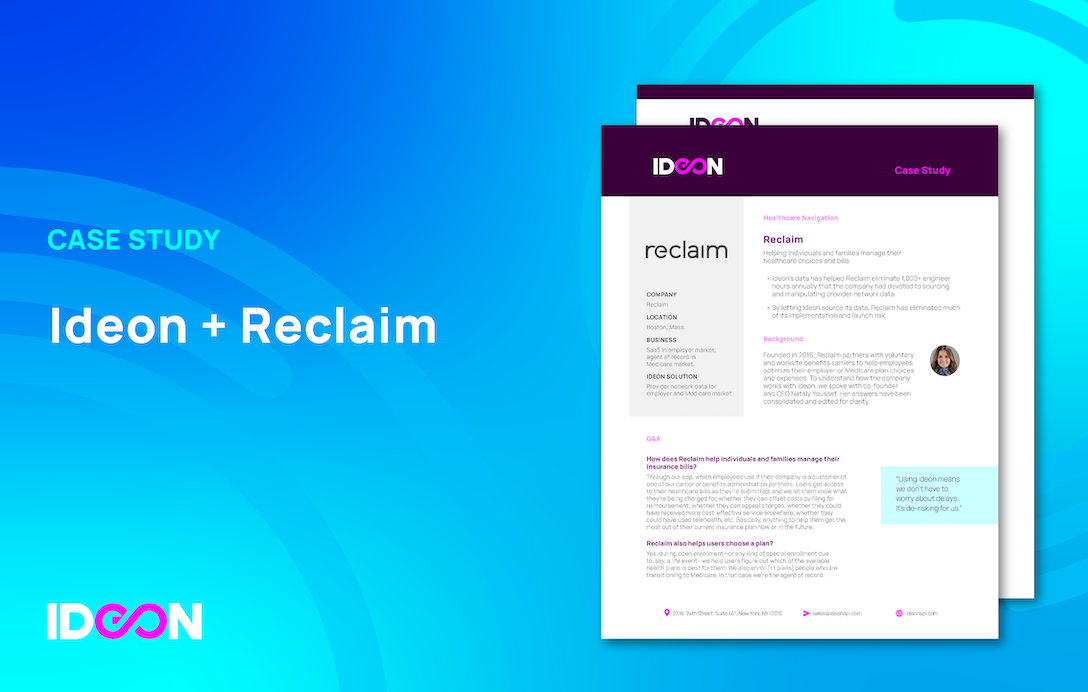
Reclaim helps individuals and families manage their healthcare bills by providing a bevy of insurance-related services. The company’s app allows users to access bills, learn how they might offset costs, discover how they might have received more cost-effective service elsewhere, and more.

 Reclaim is out to simplify the insurance experience for the consumer—but they were also eager to simplify their own internal operations.

Enter Ideon’s API, an accurate and comprehensive source for provider-network data—information on which doctors and facilities participate in each insurance network.

Before Ideon we were getting data from carriers, but each one’s schema is different. That makes the ETL [extract, transform, load] process difficult because we were doing several data manipulations per carrier. Now it’s just one schema that we have to worry about—Ideon’s. 

Using Ideon also means we don’t have to worry about delays. It’s derisking for us.

So says Reclaim’s co-founder and CEO, Nataly Youssef. Interested in hearing the whole story? Download our case study here.

DOWNLOAD

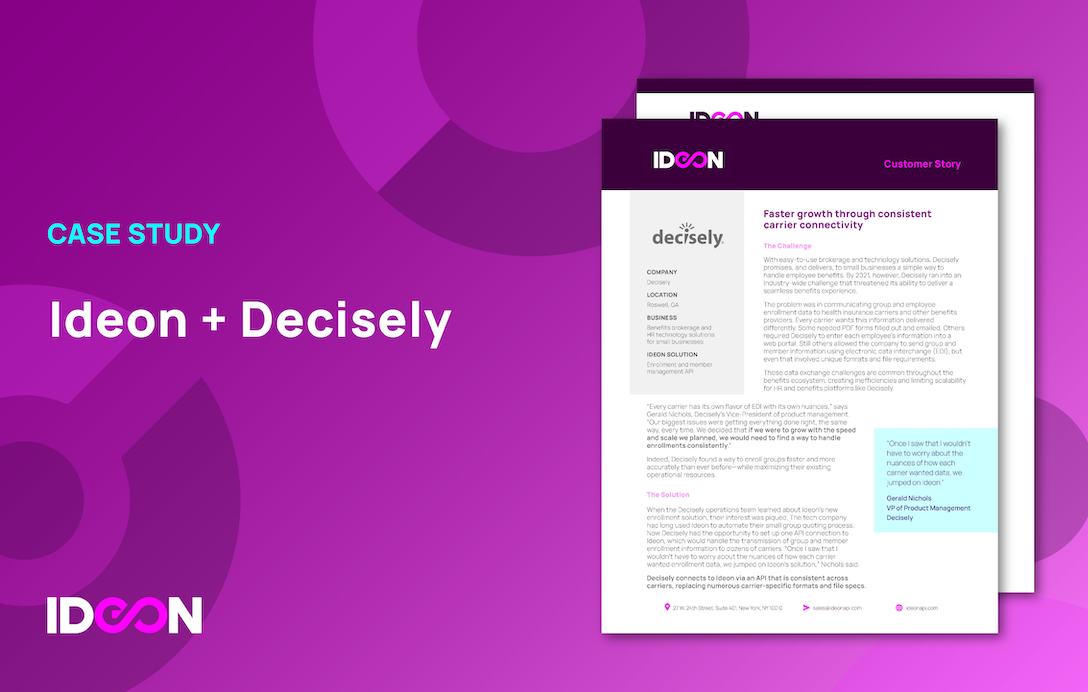
Decisely’s growth story: Seamless scalability through better carrier connections

“When data is in sync, everybody wins”

Continue reading “Decisely’s growth story: Seamless scalability through better carrier connections”

Bridging the Carrier-Benefits Platform Divide with APIs

Leading carriers and BenTechs are finally speaking the same language


Why is there never a time machine when you need one?

Companies that provide HR, payroll, and benefits software certainly could use a quick way to shuttle between generations. Their customers—employers and their employees—expect the speed and data-rich experiences of the latest smartphone apps. Meanwhile, most health insurance and benefits carriers remain in the early stages of transforming their systems for the modern era, with some still relying on decades-old technology.

So it’s no surprise that communication in this ecosystem is strained, with more than a few misunderstandings and awkward silences. Communicating enrollment and employee data, in particular, is a longstanding challenge — and of critical importance.

In the benefits industry, electronic data interchange (EDI) has for years been the most common data exchange technology. But as anyone in this ecosystem can attest, EDI is far from perfect, and it certainly doesn’t deliver the speed, efficiency, and accuracy that today’s consumers expect.

At last, there’s another way. Many forward-thinking carriers and benefits platforms are adopting API-powered middleware to replace, or at least supplement, their EDI connections. Middleware translates and exchanges data between today’s real-time connected systems and the older, EDI-based systems of most insurance companies. The result: two-way, consistent communication; unprecedented scalability and data accuracy; and an enrollment experience that, finally, meets employee expectations.

To understand the challenges faced by benefits platforms as they connect to carriers, and the advantages of APIs, Michael Levin, the CEO of Ideon, recently led a webinar featuring two experts with deep industry experience:

Cory Nicks, Manager of Insurance Operations of Rippling, an HR platform that has grown rapidly in part because of an obsessive devotion to automating processes that others handle manually.

Jeff Oldham, the CEO of Informed Consulting, who has more than 25 years of experience in the employee benefits business.

In a lively and informative discussion, the three discussed the need for carrier connectivity, the insurance industry’s slow effort at modernization, and how middleware enables benefits platforms to offer better service with far less effort. 

What follows are six of the most useful insights from the session.

You can watch the entire webinar here.

1. HR and benefits platforms require connectivity to handle increased volume

Until about five years ago, Oldham explained, platforms focused only on technology to serve brokers, employers, and employees rather than direct electronic connections to carriers. “If you talked to a founder back then, the last thing they thought about was sending a file,” he said. 

As the industry grew, platforms started to bog down with manual work. “There was no sense of automation,” said Nicks, who worked for years at Zenefits, a pioneering benefits technology platform. “We had forms and faxes and carrier portals.” Ultimately, he said, “figuring out how to distribute information to carriers became really difficult.”

By contrast, people building platforms today are using technology that allows for information to be exchanged between systems electronically through application programming interfaces (APIs), the best-practice method of digital communications. That’s how they expect to communicate with carriers and benefits providers as well.

Indeed, when Nicks started at Rippling in 2019, efficiency was a priority from the start. A main focus of ours was getting information to the carrier as efficiently as possible without having huge operational teams typing information into portals and filling out forms.”

2. Carrier connectivity is the only way to deliver the speed and accuracy that both employers and employees demand

The consequences of a mistake in an employee benefits account can be high. Health insurance is one of the largest expenses at many companies. Premiums are deducted from employee paychecks. And, of course, medical care itself is often essential. 

“When you have poor carrier connectivity, the file goes sideways, and yellow flags are thrown on the field,” Oldham said. “When the right information isn’t received, all kinds of problems occur.” 

Consumers, moreover, have come to expect that the websites and apps they use at work will be as powerful as those they use to shop, bank, and communicate.

“Customers want their benefits to work like Amazon, where you buy something and the package comes within two days,” Nicks said. “If you choose your insurance on the benefit system, you want to be able to go to the doctor the next day and not have to pay $3,000 out of pocket when you should only have a $5 copay.”

3. Current electronic connection approaches don’t meet today’s consumer expectations

For several years, benefits platforms have formed digital connections to insurance carriers. But these haven’t used APIs. Rather, most carrier systems could only communicate through EDI: according to a recent Guardian report, about two-thirds of employers say EDI is their primary method of transmitting employee enrollment data to carriers.

These connections, however, create a range of challenges for platforms and their clients, Oldham explained. “EDI is a one-way street. Data is sent once a week, and nothing is returned. So there is a lag, and the information isn’t always correct.”

When benefits platforms connect to carriers through EDI, there’s an 8-12 week setup and testing process—and sometimes longer—for each group. “Each individual carrier has a different process,” said Nicks. “It’s not scalable for us. It’s not scalable for employers. And it’s not scalable for brokers.”

EDI, moreover, isn’t any better than paper forms at preventing and rectifying data errors and discrepancies. With APIs, by contrast, every transaction can be reviewed and validated proactively, without manual intervention. “It creates much cleaner data. It allows processing to go faster. And you don’t have as many support cases coming in,” Nicks said.

EDI’s inefficiencies, the panelists said, also trickle down to employees. For example, insurance cards may be delayed and payroll deduction and billing errors may arise. These critical issues can spoil employees’ overall benefits experience. In fact, a majority of employees say a poor benefits enrollment experience could make them consider looking for another job.

4. Carriers are upgrading their technology (slowly)

Health insurance and group benefits carriers are replacing their EDI connections with APIs, but the change is part of a long-term evolution of legacy technology, Oldham said. “Of the top 20 carriers we speak to,” he explained, “all of them either have an API strategy or they are building the strategy in 2022.”

Providers of ancillary and voluntary benefits—such as dental, vision, life, and hospital indemnity insurance—are generally quicker to adapt to new market demands than medical carriers, Oldham said. He predicted that 60-75% of the ancillary carriers would move to API connections over the next five to seven years. 

Health insurance companies will be slower to change, he predicted, with national carriers and those in large markets adopting APIs before those in less competitive regions. But change is coming to all parts of the ecosystem.

5. Middleware bridges the technology gap between carriers and HR platforms. 

Benefits platforms, then, are caught between employers who want the speed and accuracy of API-powered connectivity now and carriers who will take years to fully replace their EDI connections.

For a growing number of savvy benefits technology providers, the solution is middleware—a service that integrates with the benefits platform through a single modern API, checks for errors, and then translates transactions into the format each carrier prefers, most commonly EDI.

“For a benefits administration company, middleware is real-time, secure, and scalable,” Oldham said. 

Middleware, he adds, is a ubiquitous way for businesses in every industry to simplify their workflows. Nearly every retailer, he explained, sends all their credit card charges to a single payment processor—a middleware provider that routes them to the appropriate card issuer. “Home Depot doesn’t want to create separate files to send MasterCard, Visa, and Amex,” he explained.

6. Using middleware saves time for even the most sophisticated technology teams

Most benefits platforms have built EDI connections to numerous carriers, but this turns out to be a significant drain on resources.

At Zenefits, Nicks recalled, “we were trying to be the middleware because we didn’t want to pay someone else to handle the translation.” Ultimately, this spawned “a gigantic operational function with engineers going back and forth with each carrier,” he said. “That’s not the kind of work engineers want to do, and it’s not a good ROI for a software company.”

At Rippling, Nicks looked for a different way. “We wanted to make sure that everything was automated, and everything was easy. That way our engineers could work on what was exciting to them: building new product functionality,” Nicks said.

Rippling uses Ideon (formerly Vericred) as middleware to connect to health insurance and benefits providers. “Having a middleware partner like Ideon allows our engineers to work on our product,” Nicks says. “I don’t have to build out a gigantic team to focus on each of the carriers.” Now a team of eight people handles all of Rippling’s carrier connections; without middleware, he explained, Rippling would need more than 100.

“Middleware keeps our operating costs low,” Nicks concluded, “And brokers can trust our platform to enroll groups with a multitude of different carriers without our having to build out connections to each of them.”

Want more insights on carrier connectivity trends? You can watch the entire webinar here.


Ideon’s API middleware: Powering fast, accurate, scalable data exchange for carriers and benefits platforms

Nobody has more experience helping benefits platforms and insurance carriers modernize their digital connectivity strategy than Ideon. Our API middleware offers speed, operational savings, scalability, format consistency, and reliability to dozens.

For more information, contact sales@ideonapi.com

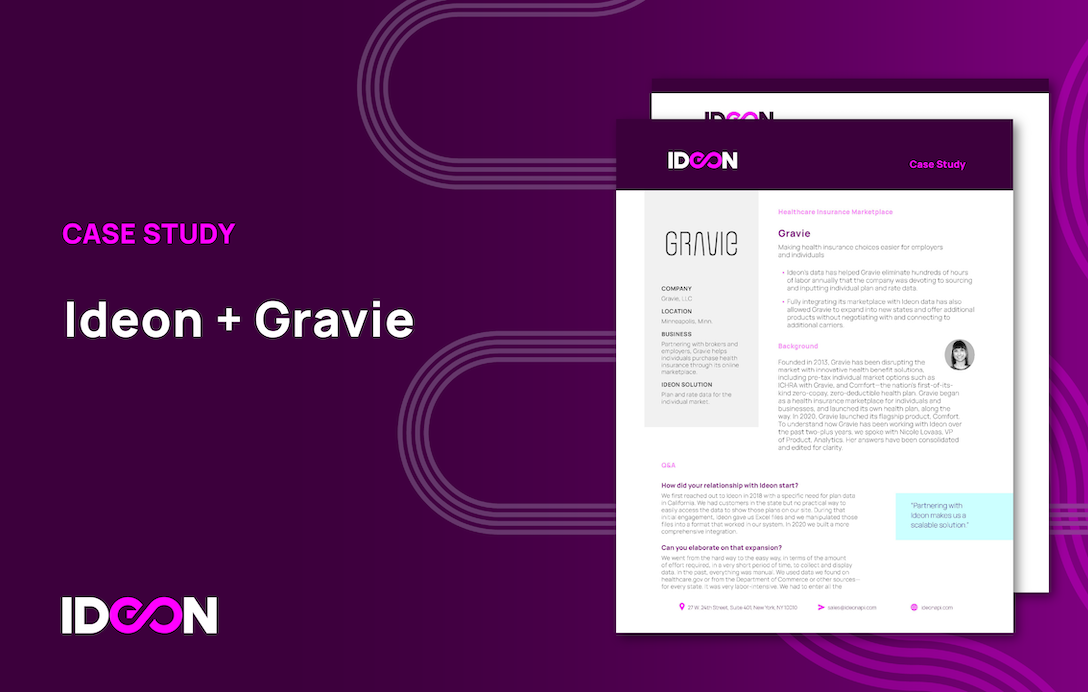
Gravie’s Story: How Ideon eliminated heaps of manual work and allowed for market expansion

“Partnering with Ideon makes us a scalable solution”

For nearly a decade, Gravie has been disrupting the health insurance space through its innovative health benefits solutions, from pre-tax individual market options to its own flagship health plan, Comfort.

Since 2018, Ideon has played an important role in streamlining Gravie’s processes. Nicole Lovaas, a vice president at Gravie, shared how things looked before Ideon came on the scene:

We used data we found on healthcare.gov or from the Department of Commerce or other sources—for every state. It was very labor-intensive. We had to enter all the information we collected into Excel spreadsheets, which we then loaded into our system to display plan and rate data.

The folks at Gravie also knew that ICHRAs were going to be a big deal in 2020, and were eager to present themselves as a national solution. However, they were unenthusiastic about the multiplicity of sources that would need to be involved.

Want to learn how Gravie said sayonara to manual processes—and expanded their national reach? Get the case study here.

DOWNLOAD

APIs, decision support, and more: An employee benefits trend report in six quotes

Ideon’s place at the center of the health insurance and employee benefits industry means we have a clear view of the technology trends shaping the entire ecosystem. But we’re hardly the only ones talking about the growing importance of APIs, digital connectivity, and other transformative innovations.

Here are six trends ushering in the digital age of employee benefits, plus what industry leaders are saying about them.

The healthcare industry embraced interoperability. Employee benefits isn’t far behind.

“Interoperability has been a huge buzzword in the healthcare industry in the last few years, and we’re now seeing it in the employee benefits space for the first time. Data is siloed between various systems and the next wave of technological innovation will be focused on connecting these systems. Not only does it eliminate manual tasks and reduce errors, but it can unlock the ability to make better decisions and drive better outcomes for all.” — Ryan Sachtjen, ThreeFlow


Employees expect health insurance and benefits experiences to be as easy as online shopping.

“The goal is to make benefits-enrollment and selection changes take place in real time, replacing a traditionally manual, error-prone process with long wait times before coverage takes effect. Smart technology allows real-time data exchange with benefit carrier partners to simplify processes and improve the benefits experience.” — Amanda Pope, ADP


Decision support—which is growing in utilization—requires data connectivity and transparency. 

“The reality of decision support today is that the extent to which such tools can help users is greatly dependent on the quality and breadth of information they have to work with.” — Michael Levin, Ideon


Voluntary benefits—crucial in the fight for talent—depend on accurate, smooth-flowing data.

“Tailoring and recommending the benefit packages that best meet employee lifestyle needs eliminates the tedious employee task of sifting through voluntary benefit options. A data-driven approach to benefits can yield higher employee participation in benefits programs as well as improved employee tenure and retention.” — Neil Vaswani, Corestream


Efficient, API-powered connectivity is a game-changer for carriers.

“Overall, APIs are helping to provide a personalized experience, rather than a one-size-fits-all solution. Looking ahead, carriers can expose APIs to broker partners and insurtech companies, to transact uniquely, improve operating efficiencies, and enhance experiences. The carriers that are able to easily interact with these partners and play within this ecosystem will have an advantage.” — James Ocampo, Wellfleet Workplace


API middleware is enabling carriers and BenAdmin platforms to exchange data with remarkable speed, flexibility, accuracy, and scalability.

“Having a middleware partner allows our engineers to work on our product. I don’t have to build out a gigantic team to focus on each of the carriers. Middleware keeps our operating costs low, and brokers can trust our platform to enroll groups with a multitude of different carriers without our having to build out connections to each of them.” — Cory Nicks, Rippling


Interested in more Ideon content and the latest benefits technology trends and analysis? Subscribe to our newsletter below!


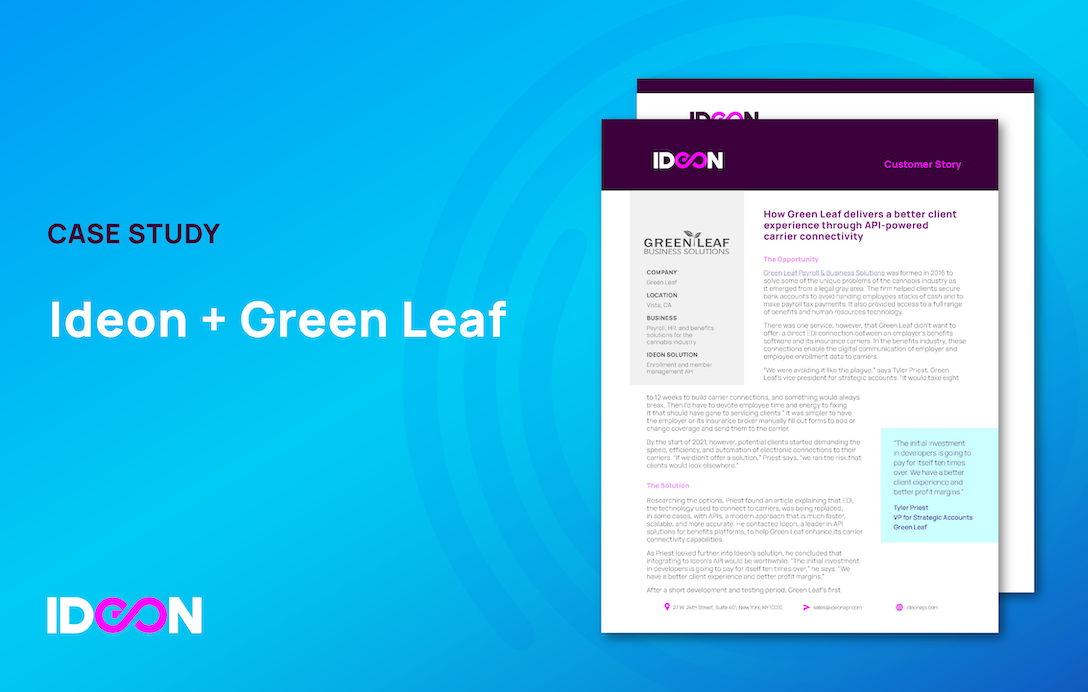
Green Leaf’s Story: How API-powered carrier connectivity delivered a better client experience

“Our benefits enrollment and administration experience is light years faster”

Green Leaf Payroll & Business Solutions helps its clients in the cannabis industry streamline a wide range of payroll and HR tasks, from securing bank accounts to providing access to a suite of benefits and HR technologies.

As Green Leaf expanded its benefits solution, there was one often-requested service that it was hard-pressed to address: connectivity between an employer’s benefits software and its insurance carriers.

Hear it from them:

“We were avoiding it like the plague,” says Tyler Priest, Green Leaf’s vice president for strategic accounts. “It would take eight to 12 weeks to build carrier connections, and something would always break. Then I’d have to devote employee time and energy to fixing it that should have gone to servicing clients.” It was simpler to have the employer or its insurance broker manually fill out forms to add or change coverage and send them to the carrier.

By the start of 2021, however, potential clients started demanding the speed, efficiency, and automation of electronic connections to their carriers. “If we didn’t offer a solution,” Priest says, “we ran the risk that clients would look elsewhere.”

Researching the options, Priest found an article explaining that EDI, the technology used to connect to carriers, was being replaced, in some cases, with APIs, a modern approach that is much faster, scalable, and more accurate. He contacted Ideon, a leader in API solutions for benefits platforms, to help Green Leaf enhance its carrier connectivity capabilities.

Wondering how it went?  (Hint: This story has a happy ending.)  Download the full case study here for all the details.

DOWNLOAD

Namely Selects Ideon to Streamline Digital Employee Benefits Enrollment

Ideon’s APIs enhance Namely’s best-in-class enrollment experience through real-time connectivity with health insurers and ancillary benefits carriers

Ideon, the API platform powering digital experiences in health insurance and employee benefits, announced today that Namely, the leading HR software for mid-sized businesses, has integrated with Ideon’s API. The integration enables Namely to deliver a faster, more efficient benefits administration experience to its clients, across a broad spectrum of insurers.

In order to provide employees with modern features and a smooth enrollment journey, two-way data exchange with insurance carriers is a necessity for HR and benefits platforms. Building individual point-to-point integrations with hundreds of carriers is cost-prohibitive, resource-intensive, and, ultimately, unsustainable. With Ideon, Namely gains a seamless and scalable means to connect and exchange data with multiple insurers.

“The needs of our customers are at the core of everything we do at Namely,” said Namely CEO Larry Dunivan. “Our solution was designed to easily construct APIs that expand its functionality to ensure our clients have access to high quality data, real-time connectivity, and the latest employee engagement technologies. We’re excited to partner with Ideon, a leading platform provider that shares our vision of advancing the user experience and making worktech easier.”

HR and benefits platforms leverage Ideon’s APIs to enable multi-carrier functionality throughout the user journey, including plan quoting and decision support, group setup and member enrollment, member management, and renewals. Once a platform integrates with Ideon, it gains scalable connectivity to a comprehensive network of insurance carriers, including Kaiser Permanente, Beam, Aetna, Anthem, Blue Shield of California, Cigna, Guardian, Humana, MetLife, and Principal.

Namely serves as a single system of record for mid-market companies, a segment employing more than 50 million workers in the U.S. Namely integrates payroll, benefits, talent management, and other key business functions in a modern, intuitive platform that employees and employers love to use.

“The addition of Namely to the Ideon platform further affirms that industry-leading benefits administration software companies view our fast, seamless connections with insurance carriers as paramount to delivering a better digital enrollment experience,” said Michael W. Levin, Ideon’s co-founder and CEO.

About Ideon

Ideon is the way health insurance carriers and employee benefits providers connect with technology partners to deliver seamless consumer experiences at every stage of the member journey. Ideon is not the websites or apps one uses to choose a plan or find a doctor. It is the infrastructure, the ‘pipes,’ that simplify the complex exchange of quoting, enrollment, and eligibility data between carriers and the technology partners so that they can, in turn, deliver health and employee benefits to hundreds of millions of Americans everyday. Ideon’s APIs transmit billions of data points between InsurTechs and insurance carriers, powering an amazing benefits experience for all. Faster. Better. Awesomely. To learn more, please visit: www.ideonapi.com

About Namely

Combining intuitive HR technology and best-in-class service, Namely empowers mid-size companies to build better workplaces. Simplifying the complexities of recruiting, onboarding, time & attendance, performance management, benefits administration, compliance, payroll, and HR analytics, Namely offers an integrated platform that saves companies time and improves their employees’ experiences. Distinguished by a dedicated support model and enhanced service offerings, Namely delivers an all-in-one HR solution for today’s people teams. Learn more at Namely.com and follow us @NamelyHR.

GetInsured’s Story: How Ideon saved the company time and resources—and boosted stakeholder confidence

“It’s a streamlined process when we’re working with a trusted, experienced data partner”

GetInsured powers state-based health insurance marketplaces by providing health insurance technology and customer service solutions for state governments. An important feature of the company’s offering is that consumers have the ability to shop for plans by healthcare provider, which helps individuals keep their doctors when enrolling in a new plan.

Back in the day, sourcing provider-network data was quite the headache. Says GetInsured’s director of product management, Archana Dekate:

Before Ideon we were getting our data directly from carriers or through other vendors. And each vendor had their own APIs and their own set of implementation procedures, which meant that we would have to modify our code every time to accept their data, then QA it, test it, and so on. It was time consuming; every product release would take anywhere from one to three months of setup time.

Thanks to Ideon, that’s all safely in the rearview mirror. To learn how partnering with Ideon helped GetInsured on multiple fronts, download our case study here.

DOWNLOAD

Webinar: Leveraging API Middleware for Carrier Connectivity

HR and BenAdmin platforms have a lot to think about these days. One top-of-mind topic: How to connect with carriers efficiently and at scale.

Powerful from the start: How data integrations helped DocMe launch an innovative digital health app

By Zach Wallens
Director of Content and Communications, Ideon

In this blog post, Ideon profiles one of our newest customers, DocMe, a digital health app based in New York.

It’s no secret that new technologies and companies are driving innovation in the healthcare industry. From mental health and virtual care to digital pharmacies, care navigation, and billing, digital health startups are popping up in all corners of the healthcare ecosystem.

That ecosystem, however, is getting crowded. The race for customers, funding, and publicity is more competitive than ever before.

One way to stand out? Build intuitive, data-driven user experiences powered by third-party data integrations. New York-based DocMe, a brand new digital health app, is one example of an innovation-through-integration approach, leveraging several APIs to create a powerful interface for patients and providers.

Connecting the Dots

Founded in 2021 by private equity investor Tim Gollin, the original concept for DocMe was an app to help consumers shop for doctors, comparing availability, insurance coverage, and prices for specific procedures. Of course, there are existing services, such as ZocDoc, for booking medical appointments.

Gollin quickly realized that a connected patient experience—bringing together disparate data sets within a single platform—could truly differentiate DocMe from competitors. Leveraging third-party integrations, Gollin and his developers understood, would be far more efficient than chasing down data sets and building functionality from scratch.

DocMe streamlined its development by relying on specialized companies to provide data and services it incorporated into its app. “A lot of the data and connections we would have had to build ourselves in the past we can now get from vendors,” Gollin says. “We see ourselves as stringing together little bits of Tinker Toys to build a complete product.”

Indeed, DocMe integrates third-party technology for functions like electronic health records, payments processing, video conferencing, and provider identity verification. And it incorporates multiple sources of data about providers, procedure costs, and—with data from Ideon—insurance networks.

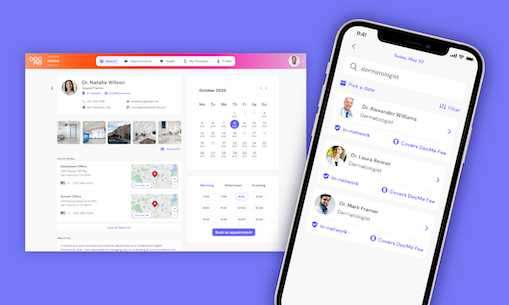
“Ideon provides me with the ability to show consumers which doctors are in their network without them having to go to their insurance company website,” Gollin says. “Doctors don’t even know what networks they are in. We’ve heard lots of stories where people get told on the phone the doctor is in their plan only to discover it’s not. Ideon has the definitive answer.”

This tight integration between services provides patients with an easier, more intuitive experience. Some examples:

  • DocMe promises patients that they’ll never have to enter medical information history more than once. 
  • When someone makes a doctor’s appointment, they not only see available times but also the specific services offered and the price they’ll pay according to the terms of their insurance plan.
  • When a patient books an appointment, DocMe will collect the amount not covered by insurance in advance. In other words, patients get a much more transparent market.

DocMe is continuing to add features to its product, integrating data more tightly to save users time. It will use Ideon’s card scanning technology, for example, to extract patients’ network information by simply snapping a photo of their insurance cards. 

DocMe is also preparing to roll out in Brazil, Italy, France, and the United Arab Emirates. Some might ask why a small company would spread its resources across different countries, each with its own health care system. Gollin answers that the work done to build integrated capabilities and smooth user experience into DocMe already gives it an advantage in other markets. “The goofy thing is the U.S. system is super complicated,” he says. “Everyplace else is significantly simpler.”

For more information about Ideon’s APIs for digital health and InsurTech platforms, click here.

Asked & Answered: What benefits administration platforms should know about LDEx

If you work for an HR or benefits administration (BenAdmin) platform, you might have heard the term LDEx, i.e., LIMRA Data Exchange Standards. Whether you’re actively adapting your systems to transmit LDEx-formatted enrollment data or have only seen the term in passing, there’s a lot happening around this opportunity and, of course, a lot for you to consider.

LDEx won’t immediately solve all of our industry’s data exchange challenges, but it’s a step in the right direction. ADP, Benefitfocus, benefitexpress, Businessolver, PlanSource, Selerix, Paycom, and other industry leaders are members of the LIMRA committee tasked with developing the LDEx, reflecting its transformative potential. Some BenAdmins, however, have a myriad of questions. 

Ideon, also a committee member, created this primer to answer basic questions about the standards and offer suggestions for leveraging them with minimal effort and expense.

What is LDEx?

The LIMRA Data Exchange (LDEx) Standards® are a set of rules—for terminology, formatting, content, and delivery—that facilitate digital communication between BenAdmin platforms and group benefits carriers. They are meant to replace various ad-hoc formats, such as EDI 834, for transmitting data about employee enrollment and eligibility in group benefit plans.

What are the advantages of LDEx for HR and benefits platforms?

If implemented broadly, LDEx will substantially reduce the complexity and expense of integrating with carrier systems and sending enrollment data in carrier-specific formats.

As BenAdmins know all too well, the lack of consistency has, traditionally, caused significant operational challenges and group-onboarding delays. BenAdmins typically spend weeks to months setting up and testing carrier connections. But if both carrier and BenAdmin platform use LDEx, there will be greater uniformity and accuracy throughout the integration and testing process, reducing the resources BenAdmins must allocate to adding and managing groups.

As industry adoption increases, BenAdmins will be able to connect and transmit data to carriers more efficiently. Ultimately, brokers, HR teams, and members will find that enrolling and modifying group benefits will be faster and more accurate if their BenAdmin uses LDEx. In today’s hyper-competitive environment, this is a business imperative: BenAdmins need to make the enrollment experience as easy and automated as possible, across as many insurance carriers and product lines as possible.

Who created LDEx?

LDEx is sponsored by LIMRA, a non-profit consulting group and trade association that works primarily with the life insurance industry. The standards were developed by a steering committee composed of 40 executives from group benefits carriers and BenAdmin platforms.

What capabilities does LDEx provide?

The initial standards, released in January 2020, covered a wide range of benefits, including dental, vision, disability, critical illness, and life products. More recently, it has been expanded to include medical plans, flexible spending and health reimbursement accounts, paid family leave, and employee assistance programs.

The LDEx standard is carrier-agnostic and covers information about benefits elections, coverage changes, terminations, non-coverage demographic changes, and eligibility management. It also allows carriers to communicate data issues and coverage confirmations back to the BenAdmin provider.

The standards are designed to communicate transactions using structured XML files, a flat file format that’s common in the insurance industry. There are also near-term plans for LDEx to support for REST APIs, which allow for faster processing and better, automated error checking.

LIMRA is working on extensions to support electronic communication of benefit plan designs and quotes.

What must benefits platforms do to use LDEx?

The standards can be downloaded for free from LIMRA. In general, BenAdmins can implement them the same way they would configure their systems for any other data exchange format.

It remains to be seen how much consistency there will be among carriers adopting the LDEx standard. One cautionary tale: EDI 834. This standard remains the status quo format for most medical plans, but over time carriers have developed their own variations, so BenAdmins have had to modify and test their data formats for each dialect of the standard. 

Will carriers do the same with LDEx? Time will tell. In the meantime, there are tactics BenAdmins can implement to leverage LDEx to the fullest extent possible while leaving room to adapt if necessary.

How can benefits platforms ease the burden of adopting LDEx?

Although LDEx will ultimately save time and money for BenAdmin platforms while enabling a smoother user experience, some remain hesitant. After all, wouldn’t adopting the standard require devoting significant resources to development and testing the format—while still building and maintaining the carrier connections?

Not quite.

Ideon’s middleware solution enables benefits administration platforms to send LDEx-formatted data to any carrier, regardless of whether the carrier is set up for LDEx. Ideon handles the translation into LDEx or whatever format is best for the carrier. It’s not just a quick fix—it’s a long-term strategic move to enhance your carrier connectivity and set yourself up for scalability and adaptability in the future. Ideon radically reduces the time and effort needed to set up and administer group benefits, while delivering faster and more accurate information for employers and members.

For more information, please reach out to us here or send us an email at sales@ideonapi.com

Data Transparency Can Power The Health Insurance And Benefits Shopping Experience Of The Future

WEBINAR: APRIL 14, 1:30 PM ET

The Care Navigation Advantage: Accurate Provider Data + Quality Scores