
‘Ghost Networks’ Are Breaking Care Navigation—Better Infrastructure is the Answer

If you’re building a care navigation, care routing, or digital front door experience, provider data accuracy isn’t optional—it’s foundational. Yet across the healthcare industry, many platforms are still guiding members using provider directories that don’t reflect real-world access.

A recent blog post from Zocdoc, Ghost Networks Explained: Why Healthcare Provider Directories Fail,” clearly outlines the problem. Ghost networks occur when provider directories list doctors or facilities as in-network even though they aren’t realistically available—because they’ve moved, stopped accepting new patients, changed network participation, or are simply unreachable. The result is a directory that looks complete but fails members at the moment they try to act on it.

This isn’t a fringe issue. It’s systemic—and it’s breaking care navigation.

How Common Are Ghost Networks?

Ghost networks are far more prevalent than many platforms realize. According to audits cited by Zocdoc, 45–52% of Medicare Advantage provider listings contain at least one inaccuracy, such as an incorrect address, phone number, or network status. In a U.S. Senate Finance Committee secret shopper study focused on mental health access, patients were able to successfully book an appointment only 18% of the time, largely due to inaccurate directory information.

For care navigation and routing platforms, these numbers translate directly into:

  • Members routed to dead ends
  • Delays in care
  • Increased abandonment and frustration
  • Higher support costs and erosion of trust

Ghost networks don’t just degrade user experience—they undermine the core promise of guiding members to care.

Why Ghost Networks Break Care Navigation and Care Routing

Care navigation depends on actionable accuracy. It’s not enough to show that a provider is technically in-network. Members need confidence that:

  • The provider actually practices at the listed location
  • The plan truly covers them
  • The recommended route leads to real, accessible care

Ghost networks introduce false destinations into routing logic. Navigation flows may look correct, but members are forced to validate everything themselves—calling offices, rechecking coverage, and starting over when reality doesn’t match the directory.

As the Zocdoc post makes clear, this is less a UX issue and more a failure of access pathways. When directories aren’t trustworthy, navigation becomes trial-and-error instead of guidance.

What Solving Ghost Networks Actually Requires

Addressing ghost networks at an industry level requires better infrastructure—not just better interfaces. Specifically, platforms need:

  • Provider directory data delivered in a single, normalized format
  • Frequent refresh cycles that reflect how often provider data changes
  • Confidence signals to distinguish reliable listings from risky ones
  • Feedback loops that correct inaccuracies at the source, not just downstream

This is where API-first provider data and carrier relationships become critical.

How Ideon Helps Solve Ghost Networks at the Source

IdeonSelect provides provider directory data purpose-built for care navigation, care routing, digital front doors, and digital health platforms. Instead of trying to “patch” directory issues downstream in UX, Ideon focuses on the infrastructure that prevents bad listings from becoming routed destinations in the first place.

In practical terms, here’s what happens in your navigation experience when it’s powered by Ideon’s API:

  • Ingest normalized, accurate provider directory data that’s mapped at the carrier, network, plan, and provider levels.
  • Use built-in location accuracy signals to reduce risky results
  • Benefit from Ideon’s upstream data quality checks so issues don’t keep reappearing

One API for Normalized Provider Directory Data

IdeonSelect delivers provider directory data from every carrier nationwide through a single API, in one consistent schema. Instead of stitching together dozens of carrier-specific files, platforms receive a unified feed that includes:

  • Provider specialties and subspecialties
  • Locations and contact details
  • Network participation by plan

This makes it far easier to build reliable care navigation and routing logic without reconciling conflicting data sources.

Direct Carrier Relationships, Plus Rigorous QA

Ghost networks persist when inaccuracies are never corrected upstream. Ideon addresses this through a combination of:

  • Direct relationships with carriers, providing authoritative network data at scale
  • A rigorous QA process that evaluates provider directory data across multiple sources to detect inconsistencies

When issues are identified—such as incorrect network participation or stale locations—Ideon works directly with carriers to correct data at the source, preventing errors from propagating across the ecosystem.

Continuously Refreshed Data and Network‑Scale Coverage

Ideon’s provider directory API covers 8.5 million providers and more than 5,000 networks nationwide, spanning individual, group, Medicare Advantage, and Medicaid markets. Data is refreshed on an ongoing basis—multiple times per month on average—so platforms aren’t routing members based on stale snapshots.

This combination of scale, refresh cadence, and source-level correction helps platforms maintain healthier networks over time, not just cleaner search results.

Address Confidence Scores

One of the most common ghost-network failures is routing members to the wrong location. Ideon’s Address Confidence Scores assign a High, Medium, or Low confidence rating to every provider address using machine learning and verified data.

Platforms can use these scores to:

  • Filter or deprioritize low-confidence locations
  • Reduce misroutes and failed appointments
  • Build smarter routing logic without pretending the data is perfect

From Directory Accuracy to Real Access

As the Zocdoc post underscores, access isn’t real unless it can be acted on. For care navigation and care routing platforms, success shouldn’t be measured by how many providers appear in a directory—but by how often members actually reach appropriate, in-network care without friction.

Ghost networks are a systemic industry problem. But with normalized provider directory data, strong carrier relationships, rigorous QA, and continuous correction at the source, platforms can stop routing members to dead ends.

If you’re building or improving a platform with care navigation or provider search functionality, consider the following:

  • Do we receive directory data in a single normalized format?
  • How often is it refreshed?
  • Do we constantly experience data quality issues around provider locations and in-network status?
  • When we find inaccuracies, can they be corrected upstream—or do they keep reappearing in the next refresh?

Explore Ideon for Care Navigation and Digital Health
If you’re building care navigation, care routing, or a digital front door, IdeonSelect can help you reduce “false destinations” with normalized provider directory data delivered through a single API.

Learn more and request an API trial here.

Provider Data Quality: The Importance of Accurate Provider Data for Benefits Platforms in 2026

Provider data quality has become the invisible infrastructure determining whether benefits platforms succeed or fail. With four out of five provider directory entries containing inaccuracies and the healthcare industry spending $4 billion annually on data quality improvements, organizations face a strategic choice: invest 12-18 months building complex normalization infrastructure, or leverage API solutions that deliver enterprise-grade data quality in weeks.

Inaccurate provider data is creating a hidden crisis in healthcare—one that threatens patients’ access to timely care. The numbers are stark: 30% of provider records contain inaccurate or missing NPI numbers, 23% of provider addresses are wrong or missing, and provider data mismanagement contributes to nearly $17 billion annually in unnecessary healthcare costs through claims processing errors and denials.

Provider data quality encompasses six critical dimensions: accuracy, completeness, consistency, validity, timeliness, and uniqueness of provider information across systems. For benefits platforms, ICHRA administrators, and carriers, this is not simply an operational requirement—it’s foundational infrastructure that determines member satisfaction, regulatory compliance, and competitive positioning.

Organizations building benefits platforms face a fork in the road: build complex provider data quality infrastructure internally, or leverage API solutions like IdeonSelect with built-in normalization and validation.

The Six Dimensions of Provider Data Quality

Enterprise-grade provider data must meet standards across six critical dimensions—each representing potential failure points for platforms building quality infrastructure internally.

Accuracy requires valid NPI numbers, correct specialties, and accurate practice locations. The reality: 30% of provider records contain inaccurate or missing NPI numbers, and 23% of provider addresses are wrong or missing.

Completeness ensures all required data fields are populated. Missing credentials, incomplete practice information, and absent network affiliations prevent members from making informed decisions.

Consistency demands that provider information matches uniformly across directories, claims systems, and enrollment platforms. Research shows 81% of provider entries contain inconsistencies across major payers—building a consistency layer requires significant normalization infrastructure.

Timeliness means provider practice changes, credential updates, and network status changes reflect immediately. Without automated systems, inaccuracies persist an average of 540 days.

Validity requires data to adhere to correct formats and standards: phone numbers in proper format, valid ZIP codes, standardized taxonomy codes.

Uniqueness eliminates duplicate or conflicting records. Industry data shows 8-12% duplicate records create member confusion and operational waste.

Maintaining all six dimensions across hundreds of carriers requires sophisticated data pipelines—or an API solution with built-in quality controls.

Business Impact: How Data Quality Affects Performance

Provider data quality failures create measurable business impact across member experience, operational costs, and claims processing.

Member Experience and Retention

More than 50% of patients use provider directories to select physicians, making directory accuracy a direct driver of member satisfaction. When data fails, 30% of patients receive surprise bills due to provider directory errors. Mental health access is particularly affected—53% of mental health patients have encountered directory inaccuracies resulting in out-of-network care and treatment disruptions.

Recent research reveals the scope: 50% of “accepting new patients” statuses are inaccurate, 28% contain wrong practitioner contact information, and 26% list retired or deceased providers.

Operational Cost Burden

Health plans spend approximately $4 billion annually to improve provider data accuracy. Manual phone verification averages 4.22 minutes per provider at roughly $4 per provider per location. One-day delays in provider onboarding cost approximately $10,122 for a medical group. Physician practices collectively spend $2.76 billion annually on directory maintenance.

Claims Processing Failures

Provider data mismanagement drives nearly $17 billion annually in unnecessary healthcare costs through claims processing errors and denials. The average health system puts $4.9 million at risk per hospital due to denials from inaccurate data.

The upside: providers using standardized PDM platforms save an average of $1,250 in administrative costs per month, with potential savings exceeding $1.1 billion annually across U.S. healthcare.

Regulatory Compliance: The Non-Negotiable Standard

Provider data quality has become a regulatory mandate with enforcement mechanisms that make quality non-negotiable.

CMS Medicare Advantage Requirements

A 2018 CMS review found 48% of Medicare Advantage directory locations contained at least one inaccuracy. The current mandate requires Medicare Advantage plans to review and update directories every 90 days with documented outreach.

No Surprises Act

The No Surprises Act protects patients from surprise bills through accurate provider directory information. Health plans bear responsibility for directory accuracy regardless of data source—meaning platforms integrating carrier data must ensure compliance.

HIPAA and Additional Frameworks

Healthcare organizations must maintain HIPAA compliance with accurate, secure data. Penalty exposure is significant: healthcare providers have faced fines exceeding $1 million for inadequate data security. Additional frameworks including the 21st Century Cures Act, state-specific directory accuracy mandates, and network adequacy standards create layered compliance requirements.

Regulators expect consistency between reports and records. Poor data quality leads to audit failures, penalties, and reputational damage. Building internal compliance monitoring requires dedicated legal oversight and continuous updates—API solutions like IdeonSelect include automatic compliance updates as regulations evolve.

The Build vs. API Infrastructure Decision

Organizations face a strategic choice between building provider data quality infrastructure internally or leveraging API-driven solutions.

Building Provider Data Quality Infrastructure

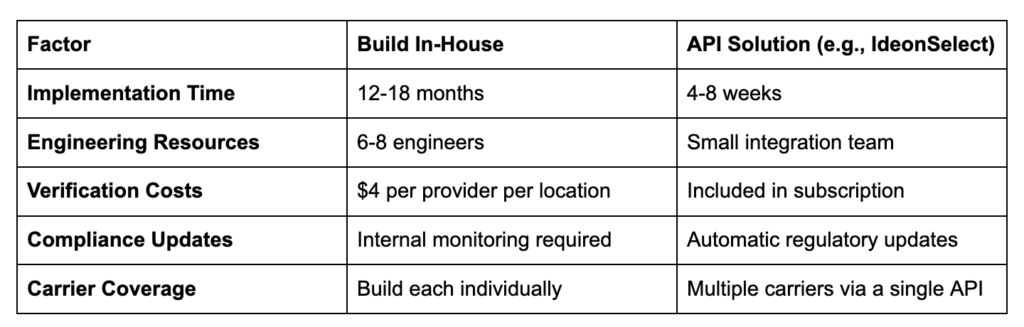
The traditional approach requires 6-8 engineers for 12-18 months constructing a normalization layer. Ongoing costs include $4 per provider per location for manual verification. The maintenance burden involves continuous carrier relationship management and format updates. Compliance overhead demands internal monitoring teams for 90-day CMS cycles and state requirements.

Modern API-Driven Approach

API infrastructure provides pre-normalized provider data across multiple carriers via single integration, built-in validation ensuring all six quality dimensions, automatic compliance updates, and real-time data quality monitoring. IdeonSelect delivers enterprise-grade provider network data with 4-8 week implementation.

Modern APi Data Approach

Organizations building custom infrastructure miss market opportunities during 12-18 month development cycles. Engineering teams freed from data plumbing can focus on product differentiation.

Real-World Impact of Data Quality Investment

Organizations investing in provider data quality infrastructure achieve measurable results.

A major health plan replaced over 1 million manual verification calls with automated outreach, achieving an 84% directory accuracy rate—significantly above national average—with substantial improvement in provider engagement and operational efficiency.

Ballad Health, an 800-physician network across 21 hospitals, implemented automated roster submission through CAQH Provider Data Portal. The result: 50% reduction in roster processing time, with data pulled weekly, standardized, quality-checked, and submitted to 30 different health plans.

The Future of Provider Data Quality

The industry is shifting toward API-first infrastructure. Manual processes are being replaced with AI-driven automation and real-time data validation. CAQH is incorporating AI and third-party data at point of entry to validate information in real-time—gathering information from 75-80% of U.S. healthcare providers.

The AI in healthcare market, worth $11+ billion in 2021, is forecast to reach $188 billion by 2030. Quality data is essential for AI algorithms to function properly—poor data quality leads to biased predictions and suboptimal outcomes.

Solving provider data quality requires commitment across the entire industry. The root cause is complex, fragmented, inconsistent data exchange between providers, payers, platforms, and vendors. Organizations with high-quality provider data achieve faster credentialing, superior member experiences, and improved compliance standing.

Platforms leveraging API infrastructure can launch with enterprise-grade data quality in 4-8 weeks. Competitors building internally face 12-18 month timelines. Modern infrastructure frees teams to focus on member experience innovation rather than data plumbing.

Conclusion: Provider Data Quality as Strategic Infrastructure

Provider data quality encompasses six critical dimensions: accuracy, completeness, consistency, validity, timeliness, and uniqueness. Poor quality costs the healthcare industry $17B+ annually in unnecessary expenses. Regulatory requirements—CMS 90-day cycles, the No Surprises Act, HIPAA—make quality non-negotiable.

Organizations face a strategic infrastructure decision. The build approach requires 12-18 months, 6-8 engineers, and contributes to the $4B+ annual industry spend on quality improvements. The API approach delivers 4-8 week implementation, subscription-based pricing, and built-in quality controls.

Organizations prioritizing provider data quality through modern infrastructure achieve faster time-to-market, superior member experiences, and reduced regulatory risk—while competitors struggle with manual verification burdens and compliance complexity.

Explore Ideon's IdeonSelect for Provider Data Quality

Ready to take the next step? See how Ideon works.

What Is Provider Data Management in Healthcare? A Complete Guide for 2026

Provider data management (PDM) is the foundational infrastructure determining whether patients find accurate provider information, whether claims process correctly, and whether organizations meet regulatory compliance. With 62% of members demanding precise provider data and CMS enforcement tightening through 2027, organizations face a strategic decision: spend 12-18 months building complex PDM infrastructure internally, or leverage API-driven solutions to launch in weeks with automatic compliance.

Healthcare consumers are making decisions with their feet. Over 33% of members will switch health plans for better digital capabilities and provider data access. This shift has transformed provider data management from back-office administrative function to competitive differentiator—the invisible infrastructure determining member satisfaction, regulatory standing, and operational efficiency.

The challenge is clear: provider information changes constantly, with inaccuracies persisting an average of 540 days in systems without automated verification. Meanwhile, regulatory requirements have accelerated dramatically. Medicare Advantage plans must verify directories every 90 days. The No Surprises Act demands 1-business-day response times. Medicaid programs require 30-day updates as of July 2025.

For benefits technology platforms, health plans, and TPAs, provider data management represents a fork in the road. Build complex infrastructure internally—requiring 12-18 months and significant engineering resources—or integrate API-driven solutions delivering accuracy, compliance, and scalability in weeks rather than months.

I. What Is Provider Data Management

Provider data management (PDM) is the systematic process of collecting, organizing, maintaining, and updating healthcare provider information across organizations. This data layer powers the provider directories patients use to find care, enables claims processing accuracy, and provides required infrastructure for regulatory compliance with CMS, state agencies, and federal mandates.

What PDM encompasses:

  • Provider credentials: NPI numbers, medical licenses, board certifications, DEA registrations
  • Practice information: Office locations, contact details, languages spoken, office hours
  • Network affiliations: Plan participation status, network tiers, panel capacity
  • Clinical capabilities: Hospital privileges, specialties, subspecialties, telehealth availability
  • Billing details: Tax IDs, group affiliations, claims submission requirements

Multiple stakeholders depend on effective PDM: health insurance carriers (Medicare Advantage, commercial plans, Medicaid programs), benefits technology platforms (HR tech vendors, ICHRA administrators, broker platforms), healthcare systems (hospitals, physician groups, integrated delivery networks), and third-party administrators.

The modern challenge is significant. Without automation, provider data inaccuracies persist an average of 540 days—creating compliance exposure, member frustration, and operational inefficiency. Organizations face a strategic choice: build complex PDM infrastructure in-house or leverage API-driven solutions that handle the data plumbing.

II. Why Provider Data Management Matters in 2025

For Patients and Members

Member expectations have fundamentally shifted. 62% of members now seek more precise provider information to make informed care decisions. Among younger demographics, demand is even more pronounced: 70% of Millennials and 64% of Gen Z want comprehensive provider details including locations, availability, and network status before selecting care.

The business impact is direct. Over 33% of members indicate willingness to switch health plans for better data access and digital capabilities. Inaccurate directories create tangible harm: delayed care, wrong provider visits, and surprise bills that erode member trust and drive churn.

For Health Plans and Payers

Regulatory compliance has become increasingly enforcement-focused. Medicare Advantage plans must verify and update provider directories every 90 days. The No Surprises Act requires response to provider inquiries within 1 business day. Medicaid programs mandate 30-day updates as of July 1, 2025. Non-compliance triggers penalties and audit exposure that compounds over time.

For Operations and Efficiency

Accurate provider data reduces claims denials and payment delays. Streamlined credentialing and network management translate directly to operational cost reduction. Organizations with centralized, accurate PDM systems report ROI of $753-$1,982 per attained enrollee through improved data quality—a measurable return on infrastructure investment.

III. Core Components of Provider Data Management Systems

Effective PDM systems integrate six interconnected components that work together to maintain accurate, compliant provider information.

Data Collection and Aggregation gathers provider information from multiple sources: initial credentialing applications, primary source verification (medical boards, DEA, NPPES), electronic health records, carrier enrollment forms, and claims systems. The challenge is that each source uses different formats, taxonomies, and identifiers—creating fragmentation that compounds over time.

Data Storage and Centralization creates a single source of truth for provider information. Cloud-based platforms provide accessibility across organizations while maintaining security and audit capabilities. Centralized repositories ensure updates propagate to all downstream systems simultaneously.

Data Normalization and Standardization converts disparate formats into unified schema. This includes mapping specialty taxonomies (NUCC codes, custom classifications), standardizing addresses and phone numbers, and resolving duplicate records and conflicting information.

Data Validation and Verification automates credential verification against primary sources, replacing manual phone calls and mail surveys. Network status validation with carriers confirms participation. Practice location confirmation verifies addresses and hours.

Data Distribution and Access flows verified data to provider directories (web, mobile, print), API endpoints for real-time search, care coordination systems, and claims processing platforms through real-time channels rather than batch transfers.

Data Governance and Quality Control establishes accountability, defines quality metrics, and maintains audit trails for compliance reporting readiness.

IV. Key Challenges in Healthcare PDM

Data Fragmentation Across Systems scatters provider information across disconnected platforms—EHR, billing, credentialing, claims—with no single source of truth. Each system holds partial information, and inconsistencies compound as data ages.

Manual Processes and Labor Intensity consume significant staff resources. Provider offices field data requests from dozens of health plans, each with different forms and timelines. Manual verification cycles are time-consuming and error-prone: phone calls go unanswered, faxes disappear, surveys are ignored.

Persistent Directory Inaccuracies including wrong addresses, outdated affiliations, and incorrect network status remain uncorrected for an average of 540 days without automated verification—well beyond regulatory compliance windows and long enough to frustrate members seeking care.

Regulatory Compliance Complexity creates overlapping requirements: Medicare Advantage 90-day verification cycles, No Surprises Act 1-business-day responses, Medicaid 30-day updates (effective July 2025), and the CMS Plan Finder mandate requiring MA plans to publish directories by 2027. Multi-state variations add another layer.

Real-World Patient Impact translates to patients unable to find accurate provider information, delayed or disrupted care from directory errors, and member frustration that drives plan switching..

V. Modern Approaches to Provider Data Management

Traditional Approach: Manual and Batch Processing relies on quarterly or annual directory update cycles, spreadsheet-based data collection, manual verification phone calls and surveys, and batch file transfers between systems. The result: slow, error-prone, labor-intensive processes that cannot keep pace with regulatory requirements or member expectations.

API-Driven Infrastructure: The Modern Standard enables real-time data exchange between systems, automated verification and validation, single integration to access multiple carrier networks, and continuous compliance monitoring. IdeonSelect exemplifies this modern standard, providing normalized provider data via unified API that eliminates the need to build and maintain individual carrier integrations.

Benefits of API-First Architecture:

  • Speed: 4-8 weeks implementation vs. 12-18 months for custom builds
  • Accuracy: Automated quality control and normalization eliminate manual errors
  • Compliance: Built-in regulatory update automation keeps pace with CMS, NSA, and state requirements
  • Scalability: Handle enrollment surges without manual intervention
  • Cost efficiency: Subscription model replaces expense of building and maintaining infrastructure

Cloud-based centralization provides single source of truth with real-time updates and enterprise-grade security (SOC 2 Type II, HIPAA compliance). API-driven PDM connects seamlessly to HRIS, payroll, benefits platforms, and claims processing systems.

VI. Implementing Effective PDM

Assessment Phase evaluates current data quality and accuracy rates, identifies system fragmentation and integration gaps, documents compliance requirements and deadlines, and calculates total cost of ownership for existing manual processes.

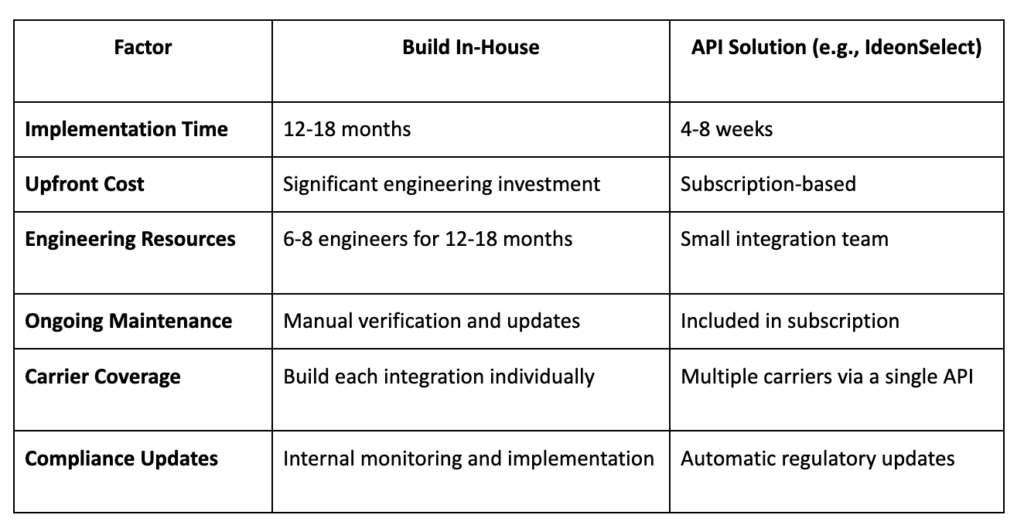
Strategic Decision: Build vs. API Infrastructure

Build vs. API Infrastructure

Implementation Best Practices include establishing data governance frameworks with clear ownership, defining quality metrics and monitoring processes, planning phased rollouts prioritizing compliance requirements, and monitoring member satisfaction alongside directory accuracy metrics.

VII. The Future of PDM

Regulatory Landscape Evolution continues with the CMS Plan Finder mandate (2027) requiring Medicare Advantage plans to publish directories to a centralized federal resource. State-level enforcement is intensifying with increasing penalties for directory inaccuracies.

Technology Acceleration makes API-first infrastructure the industry standard as real-time verification replaces quarterly batch updates. AI-powered data validation and automated compliance reporting add additional accuracy layers.

Member Expectations Rising demand real-time accuracy, comprehensive provider details, and integration with telehealth and digital care navigation that legacy systems cannot support.

Infrastructure as Competitive Advantage: Organizations leveraging modern API-driven PDM launch products faster, maintain compliance automatically, and deliver superior member experiences—while competitors struggle with 12-18 month build timelines and manual verification burdens.

Conclusion: Provider Data Management as Strategic Infrastructure

Provider data management has become strategic infrastructure determining competitive position. The requirements are clear: CMS 90-day verification cycles, No Surprises Act 1-day response times, Medicaid 30-day updates. Member expectations are equally demanding: 62% seek precise provider data, and over 33% will switch plans for better digital capabilities.

Organizations face a strategic choice. Build complex infrastructure internally—12-18 months development, significant engineering investment, ongoing operational costs for manual verification and compliance monitoring. Or integrate API solutions like IdeonSelect—4-8 weeks implementation, subscription-based pricing, automatic compliance updates included.

Modern API-driven infrastructure enables rapid implementation while ensuring accuracy, compliance, and scalability—freeing organizations to focus on product differentiation rather than data plumbing.

Explore Ideon's IdeonSelect for Provider Data Management

Ready to take the next step? See how Ideon works.

How to Achieve Health Care Provider Directory Normalization with APIs: Practical Guide for 2025

Introduction: Building Real-Time Processing That Never Lags

Summary:

This article explains that health care provider directory normalization standardizes fragmented data from EHRs, claims, and other systems into consistent, accurate, and comparable records—an essential step for interoperability, compliance, and efficient care coordination.

It argues that API-driven normalization now provides the fastest, most reliable path forward—cutting implementation from 12–18 months to 4–8 weeks while improving data accuracy, lowering maintenance costs, and turning provider data into a true strategic asset for 2025 health systems.

Health care provider directory normalization means creating consistency across every medical directory by standardizing provider data from different sources – EHRs, claims systems, and patient surveys – into a unified, reliable, and comparable format.

Directory normalization delivers:

  • Consistency creation across clinical, claims, and survey data sources
  • Reliability through standardized, validated provider records
  • True system comparability with clean, uniform datasets
  • Smooth integration of provider information from EHRs, insurance, and patient engagement platforms
  • Stronger clinical decision-making thanks to accurate, up-to-date listings

Without systematic record uniformity, health systems face fragmentation and duplicate entries that disrupt operations – leading to under-booked or over-booked providers, costly manual corrections, and delays in patient care. That’s why provider data standardization is now critical for information integrity in healthcare and true interoperability across systems.

Defining Health Care Provider Directory Normalization: What It Is and Why It Matters

Health care provider directory normalization means standardizing provider data across disparate systems, so every record – regardless of source – follows consistent formats and definitions. This process ensures directories are usable, comparable, and trustworthy across platforms, driving accuracy in every downstream workflow.

What Normalization Accomplishes:

  • Creates consistency across records pulled from sources like EHRs, insurance claims, and patient surveys
  • Establishes reliability by enforcing standardized formatting and validation
  • Allows for meaningful comparability between different platforms and systems
  • Serves as the technical foundation for integrating data from multiple sources
  • Enables smarter clinical decision-making by aligning data for accuracy and completeness

The Challenge of Fragmented Data:

Provider data changes by as much as 25% each year, increasing the risk of fragmented or duplicate records. This fragmentation leads to operational inefficiencies – such as misaligned scheduling and care delays – making systematic record uniformity non-negotiable for modern healthcare delivery. Normalization sets the baseline for strategic value, which drives business impact at scale.

The Strategic Value of Normalized Provider Directories in Health Systems

Normalized provider directories are not just a technical requirement – they are a strategic asset. For health systems intent on scaling efficiently and meeting regulatory demands, normalization bridges the gap between fragmented data and operational outcomes that actually move the needle.

Operational Benefits:

  • Improved Interoperability: Seamless data exchange across EHRs, claims systems, and partner platforms
  • Enhanced Data Quality: Fewer errors and duplicates, leading to trustworthy records
  • Advanced Analytics Capability: Clear trend identification and pattern analysis for smarter decisions
  • Better Resource Allocation: Data-driven management of networks and provider resources

Clinical & Patient Care Impact:

  • Stronger Care Coordination: Up-to-date provider data supports faster, more accurate referrals
  • Network Adequacy Assessment: Reliable directories make it easier to evaluate and optimize network coverage
  • Patient Access Improvements: Accurate listings reduce patient frustration and missed appointments
  • Compliance Support: Maintains directory accuracy for regulatory requirements at both federal and state levels

Strategic Outcomes:

Master patient-provider lists cut out booking inefficiencies and sharpen care delivery timelines, ensuring every provider record is ready for real-world operational use. While the strategic value is clear, achieving normalization still comes with significant implementation challenges that health systems must address head-on.

Common Challenges in Health Care Provider Directory Normalization

Health care provider directory normalization comes with real-world obstacles – technical, operational, and regulatory – that slow down even the most ambitious teams. Recognizing these challenges is the first step toward building a solution that actually works at scale.

Technical Challenges:

  • Data Variability: No unified coding standards across sources leads to inconsistent provider records
  • Infrastructure Limitations: Legacy systems often can’t support modern integration or standardization
  • ETL Process Failures: Complex data pipelines are prone to errors during extraction, transformation, and loading
  • High Change Rates: Provider data changes by up to 25% each year, and month to month, requiring constant updates
  • Integration Complexity: Managing and syncing data across many disparate sources magnifies normalization difficulty

Regulatory & Security Concerns:

  • HIPAA Compliance: Strict privacy controls add complexity to every step of provider data management
  • Data Governance: Maintaining protocols for data quality, access, and change management is resource-intensive
  • Audit Documentation: Ongoing audit trail requirements mean every data change must be tracked and verifiable

Resource Challenges:

  • Skilled Personnel Shortage: Few teams have enough engineers with deep data integration experience
  • Ongoing Maintenance Burden: Manual oversight and updates create significant operational drag
  • Cost Considerations: Building and maintaining custom normalization solutions drives up both time and spend
  • Extended Timelines: Custom builds typically stretch to 12–18 months before they’re production-ready

Despite these barriers, proven techniques and modern API-driven approaches give technical leaders a path forward – making scalable provider directory normalization achievable for 2025 and beyond.

Best Practices and Techniques for Effective Directory Normalization

Battle-tested approaches from leading health systems prove that directory normalization succeeds when automation, validation, and continuous oversight work together. Here’s the comprehensive methodology for achieving accuracy, speed, and ongoing integrity – without locking your team into fragile, manual processes.

Core Best Practices:

  1. Build Robust Ingestion Pipelines: Automate cleansing at the point of entry to slash manual errors.
  2. Establish Master Records: Create a single source of truth to eliminate conflicting provider data.
  3. Automate Business Rules: Programmatically resolve conflicts and duplicates using intelligent logic.
  4. Implement Continuous Validation: Multi-layered error screening detects data drift in real time.
  5. Conduct Periodic Audits: Regular integrity reviews catch long-term issues before they impact operations.
  6. Leverage Specialist Partnerships: Integrate with API platforms to accelerate timelines and scale effortlessly.

Methodology Deep Dive:

  • Ingestion and cleansing processes standardize incoming data for immediate use
  • Automated matching algorithms catch duplicates and resolve conflicts at scale
  • Manual review protocols provide a safety net for edge cases
  • Metadata consolidation techniques unify fragmented attributes across sources
  • Error screening stages continuously monitor for drift, inconsistency, and format issues

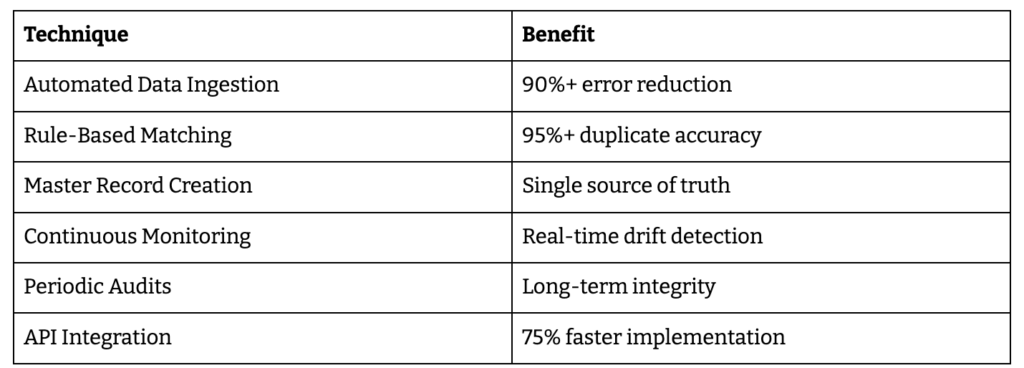
Techniques Comparison:

  • Implementation Considerations:

    Balance automation with targeted manual oversight, run pilot programs to pressure-test your workflows, and document every process step for repeatability and compliance at scale.

API-Powered Normalization: How Modern Integration Streamlines Provider Data

Manual directory normalization drags teams into long timelines and mounting errors. API-powered approaches flip the equation – offering a proven, automated path to health care provider directory normalization that compresses months into weeks and delivers enterprise-grade data accuracy.

API Advantages:

  • Real-Time Updates: Immediate synchronization of provider data across all connected platforms
  • Automated Error Correction: Built-in validation catches and resolves errors before they spread
  • Multi-Source Harmonization: Ingests and standardizes data from multiple carriers and systems at once
  • Reduced Manual Effort: 90%+ of routine validation, reconciliation, and updates handled automatically
  • Faster Implementation: Go live in 4-8 weeks, not 12-18 months
  • Scalable Architecture: Effortlessly manage growing provider catalogs and high-change rates
  • Lower Maintenance Costs: Rely on vendor-managed API infrastructure, not internal engineering headcount

Performance Metrics:

API-driven normalization delivers 99.5% accuracy, eliminates the maintenance burdens of custom builds, and frees engineering teams to focus on platform differentiation instead of data plumbing. Deploy in weeks, not months, and keep every provider record current – without manual fire drills.

Technical Benefits:

Production-ready API endpoints, robust documentation, and sandbox environments let your team test, iterate, and ship with confidence. Standardized formats across all payloads cut down on integration headaches and speed up onboarding.

Smart health systems are already using APIs to unify provider records at scale. Next, see what this looks like in practice.

Real-World Examples: Directory Normalization in Action

Concrete results beat theory every time. Here’s how real organizations use health care provider directory normalization to solve large-scale data problems and deliver measurable operational, clinical, and compliance wins.

Detailed Implementation Examples:

  1. Trilliant Health Analytics Platform
  • Challenge: Verifying the active status of millions of providers scattered across massive, fragmented datasets.
  • Solution: Claims analytics-based verification and specialty classification, powered by real-time directory cleaning in medicine.
  • Approach: Tracks provider-organization relationships through billing data to accurately classify specialties and benchmark registry accuracy.
  • Outcome: Millions of practitioner records validated, supporting strategic healthcare decisions and optimized provider network outcomes.
  1. Health System Consolidation
  • Challenge: Merging fragmented organizations with inconsistent provider records during network consolidation.
  • Solution: Unified health system hierarchies through systematic normalization and benchmarking registry accuracy.
  • Outcome: Improved operational efficiency, enhanced patient care coordination, and robust compliance through audit strategies for provider networks.

Impact Summary:

  • Compliance improvements driven by accurate directory maintenance
  • Operational efficiency gains from error reduction and less manual work
  • Patient care enhancements through improved coordination
  • Strategic advantages unlocked by data-driven network management

Organizations ready to implement can follow a clear pathway to success.

Getting Started: Steps and Requirements for Directory Normalization Success

Implementation isn’t guesswork – achieving health care provider directory normalization is a structured process. Focus on tangible requirements and a proven workflow so your team can act decisively and confidently.

Technical Requirements:

  • Infrastructure: Ingestion pipelines must handle multiple data formats from EHRs, claims systems, and patient surveys
  • Standards Compliance: Every workflow needs ISA alignment and must fit broader healthcare interoperability requirements
  • Validation Protocols: Quality assurance workflows are essential for ongoing accuracy and trust
  • Integration Architecture: API-ready systems are ideal, but legacy modernization is possible if you commit resources

Implementation Approach:

Run a pilot to validate your approach before scaling. Compare 12–18 months to build a custom solution versus launching in 4–8 weeks with APIs. Assess your team’s bandwidth and budget, then leverage enterprise-grade API endpoints and documentation for faster deployment.

Decision Framework:

Decide: build or buy? Anchor your choice in core competencies, strategic goals, and total cost of ownership. The path from planning to execution is clearer than ever.

Conclusion

Provider directory normalization has evolved from a technical nice-to-have into essential healthcare infrastructure. Organizations face a clear choice: invest 12–18 months in custom development, or leverage proven API platforms to achieve the same goals in 4–8 weeks.

The strategic advantages are undeniable – accurate provider data drives better patient care, operational efficiency, regulatory compliance, and data-driven network management. Early adopters gain competitive advantages that compound over time as their data quality improves and their teams focus on innovation instead of maintenance.

The question isn’t whether to normalize your provider directories, but how to do it most effectively. Modern API infrastructure offers the fastest, most reliable path forward for health systems ready to compete in 2025 and beyond.

Frequently Asked Questions

Q: What is data normalization in healthcare?

A: Data normalization in healthcare is the process of standardizing provider data formats from multiple sources, such as EHRs and insurance systems, to create consistent, reliable, and comparable records across connected platforms.

Q: What are the inaccuracies of the provider directory?

A: Provider directories often suffer from fragmented, outdated, or duplicate records due to constant data changes and inconsistent formatting, leading to booking errors, referral gaps, and workflow inefficiencies.

Q: What makes health care data more complex?

A: Health care data is more complex because it’s captured from many sources in varied formats, frequently updated, and tightly regulated, making standardization and consistency challenging across systems.

Scalable ICHRA software architecture: Backend infrastructure and design patterns for 2025

Introduction: Building Backend Systems for ICHRA at Scale

Every backend engineer faces the same decision: build a brittle, custom ICHRA stack – or architect a platform that processes thousands of real-time contribution calculations, manages multi-state compliance, and never blinks during open enrollment.

ICHRAs demand more than simple reimbursement logic. You need backend infrastructure that orchestrates carrier integrations, automates compliance tracking, and normalizes data across distributed services. The wrong design puts you behind: manual data entry, downtime during peak periods, and costly rewrites when regulations shift.

Modern ICHRA software architecture is microservices-first, event-driven, and built on API-first design patterns. This is how leading platforms support 50,000+ employees and deliver 99.9% uptime when it matters most.

Your infrastructure choices determine if you ship multi-carrier, multi-state functionality in weeks – or watch competitors capture market share while you debug legacy code. The most scalable platforms use architectural patterns like event sourcing for audit trails, CQRS for scale, saga workflows for automation, and circuit breakers for real-world reliability.

The foundation: a backend built for speed, resilience, and compliance, ready for 10x growth.

Core ICHRA Software Architecture Patterns

Your architecture is the difference between scaling to 50,000 employees or getting buried in maintenance tickets. Modern ICHRA platforms skip the monolith – they use microservices, event-driven patterns, and API-first design to move faster than custom builds.

Key architecture patterns that put you ahead:

  • Event sourcing: Every contribution and reimbursement transaction is stored as an immutable event, providing full audit trails for compliance and supporting time-based queries.
  • CQRS (Command Query Responsibility Segregation): Separates write logic (contributions, enrollments) from read models (reporting, dashboards), optimizing both for speed and scale.
  • Saga pattern: Orchestrates long-running, multi-step workflows like enrollments across distributed services, handling failures and rollbacks automatically.
  • Circuit breakers: Shield your system from slow or failing carrier and payroll APIs, maintaining uptime when external dependencies falter.

Core infrastructure pillars for ICHRA scalability:

  • Distributed, parallel contribution processing across employee populations
  • Real-time compliance validation for ACA, ERISA, and IRS rules
  • Automated reimbursement workflows to minimize manual intervention
  • Multi-tenant data isolation for security and customer segmentation

Choosing the right architecture sets the pace for your roadmap – outpacing custom builds and adapting as regulations or carrier requirements evolve. The wrong foundation slows every release, multiplies compliance risks, and keeps you in catch-up mode while API-first competitors ship faster.

API-Driven Reimbursement Processing Architecture

Reimbursement Workflow Engine Design

Scaling ICHRA reimbursement demands an engine that never stalls – no matter how many claims hit at once. Asynchronous processing queues absorb spikes and keep workflows moving. Orchestrate each reimbursement with a state machine: every request transitions through submitted, validated, approved, processed, paid, and audited. If an external service fails, apply retry logic with exponential backoff. When retries run out, route the event to a dead letter queue for remediation.

javascript

// Example: State machine transition for reimbursement request

switch (request.state) {

  case ‘SUBMITTED’:

    // Validate eligibility

    request.state = ‘VALIDATED’;

    break;

  case ‘VALIDATED’:

    // Calculate contribution

    request.state = ‘APPROVED’;

    break;

  case ‘APPROVED’:

    // Route payment

    request.state = ‘PROCESSED’;

    break;

  case ‘PROCESSED’:

    // Mark as paid

    request.state = ‘PAID’;

    break;

  case ‘PAID’:

    // Log audit entry

    request.state = ‘AUDITED’;

    break;

}

API Layer Architecture

API Layer Architecture

RESTful endpoints power fast submission and status checks, while GraphQL supports complex reporting and dashboard queries. Webhooks push real-time updates back to clients. Rate limiting and throttling protect uptime when clients or partners misbehave. Idempotency keys stop duplicate payouts from repeated client retries.

Processing Pipeline Components

  • Eligibility validation service
  • Contribution calculation engine
  • Payment routing service
  • Audit trail generator

Backend Performance Optimizations

  • Database connection pooling
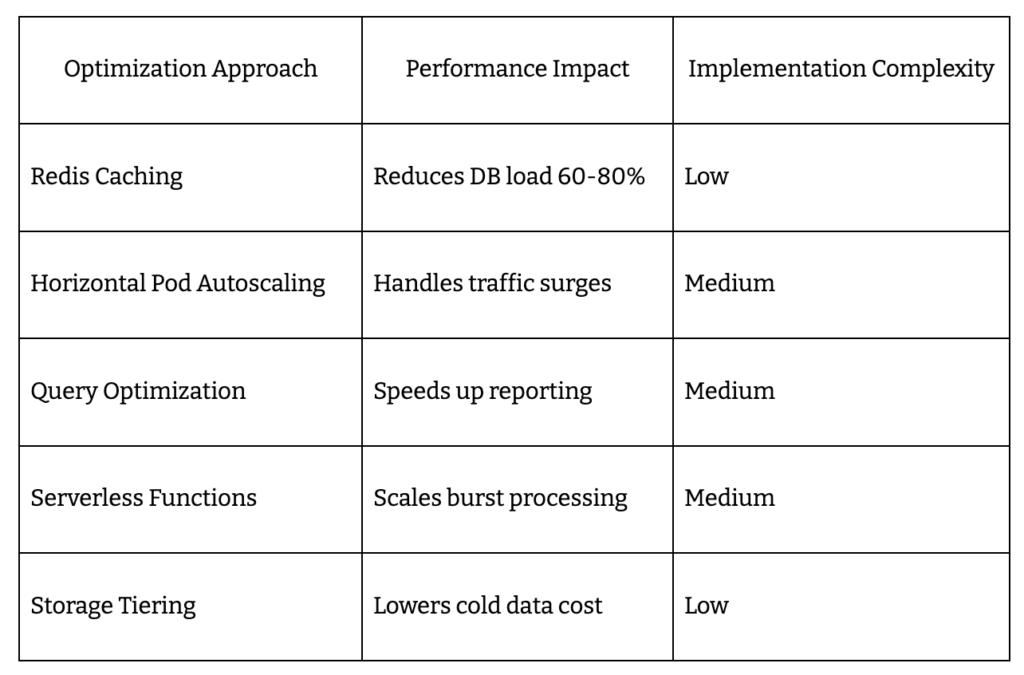
  • Redis caching for frequent eligibility lookups
  • Batch processing of high-volume claims
  • Horizontal scaling for peak open enrollment periods

Batching, caching, and scaling let you process thousands of claims in parallel while keeping API response times predictable – no matter how many clients are shipping.

Database Design and Data Flow Optimization

Core Database Schemas

Shipping scalable ICHRA platforms means building schemas that don’t buckle under peak enrollment. Start with tables for employee eligibility, contribution tracking, reimbursement transactions, and compliance audits. Each must handle rapid updates and high-volume queries.

Example: Employee eligibility table for fast lookups and easy event sourcing.

sql

CREATE TABLE employee_eligibility (

    employee_id UUID PRIMARY KEY,

    class_id UUID NOT NULL,

    status VARCHAR(16) NOT NULL,

    effective_date DATE,

    end_date DATE

);

CREATE INDEX idx_eligibility_class ON employee_eligibility(class_id);

Data Flow Architecture

Real-time sync is non-negotiable. Use change data capture (CDC) to trigger downstream processes instantly when a record changes. Event streaming platforms like Kafka or Pulsar push updates to analytics and reporting warehouses. Archive old data with GDPR-compliant retention rules to keep storage lean and compliant.

  • CDC for instant eligibility and contribution updates
  • Event streaming for audit trails and analytics
  • Data warehousing for reporting, with automated retention policies

Optimization Strategies

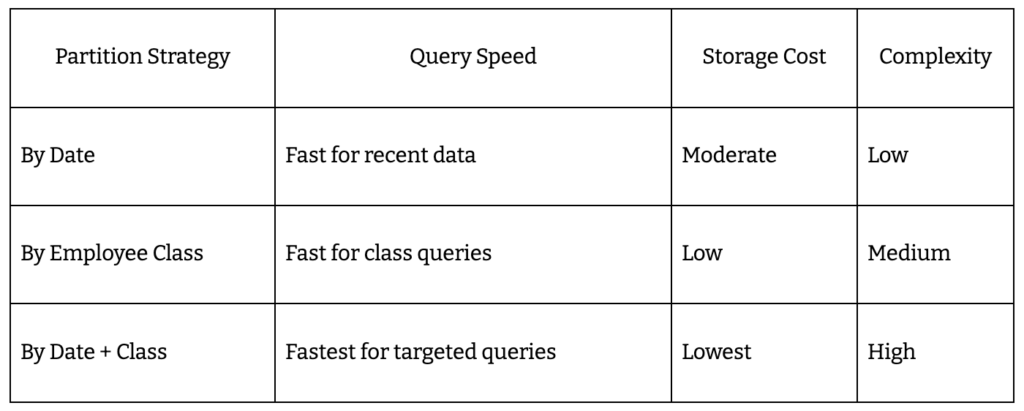
Partition by date and employee class to keep queries fast, even at scale. Index contribution tables for rapid eligibility and reimbursement lookups. Read replicas handle heavy reporting loads without slowing transaction speed. Archive historical transactions to cold storage.

  • Partitioning by month or employee class
  • Secondary indexing for contribution_id
  • Read replicas for analytics queries
  • Archive tables for records older than 2 years

Performance Considerations

Optimize queries and manage connection pools to survive open enrollment surges. For time-series contribution history, use specialized indexes or Postgres BRIN index for massive tables. Choose normalized schemas for perfect data integrity, or denormalize where speed trumps redundancy. Cloud-native databases like Aurora or Cloud SQL bring autoscaling and automated failover – critical for zero downtime in production.

Compliance Tracking and Automated Workflows

Compliance Engine Architecture

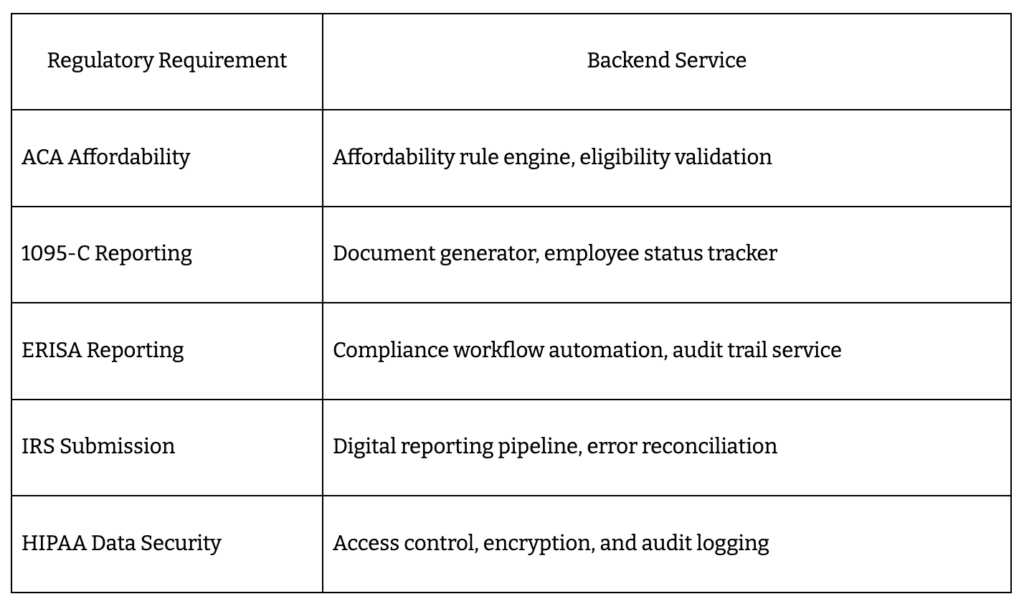
Move faster than manual audits ever could. Embed a compliance engine that automates ACA affordability checks, 1095-C generation, ERISA reporting, and IRS submissions – so every step is covered as your platform scales.

  • Rule engines for ACA safe harbor calculations
  • Automated 1095-C/1094-C document generation
  • ERISA workflow orchestration
  • IRS reporting and digital submission pipelines

Workflow Automation Patterns

Manual compliance is a bottleneck – event-driven automation isn’t. Trigger compliance checks and reporting as soon as data changes, not at the end of the month.

  • Event-driven compliance validation
  • Batch scheduling for large-scale document generation
  • Automated error handling and remediation
  • Immutable audit trail creation for every compliance event

Backend Validation Systems

Trusting stale spreadsheets risks fines. Build validation into every contribution and eligibility update.

  • Affordability calculation based on federal poverty levels and regional data
  • Employee class and eligibility checks
  • Contribution limit enforcement
  • Multi-state and cross-jurisdiction compliance verification

python

# Affordability check example (ACA 9.12% rule for 2025)

def is_affordable(monthly_premium, household_income):

    return (monthly_premium / (household_income / 12)) <= 0.0912

Monitoring and Observability

Spot compliance risks before auditors do. Real-time dashboards and alerts keep your ops team ahead.

  • Compliance dashboard APIs for real-time metrics
  • Error logging and alerting for failed checks
  • Performance analytics on workflow completion
  • Regulatory update notifications for new rules or thresholds

Integration Strategies for Carrier and Payroll Systems

Carrier Integration Architecture

Every extra carrier integration is a drag on your roadmap. API gateways manage multiple carrier connections through a single, unified entry point. Protocol adapters handle legacy EDI, modern FHIR, and REST – so you avoid rebuilding for every carrier’s quirks. Data normalization layers convert messy carrier payloads into a common schema, while fallback logic routes requests around downtime.

Payroll System Connectivity

Payroll data powers eligibility and contributions, but every provider speaks a different language. Use a hybrid of SFTP batch uploads and real-time APIs to sync employment data. Map and transform incoming files or payloads to your backend schema. Automate error reconciliation – catch mismatches and missing fields before they hit your compliance stack.

Backend Integration Patterns

Distributed integrations need patterns that survive failures and scale:

  • Publisher-subscriber messaging to decouple services
  • Request-response with timeout logic for slow or unreliable endpoints
  • Compensation transactions to unwind partial updates
  • Idempotency keys to prevent duplicate processing

python

# Idempotency handler for reimbursement submission

if is_already_processed(request_id):

    return get_previous_response(request_id)

else:

    response = process_new_submission(payload)

    save_response(request_id, response)

    return response

javascript

// Circuit breaker pattern for carrier API calls

if (circuitBreaker.isOpen()) {

  throw new Error(“Carrier API unavailable”);

}

try {

  carrierApi.call(payload);

  circuitBreaker.success();

} catch (e) {

  circuitBreaker.failure();

  // fallback or retry logic here

}

Security and Reliability

Security isn’t optional. Use mTLS for carrier connections, OAuth 2.0 for payroll APIs, and encrypt all data in transit and at rest. Circuit breakers protect your uptime when partners fail or slow down.

Real-World Architecture Case Studies

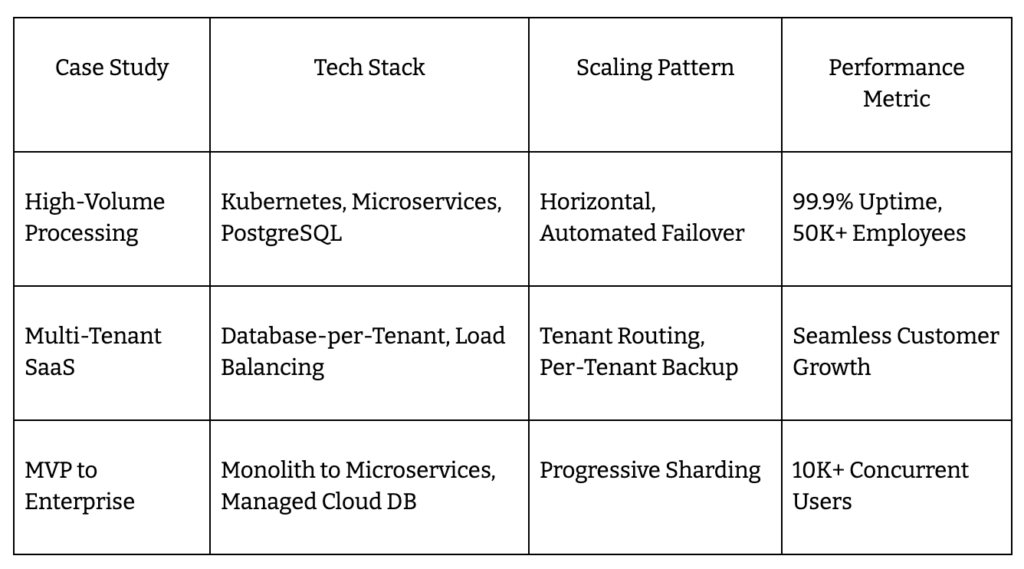
High-Volume Processing Platform

Fast-growing ICHRA platforms can’t afford downtime. One leading system scaled to 50,000+ employees across 15 states using a microservices architecture on Kubernetes. PostgreSQL, bolstered with read replicas, kept data synchronized and responsive. Peak open enrollment saw 99.9% uptime, with horizontal scaling absorbing traffic spikes and automated failover eliminating single points of failure.

Multi-Tenant SaaS Architecture

Handling dozens of employer groups on a single codebase, this SaaS model isolates each client’s data with a database-per-tenant strategy. A shared service layer uses intelligent tenant routing and load balancing to keep resource contention low. Per-tenant backup and restore routines drive compliance and reduce risk. Horizontal scaling lets platforms add customers without architectural rewrites.

Startup MVP to Enterprise Scaling

A benefits tech startup launched with a monolithic MVP, then migrated to microservices as demand surged. Cloud-native deployment (containerized services, managed databases) allowed progressive sharding and quick performance tuning. Migrating incrementally, the team fixed scaling bottlenecks before they became critical, enabling the platform to hit 10,000+ concurrent users during busy periods

Performance Optimization and Scaling Strategies

Backend Performance Techniques

Speed wins. Platforms using Redis or Memcached caching slash database load by up to 80% on eligibility and contribution queries. Asynchronous processing queues absorb spikes – batch-heavy reimbursement jobs won’t bottleneck real-time APIs. Use a CDN for static resources so your core services never slow down for asset delivery.

python

# Redis caching for employee eligibility

def get_eligibility(employee_id):

    cached = redis.get(employee_id)

    if cached:

        return cached

    data = db.query(employee_id)

    redis.set(employee_id, data, ex=86400)

    return data

Scaling Architectural Patterns

Horizontal pod autoscaling keeps you ahead of traffic surges. Deploy Kubernetes HPA to adjust capacity based on CPU, memory, or queue depth. Database connection pooling and load balancer tuning prevent bottlenecks as user count climbs. Distribute your stack across regions to minimize latency for national employers.

yaml

# Kubernetes Horizontal Pod Autoscaler example

apiVersion: autoscaling/v2

kind: HorizontalPodAutoscaler

spec:

  scaleTargetRef:

    kind: Deployment

    name: reimbursement-api

  minReplicas: 4

  maxReplicas: 50

  metrics:

     type: Resource

      resource:

        name: cpu

        target:

          type: Utilization

          averageUtilization: 65

Monitoring and Optimization

Application performance monitoring (APM), database query analysis, and real-time API response tracking reveal bottlenecks before customers do. Set resource utilization alerts to catch runaway usage or failed autoscaling.

Cost Optimization Approaches

Reserve cloud instances for predictable workloads, adopt serverless for bursty tasks, and tier storage to cut costs. Monitor network bandwidth and right-size infrastructure to avoid overpaying for idle capacity.

Common Technical Challenges and Solutions

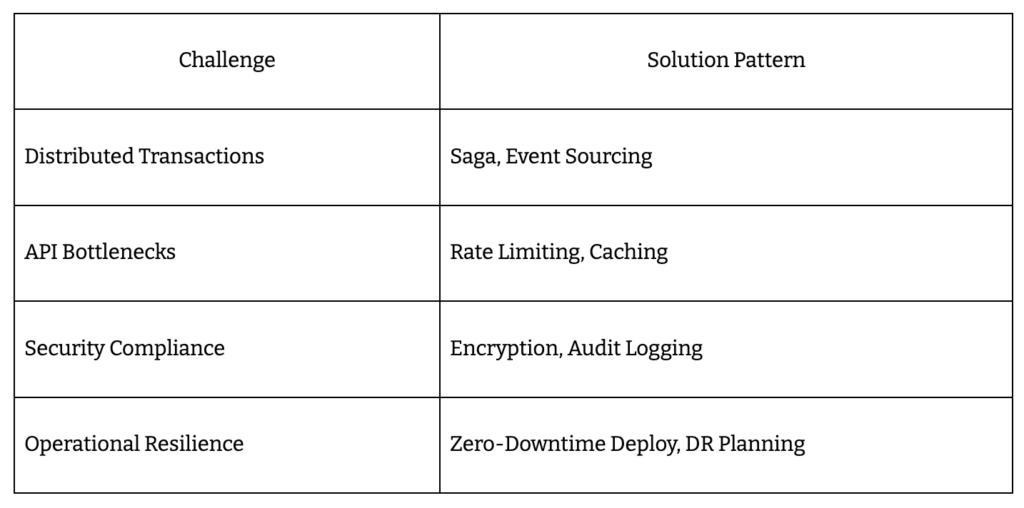
Data Consistency Challenges

Distributed ICHRA systems break if transactions fall out of sync. Multi-system updates – across carriers, payroll, and compliance – demand bulletproof patterns for consistency.

  • Use event sourcing for every reimbursement and eligibility event: every change is logged, providing a full audit trail.
  • Apply saga patterns for distributed transactions, coordinating updates and compensations when steps fail.
  • Implement conflict resolution strategies for eventual consistency – last-write-wins or versioned updates.

python

# Saga pattern for distributed reimbursement

def process_reimbursement(event):

    try:

        debit_account(event)

        update_carrier(event)

        log_audit(event)

    except Exception:

        compensate_transaction(event)

Performance Bottlenecks

Every millisecond counts when processing thousands of ICHRA contributions. Bottlenecks stop platforms cold during open enrollment.

  • Alleviate database lock contention with row-level locking and partitioned tables.
  • Set API rate limits and retry logic to avoid overload and ensure reliability.
  • Prevent memory leaks with automated profiling and container limits.
  • Minimize network latency by deploying services regionally.

Security and Compliance Issues

HIPAA and SOC 2 aren’t optional – missing requirements means lost deals and regulatory risk.

  • Encrypt all PHI at rest and in transit.
  • Enforce strict access controls and audit logging for sensitive actions.
  • Prepare for SOC 2 with automated vulnerability scans and penetration testing.
  • Track every access and change for HIPAA audit readiness.

Operational Challenges

Downtime during open enrollment is a dealbreaker. ICHRA platforms must be built for resilience.

  • Deploy zero-downtime strategies with blue/green or rolling updates.

yaml

# Kubernetes rolling update configuration

strategy:

  type: RollingUpdate

  rollingUpdate:

    maxUnavailable: 0

    maxSurge: 1

  • Schedule automated backups and disaster recovery drills.
  • Build incident response playbooks for rapid rollback and recovery.

Conclusion: Your Backend Architecture Implementation Roadmap

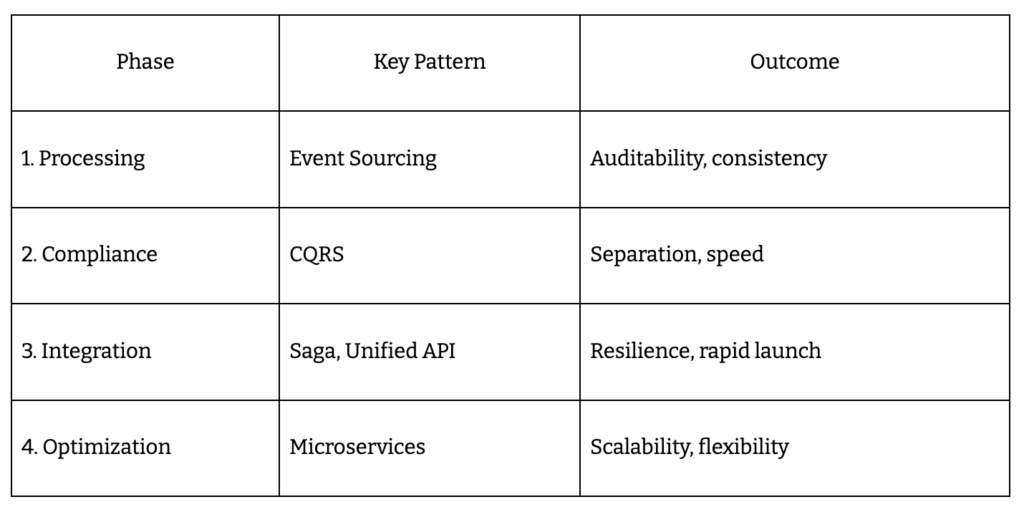
Move fast or watch competitors capture the market. Scalable ICHRA software architecture starts with event-driven, API-first, compliance-ready design – anything less slows you down. The winning roadmap looks like this:

  • Build core reimbursement processing first – get the engine running before layering complexity.
  • Add compliance automation next, so you never scramble when regulations shift.
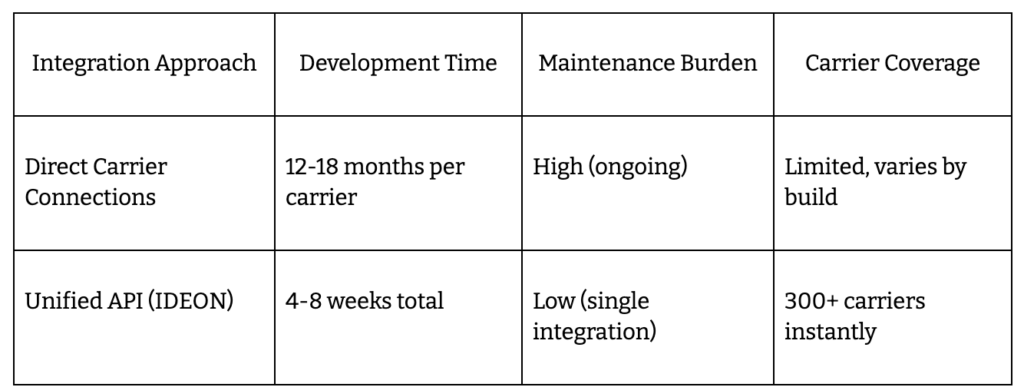
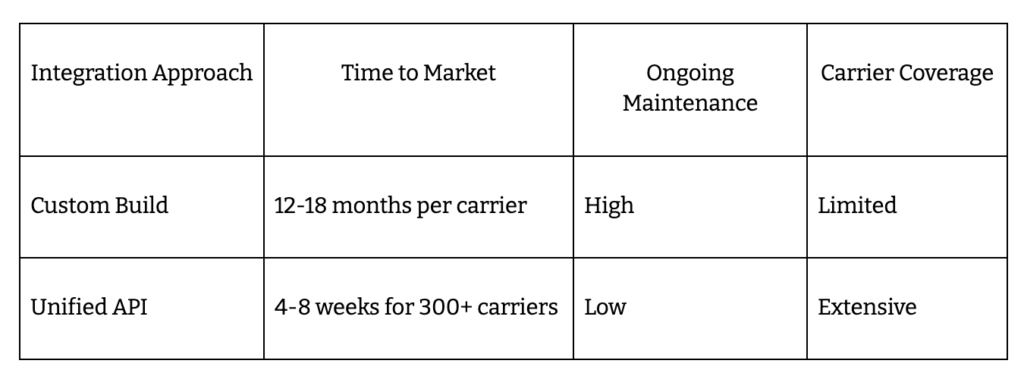
  • Integrate with carriers and payroll using unified APIs like IDEON, cutting 18 months down to 4-8 weeks.
  • Optimize for scale: implement event sourcing, CQRS, saga patterns, and microservices for reliability and agility.

Is your backend architecture built to handle 10x growth, or will you be left watching others ship first? Every technical decision you make right now will define your platform’s ability to outpace custom development for years to come.

Technical FAQs: ICHRA Backend Architecture

What technology stack sets you up to outpace custom builds?

Go with a modern stack: Node.js, TypeScript, or Go for service logic; Kubernetes for orchestration; PostgreSQL or Aurora for relational data. Pick tools that support rapid iteration, cloud-native deployment, and strong API support. Don’t get stuck with legacy stacks that slow every release cycle.

Microservices or monolith for ICHRA?

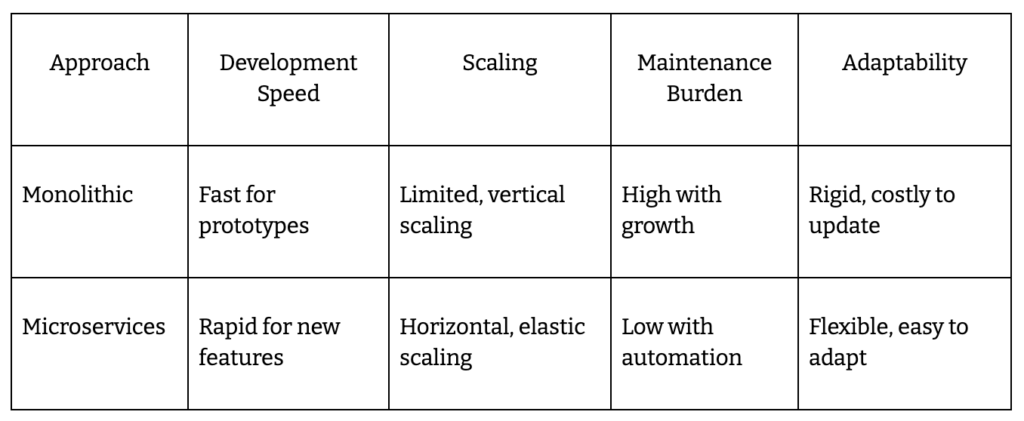
Microservices win as soon as you hit scale. Decompose by business domain – eligibility, contributions, reimbursements, compliance. Each service scales and deploys independently, so you’re never held back by a single bottleneck. Monoliths work for MVPs but cost you speed and flexibility when regulations or carriers change.

Which database fits ICHRA: PostgreSQL, MySQL, or NoSQL?

Relational is non-negotiable for compliance and financial accuracy. PostgreSQL is the go-to: robust, transactional, open-source, and cloud-optimized. Reserve NoSQL for edge use-cases – logging, analytics, or unstructured event storage. For high-volume workloads, use read replicas and partitioning to keep queries fast.

How do you manage distributed transactions across carrier and payroll integrations?

Forget multi-phase commits; use saga patterns for long-running, multi-system updates. Each step triggers the next, and failed steps are compensated with explicit rollback logic. Log every state change as an immutable event, so you never lose the audit trail.

Build custom carrier integrations or use a unified API?

A unified API like IDEON skips 18 months of custom engineering. You connect once, unlock 300+ carriers, and stay focused on product – not plumbing. Direct builds mean endless maintenance and slow onboarding. Unified APIs ship new carriers in weeks, not quarters.

What’s required for HIPAA and SOC 2 compliance?

Encrypt PHI at rest and in transit. Enforce RBAC for every service. Automate audit logging of access and changes. Run regular vulnerability scans and have incident response protocols in place. SOC 2 means continuous monitoring and documented controls – make this part of your CI/CD pipeline.

How do you optimize backend performance for ICHRA?

Cache eligibility and plan lookups with Redis to cut database load by up to 80%. Batch process reimbursements to flatten traffic spikes. Use asynchronous queues for non-blocking workflows. Monitor for slow queries and refactor hot paths before they become bottlenecks.

How do you design for horizontal scaling and high availability?

Deploy services as containers on Kubernetes with autoscaling policies. Use health checks and rolling updates for zero downtime. Spread workloads across regions to cut latency for national employers. Read replicas and multi-zone databases keep you online if a region drops.

Which monitoring and observability tools matter most?

Stack your monitoring: Prometheus for metrics, Grafana for dashboards, ELK or OpenSearch for logs, and distributed tracing (Jaeger, Zipkin) for debugging. Alert on error rates, latency spikes, and resource saturation – catch issues before customers do.

How do you implement zero-downtime deployments?

Use blue/green or rolling deployment strategies. Automate rollback on health check failures. Always deploy behind a load balancer, and keep database migrations backward-compatible to avoid breaking running services during cutovers.

How to Build a Real-Time ICHRA Reimbursement Tracking Engine

Introduction: Building Real-Time Processing That Never Lags

Real-time ICHRA reimbursement tracking isn’t optional anymore – it’s what separates platforms that scale from those stuck debugging. Every reimbursement request demands instant eligibility verification, automated claim approval workflows, and continuous audit log generation. The wrong architecture means delayed status updates, compliance gaps, and frustrated employees waiting to see if their claims went through.

Modern ICHRA reimbursement tracking API architecture is event-driven, delivers near real-time status propagation, and maintains comprehensive audit trails automatically. This guide walks through engine architecture decisions, API integration strategies, real-time processing components, status update systems, audit logging implementation, performance optimization, and production deployment considerations – all built for backend engineers and platform architects shipping production-ready ICHRA engines.

What Choice Are You Making When Building an ICHRA Reimbursement Tracking Engine?

Your decision shapes everything: build a custom real-time engine from scratch, or integrate unified API infrastructure that’s already battle-tested.

A modern ICHRA reimbursement tracking API means event-driven processing, real-time status propagation across all connected clients, and comprehensive audit trails that satisfy compliance requirements automatically. The architecture you choose determines whether you ship in weeks or spend months debugging distributed systems.

Architecture implications of each path:

Custom development demands:

  • Implementing event sourcing patterns and solving message ordering challenges
  • Building real-time streaming infrastructure and managing WebSocket connections
  • Handling distributed transactions with compensation workflows
  • Creating custom monitoring and alerting systems from scratch

API integration provides:

  • Pre-built streaming APIs with proven event ordering
  • Managed infrastructure that scales automatically
  • Automated audit trail generation built for compliance
  • Auto-scaling that handles traffic spikes without manual intervention

Technical considerations both approaches must address:

  • Data consistency across distributed reimbursement and payroll systems
  • Event ordering and duplicate claim handling
  • Error recovery when carrier APIs fail
  • Performance under high-volume open enrollment processing

Your engine architecture choice directly determines real-time capability and system reliability. Custom builds offer control but cost time. API integration delivers production-ready infrastructure significantly faster.

Why Technical Leaders Choose API Integration for Real-Time ICHRA Reimbursement Tracking Engines

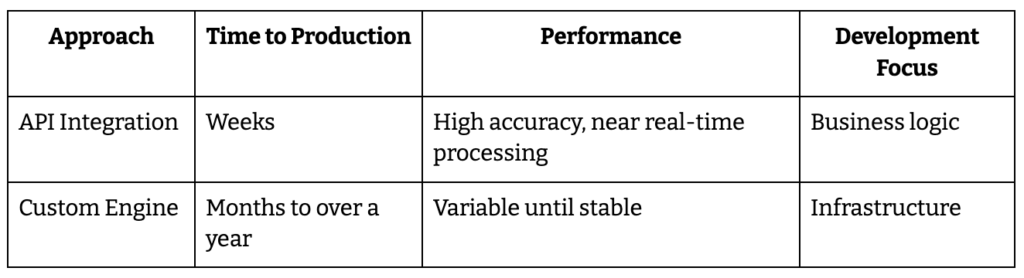
Fast deployment of production-ready engines wins. While custom engine projects stretch across many months, API integration delivers stable real-time processing in weeks instead of quarters or years.

Avoid the custom engine complexity trap:

Building from scratch means solving problems that unified APIs already handle:

  • Event sourcing implementation with proper message ordering
  • Real-time streaming infrastructure and WebSocket connection management
  • Distributed transaction handling with saga patterns
  • Comprehensive monitoring and alerting system development

Real-time processing comparisons:

Technical efficiency advantages of ICHRA reimbursement tracking API platforms:

Unified APIs like IDEON provide pre-built event streaming and WebSocket infrastructure, automated error handling with retry mechanisms, built-in load balancing and horizontal scaling, plus real-time monitoring and performance analytics – all production-ready.

Development resource optimization:

Your team focuses on business logic instead of infrastructure complexity. You leverage battle-tested streaming architectures rather than debugging distributed system issues. Iteration cycles accelerate because the foundation just works.

Platforms using unified ICHRA reimbursement tracking APIs dramatically reduce engineering resource consumption and ship features faster.

Core Components of a Real-Time ICHRA Reimbursement Tracking Engine

Event Processing Pipeline

Stream processing handles real-time eligibility checks as claims arrive. Message queuing orchestrates claim validation workflows across multiple services. Event sourcing captures every state change for complete audit trail compliance. Dead letter queues isolate errors for recovery without blocking processing.

Status Update System

WebSocket connections deliver instant notifications to connected clients. Server-sent events push real-time updates to browser-based dashboards. Webhook delivery integrates with third-party systems automatically. Push notification services alert mobile users when claim status changes.

Audit Logging Infrastructure

Immutable event logs use cryptographic hashing to prevent tampering. Structured logging with JSON formatting enables fast indexing and queries. Compliance-ready data retention and archival policies meet regulatory requirements. Real-time log streaming feeds monitoring and analytics systems.

API Layer Architecture

RESTful endpoints handle synchronous operations like claim submission. GraphQL subscriptions enable real-time data queries for dashboards. Rate limiting and throttling protect against overload. Authentication and authorization secure every access point.

Data Persistence Layer

Event stores track reimbursement state changes immutably. Time-series databases capture performance metrics for analysis. Document stores handle flexible claim data structures. Relational databases ensure transactional consistency for financial data.

How to Integrate APIs for Real-Time ICHRA Reimbursement Processing

API Integration Architecture Patterns

Event-driven integration with webhook subscriptions notifies your system instantly when claim status changes. Real-time streaming via WebSocket connections keeps dashboards synchronized. Polling-based synchronization handles batch processing for historical data. Hybrid push-pull models optimize performance based on data freshness requirements.

Implementation Timeline

  • Phase 1: API authentication setup and endpoint testing
  • Phase 2: Event subscription and webhook configuration
  • Phase 3: Real-time processing workflow implementation
  • Phase 4: Performance optimization and production deployment

Most teams complete API integration in weeks rather than the months or years required for custom engine development.

Real-time status subscription example:

javascript

// WebSocket connection for real-time reimbursement updates

const ws = new WebSocket(‘wss://api.provider.com/reimbursements/stream’);

ws.on(‘message’, (data) => {

  const update = JSON.parse(data);

  updateReimbursementStatus(update.employeeId, update.status);

  triggerClientNotification(update);

});

ws.on(‘error’, (error) => {

  console.error(‘WebSocket error:’, error);

  scheduleReconnection();

});

Platforms leveraging unified APIs like IDEON eliminate custom WebSocket management and get production-ready streaming rapidly.

Building Status Update Systems and Audit Logs

Real-Time Status Update Architecture

Event-driven status propagation broadcasts changes to all connected clients instantly. WebSocket connection management includes automatic failover and reconnection handling. Status caching improves response times for frequently accessed claims. Conflict resolution handles concurrent status updates from multiple sources.

Comprehensive Audit Logging Implementation

Every reimbursement state change gets logged automatically. Structured JSON format with standardized fields enables fast queries. Immutable append-only storage with tamper detection satisfies compliance requirements. Real-time indexing with Elasticsearch powers fast audit trail queries.

Audit log data structure:

json

{

  “timestamp”: “2025-01-15T10:30:00Z”,

  “eventType”: “reimbursement_approved”,

  “employeeId”: “emp_12345”,

  “amount”: 450.00,

  “source”: “eligibility_engine”,

  “metadata”: {

    “planId”: “plan_789”,

    “processedBy”: “system_auto”

  }

}

Compliance and retrieval features:

Fast audit trail queries by employee, date range, or event type satisfy auditor requests instantly. Automated compliance reporting generation eliminates manual work. Data retention policies match regulatory requirements automatically.

Performance Optimization for Real-Time Reimbursement Engines

Real-Time Processing Optimizations

Redis caching dramatically reduces database load for frequently accessed eligibility data. Database connection pooling and read replicas handle high query volumes. Kafka or RabbitMQ message queuing ensures reliable event processing. Load balancing distributes processing across multiple instances.

Scalability Patterns

Horizontal pod autoscaling adjusts capacity based on queue depth automatically. Database sharding handles high-volume transaction processing. CDN integration accelerates static resource delivery. Geographic distribution reduces latency for national employers.

Monitoring and Performance Metrics

Track real-time processing latency to catch slowdowns before users complain. Monitor event queue depth and processing throughput. Watch WebSocket connection health and reconnection rates. Alert on API response times and error rate spikes.

Performance benchmarks: Near real-time status updates, enterprise-grade uptime SLAs, support for high-volume concurrent processing during peak enrollment periods.

Production Deployment and Monitoring Strategies

Deployment Architecture

Docker containerization with Kubernetes orchestration enables flexible scaling. Blue-green deployment delivers zero-downtime updates for production systems. Environment isolation separates staging and production configurations. Secret management encrypts API keys and database credentials.

Monitoring and Observability

Real-time performance dashboards track system health. Automated alerting notifies teams of system failures instantly. Centralized logging with structured search enables fast troubleshooting. Health checks verify system status automatically.

Production Readiness Checklist

  • ☑ Load testing completed with expected traffic volumes
  • ☑ Monitoring and alerting systems configured
  • ☑ Backup and recovery procedures tested
  • ☑ Security audit and penetration testing completed

Common Implementation Challenges and Solutions

Real-Time Processing Challenges

Event ordering: Use timestamps and sequence numbers for deterministic ordering. Duplicate handling: Implement idempotent processing with unique request IDs. Connection management: Automatic reconnection with exponential backoff prevents thundering herd. Data consistency: Event sourcing with CQRS patterns maintains accuracy.

Performance Bottlenecks

Database locks: Optimize queries and use appropriate isolation levels. Memory leaks: Regular profiling and garbage collection tuning. Network latency: Connection pooling and geographic distribution. Queue overflow: Auto-scaling and dead letter queue handling.

Security and Compliance

OAuth 2.0 and JWT tokens secure API authentication. Encryption protects data in transit and at rest. HIPAA-compliant audit logging and data handling satisfy regulatory requirements. Regular security assessments catch vulnerabilities early.

Conclusion: Ship Real-Time Tracking That Scales

Real-time ICHRA reimbursement tracking engines are critical infrastructure for competitive platforms. The choice between custom development and API integration determines speed to market and system reliability.

Success factors: near real-time processing capability, comprehensive audit trails, and production-ready scalability from day one. Unified APIs like IDEON deliver all three without the extended development cycles required for custom builds.

Will your reimbursement tracking engine deliver near real-time updates and comprehensive audit trails from day one, or will you spend months building what already exists?

FAQs on Building ICHRA Reimbursement Tracking Engines

What are the core components of a real-time reimbursement tracking engine?

Event processing pipelines, status update systems, audit logging infrastructure, API layers, and data persistence – all working together for instant claim processing and status propagation.

How do you implement real-time status updates and notifications?

WebSocket connections for instant client updates, server-sent events for browsers, webhooks for third-party systems, and push notifications for mobile apps deliver real-time status across all channels.

What’s the best approach for audit logging and compliance tracking?

Immutable event logs with structured JSON formatting, real-time indexing for fast queries, automated retention policies, and cryptographic hashing for tamper detection satisfy regulatory requirements.

How do you optimize performance for high-volume processing?

Redis caching, database connection pooling, message queue systems like Kafka, horizontal autoscaling, and geographic distribution keep processing fast under load.

Should you build custom or integrate existing API infrastructure?

Unified ICHRA reimbursement tracking APIs cut development time significantly, provide battle-tested infrastructure, and let teams focus on business logic instead of distributed systems complexity. Custom builds take substantially longer and require ongoing maintenance of complex infrastructure.

How Smart Platforms Choose Between Small Group and Large Group Health Insurance

Summary:

This article will explain how the distinction between small group (1–50 employees) and large group (51+) health insurance fundamentally shapes how benefits platforms are built, from compliance logic to pricing and API integration.

It will explain how small group plans are standardized and state-regulated with fixed rates, while large group plans allow negotiated pricing, custom designs, and continuous enrollment—requiring far more complex, automated infrastructure to scale efficiently.

Here’s the fork in the road: Do you build your benefits platform for small group health insurance—standardized, compliance-heavy, limited negotiation leverage? Or do you architect for large group complexity, with customizable plan designs, negotiated rates, and year-round enrollment?

The way you categorize employer clients—by headcount, regulatory thresholds, and plan design requirements—doesn’t just set eligibility rules. It shapes your platform’s integration architecture, compliance automation needs, and competitive positioning when brokers and HR tech buyers compare solutions. Smart platforms map these distinctions up front to avoid costly rework later:

  • Small group plans typically serve companies with 1–50 full-time employees; large group starts at 51+ (healthinsurance.org)
  • Employer size drives everything: Large groups customize features and negotiate rates; small groups select from standardized templates (Healthcare.gov)
  • ACA compliance manifests differently at each threshold, affecting requirements and flexibility (IRS)
  • Premium calculations, risk pools, and cost structures change fundamentally as you scale (healthinsurance.org)
  • Regulatory obligations—both federal and state—shift as businesses cross the 50-employee line (Cigna Healthcare)

Get this distinction right, and your technology unlocks scalable coverage for clients at every size. Miss it, and you’re stuck rebuilding eligibility engines and rating logic while competitors win the deals you can’t support.

Small Group vs Large Group Health Insurance: What's the Real Difference?

Small group health insurance targets organizations with 1 to 50 full-time employees, though four states—California, Colorado, New York, and Vermont—extend this threshold to 100 (healthinsurance.org). Large group health insurance activates at 51 or more full-time employees (or 101+ in those same states) (PeopleKeep). This enrollment threshold isn’t arbitrary—it determines which ACA requirements you face, how much plan design flexibility you get, and whether you have leverage to negotiate with carriers.

For small groups, plans come off the shelf: highly regulated, must include all ACA essential health benefits, and carriers set the rates. Implementation is straightforward, but negotiation leverage is zero. Insurers can’t use medical history to set premiums, and rates for older employees can’t exceed 3x those for younger employees (healthinsurance.org).

Large group plans operate in a different universe. These plans are built for customization and scale. Employers with substantial workforces negotiate plan features, cost structures, benefit designs, and specialized programs. Instead of accepting insurer-set premiums, large groups participate in underwriting conversations where claims experience, demographics, and risk management directly influence pricing (Venteur).

The regulatory environment shifts dramatically at this threshold. Small group plans must comply with state-specific mandates and standardized coverage rules (healthinsurance.org). Large group plans face the federal ACA employer mandate but gain significantly more latitude in plan design—they can customize benefits beyond essential health benefits if they meet minimum value standards, negotiate custom pharmacy benefits, or implement self-funded arrangements.

The result: two fundamentally distinct frameworks. One is standardized and compliance-driven (small group). The other is customizable and negotiation-centric (large group). For benefits platforms integrating health insurance data and enrollment capabilities, this means entirely different API requirements, data models, and compliance automation workflows.

Key Distinctions at a Glance

 
  • Eligibility thresholds: 1–50 FTEs (small group) vs. 51+ FTEs (large group), with state variations
  • Plan standardization: Small groups use ACA-compliant templates with essential health benefits; large groups customize extensively
  • Regulatory oversight: Small groups navigate state mandates and strict benefit requirements; large groups focus on federal ACA employer mandate with greater design flexibility
  • Carrier negotiation: Small groups accept fixed, insurer-set pricing; large groups negotiate rates, cost-sharing, and benefit structures

Plan design control: Minimal customization for small groups; extensive customization for large groups including self-funded options

Eligibility Rules and Employer Mandates for Group Health Insurance

Lower Premium Costs Through Risk Pooling

The line separating small group from large group health insurance hinges on full-time employee count and the corresponding compliance obligations. Small group plans accommodate organizations with 1 to 50 full-time employees (extended to 100 in select states) (Healthcare.gov). Large group plans activate at 51 full-time employees or more (101+ in certain jurisdictions) (IRS). This threshold triggers the ACA employer mandate, which fundamentally changes compliance requirements, reporting obligations, and penalty exposure.

The ACA Employer Mandate Threshold


Once your business reaches 50 full-time equivalents (FTEs), the ACA employer mandate activates (IRS). The mandate requires applicable large employers to offer affordable, minimum-value coverage to at least 95% of full-time employees and their dependents, or face substantial penalties (Cigna Healthcare).

Affordability for 2025 is defined as employee premiums not exceeding 9.02% of household income (Cigna Healthcare), and minimum value means the plan covers at least 60% of expected healthcare costs (Cigna Healthcare).

Fail to offer compliant coverage, and the penalties escalate quickly (PeopleKeep):

  • No coverage offered: $2,900 per full-time employee annually (excluding the first 30) if any employee receives premium tax credits through the marketplace
  • Unaffordable or insufficient coverage: $4,350 per employee who receives marketplace subsidies

Small Group Compliance: State-Driven but Still Regulated


Small employers aren’t exempt from regulation—they simply face a different rulebook. Even without the employer mandate, small group plans must comply with (healthinsurance.org):

  • ACA consumer protections: No preexisting condition exclusions, guaranteed issue and renewability, coverage of essential health benefits
  • State-specific mandates: Additional benefit requirements, premium rating rules, participation requirements (often 70-75% of eligible employees)
  • Preventive care requirements: No-cost coverage for preventive services as defined by the ACA

Full-Time Status and Eligibility Calculations


The 30-hour rule underpins eligibility determinations across both group types (Cigna Healthcare). Employees averaging 30 or more hours per week are classified as full-time and count toward group size calculations. Variable-hour and seasonal employees require measurement and stability periods to determine FTE status—adding complexity to eligibility tracking for platforms integrating benefits enrollment.

Eligibility Requirements Comparison

Plan Type Key Eligibility Requirements
Small Group1–50 full-time employees (some states up to 100); must meet ACA consumer protections and state minimum standards; no employer mandate (Healthcare.gov)
Large Group 51+ full-time employees (or 101+ in select states); subject to ACA employer mandate requiring affordable, minimum-value coverage (IRS)
BothFull-time status defined as 30+ hours/week; must not exclude preexisting conditions; must cover designated preventive services at no cost (healthinsurance.org)

Comparing Costs: Premiums, Risk Pools, and Plan Rating Methods

Productivity and Workforce Health

Healthy employees are more productive employees. Group health insurance facilitates better health outcomes through several channels:

Preventive Care Access: Comprehensive group plans cover preventive services without cost-sharing, encouraging regular check-ups, screenings, and vaccinations that catch health issues early. Preventive care reduces the likelihood of serious illness that leads to extended absences.

Reduced Presenteeism: When employees have health coverage, they’re more likely to seek appropriate medical attention rather than working through illness. While this may seem counterintuitive, chronic presenteeism—where sick employees attend work but perform suboptimally—costs more than measured absenteeism.

Mental Health Support: Modern group plans increasingly cover mental health services including therapy and psychiatric care. Access to these services helps employees manage stress, anxiety, and depression that impact workplace performance.

Chronic Disease Management: For employees with conditions like diabetes, hypertension, or asthma, comprehensive coverage enables ongoing management that prevents acute episodes requiring emergency care and extended time away from work.

The productivity benefits extend beyond individual health. When employees have confidence in their health coverage, they experience reduced financial stress and cognitive load—freeing mental bandwidth for work responsibilities rather than healthcare concerns.

The fundamental economics of group health insurance diverge sharply at the small-to-large group threshold. For benefits platforms and carriers, understanding these cost dynamics determines pricing models, underwriting workflows, and how you structure multi-carrier offerings.

Small Group Premium Calculations: Community-Rated and Inflexible


Small group health insurance operates within a community-rated framework with limited rating variables (healthinsurance.org). Insurers calculate premiums using ACA-permitted factors:

  • Age: Rates can vary by age band, with older employees paying up to 3x younger employees
  • Geographic location: Rating areas within states affect base premiums
  • Family composition: Single, couple, family coverage tiers
  • Tobacco use: Surcharges up to 50% for tobacco users
  • Plan metal tier: Bronze, Silver, Gold, Platinum benefit levels

What’s notably absent? Claims experience, industry risk profiles, and company-specific health data. Small groups face insurer-set premiums with virtually no negotiation leverage (Venteur). The risk pool is limited—spreading risk across a smaller employee population means higher per-employee costs and greater volatility year-over-year as individual claims impact renewal rates.

Large Group Underwriting: Negotiation and Risk Management


Large group health insurance flips the model entirely. Insurers underwrite the entire workforce as a single entity (Venteur), analyzing:

  • Claims experience: Historical utilization patterns and cost trends
  • Demographics: Age distribution, geographic concentration, dependent ratios
  • Industry risk profiles: Occupational hazards and industry-specific health trends
  • Wellness programs: Employer investment in preventive care and chronic disease management

This comprehensive underwriting opens the door to direct negotiation on rates, cost-sharing structures, deductibles, copays, and covered services. Large groups can negotiate:

  • Custom pharmacy benefits and formulary designs
  • Alternative provider networks (narrow networks, centers of excellence)
  • Self-funded arrangements where the employer assumes claims risk
  • Stop-loss insurance to cap catastrophic claims exposure

Risk Pool Dynamics and Cost Stability


The size advantage in large group plans delivers risk pool stability. Spreading claims risk across hundreds or thousands of lives smooths out individual high-cost claims that would spike premiums in a small group setting (Venteur). This risk diversification translates to:

  • More predictable renewal rates: Less volatility from individual claims events
  • Better actuarial data: Larger sample sizes yield more reliable forecasting
  • Enhanced negotiation positioning: Carriers compete more aggressively for large

Premium Pricing Comparison

 
Plan Type Premium Calculation Method Risk Pool Size Negotiation Leverage
Small Group Community-rated using age, location, family size, tobacco use, plan type (insurer-set) (healthinsurance.org)Limited (fewer employees = higher volatility) Minimal (accept carrier-set rates)
Large Group Experience-rated; underwritten as single entity based on claims, demographics, industry (Venteur) Expansive (hundreds to thousands of lives) High (negotiate rates, cost-sharing, benefit design)

Implications for Benefits Technology Platforms


For platforms integrating multi-carrier health insurance data, these cost dynamics demand sophisticated rating engines capable of:

  • Real-time premium calculations across different group size thresholds
  • Carrier-specific rating logic that adapts to each insurer’s underwriting methodology
  • Subsidy and affordability calculations for ICHRA platforms helping employees choose individual coverage
  • Renewal forecasting that accounts for risk pool characteristics and claims trends

According to Ideon’s platform documentation, platforms leveraging unified API infrastructure can access normalized pricing data across 300+ carriers, eliminating the need to build individual carrier integrations. This allows benefits technology providers to offer accurate, real-time quotes for both small and large group plans without months of custom development work.

Regulatory Compliance: State vs Federal Requirements by Group Size

Compliance isn’t static—it’s a moving target shaped by state boundaries and federal thresholds. For benefits platforms integrating group health insurance, understanding which regulatory framework applies is essential to building accurate eligibility engines, generating compliant documentation, and avoiding costly integration errors.

Small Group Compliance: State-Driven Mandates

Small group health insurance faces a complex patchwork of state-specific regulations layered on top of federal ACA requirements (healthinsurance.org). Each state defines its own small group threshold, and each imposes unique mandates:
State-Level Variations

  • Group size definitions: California, Colorado, New York, and Vermont use 1-100 employees; most other states use 1-50 (healthinsurance.org)
  • Essential health benefits: While all small group plans must cover the 10 ACA essential health benefits, states add supplemental mandates (healthinsurance.org)
  • Rating restrictions: States regulate how carriers can adjust premiums—some impose stricter age band compression (healthinsurance.org)
  • Participation requirements: Many states require minimum participation percentages (often 70-75% of eligible employees) (PeopleKeep)

Federal ACA Requirements for Small Groups


Despite state variations, all small group plans must meet baseline ACA standards (healthinsurance.org):

  • Guaranteed issue: Carriers cannot deny coverage based on health status or preexisting conditions
  • Community rating: Premium variations limited to age, geography, family size, and tobacco use
  • Essential health benefits: Coverage of the 10 mandated benefit categories
  • Preventive services: No-cost coverage of recommended preventive care
  • Out-of-pocket maximums: Annual limits on cost-sharing ($9,200 individual / $18,400 family for 2025) (Healthcare.gov)

Large Group Compliance: Federal Mandate Focus


Large group health insurance prioritizes federal ACA employer mandate compliance with greater flexibility on plan design (IRS). Once an employer crosses the 50 FTE threshold, they enter “applicable large employer” (ALE) status and face:

ACA Employer Mandate Requirements

 
  • Offer of coverage: Must offer affordable, minimum-value coverage to 95% of full-time employees and their dependents (Cigna Healthcare)
  • Affordability test: Employee premium contributions for self-only coverage cannot exceed 9.02% of household income (2025) (Cigna Healthcare)
  • Minimum value: Plan must cover at least 60% of expected healthcare costs (Cigna Healthcare)
  • Reporting obligations: Annual filing of IRS Forms 1094-C and 1095-C documenting coverage offers (Cigna Healthcare)

Flexibility in Plan Design


Large groups gain significant latitude in customizing benefits (healthinsurance.org):

  • Not required to cover all essential health benefits: Can design plans that meet minimum value without covering every ACA-mandated category
  • Self-funded options: Can assume claims risk directly, avoiding state insurance regulations through ERISA preemption
  • Custom cost-sharing: Greater freedom to structure deductibles, copays, and coinsurance
  • Alternative networks: Can implement narrow networks, centers of excellence, or reference-based pricing

Continued Federal Requirements


Regardless of customization, large groups must still comply with (healthinsurance.org):

  • Preexisting condition protections: Cannot exclude or limit coverage based on health status
  • Preventive care coverage: No-cost coverage of recommended preventive services
  • Dependent coverage to age 26: Must offer coverage to adult children through age 26
  • Annual out-of-pocket maximums: $9,200 individual / $18,400 family for 2025 (Healthcare.gov)

Key Compliance Distinctions

 
  • State definitions matter: California, Colorado, New York, and Vermont treat groups up to 100 employees as “small group”; most states use 50 (healthinsurance.org)
  • Small groups face stricter benefit mandates: Must cover all 10 ACA essential health benefits plus state-specific additions (healthinsurance.org)
  • Large groups must comply with employer mandate: Offer affordable, minimum-value coverage or face penalties starting at $2,900 per FTE for 2025 (PeopleKeep)
  • Both group types protect preexisting conditions: No coverage denials or exclusions based on health status (healthinsurance.org)
  • Large groups gain plan design flexibility: Can customize benefits, implement self-funding, and use alternative networks not available to small groups (healthinsurance.org)

Operational and Administrative Considerations: Enrollment, Plan Management, and Technology Integration

The operational gap between small group and large group health insurance extends far beyond eligibility rules and compliance frameworks. For benefits technology platforms, TPAs, and HR tech providers, this distinction determines workflow automation requirements, carrier integration architecture, and whether you can scale administration without adding headcount.

Enrollment Windows: Annual Cycles vs. Continuous Onboarding


Small group plans typically operate on annual enrollment cycles with strict open enrollment windows (PeopleKeep). Outside these periods, employees can only make changes during qualifying life events. This creates predictable but inflexible workflows:

  • Concentrated enrollment periods that strain manual processes
  • Limited mid-year flexibility for new hires or status changes
  • Batch processing with carriers, often involving manual file transfers

Large group plans unlock year-round enrollment capabilities (PeopleKeep), enabling:

  • Rolling enrollment for new employees without waiting for annual windows
  • Mid-year plan changes for qualifying events processed immediately
  • Real-time carrier connectivity replacing batch EDI file exchanges
  • Proactive plan management rather than reactive annual adjustments

Plan Management: Static Templates vs. Dynamic Administration


Small group plan management is largely set-it-and-forget-it: plans follow standardized templates with minimal customization, changes occur at renewal, and ongoing administration is limited to enrollment and premium collection (PeopleKeep).

Large group plan management requires continuous oversight: custom plan designs that evolve with business needs, mid-year adjustments to cost-sharing or networks, multiple plan options (often 6-12 medical plans plus ancillary benefits), and ongoing performance monitoring (Venteur).

Technology Integration: Manual Processes vs. Automated Infrastructure


Small group administration often relies on manual data entry, spreadsheet management, email-based carrier communication, and annual reconciliation cycles.

Large group administration demands enterprise-grade automation: API-driven carrier connectivity enabling real-time eligibility verification and enrollment submission, HRIS and payroll integration syncing employee data automatically, multi-carrier orchestration managing enrollment across 5-10 carriers simultaneously, and automated compliance reporting (Venteur).

The API Infrastructure Advantage


Modern benefits platforms leverage unified API infrastructure to eliminate operational drag as group size scales. According to Ideon’s platform documentation, instead of building individual integrations with each carrier—a process that traditionally took 12-18 months and over $1.5 million per carrier—platforms can now plug into a single API providing:

  • Normalized data models across 300+ carriers
  • Real-time eligibility verification replacing batch file processing
  • Automated enrollment submission with carrier-specific validation
  • Premium reconciliation workflows matching payroll deductions to carrier billing
  • Provider network data enabling decision support for employee plan selection

Ideon’s documentation indicates that this infrastructure approach reduces integration timelines from 18 months to 4-8 weeks and can cut operational costs by up to 75%, allowing benefits technology providers to support both small and large group clients with the same underlying API infrastructure.

Key Operational Takeaways

 
  • Small group administration can function with manual processes and annual cycles, but offers limited flexibility
  • Large group administration requires automated workflows and real-time carrier connectivity to avoid operational collapse
  • API-driven platforms eliminate the traditional integration bottleneck, allowing benefits technology providers to scale seamlessly
  • Unified carrier access through infrastructure providers replaces the need to build and maintain dozens of individual carrier integrations

Automation is non-negotiable for large group administration—manual processes that work for 50 employees break at 500+

How to Choose: Assessing Which Group Health Insurance Structure Fits Your Platform Strategy

The decision between small group and large group health insurance architecture isn’t just an HR question—for benefits platforms, TPAs, and HR tech providers, it’s a product strategy decision that determines your integration roadmap, compliance infrastructure, and ability to serve clients across the growth spectrum.

Start with Group Size and Growth Trajectory


The immediate decision driver is straightforward: current employee count and projected growth. But smart platforms think beyond today’s headcount.

If you’re building for small businesses (1-50 employees):

  • Prioritize standardized plan designs and state-specific compliance automation
  • Invest in carrier connectivity for regional carriers dominating small group markets
  • Build annual enrollment workflows with qualifying event exception handling
  • Focus on broker channel integrations since most small businesses purchase through brokers

If you’re targeting mid-market and enterprise (51+ employees):

  • Architect for custom plan design and negotiation workflows
  • Develop real-time enrollment and eligibility APIs supporting year-round changes
  • Implement experience rating calculators and renewal forecasting tools
  • Prepare for multi-carrier orchestration across medical, dental, vision, and voluntary benefits

If you’re building a platform that scales across both:

  • You need unified API infrastructure that abstracts carrier-specific requirements
  • Invest in dynamic eligibility engines that adapt to state-specific group size thresholds
  • Build modular compliance frameworks activating appropriate rules based on group size
  • Plan for differentiated workflows that simplify small group while enabling large group complexity

Evaluate Cost-Benefit and Total Cost of Ownership


The financial analysis extends beyond premium comparisons to operational efficiency, technical infrastructure costs, and speed to market.

Build vs. Buy for Carrier Integration

Traditional approach (building carrier integrations in-house):

  • 12-18 months development time per major carrier
  • $50,000-$100,000+ engineering cost for complex carrier APIs
  • Ongoing maintenance burden as carriers update systems
  • Compliance risk keeping pace with regulatory changes

API infrastructure approach (leveraging platforms like Ideon):

  • 4-8 weeks integration timeline to access 300+ carriers via single API (per Ideon documentation)
  • Subscription-based pricing eliminating upfront development costs
  • Automatic updates as carriers modify data structures or add new plans
  • Pre-built compliance engines handling state mandate variations

Hidden Cost Drivers


Beyond obvious integration expenses, consider:

  • Data normalization costs
  • Quality assurance overhead
  • Regulatory update cycles
  • Carrier relationship management
  • Opportunity cost

Benchmark Against Market Trends


Don’t operate in a vacuum. Use industry data to inform your strategy:

Market Trends Shaping Group Health Insurance (2025)


  • ICHRA adoption up 34% among large employers from 2024 to 2025, creating new distribution channels (HRA Council)
  • Multi-carrier platforms becoming table stakes—clients expect choice beyond 1-2 carrier relationships
  • Embedded benefits driving demand for seamless HRIS integration
  • Compliance complexity increasing as states add mandates
  • API-driven connectivity replacing legacy EDI batch processing

Decision Framework for Platform Builders


Follow this four-step evaluation process:

  1. Define Your Target Market: Current client profile, projected growth, product vision
  2. Run Total Cost of Ownership Analysis: Engineering investment, time-to-market impact, operational efficiency
  3. Evaluate Technical Feasibility: Current platform maturity, engineering team capacity, domain expertise
  4. Benchmark Competitive Positioning: Market timing, feature parity, differentiation strategy

The decision between small group and large group health insurance architecture isn’t just an HR question—for benefits platforms, TPAs, and HR tech providers, it’s a product strategy decision that determines your integration roadmap, compliance infrastructure, and ability to serve clients across the growth spectrum.

Stat with Group Size and Growth Trajectory

The immediate decision driver is straightforward: current employee count and projected growth. But smart platforms think beyond today’s headcount.

If you’re building for small businesses (1-50 employees):

  • Prioritize standardized plan designs and state-specific compliance automation
  • Invest in carrier connectivity for regional carriers dominating small group markets
  • Build annual enrollment workflows with qualifying event exception handling
  • Focus on broker channel integrations since most small businesses purchase through brokers

If you’re targeting mid-market and enterprise (51+ employees):

  • Architect for custom plan design and negotiation workflows
  • Develop real-time enrollment and eligibility APIs supporting year-round changes
  • Implement experience rating calculators and renewal forecasting tools
  • Prepare for multi-carrier orchestration across medical, dental, vision, and voluntary benefits

If you’re building a platform that scales across both:

  • You need unified API infrastructure that abstracts carrier-specific requirements
  • Invest in dynamic eligibility engines that adapt to state-specific group size thresholds
  • Build modular compliance frameworks activating appropriate rules based on group size
  • Plan for differentiated workflows that simplify small group while enabling large group complexity

Evaluate Cost-Benefit and Total Cost of Ownership


The financial analysis extends beyond premium comparisons to operational efficiency, technical infrastructure costs, and speed to market.

Build vs. Buy for Carrier Integration


Traditional approach (building carrier integrations in-house):

  • 12-18 months development time per major carrier
  • $50,000-$100,000+ engineering cost for complex carrier APIs
  • Ongoing maintenance burden as carriers update systems
  • Compliance risk keeping pace with regulatory changes

API infrastructure approach (leveraging platforms like Ideon):

  • 4-8 weeks integration timeline to access 300+ carriers via single API (per Ideon documentation)
  • Subscription-based pricing eliminating upfront development costs
  • Automatic updates as carriers modify data structures or add new plans
  • Pre-built compliance engines handling state mandate variations

Hidden Cost Drivers


Beyond obvious integration expenses, consider:

  • Data normalization costs
  • Quality assurance overhead
  • Regulatory update cycles
  • Carrier relationship management
  • Opportunity cost

Benchmark Against Market Trends


Don’t operate in a vacuum. Use industry data to inform your strategy:

Market Trends Shaping Group Health Insurance (2025)

 
  • ICHRA adoption up 34% among large employers from 2024 to 2025, creating new distribution channels (HRA Council)
  • Multi-carrier platforms becoming table stakes—clients expect choice beyond 1-2 carrier relationships
  • Embedded benefits driving demand for seamless HRIS integration
  • Compliance complexity increasing as states add mandates
  • API-driven connectivity replacing legacy EDI batch processing

Decision Framework for Platform Builders


Follow this four-step evaluation process:

  1. Define Your Target Market: Current client profile, projected growth, product vision
  2. Run Total Cost of Ownership Analysis: Engineering investment, time-to-market impact, operational efficiency
  3. Evaluate Technical Feasibility: Current platform maturity, engineering team capacity, domain expertise

Benchmark Competitive Positioning: Market timing, feature parity, differentiation strategy

Final Considerations: Building for Scale in Group Health Insurance

Choosing between small group and large group health insurance architecture isn’t a one-time decision—it’s an ongoing strategic commitment that shapes your platform’s carrier relationships, integration infrastructure, compliance automation, and ability to serve clients across the full business lifecycle.

The Core Strategic Trade-Offs


Small group focus offers simplicity: faster initial implementation, lower compliance complexity, broker channel alignment, but limited differentiation opportunities.

Large group capabilities unlock customization: custom plan design creating competitive advantages, year-round enrollment scaling efficiency, direct employer relationships, but higher technical complexity.

Multi-segment platform strategy demands unified infrastructure: API-driven architecture, dynamic compliance engines, modular workflows, scalable data models.

Technology is the Enabler—Or the Bottleneck


The difference between platforms that scale seamlessly and those that collapse under operational burden comes down to infrastructure decisions made early. Legacy approaches—manual processes, batch EDI files, carrier-by-carrier custom integrations—work until they don’t. The breaking point typically hits around 100-200 employer clients or when 20% of clients cross the 50-employee threshold.

Modern benefits platforms leverage API-first infrastructure that:

  • Eliminates per-carrier integration costs through single API connections
  • Accelerates time-to-market with weeks instead of months of development
  • Automates compliance updates as regulations change
  • Scales without operational drag through real-time processing

Making the Right Call for Your Platform


Smart selection of small group vs. large group health insurance architecture requires honest assessment of:

  1. 1. Your target market: Who you serve today and where they’re headed
  2. 2. Your technical capabilities: API-first platform vs. legacy infrastructure
  3. 3. Your resource constraints: Engineering availability and timeline requirements
  4. 4. Your competitive positioning: How you differentiate in the market
  5.  

The platforms winning market share in 2025 aren’t necessarily those with the most features—they’re the ones that ship multi-carrier benefits fastest, scale administration efficiently, and adapt to regulatory changes automatically.

If your platform strategy involves serving clients across the small-to-large group spectrum, unified API infrastructure isn’t optional—it’s the foundation that makes everything else possible.

Frequently Asked Questions: Small Group vs Large Group Health Insurance

Q: What is the main difference between small group and large group health insurance?


A: The primary difference is employer size and the resulting regulatory framework. Small group health insurance covers businesses with 1–50 full-time employees (up to 100 in California, Colorado, New York, and Vermont) (healthinsurance.org), while large group health insurance applies to companies with 51+ full-time employees (or 101+ in those states) (IRS).

Beyond the headcount threshold:

  • Plan flexibility: Small groups select from standardized, ACA-compliant templates; large groups customize plan designs and negotiate directly with carriers (Venteur)
  • Regulatory requirements: Small groups face state-specific mandates; large groups navigate federal ACA employer mandate with more design latitude (healthinsurance.org)
  • Premium calculation: Small groups accept community-rated, insurer-set premiums; large groups participate in experience rating and negotiate pricing (healthinsurance.org)
  • Administrative complexity: Small groups operate on annual enrollment cycles; large groups implement year-round enrollment (PeopleKeep)

Q: What are the pros and cons of small group vs large group health insurance?


A:

Small Group Advantages:

  • Simplified implementation and compliance (PeopleKeep)
  • Regulated essential health benefits protecting coverage (healthinsurance.org)
  • Faster setup with standardized templates
  • Lower administrative burden with annual cycles

Small Group Limitations:

  • Zero negotiation leverage on premiums (Venteur)
  • Higher per-employee costs due to limited risk pooling
  • Minimal customization options
  • Volatile renewal rates as individual claims impact small pools

Large Group Advantages:

  • Direct carrier negotiation on rates and benefits (Venteur)
  • Custom plan design aligned to workforce needs
  • Lower per-employee premiums from broader risk distribution
  • Year-round enrollment flexibility (PeopleKeep)
  • Self-funding options and alternative networks (healthinsurance.org)

Large Group Limitations:

  • ACA employer mandate compliance with penalty exposure ($2,900 per FTE for 2025) (PeopleKeep)
  • Complex administrative requirements demanding automated infrastructure
  • Ongoing plan management overhead
  • Higher technical integration requirements

Q: How do costs compare between small group and large group health insurance?


A: Large group health plans typically deliver lower per-employee premiums and more stable costs due to superior risk pooling and negotiation leverage (Venteur).

Small Group Cost Dynamics:

  • Community-rated premiums based on age, location, family size, tobacco use (healthinsurance.org)
  • Limited risk pools (fewer lives) meaning higher per-employee costs
  • Insurer-set pricing with zero negotiation flexibility
  • Annual renewal increases often 8-15% as individual claims impact rates

Large Group Cost Dynamics:

  • Experience-rated premiums reflecting the group’s actual claims history (Venteur)
  • Expansive risk pools (hundreds to thousands of lives) distributing claims
  • Negotiated pricing allowing employers to influence rates and structures
  • More predictable renewals as large pools smooth out claim spikes
  • Self-funding options enabling cost control with stop-loss protection

Q: What are the eligibility requirements for small group and large group health insurance?


A: Eligibility requirements center on full-time employee count and hours worked.

Small Group Eligibility:

Large Group Eligibility:

  • 51+ full-time employees (or 101+ in certain states) (IRS)
  • ACA employer mandate: Must offer affordable, minimum-value coverage to 95% of FTEs (Cigna Healthcare)
  • Affordability test: Premiums cannot exceed 9.02% of household income (2025) (Cigna Healthcare)
  • Minimum value: Plan must cover at least 60% of expected costs (Cigna Healthcare)

Key Threshold: Once an employer reaches 50 FTEs, the ACA employer mandate activates, requiring coverage offers or penalties of $2,900 per FTE for 2025 (PeopleKeep).

Q: What are the large group health insurance requirements for employers?


A: Large group employers (51+ FTEs) face the ACA employer mandate (IRS):

Coverage Offer Requirements:

  • Offer affordable, minimum-value health coverage to 95% of full-time employees and their dependents (Cigna Healthcare)
  • Coverage must be offered within 90 days of hire

Affordability Standards:

  • Employee premiums for self-only coverage cannot exceed 9.02% of household income (2025) (Cigna Healthcare)
  • Employers can use safe harbor methods: W-2 wages, rate of pay, or federal poverty level

Minimum Value Requirements:

  • Plan must cover at least 60% of expected healthcare costs (Cigna Healthcare)
  • Must provide substantial coverage of physician and hospital services

Reporting Obligations:

  • Annual filing of IRS Forms 1094-C and 1095-C (Cigna Healthcare)
  • Employee copies distributed by January 31
  • IRS transmission by February 28 (paper) or March 31 (electronic)

Penalty Exposure for 2025:

  • No coverage offered: $2,900 per FTE annually (excluding first 30) (PeopleKeep)
  • Unaffordable coverage: $4,350 per employee receiving marketplace subsidies (PeopleKeep)

Additional Federal Requirements:

  • No preexisting condition exclusions
  • Dependent coverage to age 26
  • Preventive services with no cost-sharing
  • Annual out-of-pocket maximums: $9,200 individual / $18,400 family for 2025 (Healthcare.gov)

Q: What are the small group health insurance requirements for employers?


A: Small group employers (1-50 FTEs) are not subject to the ACA employer mandate (Healthcare.gov) but must meet other standards:

ACA Consumer Protection Requirements:

  • Guaranteed issue and renewability (healthinsurance.org)
  • Essential health benefits: All 10 ACA-mandated benefit categories
  • Preventive services at no cost
  • Community rating: Premium variations limited to age, geography, family size, tobacco use

State-Specific Requirements:

  • Group size eligibility: Meet state definition (1-50 in most states, 1-100 in some) (healthinsurance.org)
  • Participation minimums: Often 70-75% enrollment (PeopleKeep)
  • Contribution minimums: Typically 50% of employee-only premium
  • State mandates: Additional benefits beyond federal requirements

No Employer Mandate Penalties: Small employers face no ACA penalties for not offering coverage, but must comply with all consumer protections if they choose to offer plans (Healthcare.gov).

Q: To be eligible for small employer group coverage, how many hours must an employee work?


A: Employees typically must work at least 30 hours per week to qualify as full-time and be eligible for small group health insurance coverage (Cigna Healthcare). This 30-hour threshold is consistent with ACA definitions and applies across both small and large group plans.

Q: Can a labor union purchase group health insurance for its members?


A: Yes, labor unions can purchase group health insurance through Taft-Hartley plans or multi-employer plans. These arrangements allow unions to negotiate coverage terms on behalf of members, pooling employees from multiple employers into a single group health plan. This structure is common in unionized industries

Q: Why is it important to have a large group of individuals insured?


A: Large group insurance delivers three critical advantages: risk distribution, cost stability, and negotiation leverage (Venteur).

Risk Distribution: Spreading claims across hundreds or thousands of lives prevents individual high-cost claims from spiking premiums and provides more reliable actuarial predictions.

Cost Stability: Per-employee premiums typically decrease as group size increases due to improved risk pooling, renewal rates are more predictable, and economies of scale reduce administrative costs.

Negotiation Leverage: Large groups can negotiate directly with carriers on rates and structures, access self-funded arrangements, and implement wellness programs that reduce long-term costs.

Q: What is considered a large group employer?


A: A large group employer is defined as a business with 51 or more full-time employees, though some states set the threshold at 101 or more employees (IRS). Full-time status is determined by employees averaging 30 or more hours per week (Cigna Healthcare).

Key Implications:

  • Subject to ACA employer mandate requiring affordable coverage (IRS)
  • Must file annual IRS Forms 1094-C and 1095-C (Cigna Healthcare)
  • Face penalties of $2,900+ per FTE for 2025 for non-compliance (PeopleKeep)
  • Gain access to customized plan designs and carrier negotiation (Venteur)
  • Can implement year-round enrollment and sophisticated plan management (PeopleKeep)

State Variations: California, Colorado, New York, and Vermont define small group as up to 100 employees, making the large group threshold 101+ in those states (healthinsurance.org).

Sources and Citations

All claims in this article are supported by official government sources, healthcare industry authorities, and verified industry reports. Key sources include:

Government Sources:

Healthcare Industry Authorities:

Industry Research:

Ideon Platform References: Integration timeline and cost savings data cited in this article are based on Ideon’s platform documentation and represent Ideon’s stated capabilities for benefits technology providers using their API infrastructure.

How Group Health Insurance Delivers Competitive Advantage for Employers and Employees

Summary:

Group health insurance is strategic infrastructure—not just a benefit—delivering lower, more predictable costs through risk pooling and tax-favored employer contributions while guaranteeing comprehensive, ACA-compliant coverage that boosts hiring, retention, and productivity.

Compared with individual plans, group coverage simplifies administration and compliance via modern benefits platforms, offers broader protections (e.g., guaranteed issue, family coverage, preventive care), and strengthens an employer’s competitive edge in today’s talent market.

Group health insurance isn’t just another line item in your benefits package—it’s become the foundation of competitive advantage in today’s talent market. While some employers view health coverage as a checkbox exercise, forward-thinking organizations recognize it as a strategic lever that influences every hire, retention decision, and productivity metric.

The numbers tell the story: 53.8% of Americans rely on employer-sponsored coverage for their health security. This isn’t a coincidence—group health insurance delivers what individual plans struggle to match: comprehensive medical protection, financial predictability, and peace of mind that creates measurable business outcomes.

The benefits of group health insurance extend across multiple dimensions:

  • Financial protection from catastrophic medical costs that could derail both personal finances and business operations
  • Broader, more stable coverage than what’s available in the individual insurance market
  • Lower premiums through risk pooling and group purchasing power
  • Automatic coverage for pre-existing conditions and family members
  • Comprehensive benefits including preventative care, maternity services, and mental health support
  • Streamlined administration that reduces burden on HR teams and employees alike
  • Tax advantages that benefit both employers and employees

In an era where talent acquisition costs continue rising and retention has become mission-critical, group health insurance functions as more than just a benefit—it’s infrastructure that enables business success.

What Is Group Health Insurance?

Group health insurance is employer-sponsored coverage that pools risk across multiple employees under a single contract with an insurance carrier. Rather than individuals shopping for coverage in the marketplace and negotiating their own rates, employers contract with insurance companies to provide health benefits to their workforce.

The fundamental mechanism is risk pooling: when insurance carriers insure groups rather than individuals, they spread the financial risk of high-cost medical events across everyone in the pool. This creates more predictable costs for both insurers and employers, resulting in premiums that are typically lower than individual market alternatives.

Group health insurance became the dominant model in American healthcare through a combination of historical factors—World War II-era wage controls that pushed employers toward benefits, subsequent tax code provisions that made employer contributions tax-deductible, and decades of infrastructure development that made group purchasing the path of least resistance.

Today, employer-sponsored insurance covers over 154 million nonelderly Americans—more than any other coverage type including Medicare, Medicaid, or individual marketplace plans.

How Group Health Insurance Differs from Individual Coverage


The distinctions between group and individual health insurance extend beyond just who purchases the policy. Group plans operate under fundamentally different rules:

Guaranteed Issue Protection: Group health insurance must accept all eligible employees without medical underwriting. No health questions, no pre-existing condition exclusions, no rate variations based on individual health status. This protection is codified in the Affordable Care Act and provides coverage certainty that individual plans can’t always match.

Employer Contribution: With group plans, employers typically pay the majority of premiums. According to KFF’s 2024 Employer Health Benefits Survey, employers cover an average of 84% of premiums for single coverage and 75% for family coverage. Employees contribute an average of $1,368 annually for single coverage and $6,296 for family coverage—substantially less than they would pay for comparable individual coverage.

Administrative Simplification: Group plans provide single-contract simplicity. Employers handle enrollment, premium payment, compliance reporting, and coordination with carriers. Employees select from pre-vetted plan options during defined enrollment periods rather than navigating hundreds of marketplace alternatives.

Coverage Standards: Group plans must comply with the ACA’s essential health benefits requirements, ensuring consistent baseline coverage across medical services, preventive care, emergency services, and prescription drugs.

The infrastructure that enables these benefits—carrier connectivity, automated enrollment, compliance management, and integrated administration—operates invisibly in the background, supported by platforms that connect insurance carriers with benefits technology providers.

The Financial Benefits of Group Health Insurance

Lower Premium Costs Through Risk Pooling

The economic advantage of group health insurance begins with basic insurance mathematics: larger risk pools create more predictable losses, allowing insurers to price coverage more competitively.

When individual consumers shop for health insurance, carriers must price for uncertainty. Without knowing the exact health profile of applicants, insurers build risk premiums into individual market pricing. Even in guaranteed-issue individual markets, carriers incorporate adverse selection assumptions—the reality that people who actively seek individual coverage often do so because they anticipate needing medical care.

Group coverage eliminates much of this uncertainty. Insurance carriers underwriting group plans can analyze entire employee populations, observing that workforce demographics tend to include both healthy and unhealthy individuals in relatively predictable distributions. This allows more accurate pricing and lower overall premiums.

The cost advantage is substantial. While exact comparisons vary by plan design and geography, employer-sponsored family coverage averaged $25,572 in 2024, with employers covering approximately 75% of costs. Comparable individual market family plans—when available with similar networks and benefits—often cost significantly more, particularly for older workers or those with chronic conditions.

Employer Contributions That Extend Purchasing Power


One of group health insurance’s most significant financial benefits is employer cost-sharing. Unlike individual coverage where employees bear the full premium burden, group plans distribute costs between employers and employees.

The 2024 KFF Employer Health Benefits Survey documented average annual premiums of:

  • Single coverage: $8,951 total ($7,583 employer-paid, $1,368 employee-paid)
  • Family coverage: $25,572 total ($19,276 employer-paid, $6,296 employee-paid)

This employer subsidy fundamentally changes the affordability equation. An employee contributing $6,296 annually for family coverage receives benefits worth $25,572—a value proposition impossible to replicate in the individual market without substantial additional out-of-pocket costs.

For many families, employer contributions effectively expand household purchasing power by thousands of dollars annually. This value accrues regardless of utilization—the financial benefit exists whether families need extensive medical care or minimal services.

Tax Advantages for Both Employers and Employees


The tax treatment of group health insurance creates additional financial value that many employees underappreciate. Both employer contributions and employee premium contributions through cafeteria plans receive favorable tax treatment under IRC Section 106 and Section 125.

For Employees:

  • Employer premium contributions are excluded from taxable income
  • Employee contributions through Section 125 cafeteria plans are made pre-tax
  • This reduces federal income tax, state income tax (in most states), and FICA taxes
  • For an employee in the 22% federal bracket plus 7.65% FICA plus 5% state tax, tax savings on a $6,296 family premium contribution equals approximately $2,181 annually

For Employers:

  • Premium contributions are fully tax-deductible as ordinary business expenses
  • Reduces corporate income tax liability
  • For a C-corporation paying 21% federal tax, a $19,276 contribution costs $15,228 after-tax
  • Payroll tax savings also apply when benefits substitute for additional wages

These combined tax advantages create real financial value that extends beyond the nominal premium amounts. The infrastructure that makes these benefits possible includes automated payroll integration, compliant plan administration, and real-time carrier connectivity—systems that benefits platforms can integrate through API connections with carriers and enrollment systems.

Business Advantages: Recruitment, Retention, and Productivity

Competitive Hiring and Talent Attraction


In competitive talent markets, every hiring cycle represents a significant investment. Companies compete not just on salary but on total compensation—and health benefits consistently rank among the most valued components of employment packages.

Prospective employees evaluate total rewards, and comprehensive group health insurance signals organizational stability and employee investment. For candidates comparing offers, the presence or quality of health benefits often becomes a decisive factor—particularly for employees with families or those approaching ages where healthcare needs increase.

The absence of group health coverage creates immediate recruitment disadvantages. Organizations without health benefits must compensate with higher salaries to offset the cost employees incur purchasing individual coverage, often requiring wage premiums that exceed the cost of offering group benefits directly.

Retention and Reduced Turnover Costs


Once hired, employees consider health coverage among their top reasons for staying with an employer. Comprehensive benefits create “golden handcuffs”—not through coercion, but through genuine value that employees hesitate to sacrifice.

The financial impact of retention is substantial. Research consistently shows that replacing an employee costs between 50-200% of their annual salary, depending on the role and seniority. SHRM data indicates that on average, it costs a company six to nine months’ salary to replace a departing employee—including recruiting, interviewing, hiring, training, and reduced productivity during transitions.

For a company with 100 employees earning an average of $60,000 annually, even a modest 10% annual turnover rate translates to $300,000-$540,000 in replacement costs annually. Comprehensive health benefits that reduce turnover by even a few percentage points generate substantial return on investment.

Group health insurance contributes to retention through multiple mechanisms: financial value that employees recognize, reduced anxiety about healthcare access, protection against job lock where employees fear losing coverage, and psychological connection to employers who invest in their wellbeing.

Productivity and Workforce Health

Healthy employees are more productive employees. Group health insurance facilitates better health outcomes through several channels:

Preventive Care Access: Comprehensive group plans cover preventive services without cost-sharing, encouraging regular check-ups, screenings, and vaccinations that catch health issues early. Preventive care reduces the likelihood of serious illness that leads to extended absences.

Reduced Presenteeism: When employees have health coverage, they’re more likely to seek appropriate medical attention rather than working through illness. While this may seem counterintuitive, chronic presenteeism—where sick employees attend work but perform suboptimally—costs more than measured absenteeism.

Mental Health Support: Modern group plans increasingly cover mental health services including therapy and psychiatric care. Access to these services helps employees manage stress, anxiety, and depression that impact workplace performance.

Chronic Disease Management: For employees with conditions like diabetes, hypertension, or asthma, comprehensive coverage enables ongoing management that prevents acute episodes requiring emergency care and extended time away from work.

The productivity benefits extend beyond individual health. When employees have confidence in their health coverage, they experience reduced financial stress and cognitive load—freeing mental bandwidth for work responsibilities rather than healthcare concerns.

Essential Coverage Features and Protections

Guaranteed Issue and Pre-Existing Condition Coverage


One of group health insurance’s most valuable protections is guaranteed issue coverage—the requirement that carriers accept all eligible employees without medical underwriting. Under Affordable Care Act provisions, group health plans cannot:

  • Deny coverage based on health status
  • Charge higher premiums for employees with chronic conditions
  • Exclude coverage for pre-existing conditions
  • Impose annual or lifetime dollar limits on essential health benefits
  • Rescind coverage except in cases of fraud

This protection creates coverage certainty that individual market policies, even under ACA rules, cannot always guarantee in practice. Employees transitioning from one employer to another know they’ll have uninterrupted access to comprehensive coverage regardless of health history.

For employees with chronic conditions, guaranteed issue is transformative. A worker managing diabetes, cancer, or autoimmune disease doesn’t face the anxiety of whether they’ll be able to afford or obtain coverage if they change jobs. Coverage continuity enables better health management and removes healthcare concerns from career decisions.

Comprehensive Benefit Packages


Group health plans typically offer more comprehensive benefits than minimum coverage individual plans. The ACA’s essential health benefits requirements establish baseline coverage across ten categories:

    • Ambulatory patient services (outpatient care)
    • Emergency services
    • Hospitalization
    • Maternity and newborn care
    • Mental health and substance use disorder services
    • Prescription drugs
    • Rehabilitative services and devices
    • Laboratory services
    • Preventive and wellness services
    • Pediatric services including dental and vision

Beyond these minimums, many employer plans add:

  • Broader provider networks with access to major health systems
  • Lower deductibles and out-of-pocket maximums
  • More generous prescription drug coverage including specialty medications
  • Wellness programs with health coaching and disease management support
  • Supplemental benefits like dental and vision coverage

These enhanced benefits provide genuine financial protection against both routine and catastrophic medical costs.

Family Coverage Options


Group health insurance extends beyond just employee coverage to include spouses and dependent children. Family coverage provides coordinated benefits for households, eliminating the complexity and cost of obtaining separate policies for family members.

This matters enormously for employees with families. A worker with a spouse and two children would face prohibitive costs purchasing four separate individual market policies. Group family coverage consolidates protection under a single plan with shared deductibles, out-of-pocket maximums, and coordinated care.

Dependent coverage provisions allow children to remain on parents’ plans through age 26 regardless of student status, marital status, or financial independence—a protection that provides crucial healthcare access for young adults transitioning to independent employment.

Administrative and Compliance Benefits

Simplified Enrollment and Benefits Management


Individual health insurance shopping involves comparing dozens or hundreds of plan options, deciphering complex benefit design details, and managing enrollment entirely independently. Group health insurance streamlines this process dramatically.

Employers handle:

  • Plan selection: Vetting and negotiating with carriers to offer pre-selected plan options (typically 2-4 tiers) that meet quality and budget criteria
  • Enrollment periods: Establishing annual open enrollment windows with clear timelines and decision support
  • Life event changes: Processing qualifying life events (marriage, birth, adoption) that trigger mid-year enrollment opportunities
  • Premium payment: Handling payment to carriers and payroll deduction coordination
  • Documentation: Generating required notices, summary plan descriptions, and compliance documentation

Employees benefit from this streamlined process. Rather than independently navigating the entire health insurance marketplace, they choose among employer-vetted options with decision support tools that help match plans to their anticipated needs.

Benefits platforms can automatically sync enrollment data, handle premium deductions, manage coverage changes, and provide employees with self-service tools for understanding benefits and accessing care. The technology infrastructure enabling this automation includes API connections to insurance carriers for real-time eligibility verification and enrollment processing.

Regulatory Compliance and Risk Management

Group health insurance comes with substantial regulatory obligations spanning ERISA, ACA, HIPAA, COBRA, and various state insurance laws. For individual employers, navigating this regulatory framework represents a significant compliance burden.

However, the group insurance infrastructure distributes compliance responsibility. Insurance carriers ensure that plan designs meet legal requirements. Third-party administrators handle many compliance tasks. Benefits platforms automate required notifications and documentation.

Specific compliance requirements that group plans address include:

ACA Compliance:

  • Employer shared responsibility provisions for applicable large employers
  • Affordability calculations based on household income and federal poverty levels
  • 1094-C and 1095-C reporting to employees and IRS
  • Essential health benefits requirements
  • Annual and lifetime limit prohibitions

ERISA Requirements:

  • Summary Plan Description (SPD) distribution
  • Summary of Benefits and Coverage (SBC) provision
  • Claims and appeals procedures
  • Fiduciary responsibility standards

HIPAA Protections:

  • Privacy and security rules for protected health information
  • Transaction and code set standards for electronic data exchange
  • Breach notification requirements

COBRA Continuation:

  • Eligibility determination for continuing coverage after employment ends
  • Notification requirements and timelines
  • Premium calculation and collection processes

Employers who offer group health insurance work with carriers and benefits administrators who specialize in these requirements, reducing the risk of inadvertent non-compliance that could result in penalties or litigation.

How Group Health Insurance Works: Practical Mechanics

Employer Setup and Plan Selection

Establishing group health insurance begins with assessing workforce demographics, budget parameters, and coverage objectives. Employers typically work with insurance brokers or benefits consultants who:

  1. Analyze employee population characteristics (age distribution, geographic concentration, family status)
  2. Solicit quotes from multiple carriers
  3. Compare plan designs, provider networks, and premium structures
  4. Recommend coverage tiers that balance comprehensiveness with affordability
  5. Negotiate final terms and pricing

Most employers offer 2-4 plan options at different cost-sharing levels. Common structures include:

  • High-deductible health plans (HDHPs) with lower premiums and higher deductibles, often paired with Health Savings Accounts
  • PPO plans with moderate deductibles and broad provider networks
  • HMO plans with lower cost-sharing but more restricted networks

Employees select from these pre-vetted options based on anticipated healthcare needs, provider preferences, and budget considerations.

Enrollment Periods and Qualifying Events

Group health insurance operates on defined enrollment cycles. Annual open enrollment typically occurs in the fall (for calendar-year plans) or at plan renewal dates. During this window—usually 2-4 weeks—employees can:

  • Enroll in coverage if previously waived
  • Change plan selections
  • Add or remove dependents
  • Adjust coverage levels

Outside open enrollment, coverage changes generally require qualifying life events:

  • Marriage or divorce
  • Birth or adoption of a child
  • Loss of other coverage
  • Significant change in employment status
  • Change of residence that affects plan availability

Employees experiencing qualifying events have 30-60 days to request coverage changes, with effective dates typically aligning to the event date.

Premium Payment and Cost Sharing

Premium payment in group health insurance involves coordinated processes between employers, employees, and insurance carriers:

Employer Contributions: Employers pay their portion of premiums directly to carriers, typically monthly. This represents the majority of total premium costs—averaging $19,276 for family coverage and $7,583 for single coverage in 2024.

Employee Contributions: Employees pay their share through payroll deduction. Many employers offer Section 125 cafeteria plans allowing pre-tax contributions, which reduce employees’ taxable income and save on federal, state, and FICA taxes.

Premium Reconciliation: Carriers receive combined premium payments with enrollment files indicating which employees are covered. Benefits platforms can automate this reconciliation, ensuring accurate billing and immediate eligibility updates.

Beyond premiums, employees pay cost-sharing when accessing care:

  • Deductibles: Annual amounts paid before insurance begins covering services
  • Copayments: Fixed amounts per service or prescription
  • Coinsurance: Percentage of costs after meeting the deductible
  • Out-of-pocket maximums: Annual limits on total cost-sharing

Group Health Insurance vs. Alternative Coverage Models

Comparing Group Plans to Individual Market Coverage

The individual insurance marketplace—established under the Affordable Care Act—provides an alternative to employer-sponsored coverage. However, several factors differentiate the two markets:

Feature Group Health Insurances Individual Market Plans
Premium Costs Shared between employer and employee; employer covers 75-85% on averageMonthly payment to maintain active coverage; employer portion is tax-deductible as business expense
Risk Rating Community-rated within employee groups Age-rated (3:1 ratio), with premiums increasing significantly for older adults
Medical Underwriting Not permitted; guaranteed issue for all eligible employeesNot permitted under ACA; guaranteed issue applies
Plan Selection 2-4 options pre-selected by employer Dozens to hundreds of options to evaluate independently
Tax Treatment Employer contributions excluded from income; employee contributions often pre-tax No tax benefit unless purchased with premium tax credits
Administrative Support Employer handles enrollment, payment, compliance Individual manages all enrollment, payment, compliance independently
Coverage Continuity Stable year-to-year unless employment changes Must re-evaluate and re-enroll annually during open enrollment
Provider Networks Typically broad, negotiated at scale Can be narrower, particularly in lower-premium plans

For employees eligible for group coverage, the employer contribution and tax advantages usually make group plans significantly more affordable than comparable individual market alternatives—even when accounting for premium tax credits for lower-income individuals.

Understanding ICHRA and New Benefit Models

Individual Coverage Health Reimbursement Arrangements (ICHRA) represent an emerging alternative to traditional group health insurance. Under ICHRA, employers:

  • Provide defined contribution allowances to employees
  • Employees purchase individual market plans independently
  • Employers reimburse employees for premiums up to allowance amounts

ICHRA adoption has grown substantially—the HRA Council reported 1,000%+ growth since 2020, with over 260,000 employees offered ICHRA coverage in 2025.

This model provides flexibility for employers to control costs through fixed budgets while giving employees marketplace choice. However, it shifts selection responsibility and premium risk to employees.

The infrastructure supporting ICHRA—including real-time carrier connectivity, compliance automation, and reimbursement processing—requires sophisticated technology platforms that can bridge employers, employees, insurance marketplaces, and carriers.

Group Insurance vs. Self-Funded Plans

Larger employers often self-fund their health benefits rather than purchasing fully-insured group coverage. In self-funded arrangements, employers assume financial risk for claims rather than paying fixed premiums to insurance carriers.

Self-funding offers several advantages:

  • Avoiding state insurance mandates and premium taxes
  • Retaining unused premium dollars rather than transferring to carriers
  • Customizing benefit designs without state regulatory constraints
  • Receiving detailed claims data for population health analysis

However, self-funding also creates responsibilities:

  • Assuming financial risk for catastrophic claims (though stop-loss insurance can limit exposure)
  • Establishing claims administration infrastructure (typically through TPAs)
  • Ensuring ERISA compliance without carrier-provided support

According to KFF, 63% of covered workers were enrolled in self-funded plans in 2024—79% among large firms but only 20% among small firms. Self-funding typically makes sense once employers reach sufficient size (usually 100-200+ employees) to create stable risk pools.

Implementing Group Health Insurance: Practical Guidance

Eligibility Requirements and Employee Classes

Federal law doesn’t mandate that all employers offer health insurance, but applicable large employers (those with 50+ full-time equivalent employees) face penalties if they don’t offer affordable, minimum-value coverage to full-time employees.

Employers can define eligibility criteria including:

Full-Time vs. Part-Time Status: The ACA defines full-time as averaging 30+ hours per week. Employers must offer coverage to full-time employees but can exclude part-time workers.

Waiting Periods: New employees can be subject to waiting periods before eligibility, but ACA rules limit waiting periods to 90 days maximum.

Employee Classes: Employers can create different coverage offerings for different employee groups (hourly vs. salaried, different geographic locations, union vs. non-union) provided classifications don’t discriminate based on health status.

Dependent Eligibility: Plans typically cover spouses and children through age 26, though employers can exclude domestic partners or adult children not meeting IRS dependency requirements.

Defining eligibility carefully ensures compliance while managing benefit costs appropriately across different workforce segments.

Cost Control Strategies

Managing group health insurance costs challenges employers as medical inflation consistently exceeds general inflation. Several strategies help contain expenses:

Plan Design Optimization: Offering high-deductible health plans with HSA contributions encourages price-conscious healthcare consumption while maintaining catastrophic protection.

Wellness Programs: Implementing programs targeting chronic condition management, preventive screenings, and healthy behavior modifications can reduce long-term claims costs.

Pharmacy Benefit Management: Negotiating favorable prescription drug pricing, implementing formularies that encourage generic utilization, and requiring prior authorization for expensive specialty medications controls pharmacy spending.

Network Configuration: Using narrow or tiered networks that direct employees to high-value providers can reduce costs while maintaining quality.

Reference-Based Pricing: Establishing maximum payment amounts for specific procedures encourages price shopping and limits payment to reasonable rates.

Voluntary Benefits: Offering supplemental insurance products (critical illness, accident, hospital indemnity) helps employees manage out-of-pocket costs without increasing core plan premiums.

Choosing the Right Carrier and Plan Design

Selecting insurance carriers and plan designs requires balancing multiple factors:

Provider Network Access: Ensuring networks include physicians and hospitals where employees actually receive care. Narrow networks save money but can create access challenges.

Premium Competitiveness: Comparing total costs across carriers while accounting for differences in plan generosity, network breadth, and member service quality.

Administrative Capabilities: Evaluating carriers’ technology platforms, online enrollment systems, mobile apps, and member support infrastructure.

Claims Payment Accuracy: Reviewing carriers’ claims adjudication quality and error rates to avoid payment disputes that burden employees.

Population Health Support: Assessing wellness programs, care management services, and data analytics capabilities that help improve employee health outcomes.

Regulatory Expertise: Confirming carriers’ ability to maintain ACA compliance, handle reporting requirements, and navigate evolving regulations.

Most employers work with benefits brokers or consultants who provide market intelligence, negotiate with carriers on the employer’s behalf, and recommend optimal configurations.

Future Trends in Group Health Insurance

Technology and Digital Health Integration

Group health insurance is evolving beyond traditional coverage to incorporate technology that improves access and outcomes:

Telemedicine Integration: Virtual care platforms integrated directly into health plans provide convenient access to primary care, mental health services, and specialty consultations—reducing costs while improving access.

Digital Therapeutics: Evidence-based digital interventions for chronic conditions like diabetes, hypertension, and behavioral health are being integrated into benefit designs as proven alternatives to traditional care.

Personalization and AI: Machine learning algorithms analyze population health data to identify at-risk individuals, recommend preventive interventions, and personalize benefits communications.

Price Transparency Tools: Platforms that provide real-time healthcare pricing information help employees make informed decisions about where to receive care, driving competition and cost reduction.

Benefits Navigation: AI-powered chatbots and virtual assistants help employees understand their benefits, find in-network providers, and resolve benefits questions without human intervention.

The infrastructure enabling these capabilities requires seamless data exchange between insurance carriers, healthcare providers, benefits platforms, and wellness vendors—connectivity increasingly enabled through API-based integrations.

Value-Based Care and Alternative Payment Models

The healthcare industry is shifting from fee-for-service payment toward value-based arrangements that reward outcomes rather than volume. This affects group health insurance through:

Accountable Care Organizations (ACOs): Provider networks that assume financial responsibility for patient populations’ total cost of care, with insurance carriers offering incentives for employees to use ACO-affiliated providers.

Direct Primary Care: Employers contracting directly with primary care practices that provide unlimited primary care access for fixed monthly fees, reducing unnecessary specialist utilization.

Centers of Excellence: Establishing partnerships with high-quality providers for complex procedures (joint replacements, cardiac surgery, transplants) that guarantee quality outcomes at pre-negotiated prices.

Bundled Payments: Moving toward episode-based pricing where providers receive fixed payments for entire episodes of care rather than individual services.

These models align incentives toward prevention and efficient care delivery rather than maximizing service volume—potentially moderating healthcare cost growth over time.

Frequently Asked Questions About Group Health Insurance

Q: What qualifies as a group health insurance plan?

A group health insurance plan is employer-sponsored coverage offered to two or more employees under a single master policy contract with an insurance carrier. The plan pools risk across the covered employee population, provides guaranteed issue coverage without medical underwriting, and typically receives favorable tax treatment under IRC Section 106.

Q: How many employees are needed for group health insurance?

Federal law doesn’t establish a universal minimum group size, but most states require at least 2 employees to qualify as a group. Small group markets (typically under 50 employees) and large group markets (50+ employees) operate under different rating rules and regulatory frameworks under the Affordable Care Act.

Q: What’s the difference between small group and large group health insurance?

Small group health insurance (typically 2-50 employees) operates under community rating rules where premiums can vary based on limited factors: age, geography, family size, and tobacco use. Large group insurance (50+ employees) allows more rating flexibility including health-status-based adjustments for self-funded plans. Large employers also face employer shared responsibility provisions under the ACA individual mandate. 

Q:Can employers pay different amounts toward employee vs. family coverage?

Yes, employers can contribute different percentages or dollar amounts toward employee-only coverage versus family coverage. The ACA requires that the employer contribution toward employee-only coverage meet affordability thresholds, but no similar requirement applies to dependent coverage costs.

Q: What is COBRA continuation coverage?

COBRA (Consolidated Omnibus Budget Reconciliation Act) requires employers with 20+ employees to offer continuation coverage to employees and dependents who lose eligibility due to qualifying events (employment termination, reduced hours, divorce, etc.). Former employees can maintain identical coverage by paying the full premium plus a 2% administrative fee for 18-36 months depending on the qualifying event.

Q: Are employer contributions to health insurance taxable to employees?

No, employer contributions to group health insurance are excluded from employees’ taxable income under IRC Section 106. These contributions don’t count as wages for income tax, FICA tax, or FUTA tax purposes—making health benefits one of the most tax-efficient forms of compensation

Q: Can employees opt out of group health insurance?

Yes, employees can waive or decline enrollment in group health insurance if they have alternative coverage (through a spouse’s plan, individual coverage, Medicare, etc.). However, employees without other coverage may face individual mandate tax penalties in states that maintain their own individual mandates.

Q: How do group health insurance rates get determined?

For fully-insured plans, carriers set rates based on the employer group’s claims experience (for large groups) or community rating factors (for small groups) including aggregate age distribution, geographic location, industry classification, and plan design. Self-funded employers pay actual claims costs plus administrative fees rather than fixed premiums.

Q: What happens to group health insurance if employees leave the company?

Employees who leave the company lose eligibility for coverage at the end of the month they terminate employment (unless they elect COBRA continuation). They can then obtain individual market coverage through special enrollment triggered by loss of employer coverage, obtain coverage through a new employer’s plan during their waiting period through COBRA, or qualify for Medicaid if income-eligible.

Q: Is Medicare a group health plan?

No, Medicare is not a group health plan. Medicare is a federal health insurance program for individuals age 65 and older or those with certain disabilities, operating separately from employer-sponsored group coverage. However, employers with 20+ employees offering group coverage to active employees over 65 must provide coverage that coordinates with Medicare as either primary or secondary payer.

Q: What’s the difference between health insurance and group health insurance?

Health insurance is the broad term for any medical coverage that pays for healthcare services. Group health insurance specifically refers to employer-sponsored plans covering multiple employees under one contract, typically offering guaranteed coverage without medical underwriting, risk pooling across the workforce, employer premium contributions, and favorable tax treatment.

Why Employers Choose Group Health Insurance

Employers choose to offer group health insurance for strategic business reasons that extend beyond regulatory compliance. In competitive talent markets, comprehensive health benefits serve as a differentiator that influences recruitment, retention, productivity, and overall organizational success.

The decision to offer group coverage involves balancing costs against benefits—but for most organizations, the calculation strongly favors offering comprehensive coverage:

Talent Attraction: Health benefits consistently rank among the top factors prospective employees evaluate. Organizations without coverage face immediate competitive disadvantages and must compensate with higher salaries that often exceed the cost of providing benefits directly.

Retention: Comprehensive coverage creates genuine retention value. Employees with families or chronic conditions face substantial uncertainty if they leave jobs with good coverage. The substantial cost of replacing employees—ranging from 50-200% of annual salary according to SHRM research—makes investments in benefits that improve retention economically rational.

Productivity: Healthy employees perform better. Coverage that enables preventive care, chronic disease management, and mental health support translates into reduced absenteeism and improved workplace performance.

Tax Efficiency: The tax treatment of health benefits under IRC Section 106 makes benefits more tax-efficient than equivalent wage increases for both employers and employees.

Regulatory Compliance: For applicable large employers, offering coverage avoids ACA penalty exposure while meeting corporate responsibility standards.

Employer Brand: Offering comprehensive benefits signals that organizations invest in employees’ wellbeing, contributing to positive employer brand perception among current staff, prospective hires, and the broader community.

The infrastructure that makes modern group health benefits possible—automated enrollment, real-time carrier connectivity, compliance management, and integrated administration—continues evolving through technology platforms that streamline benefits delivery while reducing administrative burden.

Conclusion: Group Health Insurance as Strategic Infrastructure

Group health insurance has evolved from an employee benefit into strategic infrastructure that influences organizational success. The financial protection it provides employees, the competitive advantages it creates in talent markets, and the productivity gains it enables make comprehensive coverage a strategic imperative rather than a cost center.

For the 53.8% of Americans who receive coverage through employer-sponsored plans, group health insurance provides access to comprehensive medical care, financial protection against catastrophic health events, and peace of mind that healthcare needs won’t create personal bankruptcy.

For employers, group health insurance delivers measurable business value through improved recruitment and retention, enhanced productivity, favorable tax treatment, and reduced total compensation costs compared to attempting to replace coverage value with additional wages.

As healthcare continues evolving—with telemedicine expansion, value-based care models, personalized medicine, and integrated wellness programs—group health insurance remains the primary mechanism through which American workers and families access healthcare. The infrastructure enabling this system, from carrier connectivity to benefits administration platforms, will continue advancing to meet changing needs while maintaining the fundamental value propositions that have made employer-sponsored coverage the dominant healthcare delivery model in the United States.

Sources and References

This article incorporates data and regulatory information from the following authoritative sources:

How to Implement Group Health Insurance: Complete Guide for 2025 Benefits Platforms and Employers

Article Summary:

The article argues that in 2025 the winning benefits strategy isn’t choosing between traditional group plans and alternatives like ICHRA/QSEHRA, but building API-driven infrastructure (carrier connectivity, real-time data, automated enrollment/compliance) that can support all models at once.

It outlines how group health insurance works (eligibility, enrollment, risk pooling, cost sharing), contrasts it with individual and self-funded options, and details the key compliance regimes (ACA, ERISA, COBRA, HIPAA)—with the takeaway that flexible, unified tech is now the core competitive advantage.

The employee benefits landscape is shifting faster than ever. ICHRA adoption has exploded by over 1,000% since 2020, with more than 13,000 employers now offering these arrangements to over 260,000 employees. What’s driving this change? The need for flexibility, cost control, and employee choice—capabilities that traditional group health insurance alone can’t always deliver.

Yet group health insurance remains the foundation of U.S. employee benefits for good reason: guaranteed coverage regardless of health status, no medical underwriting, tax advantages for both employers and employees, and the administrative simplicity of one contract covering your entire workforce. The challenge isn’t choosing between group insurance and alternatives—it’s building infrastructure that can support both, giving employers the flexibility to meet diverse workforce needs.

Here’s the reality: Group health insurance pools risk across your entire workforce, standardizes coverage with one contract, and eliminates the complexity of managing dozens of individual policies. Whether you’re offering traditional group plans, exploring ICHRA, or evaluating self-funded options, the underlying infrastructure—carrier connectivity, real-time data, automated enrollment, and compliance tools—determines how fast you can move and how well you can scale.

Fast forward to 2025, and infrastructure is the strategic lever. Benefits platforms now connect to carriers, automate enrollment, and manage compliance through unified APIs—enabling modern flexibility without adding complexity. The question isn’t whether to offer group health insurance, but how to deliver it alongside emerging models through technology that scales.

What Is Group Health Insurance? Definition and Core Concepts

Group health insurance is employer-sponsored coverage purchased for a defined group—most commonly employees—offering guaranteed coverage and streamlined administration through a single policy. Unlike individual coverage, which requires each person to shop, buy, and manage their own policy separately, group plans provide one unified contract that covers all eligible employees and often their dependents.

Definition: Group health insurance is employer-sponsored coverage that pools risk across multiple employees, providing guaranteed health benefits through negotiated carrier contracts, typically with no medical underwriting required for enrollment.

Definition: Group health insurance is employer-sponsored coverage that pools risk across multiple employees, providing guaranteed health benefits through negotiated carrier contracts, typically with no medical underwriting required for enrollment.

The core advantage: guaranteed issue coverage. Employees can’t be denied or charged more based on pre-existing conditions or health status—a protection that individual market plans may not always provide in every state. This makes group health insurance particularly valuable for diverse workforces where health needs vary widely.

Group health insurance is one type under the broader “group health plan” category, which also includes self-funded arrangements and health reimbursement arrangements like ICHRAs. Traditional fully insured group plans remain the most widely recognized and implemented form of employer-sponsored health insurance.

The Economic Engine: Risk Pooling

Risk pooling is what makes group health insurance work. Premiums are spread across the entire workforce, so high-cost claims from a few members are balanced by the majority who use fewer healthcare services. This risk distribution creates more predictable costs and broader access to coverage than most employees could obtain individually.

Group health insurance became the dominant model after World War II, when wage controls made tax-advantaged benefits a critical recruiting tool. Today, employer contributions are tax-deductible for the business, and employee premium contributions can be made pre-tax through Section 125 cafeteria plans—delivering savings on both sides.

Definition: Group health insurance is employer-sponsored coverage that pools risk across multiple employees, providing guaranteed health benefits through negotiated carrier contracts, typically with no medical underwriting required for enrollment. 

Health insurance infrastructure is evolving rapidly, making it possible for benefits platforms and employers to support multiple coverage models—not just traditional group plans—through modern API connectivity. The result: flexibility without fragmentation, and choice without chaos.

How Group Health Insurance Works: Structure, Enrollment, and Eligibility

Employers begin by evaluating carrier networks, plan designs, and pricing structures. The decision isn’t just about selecting one carrier—it’s about choosing the right mix of plan tiers (often 2–4 options) and setting employer vs. employee contribution levels that balance budget and competitiveness. The contract locks in coverage details, premium rates, and administrative requirements, typically for one plan year.

Smart benefits teams evaluate carriers whose networks and plan designs fit their workforce demographics, but they also look for infrastructure partners that can streamline enrollment, eliminate manual data entry, and reduce errors that lead to coverage gaps.

Typical Eligibility Criteria:

  • Full-time employment status (usually 30+ hours per week)
  • Completion of waiting period (0–90 days, as defined by employer policy)
  • Employment classification (W-2 employee vs. contractor)
  • Minimum hours worked requirements (varies by employer)
  • Dependent eligibility rules (spouse, children, domestic partner coverage)
Enrollment Step Key Details
Plan Selection Employer chooses carriers and plan options; typically 2–4 plan tiers to meet diverse employee needs
Open Enrollment Annual enrollment window (usually 30–60 days) for employees to enroll or change coverage elections
Special Enrollment Triggered by qualifying life events (marriage, birth, adoption, loss of coverage) within 30–60 days of the event
Coverage Effective Date Typically 1st of month following enrollment completion; exact timing varies by employer and carrier rules

Plan Administration: Who Does What

Plan administration sits at the intersection of HR teams, benefits brokers, and technology platforms. HR handles day-to-day eligibility tracking, enrollment processing, and employee questions. Brokers consult on plan design, conduct annual renewals, and negotiate with carriers. Third-party administrators (TPAs) may step in for compliance support, claims administration, or specialized services like COBRA management.

For most employers, this process historically relied on manual spreadsheets, paper enrollment forms, and error-prone file uploads to carriers—friction that slowed onboarding and created coverage gaps when data didn’t sync properly.

Modern benefits platforms eliminate these bottlenecks by syncing directly with HRIS and payroll systems, pushing eligibility and enrollment data to carriers through real-time API connections. Automated validation catches errors before submission, and status updates flow back automatically—so HR teams know immediately when coverage is confirmed.

Platforms like Ideon automate enrollment and eligibility submissions through direct API integrations, reducing manual tasks and cutting administrative errors that previously led to coverage delays or denied claims.

Key Features and Benefits of Group Health Insurance for Employers and Employees

Group health insurance creates measurable value for both employers and employees. For benefits leaders, it’s a critical tool for talent attraction, retention, and workforce stability. For employees, it means access to comprehensive, guaranteed coverage that would be difficult or expensive to obtain individually.

Core Advantages:

  • Guaranteed issue coverage: No medical underwriting or health questions—employees with pre-existing conditions are automatically eligible, unlike some individual market plans
  • Tax advantages: Employers deduct premium contributions as business expenses; employees reduce taxable income through pre-tax payroll deductions via Section 125 cafeteria plans
  • Talent retention and recruitment: Comprehensive benefits packages significantly improve employee satisfaction and reduce turnover, making them essential for attracting competitive talent
  • Simplified administration: One contract covers multiple employees, streamlining plan management, billing, and compliance reporting compared to managing individual policies
  • Comprehensive coverage options: Access to medical, dental, vision, mental health services, and wellness programs bundled into integrated benefits packages
  • Predictable budgeting: Fixed premium rates for the plan year help employers forecast benefits costs and manage cash flow

The connection between benefits and retention is clear: employees who value their benefits are more likely to stay, reducing turnover costs and preserving institutional knowledge. When employees see comprehensive, guaranteed coverage as part of their total compensation, engagement increases and turnover decreases—strengthening the entire organization.

Integrated benefits platforms now deliver unified access to medical, dental, vision, and wellness programs through one digital experience—raising the bar for both employers and employee satisfaction while reducing administrative complexity.

Specialty hierarchies enable both broad and specific searches, allowing users to find “all internal medicine specialists” or narrow down to “interventional cardiologists.” These hierarchical relationships must be maintained in the search index to support flexible filtering options.

Parent-child relationships in taxonomy codes follow logical medical specialty groupings, but custom hierarchies may be needed to match user search patterns and business requirements. For example, “telemedicine providers” might be a custom category that spans multiple traditional specialties.

Cost-Sharing, Premiums, and Risk Pooling in Group Health Insurance

Premiums for group health insurance are calculated using two primary models: community rating and experience rating. Community rating bases premiums on factors like geographic area, employee age bands, and industry sector—standardizing rates across similar groups. Experience rating adjusts premiums based on the specific group’s claims history, meaning employers with healthier workforces and lower utilization may receive better rates over time.

Group size is the key variable: larger groups distribute risk more evenly across more members, creating greater pricing stability and making these employers more attractive to carriers. Smaller groups face more volatility because a single high-cost claim can significantly impact the entire pool’s premiums.

Cost Element Who Pays How It Works
Premium Employer (70-80%) + Employee (20-30%)Monthly payment to maintain active coverage; employer portion is tax-deductible as business expense
Deductible Employee Annual amount employee must pay out-of-pocket before insurance coverage begins for most services
Copay/Coinsurance EmployeeFixed amount (copay) or percentage of cost (coinsurance) paid for services after deductible is met
Out-of-Pocket Max Employee up to annual limit Maximum annual amount employee pays; once reached, insurance covers 100% of covered expensess

Risk Pooling Economics

Risk pooling is the economic foundation of group health insurance. When a group is large enough, high claims from a few members are offset by many healthy members with lower utilization, creating premium stability and reducing per-person costs. This structure benefits employers of all sizes but becomes increasingly efficient as group size grows—which is why large employers often receive more favorable rates than small groups.

The pooling effect works because healthcare costs aren’t evenly distributed: a small percentage of members typically account for the majority of claims. By spreading those costs across the entire group, everyone benefits from more predictable premiums than they would face buying individual coverage where each person’s risk is assessed separately.

API-driven platforms now give employers and benefits consultants real-time access to premium data, cost-sharing structures, and rate comparisons across hundreds of carriers—making it possible to model benefits affordability and design more competitive, cost-effective plans faster than ever before.

Regulatory and Compliance Aspects of Group Health Insurance

Federal regulations establish the compliance baseline for all group health insurance plans. Understanding these requirements is essential for both employers offering coverage and platforms building benefits administration tools.

ACA Employer Mandate (Applicable Large Employers – 50+ FTE)

The Affordable Care Act requires employers with 50 or more full-time equivalent employees to:

  • Offer minimum essential coverage (MEC) to at least 95% of full-time employees and their dependents
  • Ensure coverage meets affordability standards: employee-only premium cannot exceed 9.02% of household income for 2025
  • Provide coverage with minimum value: plan must cover at least 60% of total allowed costs
  • Complete annual ACA reporting (Forms 1094-C and 1095-C) documenting coverage offers and affordability

Employers failing to meet these requirements face penalties up to thousands of dollars per employee annually—making compliance tracking and documentation critical.

ERISA (Employee Retirement Income Security Act)

ERISA governs most employer-sponsored group health plans, requiring:

  • Formal plan documents detailing benefits, eligibility, and claims procedures
  • Summary Plan Description (SPD) distributed to all participants within specific timeframes
  • Annual Form 5500 filing for plans covering 100+ participants (smaller welfare benefit plans are generally exempt)
  • Fiduciary oversight ensuring plan assets are managed in participants’ best interests
  • Claims and appeals procedures meeting federal standards for transparency and timeliness

COBRA Continuation Coverage

The Consolidated Omnibus Budget Reconciliation Act (COBRA) applies to employers with 20 or more employees, requiring:

  • Continuation coverage for 18-36 months after qualifying events (job loss, reduction in hours, divorce, death)
  • Employees pay full premium plus up to 2% administrative fee
  • Strict notice requirements within specific timelines (employers have 30 days to notify administrator; administrator has 14 days to notify qualified beneficiaries)
  • Election period: qualified beneficiaries have 60 days to elect COBRA coverage

HIPAA Privacy and Security Rules

The Health Insurance Portability and Accountability Act (HIPAA) overlays privacy and security requirements on all health benefits data:

  • Protected Health Information (PHI) must be secured with appropriate technical, physical, and administrative safeguards
  • Business Associate Agreements (BAAs) required with all third-party vendors handling PHI
  • Breach notification requirements if unauthorized access or disclosure occurs
  • Employee rights to access, amend, and receive accounting of disclosures of their health information

State Regulations Add Complexity

State laws often add requirements beyond federal standards:

  • State continuation coverage (often called “mini-COBRA”) for employers below the 20-employee COBRA threshold
  • Small group market definitions varying by state (typically 1-50 employees, but some states define it as 1-100)
  • Mandated coverage types such as mental health parity, fertility treatments, or specific preventive services exceeding federal minimums
  • Premium rate review and approval processes before rates can be implemented

ACA Employer Mandate Quick Reference

  1. Determine full-time equivalent (FTE) employee count using IRS measurement methods
  2. Verify coverage meets minimum value (60%+ actuarial value) and affordability (9.02% standard for 2025)
  3. Complete annual ACA reporting by filing Forms 1094-C and 1095-C by IRS deadlines (typically February/March)
  4. Maintain documentation of coverage offers, affordability calculations, and employee elections

Platforms and employers now face regulatory complexity from every direction—federal mandates, state-specific rules, and industry-specific standards. This complexity is accelerating adoption of API-based compliance solutions with SOC 2 Type II certification and HIPAA compliance built-in, automating reporting, protecting sensitive data, and eliminating manual compliance risk that leads to costly penalties.

Comparing Group Health Insurance to Individual and Alternative Coverage Options

Group health insurance delivers guaranteed coverage with no medical underwriting—employees can’t be denied or charged more based on health status. Plans are selected by the employer, so employee choice is limited to the 2-4 tier options offered. Administrative complexity is low: one contract, one billing cycle, predictable annual renewals.

Individual coverage flips this model: employees have full access to the entire individual marketplace, choosing from dozens of plans across multiple carriers. Plans are portable—owned by the individual, not tied to employment. The trade-off: individual coverage may require health questions in some states, premiums can vary significantly based on age and health status, and without employer subsidies or tax credits, costs can be substantially higher.

Recent market data shows the cost comparison is more nuanced than traditionally believed. In 2023, average individual self-only coverage premiums were $456 per month, compared to $703 per month for employer-sponsored group coverage. While group plans often provide richer benefits and broader networks, the “group plans are always cheaper” assumption no longer holds universally—especially for younger, healthier individuals shopping in competitive individual markets with available subsidies.

Alternative Coverage Models:

  • ICHRA (Individual Coverage Health Reimbursement Arrangement): Employers reimburse employees’ individual market premiums tax-free, up to defined allowance limits. Gives employees full marketplace choice while employers set predictable budgets. Any size employer can offer ICHRA, and 83% of employers offering ICHRAs are providing benefits for the first time rather than shifting from existing group plans. 
  • QSEHRA (Qualified Small Employer HRA): Designed for employers with fewer than 50 employees. Similar to ICHRA but with simpler compliance and annual IRS reimbursement caps. Employees purchase individual coverage and submit receipts for reimbursement. 
  • Self-funded plans: Employers pay claims directly instead of paying fixed premiums to an insurance carrier. Typically viable for employers with 100+ employees who have stable cash flow and risk tolerance. Requires stop-loss insurance to cap catastrophic claim exposure but offers more control over plan design and potentially lower costs. 
  • Minimum Essential Coverage (MEC) plans: Basic preventive-only plans satisfying ACA’s individual mandate but providing limited coverage for major medical expenses. Often used by employers seeking lowest-cost compliance option, but employees should understand MEC plans may not cover hospitalization, specialist visits, or prescription drugs.
  • Health stipends: Employers provide fixed, taxable payments for health expenses. Simple to administer but without the tax advantages of formal HRAs, and fewer compliance requirements..
Plan Type Who Can Offer Key Characteristis
Traditional Group Health Insurance Any employerEmployer selects plans; employees choose from limited options; guaranteed issue coverage; risk pooled across entire workforce
QSEHRA Small employers (under 50 employees) Similar to ICHRA with annual IRS reimbursement caps; simpler compliance requirements
ICHRA Any employer (any size)Employees shop individual market; employer reimburses premiums tax-free up to allowance; full marketplace choice
Self-Funded Typically 100+ employees Employer assumes claims risk; more control over plan design; requires cash reserves and stop-loss insurance
MEC Plans Any employer Preventive-only coverage meeting ACA individual mandate; limited coverage for major medical expenses

Self-Funded vs. Fully Insured: The Risk Trade-off

Self-funded plans transfer claims risk from the insurance carrier to the employer, making them most suitable for larger organizations with stable cash flow and actuarial expertise. The employer pays claims as they occur (plus administrative fees to a TPA) rather than fixed monthly premiums. This model offers greater control over plan design, faster access to claims data, and potential cost savings when utilization is lower than projected.

Fully insured group plans keep risk with the carrier: employers pay fixed premiums, and the carrier covers all claims regardless of cost. This provides budget predictability and eliminates cash flow volatility from unexpected high-cost claims—making it the preferred option for most small and mid-sized employers.

The ICHRA Surge: What It Means for Infrastructure

ICHRA adoption has increased 34% among large employers from 2024 to 2025, with over 13,000 employers now offering ICHRA or QSEHRA arrangements covering more than 260,000 employees. Importantly, 83% of employers offering ICHRAs had no prior group coverage—meaning ICHRA is expanding benefits access to previously uninsured workforces rather than simply replacing traditional group plans.

This growth is driving demand for benefits platforms that can support multiple coverage models simultaneously—traditional group, ICHRA, QSEHRA, and self-funded—without requiring custom carrier integrations for each model. Benefits technology leaders need real-time carrier connectivity, accurate plan and premium data, and automated enrollment workflows across hundreds of carriers to meet this demand.

Ideon serves as the infrastructure layer underneath these platforms, providing instant access to traditional group, ICHRA, and individual coverage data through a single, unified API—eliminating the 12-18 month custom development cycles previously required to build multi-carrier, multi-model benefits administration capabilities.

The Future of Group Health Insurance: Digital Transformation and Employee Choice

The one-size-fits-all approach to employee benefits is being replaced by models that balance employer cost control with employee choice. Technology is the catalyst. ICHRA adoption has grown over 1,000% since 2020, with 34% growth among large employers just from 2024 to 2025. Today, more than 13,000 organizations have embraced alternatives allowing employees to select coverage matching their specific needs while employers set clear budget limits through defined contributions.

Benefits platforms must keep pace with these rising expectations. Today’s employees expect the same real-time, consumer-grade digital experiences they get from modern apps: instant access to on-exchange and off-exchange plans, side-by-side comparisons with transparent pricing, and seamless enrollment without paper forms or manual data entry.

Delivering this experience requires platforms to connect benefits administration, payroll, HRIS, and insurance carrier systems—while securing sensitive health data and automating complex compliance workflows across federal and state regulations.

The Infrastructure Challenge: Carrier Connectivity at Scale

Insurance data arrives in chaos: every carrier sends plan information, eligibility files, and enrollment confirmations in different formats, updated on different schedules, with inconsistent data quality. For a platform integrating with 300+ carriers, this historically meant building and maintaining hundreds of custom connections—each taking 12-18 months and costing $1.5M+ to develop, plus ongoing maintenance as carriers update their systems.

How Modern API Infrastructure Changes the Game

Ideon eliminates carrier integration complexity by providing a single API that connects platforms to 300+ insurance carriers simultaneously. Instead of building hundreds of custom integrations, platforms integrate once with Ideon and immediately gain access to:

  • IdeonQuote: Real-time plan data, premiums, and benefits information across all carriers, normalized into consistent formats
  • IdeonSelect: Accurate provider network data including doctors, facilities, and specialties for every plan
  • IdeonEnroll: Automated enrollment submission directly to carriers with real-time status tracking and confirmation

This architecture delivers measurable outcomes:

  • 4-8 week implementation instead of 12-18 months per carrier integration
  • Eliminates $1.5M+ per-carrier custom development costs
  • 75% reduction in operational costs compared to building and maintaining carrier connections in-house
  • 99.9% uptime with SOC 2 Type II certified, HIPAA-compliant infrastructure built to handle peak open enrollment demand without downtime
  • Automatic updates when carriers change formats, add plans, or update networks—no manual maintenance required

Ideon functions as the invisible infrastructure layer that makes modern, multi-carrier, multi-model benefits administration possible—so platforms can deliver traditional group coverage, ICHRA, and individual market options through one unified API without years of custom development.

Final Words

Group health insurance delivers guaranteed coverage, no medical underwriting, and simplified administration through a single employer-sponsored contract—advantages that remain valuable even as alternative models like ICHRA gain traction.

The strategic insight: the future isn’t about choosing between group insurance and alternatives. It’s about building infrastructure flexible enough to support multiple coverage models simultaneously, giving employers the tools to design benefits programs that fit their specific workforce needs.

As ICHRA adoption accelerates and employee expectations for choice and digital experiences rise, the platforms that win will be those with carrier connectivity, real-time data access, and automated compliance capabilities built into their foundation. The question for benefits leaders and platform builders isn’t whether to support group health insurance—it’s how to deliver it alongside emerging models through technology that scales without complexity.

The smartest platforms are already moving fast.

FAQs: Group Health Insurance Essentials

Q: What is group health insurance in the USA?

Group health insurance in the USA is employer-sponsored coverage that provides guaranteed health benefits to employees through a single contract with an insurance carrier, typically with no medical underwriting required for enrollment.

Q: Which are examples of group health plans?

Examples include traditional fully insured employer-sponsored health insurance, self-funded plans, health reimbursement arrangements (HRAs including ICHRAs and QSEHRAs), and group dental or vision coverage offered through employers.

Q: What are the main requirements for group health insurance?

Employers typically must offer coverage to full-time employees (30+ hours/week), may set waiting periods up to 90 days, and must comply with federal regulations like ACA employer mandates (for 50+ FTE employers), ERISA plan documentation, and COBRA continuation coverage rules (for 20+ employee companies).

Q: Is Blue Cross Blue Shield a group health plan?

Blue Cross Blue Shield is an insurance carrier that offers group health insurance products to employers. BCBS itself is not a group health plan, but many businesses partner with BCBS carriers to provide group coverage to their employees.

Q: Is Medicare considered a group health plan?

No, Medicare is not a group health plan. Medicare is a federal health insurance program for individuals age 65 and older or those with certain disabilities, operating separately from employer-sponsored group coverage.

Q: Is Medicaid a group health plan?

No, Medicaid is not a group health plan. Medicaid is a state and federally funded program providing health coverage to eligible low-income individuals and families, independent of employer-sponsored plans.

Q: Is Obamacare (the ACA Marketplace) a group health plan?

No, ACA Marketplace plans (often called Obamacare) are individual health insurance options purchased directly by consumers, not group health plans tied to employer sponsorship.

Q: Is Aetna a group health plan?

Aetna is a major insurance carrier that offers group health insurance products to employers. Aetna is not itself a group health plan, but it underwrites and administers group plans for businesses.

Q: What’s the difference between health insurance and group health insurance?

Health insurance is the broad term for any medical coverage. Group health insurance specifically refers to employer-sponsored plans covering multiple employees under one contract, typically offering guaranteed coverage without medical underwriting and risk pooling across the workforce.

Q: How does group health insurance work?

Group health insurance pools risk across all covered employees, spreading premium costs and creating more predictable rates. Employers contract with carriers, select plan options (typically 2-4 tiers), contribute toward premiums, and manage enrollment during annual open enrollment periods and qualifying life events.

Q: What are the biggest benefits of group health insurance for employers and employees?

Key benefits include guaranteed issue coverage (no medical underwriting), tax advantages (employer deductions and employee pre-tax contributions), simplified administration through one contract, comprehensive benefits access, and talent retention advantages that reduce turnover costs.

Q: What’s the difference between group and individual insurance plans?

Group plans are employer-sponsored with guaranteed coverage and limited plan choices selected by the employer. Individual plans are purchased directly by consumers, offering full marketplace choice and portability but potentially requiring health questions in some states and varying significantly in cost based on individual risk factors.

How to Build an ICHRA Platform via API: A Practical Guide for 2025

The Individual Coverage Health Reimbursement Arrangement (ICHRA) market is no longer a niche experiment. Adoption jumped 34% from 2024 to 2025 among large employers, with even small businesses entering the space. That growth is fueling an explosion of new ICHRA platforms—some spun up by startups, others by established benefits and HR technology providers

But here’s the fork in the road: Do you spend 12–18 months building from scratch, hiring engineers, and wrangling carrier integrations? Or do you stand up your platform in weeks by leveraging existing API infrastructure?

This guide will show why API-driven infrastructure is the more scalable path to building an ICHRA platform—and how to think about the functional blocks every platform must deliver.

ICHRA Platform Fundamentals

Every ICHRA platform needs to deliver several essential capabilities, regardless of whether it’s been created from scratch or is powered by APIs. Those elements are:

1. The Employer Experience

This is the front door for companies offering ICHRAs. Employers need to:

  • Create employee classes & allowances: Segment workers by compliant criteria (age, geography, job type) and set contribution levels.
  • Design the ICHRA benefit: Decide how much funding employees receive and whether to vary contributions across classes.
  • Stay compliant: Ensure affordability rules are applied correctly and reporting requirements are met.
  • Simplify setup & admin: Integrate with payroll and HR systems, reduce manual data entry, and generate transparent reports on allowances and payments.

2. The Employee Experience

For employees, the platform must feel intuitive and empowering. At its core, this means:

  • Plan discovery & comparison: Access to on-exchange and off-exchange individual plans across carriers, normalized into apples-to-apples comparisons.
  • Decision support: Tools, filters, or even AI-powered guidance that helps employees choose the right plan based on budget and coverage of doctors and prescriptions.
  • Frictionless enrollment and payments: Seamless submission of applications to carriers, with real-time status updates, as well as easy premium payment processing.
  • Ongoing support: From concierge services to clear visibility into premium payments, employees want confidence that they’re covered.

3. The Infrastructure Behind the Scenes

The polished experiences for employers and employees are only possible because of the infrastructure humming in the background. A strong ICHRA platform needs:

  • Real-time plan design data: Always-current rates, benefits, and contribution structures for individual market health plans—normalized and refreshed automatically so employers and employees can trust what they see.
  • Accurate provider data: Comprehensive, standardized details on doctors, specialties, and networks to ensure employees know which plans cover their preferred providers.
  • Enrollment connectivity: Carrier integrations that automatically submit applications, validate eligibility, and confirm enrollment without manual file transfers.
  • Payment automation: Built-in tools that route and reconcile premium payments to carriers on time, with full transparency and auditability.
  • Security and reliability: Enterprise-grade infrastructure with SOC 2 certification, HIPAA compliance, and the scalability to handle open enrollment surges without downtime.

These layers together define a complete ICHRA platform. The employer and employee experiences differentiate the front end. But it’s the infrastructure that makes them actually work.

Why APIs Matter

Building benefits software the old way meant relying on manual data collection and batch file processing. This made platform development challenging, and created delays and inconsistencies that could leave employees without coverage during critical moments.

But in the ICHRA space, most leading platforms have developed core functionality using pre-existing APIs. These ICHRA platforms process data in real-time, offering instant eligibility verification, immediate plan quotes, and a smooth enrollment experience. They handle thousands of requests concurrently and cut the risk of an employee being unable to access their benefits when they need them most.

Key API Components for ICHRA Platforms

Every ICHRA platform relies on a set of core building blocks. These APIs do the heavy lifting behind the scenes, turning complex data into a smooth experience for employers and employees.

Health Plan Data Normalization

Carriers deliver plan data in dozens of formats. An effective ICHRA platform must unify this into a single, consistent model, ensuring that employers and employees always see accurate, comparable rates and benefits.

The API value: APIs normalize messy carrier data automatically, so your platform can deliver clean plan comparisons without maintaining hundreds of custom mappings.

Real-time Eligibility Engine

ICHRA rules are complicated and change every year. An eligibility engine applies affordability rules, employee class rules, and ACA requirements automatically, handling scenarios like mid-month employee changes, COBRA transitions, and other complexities. The system has to account for carrier-specific eligibility requirements that vary between states too.

The API Value: APIs keep your platform compliant out of the box, saving months of development time and ensuring your customers always have up-to-date eligibility and affordability calculations.

Premium and Subsidy Calculator

ACA affordability calculations involve complex math, and they change annually. The calculator must process household income, apply federal poverty level thresholds, and account for geographic variations in pricing to ensure employers meet contribution requirements.

The API Value: APIs like Ideon’s calculate the minimum employer contribution in real time, applying FPL thresholds and returning both employer- and member-level results.

Carrier and Marketplace Connectivity

Submitting employee plan elections to insurance carriers is one of the hardest parts of ICHRA administration. Without APIs, it means manual data entry and file transfers. Where possible, modern platforms rely on automated carrier integrations that handle applications, eligibility checks, and enrollment confirmations.

The API Value: APIs give you advanced, plug-and-play connections to multiple carriers, eliminating the need to build and maintain integrations yourself.

Payment Processing

Moving premium dollars from employees to carriers is complex and high-stakes. Payment APIs automate these flows, reconcile transactions, and provide full visibility into payment status.

The API Value: APIs automate payments at scale, reduce errors, and give your platform transparent auditability—without custom payment rails or manual reconciliation.

Data Validation

ICHRA platforms rely on accurate plan, provider, and enrollment data. Without strong validation and monitoring, errors can lead to employees enrolling in the wrong plan, payments being misapplied, or employers making non-compliant contributions.

The API Value: The best APIs enforce accuracy at every step—validating carrier data and enrollment submissions, and surfacing real-time error visibility. This ensures your platform delivers clean data and builds trust with employers and employees.

Build vs Buy: Finding the Right Balance

The reality is that most ICHRA platforms take a hybrid approach—building in areas where they want to differentiate and relying on pre-existing APIs where efficiency and scale matter most. The key is knowing where to invest engineering resources versus where to leverage proven infrastructure.

Here’s the trade-off: 67% of software projects fail due to poor buy/build decisions. And the cost isn’t just in dollars—a company that spends 18 months building core ICHRA capabilities from scratch also loses 18 months of growth in a market expanding at 30% year over year.

Factor Build In-House Use API Platform
Time-to-Market 12-18 months of development 6-12 weeks of integration work
Up-Front Cost $200,000+ in engineering Usage-based pricing
Ongoing Maintenance Continuous data updates, bug fixes, and carrier relations Managed by the API provider
Carrier Coverage Ingest data from each carrier individually; manually handle enrollment submissions 300+ carriers via one integration
Development Resources Product leader and several developers for 12+ months Small integration team for 1-3 months
Scalability Each new carrier and function requires additional builds Add carriers and capabilities with no incremental effort
Data Accuracy Must build carrier-specific validations for plan data and enrollments Automated validation of all data and real-time visibility into errors

While building from scratch offers control, API-driven solutions offer a much better balance of efficiency and resource allocation—while freeing your team to focus on the parts of the platform that truly differentiate.

How Ideon Accelerates Your ICHRA Roadmap

Recent customer implementations have shown the speed and efficiency gains that come with IDEON, with organizations launching their ICHRA platforms in 6-12 weeks compared to the 12-18 month timeline typically required for building the same capabilities internally.

Here’s how:

Single API Covering All Functional Blocks

IDEON’s comprehensive API eliminates the need to build and maintain dozens of individual carrier integrations. A single connection gives access to plan information, eligibility verification, enrollment and payment connections, and more.

Built-in Affordability Calculator

With an integrated, pre-configured ACA affordability calculator API that automatically updates with regulation changes, IDEON helps you build tools to ensure employers offer ICHRA-compliant contributions and plans.

Enterprise-grade Security

All data processing happens within IDEON’s SOC 2 Type II certified and HITRUST-certified infrastructure, removing risk and giving ICHRA platforms the confidence to leverage a third-party API.

Developer Resources for Rapid Implementation

IDEON offers comprehensive developer documentation, sandbox environments, and technical support, allowing teams to build proof-of-concept implementations in days rather than months.

Implementation Checklist

To successfully build your ICHRA system with IDEON, follow this checklist:

  1. Secure API access and Sandbox Environment: Request API credentials and access the developer sandbox. Here you’ll find test data that allows experimentation without risk.
  2. Map Employee Census to API Endpoints: Connect your HRIS fields (employee ID, job type, ZIP code, salary) to Ideon’s standardized endpoints. This enables accurate rating area, class, and allowance assignments.
  3. Integrate Plan Options Feed: Pull in real-time plan and rate data across carriers so employees can compare options with confidence.
  4. Test Affordability Outputs vs Sample Cases: Ensure your platform applies ACA rules correctly by running tests, especially edge cases like part-time workers and mid-year changes.
  5. Configure Employee Classes and Allowances: Set up segmentation rules using class management tools. Define allowances by employee type, geography, or other criteria that align with your ICHRA strategy.
  6. Review enrollment and payment workflows: Study IDEON’s documentation for enrollment submissions and premium payment processing. Plan how these workflows will fit into your platform’s user experience and operational model.
  7. Go Live, Monitor, and Iterate: Launch your platform, but remember to monitor and log to track performance. Use analytics tools to find opportunities to optimize and ensure better experiences.

Conclusion and Next Steps

API-first approaches, like those you get with IDEON, allow companies to offer timely access to ICHRA benefits while leveraging proven, compliant infrastructure. Rather than spending 12-18 months building, your team can focus on offering unique value propositions that mark your platform out in a rapidly expanding market.

The choice is yours: spend over a year wrestling with carrier integrations and compliance requirements, or launch your ICHRA platform in weeks with battle-tested infrastructure that scales with your business.

FAQs on Building ICHRA Platforms Through APIs

Q: How do you build an ICHRA platform with APIs and carrier connectivity?

A: Building an ICHRA platform via API means implementing unified endpoints, real-time carrier data exchange, and normalized data models, eliminating custom integrations and manual uploads. This enables interoperability across 300+ insurance carriers with a single scalable solution.

Q: What is the IDEON ICHRA Map 2025, and how does it impact integration projects?

A: The Ideon ICHRA Map 2025 highlights the states, carriers, and markets most favorable to ICHRA adoption. For integration projects, it helps platforms and carriers prioritize where to launch first, ensuring technical efforts align with the biggest market opportunities.

Q: What is the role of the IDEON API in ICHRA administration?

A: ICHRA administration platforms use the Ideon API as a single source for carrier plan data, real-time eligibility, pricing, enrollment, and payments. It abstracts legacy complexity, supports rapid onboarding, and maintains 99.9% uptime for enterprise-grade benefits administration.

Q: What are the technical steps to set up an ICHRA platform using API-driven workflows?

A: Setting up an ICHRA platform with APIs involves configuring employer and employee data, enabling carrier and marketplace connections, and integrating health plan data, affordability calculations, enrollment, and payment endpoints. This creates a real-time, automated workflow that replaces manual file handling and accelerates platform development.

How to Build a Provider Search Tool With Network and Specialty Filters

Article Summary:

Building a provider search tool that actually works in production requires more than a directory—it demands real-time ingestion of network participation data, normalization of taxonomy codes, and intelligent filtering logic.

By combining standardized provider records, specialty hierarchies, and network mappings with scalable APIs and caching, platforms can deliver fast, accurate searches by network, specialty, geography, and availability. The result: reliable, compliant provider lookup that reduces errors, supports patient trust, and scales with modern healthcare navigation needs.

Building a robust provider search tool requires systematic data ingestion, normalization of network participation records, and intelligent filtering mechanisms that can handle complex taxonomy codes and network relationships. This technical guide covers the essential architecture, data processing techniques, and implementation strategies needed to create a production-ready provider search system that delivers accurate, fast results for healthcare navigation platforms.

Understanding provider data architecture for search functionality

Provider search tools depend on a well-structured data architecture that can efficiently handle network participation data, taxonomy codes, and real-time filtering requirements. The foundation consists of normalized provider records, network relationship mappings, and specialty taxonomy structures that enable complex queries across multiple dimensions.

Network participation data represents the relationships between healthcare providers and insurance plans, including contract status, geographic coverage areas, and participation dates. This data changes frequently and must be synchronized in near real-time to prevent users from accessing outdated network information that could result in coverage denials or unexpected costs.

Taxonomy codes standardize provider specialties and subspecialties using systems like the National Uniform Claim Committee (NUCC) taxonomy. These hierarchical codes enable precise specialty filtering but require careful normalization to handle variations in how different data sources classify the same provider types.

Core data entities for provider search:

  • Provider profiles: NPI, name, contact information, credentials, and practice locations
  • Network relationships: Plan participation status, contract dates, geographic restrictions
  • Specialty classifications: Primary and secondary taxonomy codes, board certifications
  • Geographic data: Service areas, practice locations, telehealth availability
  • Operational status: Accepting new patients, appointment availability, contact preferences

Data ingestion strategies for network participation

Effective data ingestion for network participation requires handling multiple data formats, frequencies, and source systems while maintaining data quality and consistency. Provider network data typically arrives through various channels including EDI transactions, carrier APIs, file transfers, and direct feeds from credentialing organizations.

Real-time ingestion pipelines must process both full roster updates and incremental changes, applying validation rules to catch data quality issues before they propagate to search results. Network participation status can change daily, making automated ingestion critical for maintaining accurate search functionality.

Key ingestion considerations:

  • Data source variety: Handle EDI 834 enrollment files, carrier APIs, CSV exports, and direct database connections
  • Update frequencies: Process daily roster changes, monthly full refreshes, and real-time status updates
  • Validation requirements: Verify NPI formats, validate taxonomy codes, and check geographic boundaries
  • Error handling: Implement retry logic, data quality alerts, and fallback mechanisms for failed ingestion
  • Audit trails: Maintain complete lineage tracking for regulatory compliance and troubleshooting

Handling EDI and API data sources

EDI 834 enrollment files represent the standard format for network participation data but require specialized parsing to extract provider relationships and network status. These files contain hierarchical structures where plan information, provider details, and geographic restrictions are nested within complex transaction sets.

API integrations with carrier systems offer more flexible data access but require careful rate limiting, authentication management, and error handling to maintain reliable data flows. Each carrier API may use different data schemas, requiring custom mapping logic to normalize provider attributes and network relationships.

{pyhon}

# Example EDI 834 parsing for network participation

def parse_834_enrollment(file_path):

    enrollment_data = []


    with open(file_path, ‘r’) as edi_file:

        for line in edi_file:

            if line.startswith(‘NM1’):  # Provider name segment

                provider_data = parse_provider_segment(line)

            elif line.startswith(‘HD’):  # Health coverage segment

                network_data = parse_network_segment(line)

                enrollment_data.append({

                    ‘provider’: provider_data,

                    ‘network’: network_data,

                    ‘effective_date’: parse_date(line)

                })


    return normalize_enrollment_data(enrollment_data)

Real-time data synchronization

Real-time synchronization ensures that provider search results reflect the most current network participation status, preventing coverage issues and user frustration. Event-driven architectures using message queues or streaming platforms can process network changes as they occur, updating search indices within seconds of receiving updates.

Change detection algorithms identify which provider records have been modified, enabling efficient delta updates rather than full data reloads. This approach reduces processing overhead and maintains search performance during high-volume update periods.

Normalizing taxonomy codes for specialty filtering

Taxonomy code normalization transforms disparate specialty classifications into a unified schema that enables consistent filtering across all data sources. Healthcare providers may be classified using different taxonomy systems, local specialty codes, or free-text descriptions that must be mapped to standardized categories for reliable search functionality.

The NUCC Health Care Provider Taxonomy code set provides the authoritative classification system, but many data sources use abbreviated codes, legacy classifications, or provider-specific descriptions. Normalization processes must handle these variations while preserving the granularity needed for precise specialty filtering.

Normalization workflow:

  1. 1. Code standardization: Map all specialty indicators to NUCC taxonomy codes
  2. 2. Hierarchy mapping: Establish parent-child relationships for broad and narrow specialty searches
  3. 3.Synonym handling: Create lookup tables for alternative specialty names and descriptions
  4. 4.Quality validation: Verify that all providers have valid primary taxonomy codes
  5. 5. Search optimization: Create indexed structures for fast specialty-based queries

Building taxonomy mapping tables

Taxonomy mapping tables serve as the translation layer between raw specialty data and standardized search categories. These tables must accommodate multiple input formats while providing fast lookup performance for high-volume search queries.

{SQL]

Taxonomy mapping table structure

CREATE TABLE taxonomy_mappings (

    source_code VARCHAR(50),

    source_system VARCHAR(100),

    standard_taxonomy VARCHAR(10),

    specialty_name VARCHAR(200),

    specialty_group VARCHAR(100),

    is_primary BOOLEAN,

    confidence_score DECIMAL(3,2)

);

Example mapping entries

INSERT INTO taxonomy_mappings VALUES

(‘CARDIO’, ‘legacy_system_a’, ‘207RC0000X’, ‘Cardiovascular Disease’, ‘Internal Medicine’, true, 0.95),

(‘207RC0000X’, ‘nucc_standard’, ‘207RC0000X’, ‘Cardiovascular Disease’, ‘Internal Medicine’, true, 1.00),

(‘heart_doctor’, ‘freetext_import’, ‘207RC0000X’, ‘Cardiovascular Disease’, ‘Internal Medicine’, false, 0.75);

Handling specialty hierarchies

Specialty hierarchies enable both broad and specific searches, allowing users to find “all internal medicine specialists” or narrow down to “interventional cardiologists.” These hierarchical relationships must be maintained in the search index to support flexible filtering options.

Parent-child relationships in taxonomy codes follow logical medical specialty groupings, but custom hierarchies may be needed to match user search patterns and business requirements. For example, “telemedicine providers” might be a custom category that spans multiple traditional specialties.

Implementing smart filtering logic

Smart filtering logic combines multiple search criteria—network participation, specialty classifications, geographic proximity, and availability status—into a cohesive search experience that returns relevant, actionable results. The filtering engine must handle complex Boolean logic while maintaining fast response times for interactive search interfaces.

Advanced filtering supports dynamic query building where users can combine multiple criteria using AND/OR logic, apply geographic radius searches, and filter by provider attributes like language preferences or accessibility features. The system must also handle edge cases like providers with multiple specialties or temporary network participation changes.

Core filtering components:

  • Network intersection: Find providers participating in specific insurance plans within user-defined areas
  • Specialty matching: Support exact matches, specialty group searches, and subspecialty filtering
  • Geographic boundaries: Implement radius searches, ZIP code boundaries, and service area restrictions
  • Availability filters: Include appointment availability, new patient status, and telehealth options
  • Quality indicators: Incorporate provider ratings, board certifications, and outcome

Building compound search queries

Compound search queries enable users to specify multiple criteria simultaneously, such as “cardiologists accepting new patients within 10 miles who participate in Plan XYZ.” The query engine must efficiently combine these filters while maintaining search performance.

{python]

# Example compound search query implementation

class ProviderSearchEngine:

    def search(self, criteria):

        base_query = self.get_base_provider_query()   

        # Apply network filters

        if criteria.get(‘networks’):

            base_query = self.apply_network_filter(base_query, criteria[‘networks’])

        # Apply specialty filters

        if criteria.get(‘specialties’):

            base_query = self.apply_specialty_filter(base_query, criteria[‘specialties’])    

        # Apply geographic filters

        if criteria.get(‘location’) and criteria.get(‘radius’):

            base_query = self.apply_geographic_filter(

                base_query, criteria[‘location’], criteria[‘radius’]

            )  

        # Apply availability filters

        if criteria.get(‘accepting_patients’):

            base_query = self.apply_availability_filter(base_query)

        return self.execute_search(base_query)

    def apply_network_filter(self, query, networks):

        network_conditions = []

        for network_id in networks:

            network_conditions.append(f”network_participations.plan_id = ‘{network_id}'”)

        return query.where(f”({‘ OR ‘.join(network_conditions)})”)

Performance optimization for complex filters

Complex filtering operations require careful optimization to maintain sub-second response times even when searching large provider databases. Database indexing strategies, query optimization, and caching layers all contribute to search performance under load.

Composite indexes on frequently combined filter criteria—such as (specialty, network, geographic_area)—can dramatically improve query performance for common search patterns. However, too many indexes can slow data updates, requiring careful balance between search speed and ingestion performance.

Database design for efficient provider search

Database schema design directly impacts search performance, data consistency, and maintenance complexity. The schema must support complex relationships between providers, networks, and specialties while enabling fast queries across multiple dimensions.

Normalized database designs reduce data redundancy and maintain consistency but may require complex joins for search queries. Denormalized approaches can improve search performance but increase storage requirements and update complexity. Hybrid approaches often provide the best balance for production systems.

Key schema considerations:

  • Provider entity modeling: Core provider information with stable attributes
  • Network relationship tables: Many-to-many relationships with temporal validity
  • Specialty assignments: Support for multiple taxonomies per provider
  • Geographic indexing: Spatial data types for location-based searches
  • Search optimization: Materialized views and computed columns for common queries

Designing provider relationship tables

Provider relationship tables capture the complex many-to-many relationships between providers, networks, specialties, and locations. These tables must efficiently support queries that span multiple relationship types while maintaining data integrity.

{SQL]

Core provider table

CREATE TABLE providers (

    provider_id UUID PRIMARY KEY,

    npi VARCHAR(10) UNIQUE NOT NULL,

    first_name VARCHAR(100),

    last_name VARCHAR(100),

    created_at TIMESTAMP,

    updated_at TIMESTAMP

);


Network participation with temporal validity

CREATE TABLE provider_networks (

    provider_id UUID REFERENCES providers(provider_id),

    network_id UUID REFERENCES networks(network_id),

    effective_date DATE NOT NULL,

    termination_date DATE,

    participation_status VARCHAR(20),

    geographic_restrictions JSONB,

    PRIMARY KEY (provider_id, network_id, effective_date)

);


Specialty assignments with confidence scoring

CREATE TABLE provider_specialties (

    provider_id UUID REFERENCES providers(provider_id),

    taxonomy_code VARCHAR(10),

    specialty_name VARCHAR(200),

    is_primary BOOLEAN DEFAULT false,

    confidence_score DECIMAL(3,2) DEFAULT 1.00,

    data_source VARCHAR(100),

    PRIMARY KEY (provider_id, taxonomy_code)

);

Indexing strategies for search performance

Strategic indexing dramatically improves search query performance but requires careful consideration of query patterns, update frequencies, and storage overhead. The most effective indexes align with common search patterns while minimizing impact on data ingestion processes.

Composite indexes on frequently combined search criteria provide the best performance gains, but index selection requires analysis of actual query patterns and user behavior. Partial indexes can reduce storage overhead for large tables while still providing performance benefits for filtered queries.

{SQL]

Geographic search optimization

CREATE INDEX idx_provider_locations_spatial 

ON provider_locations USING GIST(location_point);


Network and specialty compound index

CREATE INDEX idx_network_specialty_search 

ON provider_networks (network_id, provider_id) 

WHERE participation_status = ‘active’;


Specialty hierarchy search

CREATE INDEX idx_specialty_hierarchy 

ON provider_specialties (taxonomy_code, is_primary, provider_id););

Search API implementation patterns

Search API implementation requires careful consideration of query parsing, result ranking, pagination, and caching strategies to deliver responsive user experiences. The API must handle various search patterns while maintaining consistent response times and accurate results.

RESTful API design patterns work well for provider search, but GraphQL implementations can reduce over-fetching and provide more flexible query capabilities for complex search interfaces. WebSocket connections may be beneficial for real-time search suggestions and updates.

API design considerations:

  • Query parameter handling: Support multiple filter types and complex search criteria
  • Result pagination: Implement cursor-based pagination for consistent results
  • Response formatting: Include relevant provider attributes and relationship data
  • Error handling: Provide meaningful error messages and fallback options
  • Rate limiting: Protect against abuse while supporting legitimate high-volume usage

Building flexible search endpoints

Flexible search endpoints accommodate various search patterns and user interfaces while maintaining clean API design. The endpoint design should support both simple searches and complex multi-criteria queries without requiring multiple API calls.

{Python]

# Example Flask API endpoint for provider search

from flask import Flask, request, jsonify

from typing import Dict, List, Optional


app = Flask(__name__)


@app.route(‘/api/providers/search’, methods=[‘GET’])

def search_providers():

    # Parse search parameters

    networks = request.args.getlist(‘network’)

    specialties = request.args.getlist(‘specialty’)

    location = request.args.get(‘location’)

    radius = request.args.get(‘radius’, type=int)

    accepting_patients = request.args.get(‘accepting_patients’, type=bool)

    limit = request.args.get(‘limit’, 20, type=int)

    offset = request.args.get(‘offset’, 0, type=int)


    # Build search criteria

    search_criteria = {

        ‘networks’: networks,

        ‘specialties’: specialties,

        ‘location’: location,

        ‘radius’: radius,

        ‘accepting_patients’: accepting_patients,

        ‘limit’: limit,

        ‘offset’: offset

    }


    # Execute search

    try:

        results = provider_search_engine.search(search_criteria)

        return jsonify({

            ‘providers’: results[‘providers’],

            ‘total_count’: results[‘total_count’],

            ‘has_more’: results[‘has_more’],

            ‘search_criteria’: search_criteria

        })

    except SearchException as e:

        return jsonify({‘error’: str(e)}), 400

Implementing result caching

Result caching improves API response times and reduces database load for common search patterns. Cache keys must account for all search parameters while cache invalidation ensures users receive updated results when provider data changes.

Time-based cache expiration works well for relatively stable search results, but event-driven cache invalidation provides better consistency for frequently changing data like network participation status

Testing and validation approaches

Comprehensive testing ensures that provider search functionality works correctly across various scenarios including edge cases, data quality issues, and high-volume usage patterns. Testing strategies must cover data ingestion accuracy, search result correctness, and system performance under load.

Automated testing suites should include unit tests for individual components, integration tests for end-to-end search workflows, and performance tests that simulate realistic usage patterns. Data validation tests ensure that ingested provider information meets quality standards and search results match expected criteria.

Testing categories:

  • Data ingestion testing: Verify correct parsing and normalization of source data
  • Search accuracy testing: Confirm that search results match specified criteria
  • Performance testing: Validate response times under various load conditions
  • Edge case testing: Handle malformed data, empty results, and system errors
  • Integration testing: Test complete workflows from data ingestion through search API

Automated data validation

Automated data validation catches quality issues before they impact search functionality, ensuring that provider records contain required fields and meet business rules. Validation rules should be configurable and extensible to accommodate changing data quality requirements.

{Python]

# Example data validation framework

class ProviderDataValidator:

    def __init__(self):

        self.validation_rules = [

            self.validate_npi_format,

            self.validate_taxonomy_codes,

            self.validate_network_dates,

            self.validate_geographic_data

        ]


    def validate_provider_record(self, provider_record):

        validation_results = []


        for rule in self.validation_rules:

            try:

                rule(provider_record)

                validation_results.append({‘rule’: rule.__name__, ‘status’: ‘passed’})

            except ValidationError as e:

                validation_results.append({

                    ‘rule’: rule.__name__, 

                    ‘status’: ‘failed’, 

                    ‘error’: str(e)

                })


        return validation_results


    def validate_npi_format(self, record):

        npi = record.get(‘npi’)

        if not npi or not re.match(r’^\d{10}$’, npi):

            raise ValidationError(f”Invalid NPI format: {npi}”)


    def validate_taxonomy_codes(self, record):

        taxonomies = record.get(‘specialties’, [])

        for taxonomy in taxonomies:

            if not self.is_valid_taxonomy_code(taxonomy[‘code’]):

                raise ValidationError(f”Invalid taxonomy code: {taxonomy[‘code’]}”)

Performance benchmarking

Performance benchmarking establishes baseline response times and identifies performance bottlenecks before they impact production systems. Benchmarks should simulate realistic search patterns including common filter combinations and various result set sizes.

Load testing tools can simulate concurrent search requests to identify system limits and scaling requirements. Performance metrics should include not just average response times but also 95th and 99th percentile response times to ensure consistent user experiences.

Production deployment considerations

Production deployment requires careful planning for high availability, monitoring, and operational maintenance of provider search systems. The deployment architecture must handle traffic spikes during open enrollment periods while maintaining consistent search performance.

Monitoring and alerting systems should track data freshness, search accuracy, API response times, and error rates to quickly identify and resolve issues. Automated deployment pipelines enable rapid updates while maintaining system stability.

Production requirements:

  • High availability: Multi-region deployment with failover capabilities
  • Scalability: Auto-scaling search infrastructure based on demand
  • Monitoring: Comprehensive metrics for performance and data quality
  • Security: API authentication, rate limiting, and data encryption
  • Compliance: Audit logging and data retention policies

Monitoring search system health

Comprehensive monitoring covers both technical performance metrics and business-critical data quality indicators. Search system health depends on data freshness, result accuracy, and consistent performance across all search patterns.

{Python]

# Example monitoring metrics collection

class SearchMetricsCollector:

    def __init__(self, metrics_client):

        self.metrics = metrics_client


    def record_search_request(self, criteria, results, response_time):

        # Performance metrics

        self.metrics.histogram(‘search.response_time’, response_time, tags={

            ‘specialty_count’: len(criteria.get(‘specialties’, [])),

            ‘network_count’: len(criteria.get(‘networks’, [])),

            ‘has_location’: bool(criteria.get(‘location’))

        })


        # Result quality metrics

        self.metrics.gauge(‘search.results_count’, len(results[‘providers’]))

        self.metrics.counter(‘search.requests_total’, tags={‘status’: ‘success’})


        # Data freshness metrics

        avg_data_age = self.calculate_average_data_age(results[‘providers’])

        self.metrics.gauge(‘search.data_freshness_hours’, avg_data_age)

Building an effective provider search tool with network and specialty filters requires careful attention to data architecture, ingestion processes, normalization techniques, and performance optimization. The combination of robust data processing pipelines, intelligent filtering logic, and scalable API design creates a foundation for reliable healthcare navigation that serves both technical requirements and user needs.

Why Provider Data Accuracy Matters for Healthcare Navigation Platforms

Article Summary:

Provider data accuracy is the make-or-break factor for healthcare navigation platforms. Bad records (wrong specialty, stale locations, missing credentials) derail patient journeys, inflate ops costs, and create compliance risk.

This guide shows how to reach ~99.5% integrity with a unified schema, normalization and ontology mapping (e.g., SNOMED/FHIR), automated deduping and primary-source verification, versioned audit trails, and real-time validation/monitoring—so your recommendations, eligibility checks, and claims workflows stay trustworthy at scale. 

Provider data quality is the single biggest source of friction – and failure – for health care navigation platforms at scale. Incorrect specialties, outdated locations, or missing credentials in a provider record lead to broken patient experiences, compliance headaches, and unforeseen operational costs. For CTOs, product managers, and platform architects, delivering real-time, reliable provider data is not just a workflow enhancement – it’s the foundation that determines whether your navigation system can be trusted to make critical care recommendations.

This technical guide breaks down the data accuracy standards, normalization frameworks, and automation strategies that enterprise platforms use to achieve 99.5% provider data integrity, maintain digital record consistency, and support robust practitioner profile validation – at volume and speed. If your roadmap depends on trusted provider information, here’s how to build it right.

Understanding health care navigation provider data quality

Health care navigation provider data quality measures the accuracy, completeness, and ongoing maintenance of information tied to practitioners – such as specialties, locations, credentials, and network participation. Enterprise benefits platforms and navigation systems rely on this data to power provider search, plan recommendations, and care guidance. When a provider’s record is inaccurate or incomplete, digital record consistency breaks down: patients may be routed to outdated locations, matched with out-of-network practitioners, or denied timely access to care.

The cost of low-quality provider data goes beyond administrative friction. Incorrect specialties or misclassified network status can cause delays, denied claims, and misinformed care decisions. Practitioner profile validation is critical; even a single error can erode trust and trigger compliance risks for carriers and benefits technology platforms. As the industry moves towards real-time, API-driven data exchange, the need for comprehensive provider record enrichment and automated validation has become a technical mandate.

    • Accuracy: Provider details – such as specialty, location, network participation, and credentialing status – must be correct and up to date for safe patient guidance.
    • Completeness: Every practitioner profile needs all critical fields populated, from NPI to accepted plans and availability.
    • Timeliness: Updates to status, contact information, and network participation should be reflected in near real time.
    • Standardization: Data formats and terminologies must be normalized to a unified schema for consistent processing across platforms.
    • Traceability: Every data change should be auditable, with a clear record of source, timestamp, and update reason.

High-quality provider data underpins the reliability of navigation platforms. Consistent, validated, and enriched records enable accurate search, credentialing, and care recommendations – delivering the confidence technical leaders need to build scalable, compliant, and user-centric health benefits experiences.

Challenges impacting provider data quality in health care navigation

Provider data quality in health care navigation is undermined by fragmented processes and inconsistent data entry. Manual workflows across departments and disconnected systems introduce duplicate records, conflicting provider profiles, and errors in network participation status. Without systematic digital health record cleansing and network roster auditing, inaccuracies quickly propagate, compromising medical network record integrity and leading to misrouted care or denied claims.

Legacy infrastructure compounds these problems. Many organizations still rely on outdated ETL tools, multiple subsystems, and hundreds of loosely integrated database tables. These architectures create data silos and batch processing backlogs, making near real-time updates nearly impossible. Infrequent data refreshes – sometimes only monthly – make it difficult to reconcile records or maintain a reliable single source of truth, resulting in slow error remediation and persistent inconsistencies.

Complex coding standards and healthcare ontologies further complicate data normalization. Variations between US-based codes, SNOMED, and local adaptations require constant mapping and validation. Incompatible data structures and evolving standards create interoperability gaps, forcing manual reconciliation and increasing the risk of errors slipping through. This complexity drives up operational burden and slows platform scalability.

ChallengeImpactExample
Duplicate Provider RecordsFragmented network roster; confused patient searchSame practitioner listed multiple times with different specialties or locations
Infrequent Data UpdatesOutdated or stale provider information in navigation toolsNew providers not appearing, or terminated practitioners still searchable weeks after changes
Identity VerificationEnsures provider credential and NPI accuracyNPPES API, third-party verification services
Legacy System ConstraintsSlow processing and delayed data synchronizationBatch jobs extend processing to days, delaying access to updated network rosters
Ontology and Coding MismatchesInconsistent data normalization, increased manual reconciliationConflicting specialty codes between SNOMED and local system implementations

Legacy infrastructure limitations

Legacy system constraints directly impact provider data quality by introducing slow processing cycles and inconsistencies. Many healthcare organizations still operate with multiple subsystems, each maintaining hundreds of database tables. This fragmented environment leads to infrastructure processing delays as data must be consolidated and reconciled across silos. Batch processing jobs, often running nightly or even weekly, make it impossible to deliver real-time provider updates or correct errors quickly.

Outdated ETL tool limitations further degrade data quality. Older ETL frameworks lack modern validation, transformation, and automation features required by navigation platforms. As a result, errors and inconsistencies slip through the cracks, requiring manual intervention to resolve. These manual processes stretch IT resources and increase the risk of incorrect provider information being surfaced to end users.

System integration challenges are multiplied when legacy subsystems are involved. Incompatible data formats, limited API support, and inadequate error handling force organizations to build complex, fragile integration layers. This not only slows down onboarding of new data sources but also undermines the reliability and scalability of healthcare navigation systems.

Coding and ontology complexity

Healthcare navigation platforms face significant data standardization challenges due to disparate healthcare coding standards and ontologies. Each carrier, EMR, and health system may use a different schema or classification – ranging from SNOMED CT and FHIR to proprietary or locally adapted codes – creating barriers to seamless ontology interoperability.

Mapping between these systems is not a one-off project. Regional coding variations, ongoing updates to standards, and custom implementations require constant maintenance. SNOMED FHIR integration, for example, demands precise mapping to avoid data loss or misclassification when synchronizing provider records across platforms.

These coding complexities directly impact navigation platform data consistency. Inconsistent mappings lead to mismatched specialties, incorrect provider attributes, and unreliable search results. As new standards evolve and local adaptations proliferate, integration complexity multiplies, making scalable, real-time interoperability a persistent technical challenge.

Common data quality issues

Provider data quality problems undermine the reliability of health care navigation platforms at scale. Duplicate records, outdated contact details, and inconsistent network participation status are the primary sources of data consistency issues. These provider information errors directly impact user experience and operational outcomes.

Duplicate provider records fragment profiles, leading to multiple, conflicting entries for the same practitioner. Outdated contact information results in failed appointment bookings and erodes trust in the platform. Incorrect network participation status causes insurance verification failures and unexpected patient costs. Missing specialty information leads to poor provider matching and inaccurate care recommendations.

Data Quality Problem Impact on Navigation Example
Duplicate Provider Records Confused user experience, fragmented provider history Same doctor listed twice with different specialties
Outdated Contact Information Failed appointments, lost patient trust Phone number no longer in service
Incorrect Network Participation Insurance claim denials, unexpected costs Provider shown as in-network after contract termination
Missing Specialty Information Poor provider recommendations, inaccurate matching Users can’t filter search by needed specialty

Systematic quality improvement is required to address these recurring data consistency issues and support reliable healthcare navigation.

Data normalization and standardization for provider data quality

Normalization and standardization are essential for transforming fragmented provider records into a unified, actionable data asset across healthcare navigation systems. Information normalization techniques align data formats, field definitions, and terminologies from hospitals, EMRs, telehealth, and insurance carriers. By consolidating provider attributes – such as specialties, locations, and network participation – into a single schema, platforms eliminate conflicts introduced by source-specific formats and legacy system quirks. This alignment reduces provider mapping analytics complexity, streamlining eligibility record standardization and digital claims standardization workflows.

Standardization addresses a second layer of complexity: diverse healthcare ontologies and coding systems. Platforms must interpret and reconcile data from standards like SNOMED and FHIR, along with regional or proprietary formats. A metadata-driven schema on read, coupled with logical data zones (raw, staged, gold), ensures that both structured and unstructured data are consistently ingested, validated, and enriched. Enhanced fuzzy matching algorithms raise provider matching accuracy from under 80% to 95%, while robust data lineage and provenance features track every transformation for audit and compliance. These health data standard metrics are critical for supporting real-time navigation, eligibility checks, and claims workflows.

Normalize all provider data to a unified schema before ingestion, addressing field discrepancies and terminological conflicts.

Implement metadata-driven processing to separate raw, staged, and final (gold) data zones for quality control and auditability.

Apply advanced fuzzy matching algorithms to unify duplicate provider records and improve mapping accuracy.

Map and validate all provider data against established coding standards (such as SNOMED, FHIR) for interoperability.

Capture detailed data lineage and provenance at every transformation step to support compliance and troubleshooting.

Aligning disparate data sources

Normalization techniques are the backbone of data source alignment for healthcare navigation platforms. Provider data integration requires reconciling formats and terminologies from hospitals, EMRs, telehealth systems, and insurance carriers. Without a unified approach, inconsistent identifiers, specialty codes, and contact details erode multi-source normalization efforts and lead to unreliable search, eligibility, and claims workflows.

To achieve healthcare data consolidation, integration processes must handle varying data structures and field mappings. This means standardizing provider identifiers, unifying specialty classifications, and transforming contact information into a single, consistent schema. Automated data pipelines resolve conflicts by scoring data quality, prioritizing authoritative sources, and eliminating duplicates to create a reliable provider profile.

Consistent provider information depends on strict consolidation requirements: conflict resolution logic, continuous validation, and synchronized updates across all input sources. By enforcing these standards, navigation platforms deliver accurate, up-to-date provider records – removing ambiguity and supporting every eligibility check, appointment booking, and care recommendation.

Implementing standardization frameworks

Standardization frameworks are essential for eliminating fragmentation across healthcare navigation platforms. By adopting industry standards such as SNOMED and FHIR, organizations align diverse coding systems into a unified structure that supports true interoperability. This approach reduces integration friction and delivers a consistent data layer across internal systems and external partners.

Effective framework implementation depends on robust mapping between coding systems, ongoing compliance with evolving standards, and proactive management of version updates. Terminology management and automated code validation ensure that provider records remain accurate and consistent, even as carriers and networks adopt new codes or make schema changes.

Interoperability standards power seamless data exchange between navigation platforms and external systems. Standardization processes – such as cross-reference maintenance and validation routines – safeguard data quality and prevent inconsistencies from propagating across provider profiles, supporting reliable search, eligibility, and claims workflows at scale

Best-practice normalization techniques

Normalization is the backbone of scalable, high-quality provider data infrastructure. Leading platforms use automated data processing and quality improvement techniques to consolidate, validate, and enhance provider records at scale. These proven methods deliver consistent, reliable data for healthcare navigation and benefits platforms.

Metadata-driven schema on read: Ingest both structured and unstructured data by applying a flexible schema at processing time, eliminating rigid requirements and reducing onboarding friction for new data sources.

Logical data zones: Partition data into raw, staged, and gold layers to isolate ingested records, execute validation and enrichment, and only promote high-quality data to active use, supporting systematic provider data enhancement.

Enhanced fuzzy matching algorithms: Leverage advanced pattern recognition to unify duplicate records and reconcile minor discrepancies, raising provider matching accuracy from 80% to 95%.

Data lineage tracking: Maintain a full audit trail of every transformation, mapping each change by timestamp and source for regulatory compliance and rapid debugging.

Automated quality scoring: Continuously score provider records against accuracy and completeness benchmarks, triggering automated remediation workflows for any data falling below thresholds.

These normalization steps form the technical foundation for trustworthy provider data, reducing manual intervention and powering real-time, scalable healthcare navigation.

Automated verification, auditing, and data quality monitoring

Automated record deduplication and real-time data inspection are now critical for provider data accuracy at enterprise scale. Modern systems process up to 30,000 automated updates monthly, eliminating the delays and error rates that plague manual call center verification. Real-time validation rules and stateful transformations identify inconsistencies as they occur, locking in data accuracy and reducing operational overhead. Every update is logged, maintaining 10–12 historical versions of provider records for instant rollback and full audit trail reliability.

Centralized analytics environments deliver continuous provider audit methodology and data flow optimization. Real-time dashboards monitor data quality metrics, giving technical teams immediate insights and the ability to act on anomalies before they disrupt downstream workflows. Audit trails track every data change – timestamp, source, transformation – ensuring compliance and supporting rapid troubleshooting. Automated verification, historical versioning, and real-time monitoring together create a closed feedback loop, sustaining high-quality provider data across navigation platforms.

Replacing manual verification processes

Automated verification systems transform large-scale data maintenance by replacing manual review with continuous, rules-driven processes. These systems support thousands of provider updates each month, enabling platforms to validate credentialing status, network participation, and contact information through direct API integrations – without relying on legacy spreadsheets or call center teams.

Process automation eliminates manual data entry and reduces error rates across provider databases. Credential and participation checks are triggered in real time as new data arrives, accelerating update cycles and ensuring current information is always available to users. This approach delivers substantial operational efficiency: high-volume data maintenance is achieved without expanding staff, freeing technical teams to focus on infrastructure improvements rather than routine data cleansing.

Scalable verification workflows ensure that as provider directories grow, data quality remains high – supporting reliable navigation, eligibility, and claims processes at enterprise scale.

Centralized analytics environments deliver continuous provider audit methodology and data flow optimization. Real-time dashboards monitor data quality metrics, giving technical teams immediate insights and the ability to act on anomalies before they disrupt downstream workflows. Audit trails track every data change – timestamp, source, transformation – ensuring compliance and supporting rapid troubleshooting. Automated verification, historical versioning, and real-time monitoring together create a closed feedback loop, sustaining high-quality provider data across navigation platforms.

Real-time validation and quality control

Real-time data validation drives accuracy by detecting errors and inconsistencies at the moment provider records are ingested or updated. Automated validation rules check for missing fields, invalid credentials, and mismatched network status before information enters the navigation platform, preventing error propagation and eliminating the need for manual review cycles.

Stateful data transformations enable platforms to continuously track changes and maintain accurate provider histories. Each update is evaluated in context – comparing new input against existing records – so that only verified changes are accepted. Quality control automation runs in parallel, scanning for duplicate entries, conflicting specialty codes, or outdated contact details, and triggering real-time correction workflows.

This approach reduces operational burden by eliminating manual intervention and accelerating error resolution. Immediate feedback loops empower technical teams to sustain high data accuracy standards, while navigation users benefit from reliable, up-to-date provider information with every search or eligibility check.

Enterprise verification methods

Enterprise healthcare navigation platforms depend on verification approaches that deliver real-time accuracy and measurable data quality improvements across provider records. Automated record deduplication leverages machine learning algorithms for continuous, high-volume processing, reducing duplicate provider profiles by 90%. Primary source verification uses API integrations with credentialing authorities, providing weekly updates and sustaining 95% credential accuracy. Network participation validation is driven by daily checks against insurance carrier APIs, ensuring live network status and minimizing outdated participation errors for users and administrators.

These enterprise-grade verification specifications are critical for optimizing data quality measurement and sustaining platform reliability at scale.

Integration techniques and API infrastructure for provider data quality

API-driven carrier coordination is the backbone of scalable, reliable provider data in modern healthcare navigation. Unified APIs integrate data from hospitals, EMRs, telehealth platforms, and insurance carriers, eliminating custom point-to-point connections and reducing operational overhead. With a single interface, platforms can access normalized, real-time provider profiles – removing the complexity of managing hundreds of disparate data feeds. Standardized APIs power over a million requests monthly, enabling navigation system interoperability and seamless interface connectivity at enterprise scale.

Modern benefits connectivity architecture leverages control planes, structured streaming, and Delta Lake frameworks to synchronize provider data with high throughput and consistency. Distributed processing and event-driven data flows ensure that eligibility checks, claims processing, and provider lookups reflect the most current network participation and credentials. API-driven systems enforce compliance, deliver built-in audit trails, and scale on demand, making them essential for platforms that require real-time data accuracy and uptime during peak enrollment or regulatory cycles.

Real-time carrier connectivity: Instantly synchronize provider networks for eligibility, claims, and search workflows.

Standardized data formats: Normalize provider attributes, specialties, and credentialing status across every integrated source.

Scalable request handling: Support millions of transactions monthly without performance degradation.

Compliance-ready architecture: Maintain audit trails, data security, and regulatory adherence across all data exchanges.

This infrastructure transforms provider data from a bottleneck into a competitive advantage, delivering reliability, speed, and accuracy for every healthcare navigation use case.

Unified API architecture for data integration

Unified API architecture transforms healthcare data integration by centralizing provider data from hospitals, EMRs, telehealth platforms, and insurance carriers into a single, accessible layer. This approach eliminates the need for custom integrations with each partner, streamlining provider data consolidation and ensuring every navigation system operates from a single source of truth.

Standardized endpoints and consistent data formats simplify onboarding and maintenance, while unified authentication mechanisms secure every connection and reduce the engineering effort required to manage credentials across sources. Integration capabilities extend to real-time data synchronization and automated updates, so every change – whether a new provider joins the network or a credential is updated – immediately propagates across all connected systems.

Consolidation through unified APIs supports seamless navigation capabilities at scale, providing platforms with reliable, up-to-date provider information and accelerating the development of new features and workflows. This architecture is the foundation for responsive, scalable, and future-ready healthcare navigation platforms.

Scalable data exchange infrastructure

Modern architecture frameworks drive scalable data infrastructure for health care navigation, delivering provider data synchronization and high-volume data processing without lag or downtime. Control planes orchestrate data ingestion and routing across distributed systems, ensuring each provider record is processed, validated, and made available in real time.

Structured streaming pipelines ingest and synchronize millions of provider updates monthly, using event-driven workflows to minimize latency and maximize reliability. Delta Lake frameworks provide robust data versioning, transaction consistency, and schema enforcement, making it possible to manage both batch and real-time streams at scale. Distributed processing capabilities automatically scale infrastructure during open enrollment surges or regulatory changes, maintaining data quality standards even during peak loads.

Navigation platforms require this level of infrastructure to manage batch uploads, real-time streaming, and live provider data corrections simultaneously. Automated scaling ensures demand spikes never degrade performance, while event-driven synchronization keeps every provider attribute current and accurate across all connected systems.

Key benefits of API-driven provider data quality

API-driven provider data quality turns fragmented, error-prone workflows into a streamlined infrastructure advantage for navigation platforms. Carrier connectivity, eligibility checks, and provider lookup processes all depend on real-time, normalized data flowing through a scalable architecture. Performance and reliability hinge on these technical fundamentals.

Real-time carrier connectivity delivers immediate updates on provider network participation and eligibility, powering accurate search, claims, and authorization workflows without lag.

Standardized data formats eliminate inconsistencies and conflicts across carrier feeds, enabling seamless integration and reducing the engineering effort required to reconcile differences.

Scalable data architecture supports high-volume queries and transaction spikes – such as during open enrollment – while maintaining sub-second response times and uninterrupted platform operation.

Compliance-ready systems feature integrated audit trails and robust security controls, simplifying healthcare data management and meeting regulatory demands for HIPAA, SOC 2, and other standards.

These advantages enable platforms to scale with confidence, deliver consistent user experiences, and maintain the highest standards of data accuracy and security.

Best practices for maintaining high health care navigation provider data quality

End-to-end system validation and systematic data review are the backbone of benefits operational excellence. Regular audits, automated data cleaning, and compliance-driven verification protocols are essential for sustaining provider data accuracy as platforms scale. Without disciplined accuracy control protocols, even advanced navigation systems become vulnerable to outdated or incomplete provider profiles, jeopardizing user experience and exposing carriers to compliance risks.

Operational teams realize significant data aggregation efficiencies by embedding navigation tools directly into the benefits structure and leveraging trusted provider directories. Hybrid models – where digital automation is paired with human support – ensure routine and complex scenarios are handled with validated, high-quality data. Personalizing provider recommendations through clear communication and attention to social determinants of health further improves accuracy and relevance.

Conduct systematic data reviews and automated validation cycles to catch errors before they impact eligibility, search, or claims workflows.

Integrate trusted provider directories and authoritative data sources for real-time updates and enhanced data reliability.

Implement end-to-end system validation, confirming accuracy from ingestion through user-facing workflows.

Use hybrid verification models that combine digital automation with targeted human oversight for complex or exception cases.

Incentivize high-quality provider selection by surfacing reliable providers and offering cost-sharing advantages to reinforce data-driven decisions.

Operational excellence strategies

Regular audits and automated data cleaning form the backbone of sustainable data quality maintenance in health care navigation platforms. Scheduled quality assessments identify inconsistencies before they impact users, while automated error detection removes manual bottlenecks and drives continuous data correction. These operational excellence approaches support scalable, high-performing systems capable of adapting to new data sources and network changes without compromising provider data integrity.

Systematic validation processes are critical for ongoing quality assurance. Automated validation routines monitor provider records for missing credentials, outdated contact details, or mismatched network participation, triggering proactive updates and corrections. Comprehensive monitoring and performance tracking ensure that every data change meets strict quality standards, reducing manual intervention and maintaining reliable, up-to-date provider information for navigation users. Sustainable quality workflows like these underpin platform reliability and support long-term operational success.

Integration and validation approaches

Integrating navigation platforms with trusted provider directories is foundational for data reliability enhancement. Direct connections to authoritative sources – such as national registries and leading carrier-maintained directories – ensure that every provider record is anchored to the most current and accurate information available. Primary source verification systems validate credentials, network participation, and status changes in real time, reducing the risk of outdated or incorrect provider details reaching end users.

Comprehensive validation approaches combine automated directory updates, real-time verification checks, and multi-source data reconciliation processes. Automated workflows systematically cross-reference provider information across multiple databases, flagging discrepancies and triggering corrective actions before issues impact user experience. Consistent accuracy verification and trusted source prioritization build user confidence, as navigation platforms can demonstrate that every provider recommendation is rooted in validated, up-to-date data. This level of integration and validation is essential for delivering reliable, scalable healthcare navigation.

Proven data quality best practices

Modern health care navigation platforms rely on disciplined operational and technical practices to maintain high standards for provider data validation and quality assurance automation. The following best practices drive sustained data quality, reduce manual intervention, and support scalable growth for benefits platforms and carriers:

Automated daily validation: Run real-time data checks against primary sources to continuously verify provider credentials, network participation, and contact details, reducing lag and error rates in provider directories.

Multi-source data reconciliation: Cross-reference provider information across multiple authoritative databases to identify discrepancies, unify fragmented records, and enforce data consistency at scale.

User feedback integration: Capture reports from end users and administrators to flag data inconsistencies, enabling crowd-sourced correction and rapid resolution of emerging quality issues.

Hybrid verification models: Combine automated quality assurance with targeted human oversight for complex cases – such as conflicting specialties or credential changes – where manual review ensures data integrity.

Incentive-based data accuracy: Prioritize high-quality provider records in search rankings and recommendations, and structure incentives to encourage ongoing data quality improvements from network partners and contributors.

Implementing these practices creates a comprehensive quality management system that delivers reliable, high-accuracy provider data for every navigation workflow.

Measuring and benchmarking provider data quality in navigation systems

Dashboards for quality metrics are central to provider data quality benchmarking in healthcare navigation platforms. Organizations rely on real-time analytics to assess the critical dimensions of information accuracy, record matching efficiency, and health plan integration metrics. With modern infrastructure supporting high-velocity data loads – up to 20 million records in 20 minutes – technical teams can track and benchmark performance at scale. Metrics are visualized in centralized dashboards, allowing rapid detection of anomalies and immediate operational response.

Continuous improvement and regulatory alignment depend on ongoing measurement against these benchmarks. Detailed lineage and provenance tracking are embedded in reporting workflows, ensuring every attribute meets compliance requirements and supports transparent, audit-ready quality management.

Analytics and monitoring infrastructure

Centralized analytics monitoring infrastructure delivers real-time operational visibility into provider data quality metrics for healthcare navigation platforms. Dashboards aggregate performance data, status alerts, and trend analysis, enabling technical teams to pinpoint anomalies and data integrity issues as they arise.

Operational visibility systems integrate automated alerting and real-time tracking to flag quality deviations before they impact users. Comprehensive reporting capabilities empower teams to drill into data quality metrics, identify recurring patterns, and prioritize remediation based on business impact.

Analytics capabilities extend beyond basic measurement, supporting predictive quality monitoring and proactive issue resolution. Trend analysis surfaces potential risks early, while automated correction workflows address errors at scale. This infrastructure underpins rapid response capabilities and enables continuous quality improvement, ensuring provider data remains reliable, current, and actionable for every navigation workflow.

Key data quality metrics

Data quality measurement criteria are foundational for maintaining accuracy and reliability across health care navigation platforms. Tracking the right performance metrics ensures that provider information remains actionable and trustworthy at scale. To meet operational and compliance requirements, platforms should monitor data accuracy, completeness, timeliness, and matching efficiency – each mapped to clear benchmarks and measured with specialized quality assessment tools.

Performance tracking metrics like these allow technical teams to identify gaps, automate quality assurance, and maintain provider information benchmarks across the entire navigation stack.

Continuous improvement and compliance

Continuous quality improvement is mandatory for maintaining healthcare data accuracy and supporting patient safety requirements. Navigation platforms must implement regular quality assessments, compliance monitoring, and systematic enhancements to data validation procedures, ensuring that provider information remains current and reliable as new data sources or regulations emerge.

Regulatory compliance alignment is non-negotiable. Every update to provider records must meet rigorous healthcare data standards and audit requirements, including HIPAA, SOC 2, and relevant state or federal mandates. Compliance frameworks are built into the infrastructure, enforcing data protection, privacy, and quality protocols at every stage. Comprehensive quality management systems safeguard patient safety and operational integrity, positioning the platform to respond rapidly to regulatory changes or audit demands.

How Ideon ensures superior provider data quality

Ideon provider data quality is built on a comprehensive data infrastructure that delivers continuous validation, normalization, and enrichment across all connected carriers and networks. Through a unified API, Ideon streamlines access to clean, normalized provider data – eliminating the integration and maintenance challenges that strain engineering resources at benefits platforms and carriers.

Real-time data accuracy is achieved by synchronizing provider information as soon as updates occur, ensuring every navigation workflow – eligibility checks, provider search, or claims – uses current and validated records. Automated verification processes monitor each data change, leveraging enterprise-grade quality assurance to detect errors, enforce compliance protocols, and maintain data lineage for full auditability.

Every API response is designed for reliability and speed, supporting scalable healthcare navigation and reducing the operational burden on technical teams. Developer-friendly documentation and support resources accelerate platform development, letting product teams focus on innovation instead of managing data complexity. Ideon’s architecture transforms provider data quality from a problem to a solved infrastructure standard..

Comprehensive data infrastructure and validation

Ideon’s unified API infrastructure delivers continuous data validation, normalization, and multi-carrier data enrichment at scale. Every provider record is automatically checked against quality standards – across hundreds of carriers and networks – using real-time validation processes that catch errors before they disrupt eligibility, search, or claims workflows.

The infrastructure supports comprehensive data enhancement by ingesting, transforming, and enriching provider data from all integrated sources. Automated quality checks and normalization routines ensure that records remain consistent, regardless of carrier-specific formats or network changes. This systematic approach guarantees that every navigation platform receives reliable, up-to-date provider information with minimal engineering effort.

Multi-carrier integration means platforms benefit from broad coverage and a single, standardized data model. Consistent quality assurance is built in, reducing operational overhead and accelerating the deployment of new navigation features. Unified APIs abstract away complexity, enabling technical teams to build on a foundation of trusted, always-current provider data.

Real-time data accuracy and freshness

Real-time data synchronization keeps provider information current and accurate across every connected healthcare navigation platform. IDEON’s infrastructure pushes immediate updates for provider status changes, network participation modifications, and contact detail corrections, so users and systems always operate on the latest available data.

Accuracy maintenance systems continuously monitor incoming information, trigger automated validation checks, and perform real-time correction of any inconsistencies. This automated, event-driven process eliminates manual intervention and reduces the risk of outdated or erroneous provider details surfacing in user workflows.

Integrated platform updates ensure that every change – regardless of origin – propagates instantly throughout the ecosystem. This approach delivers reliable, up-to-date provider information for eligibility checks, care navigation, and claims processing, supporting operational excellence and user trust at scale.

Enterprise-grade data quality assurance

IDEON’s enterprise data quality standards are enforced through automated verification processes and a compliance-ready architecture that meets the demands of healthcare navigation at scale. Every provider record is validated using built-in quality controls – automated error detection, systematic quality checks, and real-time monitoring ensure sustained data accuracy across all integrated sources.

Comprehensive audit trails and automated compliance monitoring are core components of IDEON’s infrastructure. Every data change is tracked with full data lineage, providing a transparent record of source, timestamp, and modification reason. This makes every aspect of provider data traceable for regulatory review and rapid troubleshooting.

The platform’s architecture integrates robust security frameworks and regulatory compliance measures, supporting HIPAA and SOC 2 requirements. Performance guarantees and continuous quality validation workflows deliver both operational reliability and audit-ready confidence for benefits platforms, carriers, and InsurTech teams building on IDEON’s foundation.

Developer-friendly data access

IDEON delivers developer-friendly APIs that provide clean, normalized provider data, eliminating the friction of integrating with fragmented carrier feeds. With a unified data model, every API response is consistent – no custom mapping or transformation layer required. This simplicity accelerates platform development and reduces engineering overhead.

Comprehensive documentation, live code examples, and a robust sandbox environment give technical teams what they need to move from proof of concept to production in weeks, not months. IDEON’s support resources are built for engineers – offering fast technical support and clear integration guides for each workflow.

Normalized provider data means less time spent resolving format inconsistencies and more time delivering new features. Rapid integration cycles and predictable API behavior let teams focus on user experience and business growth, not data wrangling.

Final words

Tackling the complexities of health care navigation provider data quality means mastering accuracy, consistency, and real-time updates across sprawling, disparate sources.

This article broke down the essential quality attributes, technical barriers, and normalization strategies required for scalable, compliant navigation platforms – while underscoring how automation, unified APIs, and operational best practices transform persistent challenges into competitive advantages.

Reliable provider data quality underpins trustworthy decision support, operational efficiency, and better patient outcomes.

With the right infrastructure and continuous quality improvement, health care navigation provider data quality becomes a foundation for scalable growth and industry leadership.

FAQs

What is data quality in health care?

Data quality in health care measures the accuracy, completeness, and maintenance of provider information – such as specialties, credentials, and locations – essential for reliable health system operations and patient care.

What does PDM mean in healthcare?

PDM in healthcare stands for “Provider Data Management,” which refers to processes and systems that collect, validate, update, and manage healthcare provider information used in claims, credentialing, and navigation platforms.

What are the sources of quality data for healthcare?

Sources of quality healthcare data include provider master files, EMRs, health plan directories, credentialing databases, and third-party data aggregators that regularly update and validate provider information.

What is the quality data model in healthcare?

A quality data model in healthcare defines standardized data structures and rules – such as accuracy, completeness, and traceability – to ensure provider information is reliable, consistent, and interoperable across navigation systems and platforms.

What is the LexisNexis Provider Data and how is it used?

LexisNexis Provider Data is a commercial database aggregating and validating healthcare provider information. It is used by navigation platforms, carriers, and TPAs to enrich, verify, and maintain accurate provider records at scale.

What is the Provider Master File in healthcare navigation?

The Provider Master File is the authoritative repository of healthcare provider records, containing verified details such as specialties, credentials, and network participation, supporting accurate recommendations and benefit administration.

What is H1 Healthcare data in the context of provider information?

H1 Healthcare data focuses on compiling detailed practitioner profiles – including clinical experience and network status – to improve the accuracy and integrity of provider directories and healthcare navigation systems