

How to Build a Real-Time ICHRA Reimbursement Tracking Engine
Published on November 30, 2025
By: Ideon

Introduction: Building Real-Time Processing That Never Lags
Real-time ICHRA reimbursement tracking isn’t optional anymore – it’s what separates platforms that scale from those stuck debugging. Every reimbursement request demands instant eligibility verification, automated claim approval workflows, and continuous audit log generation. The wrong architecture means delayed status updates, compliance gaps, and frustrated employees waiting to see if their claims went through.
Modern ICHRA reimbursement tracking API architecture is event-driven, delivers near real-time status propagation, and maintains comprehensive audit trails automatically. This guide walks through engine architecture decisions, API integration strategies, real-time processing components, status update systems, audit logging implementation, performance optimization, and production deployment considerations – all built for backend engineers and platform architects shipping production-ready ICHRA engines.
What Choice Are You Making When Building an ICHRA Reimbursement Tracking Engine?
Your decision shapes everything: build a custom real-time engine from scratch, or integrate unified API infrastructure that’s already battle-tested.
A modern ICHRA reimbursement tracking API means event-driven processing, real-time status propagation across all connected clients, and comprehensive audit trails that satisfy compliance requirements automatically. The architecture you choose determines whether you ship in weeks or spend months debugging distributed systems.
Architecture implications of each path:
Custom development demands:
- Implementing event sourcing patterns and solving message ordering challenges
- Building real-time streaming infrastructure and managing WebSocket connections
- Handling distributed transactions with compensation workflows
- Creating custom monitoring and alerting systems from scratch
API integration provides:
- Pre-built streaming APIs with proven event ordering
- Managed infrastructure that scales automatically
- Automated audit trail generation built for compliance
- Auto-scaling that handles traffic spikes without manual intervention
Technical considerations both approaches must address:
- Data consistency across distributed reimbursement and payroll systems
- Event ordering and duplicate claim handling
- Error recovery when carrier APIs fail
- Performance under high-volume open enrollment processing
Your engine architecture choice directly determines real-time capability and system reliability. Custom builds offer control but cost time. API integration delivers production-ready infrastructure significantly faster.
Why Technical Leaders Choose API Integration for Real-Time ICHRA Reimbursement Tracking Engines
Fast deployment of production-ready engines wins. While custom engine projects stretch across many months, API integration delivers stable real-time processing in weeks instead of quarters or years.
Avoid the custom engine complexity trap:
Building from scratch means solving problems that unified APIs already handle:
- Event sourcing implementation with proper message ordering
- Real-time streaming infrastructure and WebSocket connection management
- Distributed transaction handling with saga patterns
- Comprehensive monitoring and alerting system development
Real-time processing comparisons:
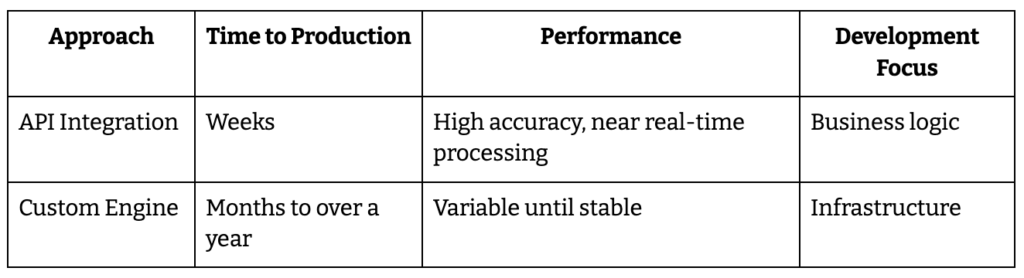
Technical efficiency advantages of ICHRA reimbursement tracking API platforms:
Unified APIs like IDEON provide pre-built event streaming and WebSocket infrastructure, automated error handling with retry mechanisms, built-in load balancing and horizontal scaling, plus real-time monitoring and performance analytics – all production-ready.
Development resource optimization:
Your team focuses on business logic instead of infrastructure complexity. You leverage battle-tested streaming architectures rather than debugging distributed system issues. Iteration cycles accelerate because the foundation just works.
Platforms using unified ICHRA reimbursement tracking APIs dramatically reduce engineering resource consumption and ship features faster.
Core Components of a Real-Time ICHRA Reimbursement Tracking Engine
Event Processing Pipeline
Stream processing handles real-time eligibility checks as claims arrive. Message queuing orchestrates claim validation workflows across multiple services. Event sourcing captures every state change for complete audit trail compliance. Dead letter queues isolate errors for recovery without blocking processing.
Status Update System
WebSocket connections deliver instant notifications to connected clients. Server-sent events push real-time updates to browser-based dashboards. Webhook delivery integrates with third-party systems automatically. Push notification services alert mobile users when claim status changes.
Audit Logging Infrastructure
Immutable event logs use cryptographic hashing to prevent tampering. Structured logging with JSON formatting enables fast indexing and queries. Compliance-ready data retention and archival policies meet regulatory requirements. Real-time log streaming feeds monitoring and analytics systems.
API Layer Architecture
RESTful endpoints handle synchronous operations like claim submission. GraphQL subscriptions enable real-time data queries for dashboards. Rate limiting and throttling protect against overload. Authentication and authorization secure every access point.
Data Persistence Layer
Event stores track reimbursement state changes immutably. Time-series databases capture performance metrics for analysis. Document stores handle flexible claim data structures. Relational databases ensure transactional consistency for financial data.
How to Integrate APIs for Real-Time ICHRA Reimbursement Processing
API Integration Architecture Patterns
Event-driven integration with webhook subscriptions notifies your system instantly when claim status changes. Real-time streaming via WebSocket connections keeps dashboards synchronized. Polling-based synchronization handles batch processing for historical data. Hybrid push-pull models optimize performance based on data freshness requirements.
Implementation Timeline
- Phase 1: API authentication setup and endpoint testing
- Phase 2: Event subscription and webhook configuration
- Phase 3: Real-time processing workflow implementation
- Phase 4: Performance optimization and production deployment
Most teams complete API integration in weeks rather than the months or years required for custom engine development.
Real-time status subscription example:
javascript
// WebSocket connection for real-time reimbursement updates
const ws = new WebSocket(‘wss://api.provider.com/reimbursements/stream’);
ws.on(‘message’, (data) => {
const update = JSON.parse(data);
updateReimbursementStatus(update.employeeId, update.status);
triggerClientNotification(update);
});
ws.on(‘error’, (error) => {
console.error(‘WebSocket error:’, error);
scheduleReconnection();
});
Platforms leveraging unified APIs like IDEON eliminate custom WebSocket management and get production-ready streaming rapidly.
Building Status Update Systems and Audit Logs
Real-Time Status Update Architecture
Event-driven status propagation broadcasts changes to all connected clients instantly. WebSocket connection management includes automatic failover and reconnection handling. Status caching improves response times for frequently accessed claims. Conflict resolution handles concurrent status updates from multiple sources.
Comprehensive Audit Logging Implementation
Every reimbursement state change gets logged automatically. Structured JSON format with standardized fields enables fast queries. Immutable append-only storage with tamper detection satisfies compliance requirements. Real-time indexing with Elasticsearch powers fast audit trail queries.
Audit log data structure:
json
{
“timestamp”: “2025-01-15T10:30:00Z”,
“eventType”: “reimbursement_approved”,
“employeeId”: “emp_12345”,
“amount”: 450.00,
“source”: “eligibility_engine”,
“metadata”: {
“planId”: “plan_789”,
“processedBy”: “system_auto”
}
}
Compliance and retrieval features:
Fast audit trail queries by employee, date range, or event type satisfy auditor requests instantly. Automated compliance reporting generation eliminates manual work. Data retention policies match regulatory requirements automatically.
Performance Optimization for Real-Time Reimbursement Engines
Real-Time Processing Optimizations
Redis caching dramatically reduces database load for frequently accessed eligibility data. Database connection pooling and read replicas handle high query volumes. Kafka or RabbitMQ message queuing ensures reliable event processing. Load balancing distributes processing across multiple instances.
Scalability Patterns
Horizontal pod autoscaling adjusts capacity based on queue depth automatically. Database sharding handles high-volume transaction processing. CDN integration accelerates static resource delivery. Geographic distribution reduces latency for national employers.
Monitoring and Performance Metrics
Track real-time processing latency to catch slowdowns before users complain. Monitor event queue depth and processing throughput. Watch WebSocket connection health and reconnection rates. Alert on API response times and error rate spikes.
Performance benchmarks: Near real-time status updates, enterprise-grade uptime SLAs, support for high-volume concurrent processing during peak enrollment periods.
Production Deployment and Monitoring Strategies
Deployment Architecture
Docker containerization with Kubernetes orchestration enables flexible scaling. Blue-green deployment delivers zero-downtime updates for production systems. Environment isolation separates staging and production configurations. Secret management encrypts API keys and database credentials.
Monitoring and Observability
Real-time performance dashboards track system health. Automated alerting notifies teams of system failures instantly. Centralized logging with structured search enables fast troubleshooting. Health checks verify system status automatically.
Production Readiness Checklist
- ☑ Load testing completed with expected traffic volumes
- ☑ Monitoring and alerting systems configured
- ☑ Backup and recovery procedures tested
- ☑ Security audit and penetration testing completed
Common Implementation Challenges and Solutions
Real-Time Processing Challenges
Event ordering: Use timestamps and sequence numbers for deterministic ordering. Duplicate handling: Implement idempotent processing with unique request IDs. Connection management: Automatic reconnection with exponential backoff prevents thundering herd. Data consistency: Event sourcing with CQRS patterns maintains accuracy.
Performance Bottlenecks
Database locks: Optimize queries and use appropriate isolation levels. Memory leaks: Regular profiling and garbage collection tuning. Network latency: Connection pooling and geographic distribution. Queue overflow: Auto-scaling and dead letter queue handling.
Security and Compliance
OAuth 2.0 and JWT tokens secure API authentication. Encryption protects data in transit and at rest. HIPAA-compliant audit logging and data handling satisfy regulatory requirements. Regular security assessments catch vulnerabilities early.
Conclusion: Ship Real-Time Tracking That Scales
Real-time ICHRA reimbursement tracking engines are critical infrastructure for competitive platforms. The choice between custom development and API integration determines speed to market and system reliability.
Success factors: near real-time processing capability, comprehensive audit trails, and production-ready scalability from day one. Unified APIs like IDEON deliver all three without the extended development cycles required for custom builds.
Will your reimbursement tracking engine deliver near real-time updates and comprehensive audit trails from day one, or will you spend months building what already exists?
FAQs on Building ICHRA Reimbursement Tracking Engines
What are the core components of a real-time reimbursement tracking engine?
Event processing pipelines, status update systems, audit logging infrastructure, API layers, and data persistence – all working together for instant claim processing and status propagation.
How do you implement real-time status updates and notifications?
WebSocket connections for instant client updates, server-sent events for browsers, webhooks for third-party systems, and push notifications for mobile apps deliver real-time status across all channels.
What’s the best approach for audit logging and compliance tracking?
Immutable event logs with structured JSON formatting, real-time indexing for fast queries, automated retention policies, and cryptographic hashing for tamper detection satisfy regulatory requirements.
How do you optimize performance for high-volume processing?
Redis caching, database connection pooling, message queue systems like Kafka, horizontal autoscaling, and geographic distribution keep processing fast under load.
Should you build custom or integrate existing API infrastructure?
Unified ICHRA reimbursement tracking APIs cut development time significantly, provide battle-tested infrastructure, and let teams focus on business logic instead of distributed systems complexity. Custom builds take substantially longer and require ongoing maintenance of complex infrastructure.