Ideon Releases 2026 ICHRA Map

Explore which states and counties are primed for ICHRA adoption

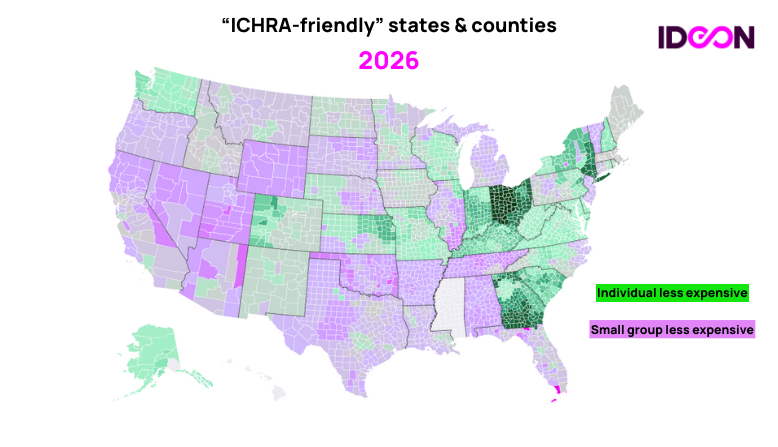
The 2026 ICHRA Map is here! (View the interactive tool)


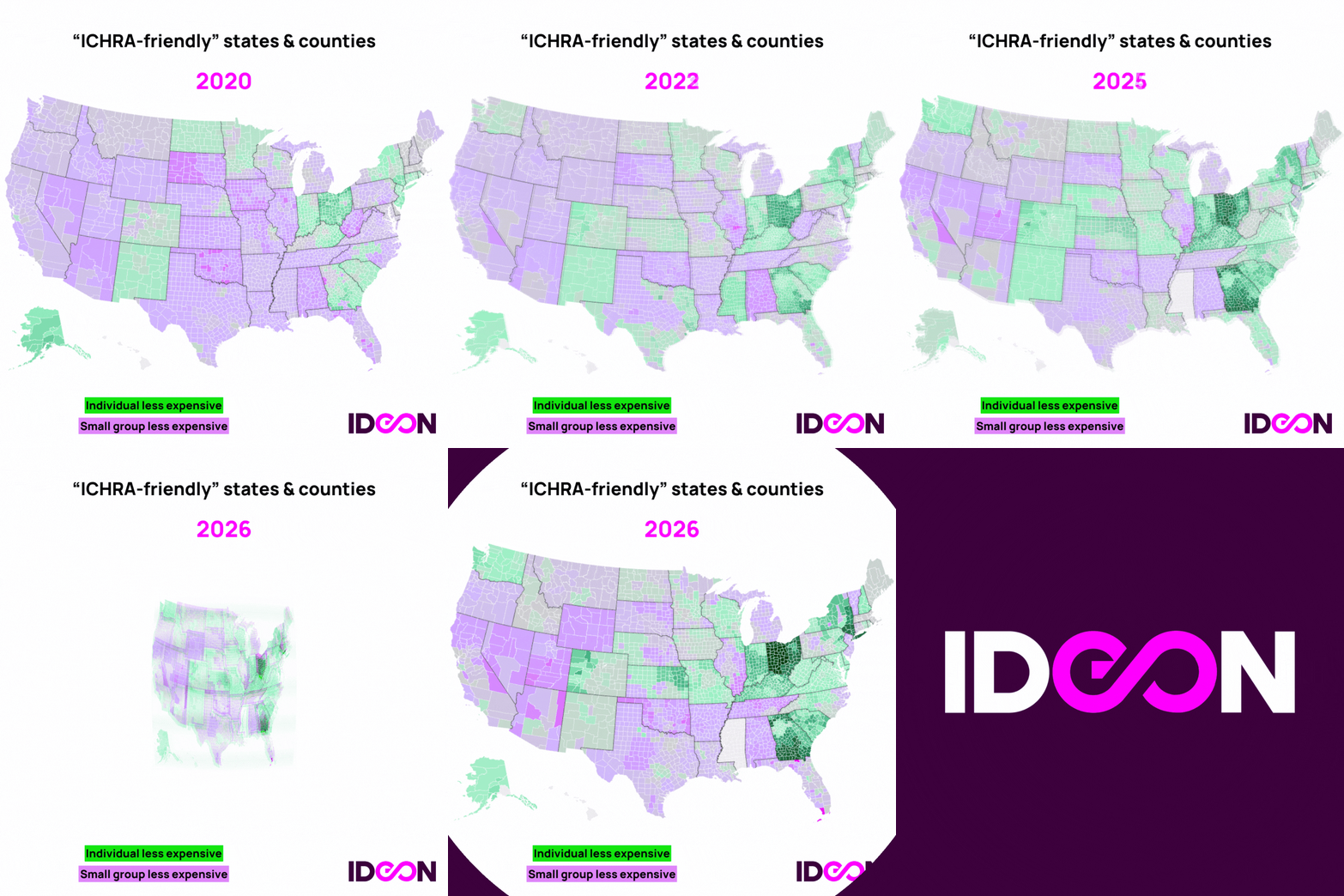
Each year, Ideon’s ICHRA map tracks where individual market premiums are lower than (or equal to) small-group premiums — a key signal of ICHRA viability across the U.S. And for 2026, the landscape is shifting:

2025 → 2026 market snapshot

Number of states where the lowest-cost individual plans ≤ small-group, by metal level:

  • 🥉 Bronze: 30 → 25
  • 🥈 Silver: 21 → 18
  • 🥇 Gold: 21 → 17

Percentage of counties where the lowest-cost individual plans ≤ small-group, by metal level:

  • 🥉 Bronze: 59.9% → 54.0%
  • 🥈 Silver: 49.9% → 43.9%
  • 🥇 Gold: 50.6% → 42.0%

But it’s not all about premiums…

ICHRA adoption continues to grow as employers lean into choice, portability, and personalized benefits — especially in markets where individual coverage remains strong or where off-exchange plan options offset cost trends. And despite premium fluctuations, the ICHRA ecosystem continues to accelerate at a record pace:

  • 🚀 About 40 ICHRA platforms now use Ideon’s APIs to power quoting and plan selection — including 14 new platforms this year alone.
  • 📈 ICHRA quoting volume is up ~120% year over year via the IdeonQuote API.

Explore Ideon’s 2026 ICHRA map here: 2026 ICHRA Insights, powered by Ideon

How to Build an ICHRA Platform via API: A Practical Guide for 2025

The Individual Coverage Health Reimbursement Arrangement (ICHRA) market is no longer a niche experiment. Adoption jumped 34% from 2024 to 2025 among large employers, with even small businesses entering the space. That growth is fueling an explosion of new ICHRA platforms—some spun up by startups, others by established benefits and HR technology providers

But here’s the fork in the road: Do you spend 12–18 months building from scratch, hiring engineers, and wrangling carrier integrations? Or do you stand up your platform in weeks by leveraging existing API infrastructure?

This guide will show why API-driven infrastructure is the more scalable path to building an ICHRA platform—and how to think about the functional blocks every platform must deliver.

ICHRA Platform Fundamentals

Every ICHRA platform needs to deliver several essential capabilities, regardless of whether it’s been created from scratch or is powered by APIs. Those elements are:

1. The Employer Experience

This is the front door for companies offering ICHRAs. Employers need to:

  • Create employee classes & allowances: Segment workers by compliant criteria (age, geography, job type) and set contribution levels.
  • Design the ICHRA benefit: Decide how much funding employees receive and whether to vary contributions across classes.
  • Stay compliant: Ensure affordability rules are applied correctly and reporting requirements are met.
  • Simplify setup & admin: Integrate with payroll and HR systems, reduce manual data entry, and generate transparent reports on allowances and payments.

2. The Employee Experience

For employees, the platform must feel intuitive and empowering. At its core, this means:

  • Plan discovery & comparison: Access to on-exchange and off-exchange individual plans across carriers, normalized into apples-to-apples comparisons.
  • Decision support: Tools, filters, or even AI-powered guidance that helps employees choose the right plan based on budget and coverage of doctors and prescriptions.
  • Frictionless enrollment and payments: Seamless submission of applications to carriers, with real-time status updates, as well as easy premium payment processing.
  • Ongoing support: From concierge services to clear visibility into premium payments, employees want confidence that they’re covered.

3. The Infrastructure Behind the Scenes

The polished experiences for employers and employees are only possible because of the infrastructure humming in the background. A strong ICHRA platform needs:

  • Real-time plan design data: Always-current rates, benefits, and contribution structures for individual market health plans—normalized and refreshed automatically so employers and employees can trust what they see.
  • Accurate provider data: Comprehensive, standardized details on doctors, specialties, and networks to ensure employees know which plans cover their preferred providers.
  • Enrollment connectivity: Carrier integrations that automatically submit applications, validate eligibility, and confirm enrollment without manual file transfers.
  • Payment automation: Built-in tools that route and reconcile premium payments to carriers on time, with full transparency and auditability.
  • Security and reliability: Enterprise-grade infrastructure with SOC 2 certification, HIPAA compliance, and the scalability to handle open enrollment surges without downtime.

These layers together define a complete ICHRA platform. The employer and employee experiences differentiate the front end. But it’s the infrastructure that makes them actually work.

Why APIs Matter

Building benefits software the old way meant relying on manual data collection and batch file processing. This made platform development challenging, and created delays and inconsistencies that could leave employees without coverage during critical moments.

But in the ICHRA space, most leading platforms have developed core functionality using pre-existing APIs. These ICHRA platforms process data in real-time, offering instant eligibility verification, immediate plan quotes, and a smooth enrollment experience. They handle thousands of requests concurrently and cut the risk of an employee being unable to access their benefits when they need them most.

Key API Components for ICHRA Platforms

Every ICHRA platform relies on a set of core building blocks. These APIs do the heavy lifting behind the scenes, turning complex data into a smooth experience for employers and employees.

Health Plan Data Normalization

Carriers deliver plan data in dozens of formats. An effective ICHRA platform must unify this into a single, consistent model, ensuring that employers and employees always see accurate, comparable rates and benefits.

The API value: APIs normalize messy carrier data automatically, so your platform can deliver clean plan comparisons without maintaining hundreds of custom mappings.

Real-time Eligibility Engine

ICHRA rules are complicated and change every year. An eligibility engine applies affordability rules, employee class rules, and ACA requirements automatically, handling scenarios like mid-month employee changes, COBRA transitions, and other complexities. The system has to account for carrier-specific eligibility requirements that vary between states too.

The API Value: APIs keep your platform compliant out of the box, saving months of development time and ensuring your customers always have up-to-date eligibility and affordability calculations.

Premium and Subsidy Calculator

ACA affordability calculations involve complex math, and they change annually. The calculator must process household income, apply federal poverty level thresholds, and account for geographic variations in pricing to ensure employers meet contribution requirements.

The API Value: APIs like Ideon’s calculate the minimum employer contribution in real time, applying FPL thresholds and returning both employer- and member-level results.

Carrier and Marketplace Connectivity

Submitting employee plan elections to insurance carriers is one of the hardest parts of ICHRA administration. Without APIs, it means manual data entry and file transfers. Where possible, modern platforms rely on automated carrier integrations that handle applications, eligibility checks, and enrollment confirmations.

The API Value: APIs give you advanced, plug-and-play connections to multiple carriers, eliminating the need to build and maintain integrations yourself.

Payment Processing

Moving premium dollars from employees to carriers is complex and high-stakes. Payment APIs automate these flows, reconcile transactions, and provide full visibility into payment status.

The API Value: APIs automate payments at scale, reduce errors, and give your platform transparent auditability—without custom payment rails or manual reconciliation.

Data Validation

ICHRA platforms rely on accurate plan, provider, and enrollment data. Without strong validation and monitoring, errors can lead to employees enrolling in the wrong plan, payments being misapplied, or employers making non-compliant contributions.

The API Value: The best APIs enforce accuracy at every step—validating carrier data and enrollment submissions, and surfacing real-time error visibility. This ensures your platform delivers clean data and builds trust with employers and employees.

Build vs Buy: Finding the Right Balance

The reality is that most ICHRA platforms take a hybrid approach—building in areas where they want to differentiate and relying on pre-existing APIs where efficiency and scale matter most. The key is knowing where to invest engineering resources versus where to leverage proven infrastructure.

Here’s the trade-off: 67% of software projects fail due to poor buy/build decisions. And the cost isn’t just in dollars—a company that spends 18 months building core ICHRA capabilities from scratch also loses 18 months of growth in a market expanding at 30% year over year.

Factor Build In-House Use API Platform
Time-to-Market 12-18 months of development 6-12 weeks of integration work
Up-Front Cost $200,000+ in engineering Usage-based pricing
Ongoing Maintenance Continuous data updates, bug fixes, and carrier relations Managed by the API provider
Carrier Coverage Ingest data from each carrier individually; manually handle enrollment submissions 300+ carriers via one integration
Development Resources Product leader and several developers for 12+ months Small integration team for 1-3 months
Scalability Each new carrier and function requires additional builds Add carriers and capabilities with no incremental effort
Data Accuracy Must build carrier-specific validations for plan data and enrollments Automated validation of all data and real-time visibility into errors

While building from scratch offers control, API-driven solutions offer a much better balance of efficiency and resource allocation—while freeing your team to focus on the parts of the platform that truly differentiate.

How Ideon Accelerates Your ICHRA Roadmap

Recent customer implementations have shown the speed and efficiency gains that come with IDEON, with organizations launching their ICHRA platforms in 6-12 weeks compared to the 12-18 month timeline typically required for building the same capabilities internally.

Here’s how:

Single API Covering All Functional Blocks

IDEON’s comprehensive API eliminates the need to build and maintain dozens of individual carrier integrations. A single connection gives access to plan information, eligibility verification, enrollment and payment connections, and more.

Built-in Affordability Calculator

With an integrated, pre-configured ACA affordability calculator API that automatically updates with regulation changes, IDEON helps you build tools to ensure employers offer ICHRA-compliant contributions and plans.

Enterprise-grade Security

All data processing happens within IDEON’s SOC 2 Type II certified and HITRUST-certified infrastructure, removing risk and giving ICHRA platforms the confidence to leverage a third-party API.

Developer Resources for Rapid Implementation

IDEON offers comprehensive developer documentation, sandbox environments, and technical support, allowing teams to build proof-of-concept implementations in days rather than months.

Implementation Checklist

To successfully build your ICHRA system with IDEON, follow this checklist:

  1. Secure API access and Sandbox Environment: Request API credentials and access the developer sandbox. Here you’ll find test data that allows experimentation without risk.
  2. Map Employee Census to API Endpoints: Connect your HRIS fields (employee ID, job type, ZIP code, salary) to Ideon’s standardized endpoints. This enables accurate rating area, class, and allowance assignments.
  3. Integrate Plan Options Feed: Pull in real-time plan and rate data across carriers so employees can compare options with confidence.
  4. Test Affordability Outputs vs Sample Cases: Ensure your platform applies ACA rules correctly by running tests, especially edge cases like part-time workers and mid-year changes.
  5. Configure Employee Classes and Allowances: Set up segmentation rules using class management tools. Define allowances by employee type, geography, or other criteria that align with your ICHRA strategy.
  6. Review enrollment and payment workflows: Study IDEON’s documentation for enrollment submissions and premium payment processing. Plan how these workflows will fit into your platform’s user experience and operational model.
  7. Go Live, Monitor, and Iterate: Launch your platform, but remember to monitor and log to track performance. Use analytics tools to find opportunities to optimize and ensure better experiences.

Conclusion and Next Steps

API-first approaches, like those you get with IDEON, allow companies to offer timely access to ICHRA benefits while leveraging proven, compliant infrastructure. Rather than spending 12-18 months building, your team can focus on offering unique value propositions that mark your platform out in a rapidly expanding market.

The choice is yours: spend over a year wrestling with carrier integrations and compliance requirements, or launch your ICHRA platform in weeks with battle-tested infrastructure that scales with your business.

FAQs on Building ICHRA Platforms Through APIs

Q: How do you build an ICHRA platform with APIs and carrier connectivity?

A: Building an ICHRA platform via API means implementing unified endpoints, real-time carrier data exchange, and normalized data models, eliminating custom integrations and manual uploads. This enables interoperability across 300+ insurance carriers with a single scalable solution.

Q: What is the IDEON ICHRA Map 2025, and how does it impact integration projects?

A: The Ideon ICHRA Map 2025 highlights the states, carriers, and markets most favorable to ICHRA adoption. For integration projects, it helps platforms and carriers prioritize where to launch first, ensuring technical efforts align with the biggest market opportunities.

Q: What is the role of the IDEON API in ICHRA administration?

A: ICHRA administration platforms use the Ideon API as a single source for carrier plan data, real-time eligibility, pricing, enrollment, and payments. It abstracts legacy complexity, supports rapid onboarding, and maintains 99.9% uptime for enterprise-grade benefits administration.

Q: What are the technical steps to set up an ICHRA platform using API-driven workflows?

A: Setting up an ICHRA platform with APIs involves configuring employer and employee data, enabling carrier and marketplace connections, and integrating health plan data, affordability calculations, enrollment, and payment endpoints. This creates a real-time, automated workflow that replaces manual file handling and accelerates platform development.

Employee Spotlight: Cory Freshour

At Ideon, we’re proud to have such a talented, diverse team leading the charge for a better and more connected health insurance and employee benefits industry. Our ongoing Employee Spotlight series showcases the people behind our product and unveils what life is like at Ideon. This month we’re featuring Cory Freshour, Sr. Director of Enrollment Operations!

Name: Cory Freshour
Department: Enrollment Operations
Title: Sr. Director of Enrollment Operations
Location: Atlanta, GA

Work

How long have you worked at Ideon?

I joined Ideon in April 2024.

Tell us about your day-to-day.

As the Senior Director of Enrollment Operations, I lead a team responsible for building and managing the enrollment data exchange between InsurTech platforms and insurance carriers. 

How have you grown professionally while on our team?

Over the past eight months, we’ve completed a team restructuring that has resulted in significant improvements and efficiency gains. The team quickly adapted to this new model and has shown remarkable resilience as we continue refining our processes and products. Leading this restructuring has been a major opportunity for personal growth and has also contributed to the growth and development of members on the Enrollment Operations team.  

What excites you about the future of Ideon?

Better Data. Better Benefits. I’m excited about the future of Ideon because we have the opportunity to drive meaningful change in an industry that still faces challenges in accuracy and member experience. By leveraging better data, we can improve benefits delivery and ensure members have the coverage they need when it matters most. 

What do you like about Ideon’s company culture?

I appreciate the thoughtfulness and intentionality that everyone at Ideon brings to their work. The team stays focused on the bigger picture, even when it means taking the more challenging path to achieve our goals. 

What attracted you to Ideon’s mission?

I’ve seen firsthand how impactful issues with benefits data exchange can be—whether it’s incomplete EOI forms that result in policies not being in place when families depend on them, or inactive medical coverage at a critical time for members. We have to do better, and Ideon is on a mission to make that change. 

Life

Favorite activity when you’re not working? 

My favorite activity outside of work is waterskiing, particularly barefoot waterskiing. I’m also enjoying the process of teaching my 6-year-old daughter, Meadow, and 8-year-old son, Dash, how to waterski. 

Favorite place you’ve traveled?

Telluride, CO. Snowboarding is another hobby.  

Interesting fact about yourself?

An interesting fact about me—I’ve managed to rupture both of my Achilles tendons, but thankfully, I’ve come back stronger and healthier than ever! 😁 


Employee Spotlight: Tara Anguish

At Ideon, we’re proud to have such a talented, diverse team leading the charge for a better and more connected health insurance and employee benefits industry. Our ongoing Employee Spotlight series showcases the people behind our product and unveils what life is like at Ideon. This month we’re featuringTara Anguish, our Sr. Director, PMO!

Name: Tara Anguish
Department: Client Operations
Title: Sr. Director, PMO
Location: Upstate, NY

Work

How long have you worked at Ideon?

Almost 3.5 years.

Tell us about your day-to-day.

In addition to leading our PMO team, I get the opportunity to work with our clients, primarily for our enrollment and EOI products. This involves supporting our sales team as they finalize contracts, meeting new clients and setting them up for an amazing implementation with our team, advising clients as they make operational decisions, and bringing them live with our enrollment and EOI products. This last part is my favorite because we get to showcase the value Ideon brings in real-time!

How have you grown professionally while on our team?

Here at Ideon, I’ve been able to grow, particularly as a leader. I’m supported but given the autonomy to use my experience and expertise to make decisions, including making process and efficiency changes.

What excites you about the future of Ideon?

I’m excited to meet and work with more and more companies as they join our portfolio and see for themselves the value that Ideon brings. The health and benefits industry—particularly the enrollments and EOI realms—doesn’t have to be as difficult as it is now, and the team at Ideon can help. It’s exciting to be working with people and products that serve an industry in need with expertise.

What do you like about Ideon’s company culture?

Our leadership is thoughtful and cares about the personal development of each person on the team—so much so that this is one of the few cultures I’ve seen exude psychological safety. We support each other but also challenge each other in a really healthy way. We’re allowed to fail but encouraged to be stretched, learn, and grow. We’re all dedicated to making improvements in an industry that needs it—and that impacts us all. We feel connected to our mission every day.

Life

Favorite activity when you’re not working? 

Spending time with my family, which includes my husband and 3 kiddos. They are involved in lots of sports which makes life outside of work busy and full. They are growing into great humans!

Favorite place you’ve traveled?

Salamanca, Spain—I was lucky enough to partake in a full immersion study abroad summer program.

Interesting fact about yourself?

Less than 1% of the world’s population has heterochromia, and I’m one of them (left eye is blue, right eye is brown). This didn’t get passed down to any of my kiddosperhaps my potential grandchildren??? 


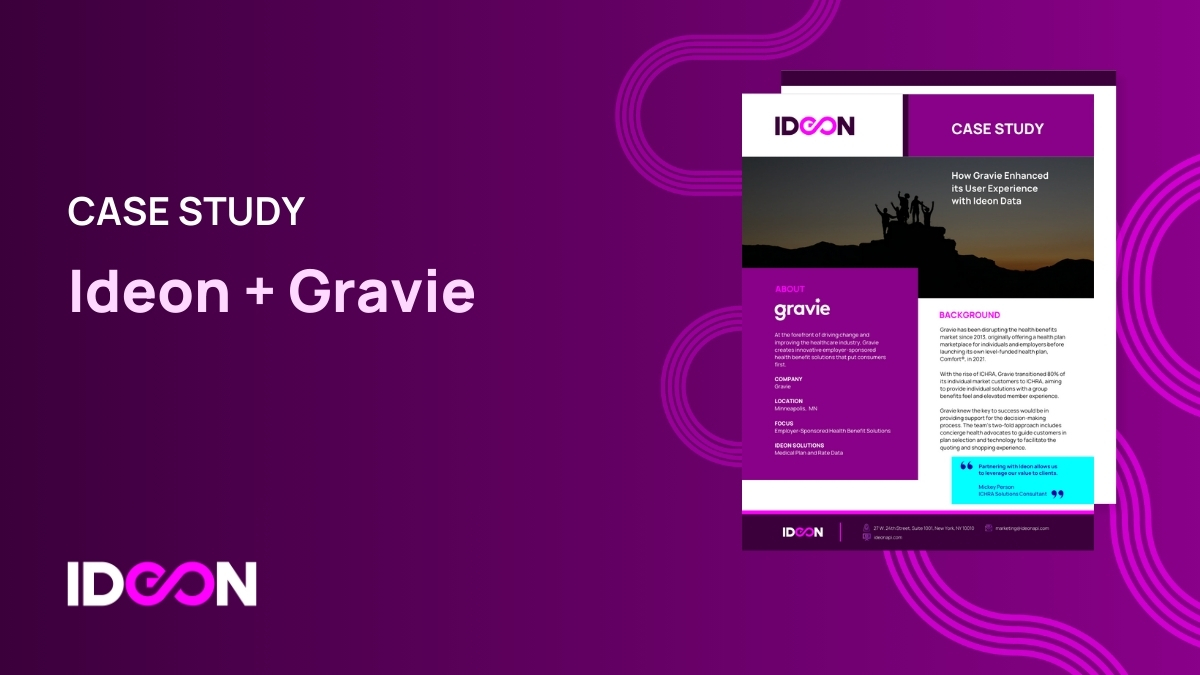
How Gravie Enhanced its User Experience with Ideon Data

Learn how Ideon powers Gravie’s ICHRA experience with accurate and timely data, helping people find a health insurance plan that meets their needs.

Click here to view as a PDF.

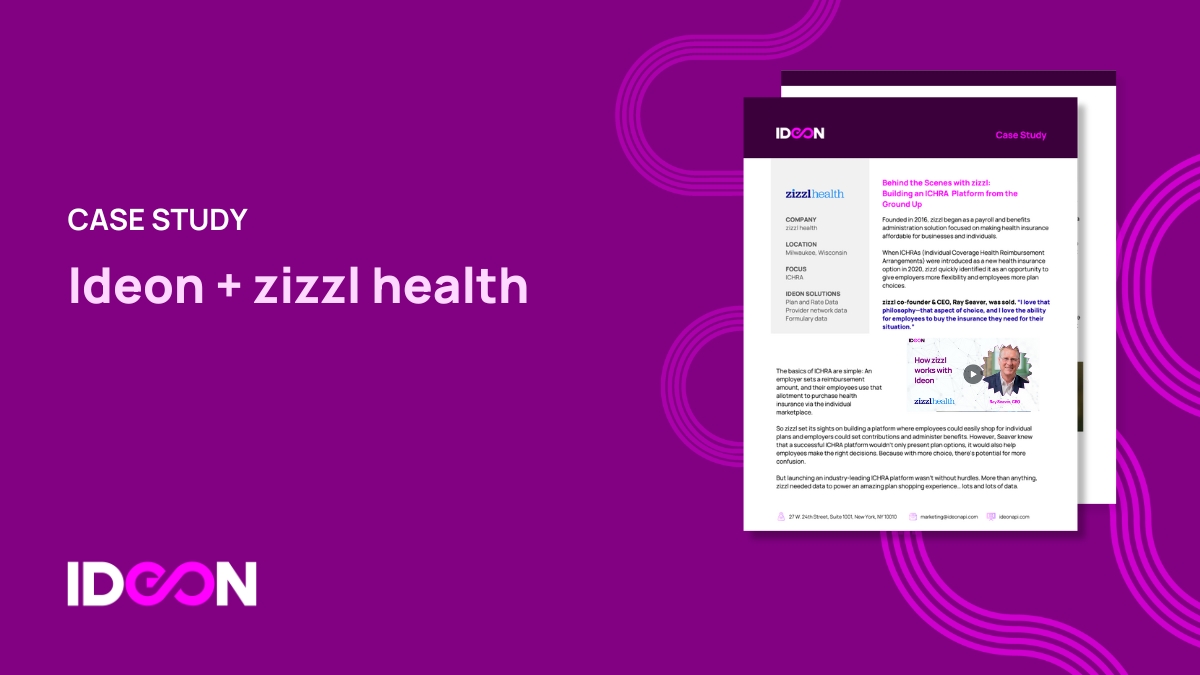
zizzl health’s Story: Developing the ultimate ICHRA experience with Ideon

Learn how Zizzl enhanced its ICHRA experience with Ideon’s data solutions. Click between the pages and see what Ray Seaver, Zizzl’s co-founder and CEO, has to say about innovating with Ideon and Zizzl’s core features!


Click here to view as a PDF.

Webinar: Ask Dan Anything

Want to learn more about how Ideon works? From the ultra-technical to the more thematic, Ideon CTO Dan Langevin answers it all in this ’Ask Me Anything” session.

API connectivity and the bentech ecosystem: A Q&A with Sun Life’s Ted Phillips

By Zach Wallens, Director of Content and Communications, Ideon

The HR and benefits technology (bentech) ecosystem has exploded in recent years, with billions in venture capital investment driving innovation and new players in the space.

That’s left insurance carriers with a strategic and technology challenge: how do we partner and connect with dozens of bentechs, ensuring brokers and members have a great experience across the platforms they use today?

Ted Phillips, Sun Life’s AVP, Distribution Digital Center of Excellence, tackles these challenges every day. Ideon spoke with Ted about Sun Life’s tech partnership strategy, the value of “enhanced” API connectivity, and their new partnership with Ideon.

 The below interview has been condensed and edited for clarity.


IDEON: What’s your role at Sun Life?

TED PHILLIPS: I lead a team that’s responsible for the strategy and execution of our benefits technology (bentech) platform partnerships. We’re looking to create new partnerships, bring them to market, and grow premium through these relationships. Through Sun Life Link, we work with our accelerator team on building out API connectivity, and our data operations team, which takes the connectivity we build and operationalizes it.

Our ultimate objective is to make benefits easier to manage — to remove headaches that are often felt in managing ancillary products. We want to streamline benefits administration, billing, and everything in between.


How has your partnership strategy evolved recently?

We’ve transformed our partnership strategy for three reasons: First, there’s an expectation now—among members, brokers, and employers—that technology works seamlessly. It’s incumbent upon Sun Life to make sure the benefits experience is great for everyone and that we meet their expectations.

Second, technology has advanced quite dramatically over the past 2-3 years. APIs and enhanced connectivity are the hot topics of today. Most of the bentech ecosystem are working toward some level of enhanced API connectivity.

Third, the bentech ecosystem is far more complex and nuanced than a few years ago. Before, there were benefits administration platforms (BenAdmins), but now there are many more layers and segments within our ecosystem: HCM, proposal tools, quote-to-enroll, broker tech, resellers, and more.


What does that complexity mean for your team?

In 2019, the global investment in HR tech was $5B. In 2020, it was $17B. What that creates is a whole host of companies that are extremely valuable, like Ideon, and others that are just getting their idea off the ground. For us, the challenge is making the right decisions on which bentech platforms to partner with.

We’re always evaluating two things: which segments of the ecosystem do we want to work with, and how can we connect with them? Sun Life can’t take in every connection request we receive from bentech platforms. Middleware like Ideon allows us to multiply our team’s impact by increasing the number of platforms we can connect to.


Sun Life recently partnered with Ideon to enhance your data exchange capabilities with bentech platforms. How does better connectivity affect your clients?

It’s all about making benefits easier. APIs and enhanced connectivity enable us to streamline eligibility, benefits administration, enrollment, etc., and that saves hundreds of hours for our brokers and clients.

We find that when employer groups are on platforms, especially those with which we have enhanced connections, they have access to more Sun Life products and better benefits education experiences.  Also, with better connectivity, the enrollment and administration process is faster and more accurate, leading to fewer claims and billing issues.


Let’s talk more about that. How do APIs improve data accuracy?

Technology, including APIs and enhanced connectivity, allows us to identify errors and correct them before they become significant client issues.

It starts with making sure benefits products are set up correctly on platforms. We then use APIs to ensure enrollment eligibility is completed quickly and accurately, to make sure benefits are available when they’re needed.

As enhanced connectivity becomes commonplace, there will be tremendous value in having more accurate data connections. It’s not just about speed — accuracy is just as important.


Does this help Sun Life’s operational team, too?

Absolutely, there’s a big impact on carriers. The Ideon system creates better data accuracy — which may equate to fewer support calls, fewer billing issues, and fewer claim issues. That can have a huge effect on the industry: we’ll all be much better off if we aren’t using paper and email to solve and reconcile these data errors. With better connectivity, they might not be issues at all.


We’ve talked a lot about carrier-bentech partnerships. How else is the industry working together?

There’s beginning to be a collaborative mentality in the benefits industry. Data accuracy and data exchange are industry-wide challenges, and neither will be solved by one carrier alone.

LIMRA is a great example of industry participants and even competitors working together to solve these challenges. There’s a mentality amongst a group of individuals that we need to fix this as an industry. If we do, everyone will be better for it.


Final question: Besides API connectivity, in what other areas is Sun Life investing in technology?

Sun Life is, first and foremost, an insurance company. But we have developed proprietary technology that provides a modern client experience. Sun Life Onboard, for example, is a digitally enhanced onboarding experience. Our Benefits Explorer tool helps educate members on benefits pre-enrollment and throughout the client lifecycle.

But it’s a balance. We also need to be where our clients are. As we’ve talked about, Sun Life has invested significantly in API-powered partnerships with bentechs in the market. Ideon is a big part of that.

We don’t think of these as separate buckets — in-house vs. external investment. We look at it holistically and invest accordingly. Ultimately, we want to make benefits easier to enroll, manage, and administer, on platforms and throughout the benefits ecosystem. We do it by developing technology and through partnerships with companies like Ideon.


Interested in learning more about Ideon? Check out our API middleware solution, connect with our sales team, or subscribe to our newsletter.


Webinar: Decision Support Tools Are Modernizing the Employee Benefits Experience

Learn how leading carriers and 3rd party platforms guide employees through their benefits journey with decision support technology.

Why so many organizations still struggle with digital transformation

If your organization is more deliberate than you think ideal when adopting new technology, you can take some cold comfort in the fact that it’s hardly unique. Transitions in general—and especially those that require great investments of time, money or other resources—have been challenging for humans since, well, humans became a thing. 

And that’s very much the case when technology is involved. “All too often, selling digital transformation within large organizations is an uphill battle,” wrote Ideon CEO and co-founder Michael Levin in a recent Forbes article.

The reasons for this are many, a great deal of them explored in behavioral economics. Essentially the study of human judgment and decision making, the field encompasses a deep and growing list of cognitive biases that influence decision making. Among the most powerful are aversion to lossaversion to regret and a preference for the status quo. In short, humans are biased towards keeping things the way they’ve been (because we’ve survived so far) and are often more afraid of feeling bad about an outcome than about the bad outcome itself. That’s as true for CTOs and CFOs today as it was for hunters and gatherers of the past. For good reason, too: For most of human history, time spent on regret (say, for taking the wrong turn in a forest) meant less time to address the resultant problem (say, the bear now chasing you). 

What does all this have to do with digital transformation? More than you’d think. It makes sense that companies dependent on analog processes are hesitant to embrace digital solutions. The status quo has worked, and most significant technological transformation requires significant investment, which presents the potential for significant regret if systems go south. There’s also the misunderstood but pervasive idea that technology equals layoffs, a loss most employees seek to avoid. But one need only consider the current U.S. economy to understand the complexity of this understanding. Even as technological change continues to sweep through industry, the labor market is as tight as it has been in decades.

The health insurance and employee benefits industry is one example of how technology can transform a business even as employment grows. In what was not too long ago a very manual process, consumers today routinely use digital apps and platforms to choose and manage their health insurance and voluntary benefits. These transitions are powered by APIs—including those developed by Ideon—that power data exchange between insurers, employers, brokers, and the growing ranks of insurtech companies. The overwhelming majority of that latter category didn’t even exist a decade ago. (And they’re hiring.) Not surprisingly, a look at the health insurance and employee benefits ecosystem suggests four strategies for propelling digital change:

1. Connecting digital reform to company priorities.
This increases organizational abilities and allows them to efficiently continue working toward their goals while adapting to technological developments. 

2. Maximizing employee engagement.
Employees will instinctively feel more comfortable with the technology being used when they are a part of the decision-making. 

3. Pump priming.
Selling a particular change for a particular organization is rarely as effective as also selling the benefits of technological change, broadly. People have a harder time resisting change when confronted by statistics, research, case studies, and other evidence proving the ROI of digital transformation in their and other industries.

4. Using cognitive biases for good.
The very biases that keep people from making change can be used to spark action if inaction is framed as the more dangerous option. When we choose not to decide we have still made a choice—and that can be a source of regret, too.

Internal evangelists selling and installing digital transformation within their organizations invariably do so through a combination of the above strategies. While rarely a simple task, if done well, it’s almost invariably rewarding.

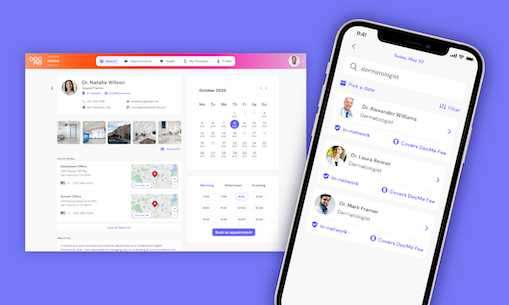
Powerful from the start: How data integrations helped DocMe launch an innovative digital health app

By Zach Wallens
Director of Content and Communications, Ideon

In this blog post, Ideon profiles one of our newest customers, DocMe, a digital health app based in New York.

It’s no secret that new technologies and companies are driving innovation in the healthcare industry. From mental health and virtual care to digital pharmacies, care navigation, and billing, digital health startups are popping up in all corners of the healthcare ecosystem.

That ecosystem, however, is getting crowded. The race for customers, funding, and publicity is more competitive than ever before.

One way to stand out? Build intuitive, data-driven user experiences powered by third-party data integrations. New York-based DocMe, a brand new digital health app, is one example of an innovation-through-integration approach, leveraging several APIs to create a powerful interface for patients and providers.

Connecting the Dots

Founded in 2021 by private equity investor Tim Gollin, the original concept for DocMe was an app to help consumers shop for doctors, comparing availability, insurance coverage, and prices for specific procedures. Of course, there are existing services, such as ZocDoc, for booking medical appointments.

Gollin quickly realized that a connected patient experience—bringing together disparate data sets within a single platform—could truly differentiate DocMe from competitors. Leveraging third-party integrations, Gollin and his developers understood, would be far more efficient than chasing down data sets and building functionality from scratch.

DocMe streamlined its development by relying on specialized companies to provide data and services it incorporated into its app. “A lot of the data and connections we would have had to build ourselves in the past we can now get from vendors,” Gollin says. “We see ourselves as stringing together little bits of Tinker Toys to build a complete product.”

Indeed, DocMe integrates third-party technology for functions like electronic health records, payments processing, video conferencing, and provider identity verification. And it incorporates multiple sources of data about providers, procedure costs, and—with data from Ideon—insurance networks.

“Ideon provides me with the ability to show consumers which doctors are in their network without them having to go to their insurance company website,” Gollin says. “Doctors don’t even know what networks they are in. We’ve heard lots of stories where people get told on the phone the doctor is in their plan only to discover it’s not. Ideon has the definitive answer.”

This tight integration between services provides patients with an easier, more intuitive experience. Some examples:

  • DocMe promises patients that they’ll never have to enter medical information history more than once. 
  • When someone makes a doctor’s appointment, they not only see available times but also the specific services offered and the price they’ll pay according to the terms of their insurance plan.
  • When a patient books an appointment, DocMe will collect the amount not covered by insurance in advance. In other words, patients get a much more transparent market.

DocMe is continuing to add features to its product, integrating data more tightly to save users time. It will use Ideon’s card scanning technology, for example, to extract patients’ network information by simply snapping a photo of their insurance cards. 

DocMe is also preparing to roll out in Brazil, Italy, France, and the United Arab Emirates. Some might ask why a small company would spread its resources across different countries, each with its own health care system. Gollin answers that the work done to build integrated capabilities and smooth user experience into DocMe already gives it an advantage in other markets. “The goofy thing is the U.S. system is super complicated,” he says. “Everyplace else is significantly simpler.”

For more information about Ideon’s APIs for digital health and InsurTech platforms, click here.

BenAdmin Platforms Beware: Three potential data quality pitfalls—and how to avoid them

By Zach Wallens, Ideon’s Communications Manager

The busy season is upon us yet again. And, yet again, health and benefits industry stakeholders are preparing for a mostly digital open-enrollment season in year two of the Covid-19 pandemic. Brokers are quoting the latest benefits products and formulating client proposals; employers are debating whether to stay the course or offer different health insurance and benefits in the coming year; and employees are familiarizing themselves with the digital tools that will guide their selections.

The focus for benefits administration (BenAdmin) platforms and other BenAdmin providers, as usual, is delivering high-level customer experiences through technology that eases the enrollment process rather than inhibits it. But given this emphasis on customer experience, there is another essential consideration for benefits technology vendors: data quality. Even the most user-friendly, feature-rich benefits software can earn a reputation as a front-end failure if data accuracy and quality are problematic during open enrollment.

The good news: BenAdmins have tools at their disposal to rectify—or, at least, minimize—data quality issues. 

The better news: BenAdmins need not rebuild their data infrastructure from the ground up to significantly improve quality. 

Rather, BenAdmins can lower their risk of data snafus by working with specialized vendors, whose solutions improve the speed and accuracy with which enrollment-related data is sent and received. With that in mind, here are three potential hazard areas that BenAdmins should keep an eye on—and how to avoid them.

1. Product-specific data

Employees need… 

  • An easy, streamlined way to review specific criteria they deem most important among the health plans offered by their employer. 
  • Confidence that they understand which plans meet their criteria, and will fit their budget. 
  • Help navigating the complexities of choosing not only health insurance, but also ancillary products (vision, dental, life and disability) that best suit their needs. 

API Middleware solutions can… 

  • Ensure data accuracy remains king, by aggregating plan and provider data directly from health plans and ancillary carriers. In doing so, they help BenAdmins maintain fidelity to their plan library and provider directory—plus the thousands of data points associated with each plan—without risking damage to employees’ health, financial well-being and goodwill. 
  • Shift the burden of data accuracy to the API vendor, enabling BenAdmins to confidently display product-specific information without fear of inadvertently misleading employees.

The Takeaway: The pathway to choosing the most appropriate health plan and ancillary benefits begins with employees having access to accurate, in-depth, comparable information about their options. Low-quality or outdated data, for example, can lead an employee into thinking that a plan covers their primary care physician, only to learn, post-enrollment, that the doctor recently dropped out-of-network. In third-party APIs, UX-focused BenAdmins have found a secret sauce for maintaining quality data. 

2. Group and member-level enrollment data

Employees need… 

  • Confidence that group and member information won’t fall prey to human error as it is manually keyed into enrollment apps. 
  • A seamless, delay-free receipt of their insurance card and, ultimately, use of their health insurance and benefits.

API Middleware solutions can… 

  • Connect carriers and BenAdmins and exchange accurate data between them (in fact, that’s their specialty). 
  • Enhance the quality of enrollment data by validating whether the submitted information meets carrier-defined business rules and other criteria, before the data even reaches the carrier. 
  • Allow BenAdmins to quickly and accurately identify and revise data issues, minimizing the chance of a lengthy enrollment delay for an employee.

The Takeaway: There will always be some risk of typos and other mistakes in enrollment data transferred from BenAdmins to carriers and benefits providers. After all, enrollment still involves some degree of human data entry. But for BenAdmins, the objective should be minimizing the amount of errors that reach carrier systems. API middleware partners can do that. 

3. Plan, class, and division mapping

Employees need… 

  • Confidence they will get enrolled in the correct plans with the correct carriers
  • BenAdmins with streamlined operations based on correct plan maps.

API Middleware solutions can… 

  • Enhance BenAdmins’ mapping capability to ensure groups and employees are enrolled in the right plans for the right coverage periods. 
  • Offer unique visibility into what’s under the hood at carriers and BenAdmins, making it easier to configure complex group setups when an employer has multiple plans, classes, and divisions.

The Takeaway: As with many things related to health insurance and benefits, what should be simple often is not. Where a group or employee may believe that they are enrolled in “Carrier PPO 123,” the carrier might identify that plan, internally, as “Carrier PPO NY ABC.” Or the same plan could have different IDs depending on the state or employee classification. This can generate massive confusion and even instances where employees or groups get enrolled in the wrong plan. Some larger businesses with numerous classes and divisions of employees might offer upwards of, say, 10 medical plans and several ancillary plans. Carrier-connectivity partners can help BenAdmin vendors relieve this pressure. 

And that’s no small thing. At a time when fully-digital, employee-facing enrollment capabilities are nearly universal, maintaining highly accurate data can be a true differentiator. Thankfully, there are partners, such as Ideon, that have considerable experience helping BenAdmins enhance their data quality without much development effort and investment.


Interested in learning more about middleware solutions? Download our guide on outsourcing carrier connectivity.