GetInsured’s Story: How Ideon saved the company time and resources—and boosted stakeholder confidence

“It’s a streamlined process when we’re working with a trusted, experienced data partner”

GetInsured powers state-based health insurance marketplaces by providing health insurance technology and customer service solutions for state governments. An important feature of the company’s offering is that consumers have the ability to shop for plans by healthcare provider, which helps individuals keep their doctors when enrolling in a new plan.

Back in the day, sourcing provider-network data was quite the headache. Says GetInsured’s director of product management, Archana Dekate:

Before Ideon we were getting our data directly from carriers or through other vendors. And each vendor had their own APIs and their own set of implementation procedures, which meant that we would have to modify our code every time to accept their data, then QA it, test it, and so on. It was time consuming; every product release would take anywhere from one to three months of setup time.

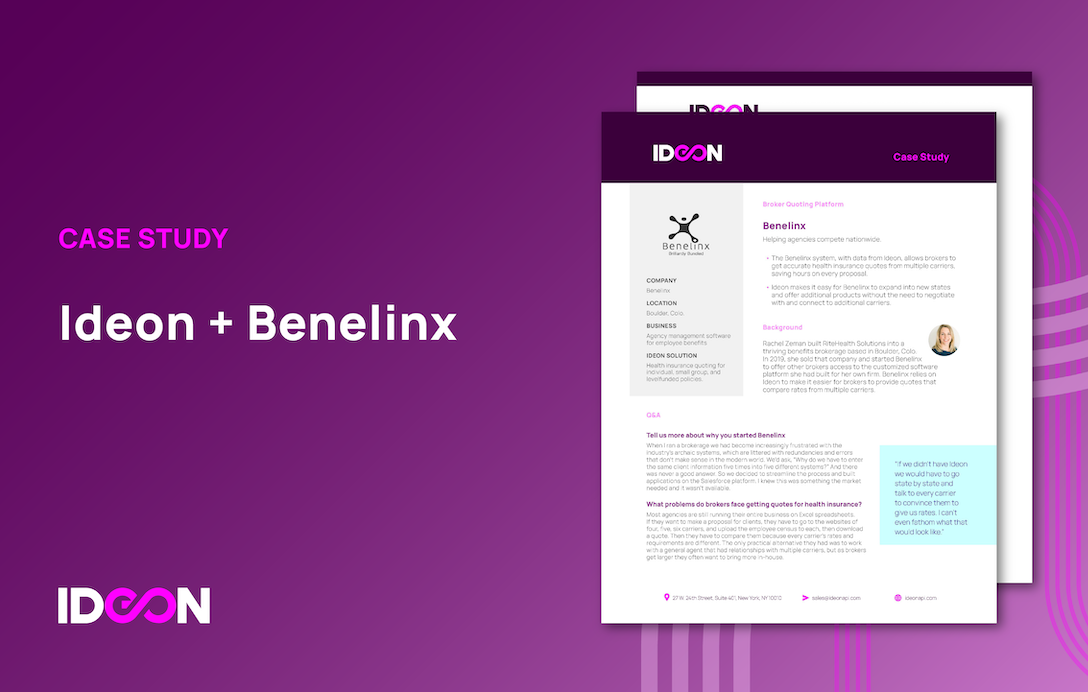
Thanks to Ideon, that’s all safely in the rearview mirror. To learn how partnering with Ideon helped GetInsured on multiple fronts, download our case study here.

DOWNLOAD

Why Our Name and Look are Changing But Our Mission Is Not

By Ideon co-founders Michael W. Levin and Dan Langevin

“What’s in a name?”

More often than not, quite a lot, especially when it comes to industry-leading technology companies.

We refer here to the API platform formerly known as Vericred, which has been powering digital experiences in health insurance and employee benefits since 2015 (give or take a few months). 

Today we announced that we’re changing our name—to Ideon—because we believe it more accurately represents our core mission and the enormity of the problem we are solving, which is more important than ever. More crucially, the name change also more accurately reflects the work we do every day to help redefine member experiences in the health insurance and benefits industry. 

You can read the official press release here, but we wanted to use this blog post to talk about our new moniker and fresh branding a bit less formally.

When we founded the company, together, a little more than seven years ago, we did so with the intention of rationalizing and simplifying the cumbersome process of verification for the credentials of medical professionals. Thus was born the name Vericred. 

Almost immediately, however, our conversations with various industry constituents led us to identify an even bigger opportunity, which we recognized as far more important: enabling great member experiences through an efficient exchange of employee benefits data in a rapidly changing health insurance ecosystem. 

Even back in 2015, consumers were growing accustomed to managing all aspects of their lives on digital apps and platforms, and it was clear to us that they would increasingly expect similarly modernized benefits experiences. That is, they would want to compare, enroll in, and manage health insurance and voluntary benefits (e.g., dental, vision, life and disability insurance, legal services, investment advice, etc.) online. And they would want those experiences to be as easy as calling an Uber or booking a flight.

But seamless digital member journeys are only possible when data can flow freely and accurately between insurers and the HR and benefits platforms used by employers, employees, and brokers. So we began the hard work of building the benefits industry’s pipes, i.e., creating the APIs that now work behind the scenes to enable a faster and more efficient flow of data, empowering our partners and customers to build top-tier customer experiences. 

Today, we are humbled to report, Ideon’s API platform is used by more than 300 carriers including MetLife, Principal, Beam, Kaiser and Guardian, and 100 HR and benefits platforms including Rippling, Gusto, Sequoia, and GoCo.

We are also humbled to report that we’ve been toying with an identity change for a couple of years, but good fortune got in the way. We’ve been growing so quickly that we struggled to find the time necessary to conduct a thoughtful naming process. In the past 12 months alone, following a $23 million Series B funding round, we’ve increased our headcount from 50 to more than 100 employees. We have likewise expanded our executive team, recruiting experienced leaders in product, engineering, customer success, marketing, and sales.  

With that growth, we felt an even greater sense of urgency to ensure that our brand—the way our company is experienced before you are ever introduced to our platform—truly reflects the ease, security, and satisfaction which we have helped our customers deliver at every step of the benefits journey since day one. We’re proud of the organization we’ve become—and the ecosystem we’re powering—and we think our new name and brand accurately reflects this achievement. 

Non-literal company names and brands can be their own kind of inkblot test, but to all of us here at Ideon (pronounced “eye-dee-ahn”) ours embodies first and foremost our role as ideator—and catalyst—for innovation in an industry that must continue to evolve. With everyone at Ideon focused intently on that goal, we know it will.

As for the second part of our new name, eons—that’s a geological term representing the largest time period. In our eyes, it’s a reference to the very real and sustainable impact we strive to make in this industry.   

So, what’s in a name?

A promise to keep ideating transformative change and propelling modernized member experiences for all.

Vericred is Now Ideon, on a Mission to Make the Employee Benefits Industry Work Better

Leading API platform unveils new name, industry vision for fast, accurate data exchange between carriers and InsurTech platforms

NEW YORK, May 18, 2022  — Vericred, the API platform powering digital experiences in health insurance and employee benefits, today announced that it has changed its name to Ideon to more closely align with the company’s mission and value proposition. The new name embodies Ideon’s role as the catalyst for innovation in an industry that is rapidly transforming to fulfill the expectations of consumers for better and faster benefits experiences.

Accustomed to managing all aspects of their lives on digital apps and platforms, most consumers now compare, enroll, and manage health insurance and ancillary benefits exclusively online. However, seamless member journeys are only possible when data can flow freely between insurers and the HR and benefits platforms used by employers, employees, and brokers. Ideon’s APIs work behind the scenes to enable the seamless flow of data, empowering amazing customer experiences throughout the employee benefits ecosystem.

“It’s never been more clear that the employee benefits industry is at an inflection point, with carriers and InsurTech platforms searching for the easiest and fastest path to digital connectivity,” said Michael W. Levin, co-founder and CEO of Ideon. “As we meet this moment, we want to boldly signal to the industry that we are the catalyst for this innovation and are contributing to our customers’ growth on a large scale. Our new name, Ideon, embodies this spirit.”

Ideon was founded in 2015 by Levin and Dan Langevin, Ideon’s CTO. Today, Ideon’s API platform is used by more than 300 carriers, including MetLife, Principal, Beam, Kaiser and Guardian; and 100 HR and benefits platforms, including Rippling, Gusto, Sequoia, and GoCo.

“It’s an exciting time for Ideon as we enter this next chapter, bringing with us a new name to better reflect our role as the central point in the employee benefits ecosystem,” added Langevin. “We are truly leading the industry as it enters a new era.”

The name change comes on the heels of rapid growth for Ideon as its APIs are increasingly in demand by carriers and InsurTech platforms. In the past 12 months, Ideon doubled employee headcount encompassing its New York City headquarters, Omaha office and remote employees across the U.S. The company also expanded its executive team to double down on its commitment to product innovation and customer growth, recently hiring Chief Growth Officer Meg Collins and Vice President of Product Meghna Misra. Other notable executive hires in the last year include Vice President of Engineering Claude Correll, Senior Vice President of Carrier Sales John Emge, Vice President of Marketing Lindsay Gerspach, and Senior Vice President of Solution Delivery Kevin Thompson. 

The name Ideon is a synthesis of “idea,” and the geological term “eon,” the largest time period. Ideon represents innovation and the evolution of an industry into a new age of data exchange — powered by the company’s platform.

About Ideon

Ideon is the way health insurance carriers and employee benefits providers connect with technology partners to deliver seamless consumer experiences at every stage of the member journey. Ideon is not the websites or apps one uses to choose a plan or find a doctor. It is the infrastructure, the ‘pipes,’ that simplify the complex exchange of quoting, enrollment, and eligibility data between carriers and the technology partners so that they can, in turn, deliver health and employee benefits to hundreds of millions of Americans everyday. Ideon’s APIs transmit billions of data points between InsurTechs and insurance carriers, powering an amazing benefits experience for all. Faster. Better. Awesomely. To learn more, please visit: www.ideonapi.com.

Webinar: Leveraging API Middleware for Carrier Connectivity

HR and BenAdmin platforms have a lot to think about these days. One top-of-mind topic: How to connect with carriers efficiently and at scale.

A People-Centric Approach to Digital Transformation in Health Insurance

By Meg Collins, Ideon’s Chief Growth Officer

By now the argument is all too familiar: Digital transformation offers a host of attractive rewards, ranging from cost savings to improved customer experience. 

That’s especially true in health insurance, an industry long dominated by established carriers skeptical of change but also being disrupted by new technology platforms reimagining benefits administration. In this rapidly evolving ecosystem, organizations that embrace digital change will inevitably emerge in a stronger competitive position.

But there’s a caveat. For digital transformation to be, well, transformative, it must be done right. 

And that’s far easier said than done. According to research by consulting giant McKinsey, the success rate of organizational transformations in general is lower than 30%. Digital refittings—which require collaboration between multiple business groups—are even tougher to make work. Just 16% of respondents to the McKinsey survey said that digital transformation efforts at their organizations “have successfully improved performance and also equipped them to sustain changes in the long term.”

There are many reasons for this, but according to Boston Consulting Group one commonality reigns supreme: The human dimension is usually most vital to the outcome of attempted digital transformations. 

In other words: Operating models, processes, and culture are at least as important to digital-transformation success as the technologies themselves. That’s certainly our experience at Ideon. With our APIs, we have successfully helped organizations in every corner of the health insurance and benefits ecosystem. But in doing so we have also observed the importance of a people-centric approach. And though every company is unique, the following four imperatives will go a long way to getting digital transformation right at any organization:

  1. Establish clear goals and governance. In planning stages, digital transformation should be attacked quasi-journalistically: What are we doing? Why are we doing this? Who is accepting ownership of this project? Where will we procure resources from? What is the sequence of events? Whether your organization seeks to replace legacy IT infrastructure or create an end-to-end customer experience, leaders should create a roadmap with quantifiable outcomes for digital transformation projects. But they must also be sure to make clear who “owns” each undertaking, instilling in each owner a clear understanding of how their work fits into the greater whole.

  2. Craft a compelling story. Many of the strongest reasons for dramatic change make for an uninspiring or anxiety-causing narrative. This is notably so with digital transformation, which many employees interpret as job-threatening. That’s why it’s crucial for leadership to craft a compelling story about where a company is headed and why wholesale change in technology and process is necessary. More often than not, that story involves improving the customer experience, but whatever the tale, it needs to be told and reinforced—via regular updates—so that all decisions can be easily understood as part of a meaningful journey.

  3. Assemble a complete team. Yes, having tech-savvy and tech-embracing people on transition teams is crucial. And yes, it’s important to include leaders from across an organization. But it’s also crucial to involve employees of all ranks and personality types wherever possible in planning and execution. First, because wholesale change inevitably impacts employees and workflows at all levels. But also because inclusion builds buy-in, increasing the likelihood that changing priorities, shifting tactics, and other crucial information is widely disseminated. Nothing increases mistrust more than actual or perceived secrecy, and an inclusive transition team helps avoid that reality or perception. Finally, building a transformation team that accounts for personality types and roles lessens the likelihood that this extremely important endeavor will be derailed by unhealthy (and all-too-common) group dynamics

  4. Encourage input. Digital transformation is usually messy and rarely without challenges. As a result, it’s important to provide all employees with a mechanism to comment on or contribute to transformation planning or execution in (relatively) real time. This fosters a valuable sense of ownership and investment, which helps to avoid internal resistance (a common-enough phenomenon that it has a name: “blocking”) and also overcome the inevitable glitches or missteps.

Digital transformation is almost always a momentous undertaking, but it need not be intimidating. Organizations that succeed in keeping people and culture top of mind are already halfway to meaningful change. We know this at Ideon, because we see it happen every day with our customers and partners. We can’t enable your entire transformation, but when it comes to revamping your digital connectivity strategy, Ideon is happy to help. Contact us to learn more!


Powerful from the start: How data integrations helped DocMe launch an innovative digital health app

By Zach Wallens
Director of Content and Communications, Ideon

In this blog post, Ideon profiles one of our newest customers, DocMe, a digital health app based in New York.

It’s no secret that new technologies and companies are driving innovation in the healthcare industry. From mental health and virtual care to digital pharmacies, care navigation, and billing, digital health startups are popping up in all corners of the healthcare ecosystem.

That ecosystem, however, is getting crowded. The race for customers, funding, and publicity is more competitive than ever before.

One way to stand out? Build intuitive, data-driven user experiences powered by third-party data integrations. New York-based DocMe, a brand new digital health app, is one example of an innovation-through-integration approach, leveraging several APIs to create a powerful interface for patients and providers.

Connecting the Dots

Founded in 2021 by private equity investor Tim Gollin, the original concept for DocMe was an app to help consumers shop for doctors, comparing availability, insurance coverage, and prices for specific procedures. Of course, there are existing services, such as ZocDoc, for booking medical appointments.

Gollin quickly realized that a connected patient experience—bringing together disparate data sets within a single platform—could truly differentiate DocMe from competitors. Leveraging third-party integrations, Gollin and his developers understood, would be far more efficient than chasing down data sets and building functionality from scratch.

DocMe streamlined its development by relying on specialized companies to provide data and services it incorporated into its app. “A lot of the data and connections we would have had to build ourselves in the past we can now get from vendors,” Gollin says. “We see ourselves as stringing together little bits of Tinker Toys to build a complete product.”

Indeed, DocMe integrates third-party technology for functions like electronic health records, payments processing, video conferencing, and provider identity verification. And it incorporates multiple sources of data about providers, procedure costs, and—with data from Ideon—insurance networks.

“Ideon provides me with the ability to show consumers which doctors are in their network without them having to go to their insurance company website,” Gollin says. “Doctors don’t even know what networks they are in. We’ve heard lots of stories where people get told on the phone the doctor is in their plan only to discover it’s not. Ideon has the definitive answer.”

This tight integration between services provides patients with an easier, more intuitive experience. Some examples:

  • DocMe promises patients that they’ll never have to enter medical information history more than once. 
  • When someone makes a doctor’s appointment, they not only see available times but also the specific services offered and the price they’ll pay according to the terms of their insurance plan.
  • When a patient books an appointment, DocMe will collect the amount not covered by insurance in advance. In other words, patients get a much more transparent market.

DocMe is continuing to add features to its product, integrating data more tightly to save users time. It will use Ideon’s card scanning technology, for example, to extract patients’ network information by simply snapping a photo of their insurance cards. 

DocMe is also preparing to roll out in Brazil, Italy, France, and the United Arab Emirates. Some might ask why a small company would spread its resources across different countries, each with its own health care system. Gollin answers that the work done to build integrated capabilities and smooth user experience into DocMe already gives it an advantage in other markets. “The goofy thing is the U.S. system is super complicated,” he says. “Everyplace else is significantly simpler.”

For more information about Ideon’s APIs for digital health and InsurTech platforms, click here.

Employee Spotlight: Colin Crihfield

At Ideon, we’re proud to have such a talented, diverse team leading the charge for a better and more connected health insurance and employee benefits industry. Our ongoing Employee Spotlight series showcases the people behind our product and unveils what life is like at Ideon. Next up… Colin Crihfield, Product Manager.

Name: Colin Crihfield

Department: Product

Title: Product Manager

Location: New York


Work

How long have you worked at Ideon?

Seven months. I started in July of 2021.

What do you enjoy most about Ideon’s company culture?

There’s a genuinely positive atmosphere at the company. We work hard but we also have fun, which goes a long way in brightening up meetings, especially in a primarily remote working environment.

What is the best part about your job?

The collaboration across teams and willingness to help each other out is fantastic. The learning process at Ideon is endless because of the complexities inherent to our industry and our products. But I feel incredibly lucky to learn from great people every single day.

Tell us about your day-to-day on the product team?

My favorite part of product management is that no two days are the same. My days are a mix of creating innovative products and features for our customers and new internal tooling for our operations team. I also have the privilege of working with Ideon’s marketing, sales, and engineering teams to research, plan, develop, test, launch, and enhance our products.

What attracted you to Ideon’s mission?

I was drawn to Ideon for two reasons. First, the problem we’re solving is incredibly important: people need more choice, transparency, and information to make better decisions about their health insurance and benefits. Second, I wanted an opportunity to work on innovative products. We’re building API infrastructure that has never existed in our industry.

What do you find interesting about managing Ideon’s quoting and decision support (QDS) products?

Over the last five years, the team has done an amazing job establishing our QDS products as the industry leader. Still, there are avenues for us to improve and expand these products. It’s really exciting to face this challenge head-on, through creative problem-solving and analytical thinking.

Life

Favorite activity when you’re not working? 

I love to cook, but recently that has been trumped by the addition of a new furry friend to our family. Now going to the Madison Square dog park is at the top of my list. 

Favorite place you’ve traveled?

Vermont. Not the most exotic, but dirt roads, trees, and fresh air are such a welcome change from my home in NYC.

Interesting fact about yourself…. Go!

Since high school, my claim to fame has been being able to dunk a basketball. I try it out every few months to make sure I can still do it so I’m still clinging to that!


Interested in joining our team? Check out Ideon’s careers page.


The Path to Real-Time Connectivity: An API Road Map for Insurance Carriers

Asked & Answered: What group benefits carriers should know about LDEx

If you’re in the group benefits industry, you’ve probably heard the term LDEx, i.e., LIMRA Data Exchange Standards. Whether you’re actively adapting your systems to accept LDEx-formatted enrollment data or have only seen the term in passing, there’s a lot happening around this opportunity and, of course, a lot for carriers to consider.

LDEx won’t immediately solve all of our industry’s data exchange challenges, but it’s a step in the right direction. MetLife, Guardian, Sun Life, Aflac, and other industry leaders are members of the LIMRA committee tasked with developing the LDEx, reflecting its transformative potential. Some carriers, however, have a myriad of questions. 

Ideon, also a committee member, created this primer to answer basic questions about the standards and offer suggestions for leveraging them with minimal effort and expense.

What is LDEx?

The LIMRA Data Exchange (LDEx) Standards® are a set of rules—for terminology, formatting, content, and delivery—that facilitate digital communication between benefits administration (BenAdmin) platforms and insurance carriers. They are meant to replace various ad-hoc formats, such as EDI 834, for transmitting data about employee enrollment and eligibility in group benefit plans.

What are the benefits of LDEx for carriers?

If implemented broadly, LDEx will substantially reduce the complexity and expense of receiving enrollment information from BenAdmin platforms. Without LDEx, carriers typically spend weeks to months setting up and testing variations of EDI connections for each new group they enroll. If the industry uses LDEx, there will be greater consistency and accuracy throughout the integration and testing process, reducing the resources carriers must allocate to adding and managing groups.

As industry adoption increases, carriers will be able to connect more easily to benefits platforms and other insurance technology providers, dramatically improving the user experience for members who want to manage their eligibility through those platforms. 

Ultimately, brokers, HR teams, and members will find that enrolling and modifying group benefits will be faster and more accurate. In today’s competitive environment, this is a business imperative for insurance carriers. Increasingly, brokers and BenAdmin platforms are steering their group clients to insurance carriers that make the enrollment experience as easy and automated as possible, across the software they use today.

Who created LDEx?

LDEx is sponsored by LIMRA, a non-profit consulting group and trade association that works primarily with the life insurance industry. The standards were developed by a steering committee composed of 40 executives from group benefits carriers and insurance technology companies. 

What capabilities does LDEx provide?

The initial standards, released in January 2020, covered a wide range of benefits, including dental, vision, disability, critical illness, and life products. More recently, it has been expanded to include medical plans, flexible spending and health reimbursement accounts, paid family leave, and employee assistance programs.

The LDEx standard covers information about benefit enrollment, eligibility, and member changes. It also allows carriers to communicate data issues and coverage confirmations back to the BenAdmin provider.

The standards are designed to communicate transactions using structured XML files, a flat file format that’s common in the insurance industry. There are also near-term plans for LDEx to support REST APIs, which would allow for faster processing and better, automated error checking.

LIMRA is working on additional standards to support electronic communication of benefit plan designs and quotes.

What must carriers do to use LDEx?

The standards can be downloaded for free from LIMRA. Carriers must modify their existing enrollment systems to accept data in the new formats—or they can use separate data transformation software to convert each LDEx file they receive into the format their system uses. 

How can carriers ease the burden of adopting LDEx?

Although LDEx will ultimately save time and money for carriers, adopting the standards can add development expenses for carriers already spreading limited technology resources across many priorities. Some carriers, however, are finding ways to adopt LDEx without devoting resources to development.

Ideon’s middleware solution enables carriers to accept LDEx files from numerous BenAdmins, with minimal development effort and capital costs, and no need to modify their current system and format. It’s not just a quick fix—it’s a long-term strategic move to enhance your connectivity with BenAdmins and set yourself up for scalability and adaptability in the future. Ideon radically reduces the time and effort needed to set up and administer group benefits, while delivering faster and more accurate information for employers and members. Reach out to us for more information.

Asked & Answered: What benefits administration platforms should know about LDEx

If you work for an HR or benefits administration (BenAdmin) platform, you might have heard the term LDEx, i.e., LIMRA Data Exchange Standards. Whether you’re actively adapting your systems to transmit LDEx-formatted enrollment data or have only seen the term in passing, there’s a lot happening around this opportunity and, of course, a lot for you to consider.

LDEx won’t immediately solve all of our industry’s data exchange challenges, but it’s a step in the right direction. ADP, Benefitfocus, benefitexpress, Businessolver, PlanSource, Selerix, Paycom, and other industry leaders are members of the LIMRA committee tasked with developing the LDEx, reflecting its transformative potential. Some BenAdmins, however, have a myriad of questions. 

Ideon, also a committee member, created this primer to answer basic questions about the standards and offer suggestions for leveraging them with minimal effort and expense.

What is LDEx?

The LIMRA Data Exchange (LDEx) Standards® are a set of rules—for terminology, formatting, content, and delivery—that facilitate digital communication between BenAdmin platforms and group benefits carriers. They are meant to replace various ad-hoc formats, such as EDI 834, for transmitting data about employee enrollment and eligibility in group benefit plans.

What are the advantages of LDEx for HR and benefits platforms?

If implemented broadly, LDEx will substantially reduce the complexity and expense of integrating with carrier systems and sending enrollment data in carrier-specific formats.

As BenAdmins know all too well, the lack of consistency has, traditionally, caused significant operational challenges and group-onboarding delays. BenAdmins typically spend weeks to months setting up and testing carrier connections. But if both carrier and BenAdmin platform use LDEx, there will be greater uniformity and accuracy throughout the integration and testing process, reducing the resources BenAdmins must allocate to adding and managing groups.

As industry adoption increases, BenAdmins will be able to connect and transmit data to carriers more efficiently. Ultimately, brokers, HR teams, and members will find that enrolling and modifying group benefits will be faster and more accurate if their BenAdmin uses LDEx. In today’s hyper-competitive environment, this is a business imperative: BenAdmins need to make the enrollment experience as easy and automated as possible, across as many insurance carriers and product lines as possible.

Who created LDEx?

LDEx is sponsored by LIMRA, a non-profit consulting group and trade association that works primarily with the life insurance industry. The standards were developed by a steering committee composed of 40 executives from group benefits carriers and BenAdmin platforms.

What capabilities does LDEx provide?

The initial standards, released in January 2020, covered a wide range of benefits, including dental, vision, disability, critical illness, and life products. More recently, it has been expanded to include medical plans, flexible spending and health reimbursement accounts, paid family leave, and employee assistance programs.

The LDEx standard is carrier-agnostic and covers information about benefits elections, coverage changes, terminations, non-coverage demographic changes, and eligibility management. It also allows carriers to communicate data issues and coverage confirmations back to the BenAdmin provider.

The standards are designed to communicate transactions using structured XML files, a flat file format that’s common in the insurance industry. There are also near-term plans for LDEx to support for REST APIs, which allow for faster processing and better, automated error checking.

LIMRA is working on extensions to support electronic communication of benefit plan designs and quotes.

What must benefits platforms do to use LDEx?

The standards can be downloaded for free from LIMRA. In general, BenAdmins can implement them the same way they would configure their systems for any other data exchange format.

It remains to be seen how much consistency there will be among carriers adopting the LDEx standard. One cautionary tale: EDI 834. This standard remains the status quo format for most medical plans, but over time carriers have developed their own variations, so BenAdmins have had to modify and test their data formats for each dialect of the standard. 

Will carriers do the same with LDEx? Time will tell. In the meantime, there are tactics BenAdmins can implement to leverage LDEx to the fullest extent possible while leaving room to adapt if necessary.

How can benefits platforms ease the burden of adopting LDEx?

Although LDEx will ultimately save time and money for BenAdmin platforms while enabling a smoother user experience, some remain hesitant. After all, wouldn’t adopting the standard require devoting significant resources to development and testing the format—while still building and maintaining the carrier connections?

Not quite.

Ideon’s middleware solution enables benefits administration platforms to send LDEx-formatted data to any carrier, regardless of whether the carrier is set up for LDEx. Ideon handles the translation into LDEx or whatever format is best for the carrier. It’s not just a quick fix—it’s a long-term strategic move to enhance your carrier connectivity and set yourself up for scalability and adaptability in the future. Ideon radically reduces the time and effort needed to set up and administer group benefits, while delivering faster and more accurate information for employers and members.

For more information, please reach out to us here or send us an email at sales@ideonapi.com

Vericred Named to the NYC Digital Health 100

CTO Connection Podcast featuring Vericred CTO, Dan Langevin

WEBINAR: APRIL 14, 1:30 PM ET

The Care Navigation Advantage: Accurate Provider Data + Quality Scores