

Launch a White Label ICHRA Solution Fast: How APIs Power Your Branded Benefits Platform

Article Summary:

Building ICHRA functionality in-house takes 12–18 months and millions per carrier integration. White label ICHRA APIs cut that to 4–8 weeks, delivering full eligibility, premium aggregation, enrollment, compliance, and branding under your own name. Platforms, carriers, and TPAs can launch fast, scale cost-effectively, and retain complete brand control—while redirecting resources to customer experience and growth instead of backend infrastructure.

Building a benefits platform with full ICHRA functionality under your own brand used to mean one thing: a painful 12-18 month development marathon. While you’re hiring engineers and wrestling with carrier integrations, your competitors are already in market, serving customers.

In benefits technology, we sometimes use the term ‘white label’ to describe an API-driven infrastructure that disappears behind your brand — not the lighter, logo-swap definition used in other industries. It’s with that interpretation in mind for white label that this article is written.

White label ICHRA API solutions flip that entire dynamic. With the right API-driven infrastructure, benefits platforms, insurance carriers, and TPAs can launch a fully branded ICHRA offering in weeks—not years—with zero third-party visibility to end users.

This isn’t about slapping a logo on someone else’s product. It’s about leveraging proven infrastructure to build something that’s genuinely yours, faster and smarter than building from scratch.

What is a White Label ICHRA API Solution?

Think of white label ICHRA APIs like this: you get all the complex backend infrastructure—eligibility engines, carrier connections, compliance reporting—but your customers only see your brand. No “powered by” footers. No redirect URLs. No shared support desks.

It’s the difference between renting office space in a building with someone else’s name on it versus having your own building with your name on the door. Your customers interact with your platform, your support team, your branding—even though the underlying infrastructure is managed by specialists who’ve already solved the hard problems.

Who uses white label ICHRA APIs?

  • Benefits technology vendors who want to add ICHRA without rebuilding their entire platform
  • Insurance carriers looking to launch digital ICHRA offerings quickly
  • TPAs who need to scale ICHRA administration without proportional headcount increases

The key advantage: you can focus on what differentiates your business—customer experience, sales, unique features—while someone else handles the commodity infrastructure that just needs to work reliably. 

Why White Label? The Business Reality

Here’s the fork in the road every benefits platform faces: build comprehensive ICHRA infrastructure in-house, or leverage existing APIs to get to market faster.

The build-from-scratch path:

  • 12-18 months of development time
  • $1.5M+ per carrier integration
  • Ongoing maintenance and regulatory updates
  • Risk of technical debt and compliance gaps

The white label API path:

  • 4-8 weeks to market
  • Subscription-based pricing with predictable costs
  • Automated compliance and regulatory updates
  • Focus resources on customer experience and growth

But here’s what makes white label particularly compelling: you’re not sacrificing control for speed. True white label solutions give you complete brand ownership and customer relationship control. Your users never know there’s infrastructure running behind the scenes—they just experience a fast, reliable platform that happens to carry your brand.

Cost-effective scaling: Instead of building separate integrations for 300+ carriers, you get them all through one API. Instead of hiring compliance specialists, you get automated regulatory updates. Instead of building redundant infrastructure, you leverage enterprise-grade systems that are already battle-tested.

Complete Brand Control

White label means your customers interact with your brand at every touchpoint—enrollment portals, email communications, support documentation, even error messages. There’s no “powered by” language anywhere in the user experience.

This level of brand control matters because trust is everything in benefits. When an employee is choosing health coverage for their family, they need to feel confident in the platform they’re using. If they see third-party branding or get redirected to external sites, it creates friction and doubt.

What complete brand control looks like:

    • Custom URLs (yourcompany.com/benefits, not vendor.com/client-portal)
    • Branded email templates and communications
    • Your support team handling all customer interactions
    • Your logo and color scheme throughout the entire user journey
    • Direct customer relationships with no intermediary

This isn’t just about vanity—it’s about owning the customer experience end-to-end, which is critical for retention and growth in competitive benefits markets.

Focus on Your Core Strengths

Every hour your engineering team spends maintaining carrier integrations or updating compliance logic is an hour they’re not building features that differentiate your platform.

White label ICHRA APIs let you redirect those resources toward what actually moves your business forward: better user experiences, sales tools, customer success programs, and unique platform features that competitors can’t easily copy.

Resource optimization in practice:

    • Engineering focuses on front-end innovation instead of backend maintenance
    • Operations teams handle customer success instead of data reconciliation
    • Product teams build differentiating features instead of commodity infrastructure
    • Sales teams have more compelling demos because the platform actually works reliably

The companies winning in benefits technology aren’t the ones with the most impressive backend infrastructure—they’re the ones solving customer problems most effectively. White label APIs let you focus on solving those problems while someone else handles the plumbing.

Core Functional Blocks of a White Label ICHRA API

Every comprehensive ICHRA platform needs these essential components, whether built from scratch or powered by APIs:

Eligibility and Class Logic

Automatically classifies employees into ICHRA-eligible groups based on business rules, location, job type, and custom employer criteria. Handles complex scenarios like mid-year employment changes, COBRA transitions, and multi-state workforces.

Premium Aggregation and Subsidy Calculation

Collects real-time, ACA-compliant rates from hundreds of carriers and calculates individualized subsidies based on income, location, and family composition. Updates automatically as carrier rates change or regulations shift.

Enrollment and Data Sync

Powers seamless, real-time data transfer between carriers, HRIS systems, and employee portals. Eliminates manual file uploads and reduces enrollment errors through automated validation and error handling.

Compliance and Reporting

Auto-generates all required documentation—1095-C forms, PCORI filings, ACA verification—with built-in audit trails. Adapts automatically as IRS and ACA requirements evolve, reducing compliance risk.

Custom Branding and UI

Supports complete interface customization, branded communications, and custom URLs. Enables platforms to deliver consistent, organization-specific experiences without any visible third-party elements.

The integration advantage: Instead of building and maintaining each of these systems separately, white label APIs deliver all functionality through unified endpoints. One integration gives you access to enterprise-grade versions of every component.

Implementation: From API to Branded Product

Transforming a white label ICHRA API into your branded product follows a systematic process designed for speed and reliability:

Week 1: Foundation Setup

    • Generate API credentials for sandbox and production environments
    • Upload brand assets (logos, colors, typography) to establish visual consistency
    • Configure custom URLs and navigation to match your platform architecture demos because the platform actually works reliably

Week 2-3: Data Integration

    • Map your HRIS data fields to API endpoints using flexible schema design
    • Set up webhook notifications for real-time status updates and branded communications
    • Customize email and SMS templates to reflect your brand voice and design standards

Week 4-6: Testing and Refinement

    • Validate data flow accuracy and error handling across all user scenarios
    • Test branded interfaces across devices and browsers
    • Conduct security and compliance verification
    • Train support teams on new ICHRA functionality

Week 6-8: Launch and Monitor

    • Deploy to production with real-time monitoring
    • Track system performance and user engagement
    • Collect feedback and iterate on user experience
    • Scale infrastructure based on actual usage patterns

The key to successful implementation is treating it like a product launch, not just a technical integration. Your customers should experience a seamless addition to your existing platform, not a bolted-on third-party tool.

Hidden Challenges (And How to Avoid Them)

Even with white label APIs, certain challenges require careful planning:

Regulatory Compliance Evolution ICHRA regulations change annually—affordability calculations, reporting requirements, tax implications. Your API provider should handle these updates automatically, but you need to ensure your customer communications and support documentation stay current.

Multi-State Premium Data Accuracy Insurance rates vary by location and update frequently. Manual rate management becomes unmanageable at scale. Look for APIs that provide automated rate updates with quality assurance built-in.

Brand Consistency Across All Touchpoints As your platform grows and integrates with more systems, maintaining brand consistency becomes complex. Every email template, error message, and support interaction needs to reinforce your brand identity.

Security and Uptime Requirements Benefits platforms handle sensitive personal and financial data. Your API solution needs enterprise-grade security (SOC 2 Type II, HIPAA compliance) and reliability (99.9%+ uptime) from day one.

Customer Success and Change Management New ICHRA functionality means training your support team, updating help documentation, and potentially changing how customers interact with your platform. Plan for this operational impact alongside technical implementation.

Build vs. Buy: The Real Numbers

The financial case for white label ICHRA APIs becomes clear when you factor in opportunity cost and hidden expenses:

Factor Build In-House Use API Platform
Time-to-Market 12-18 months minimum 4-8 weeks
Up-Front Cost $1.5M+ per carrier integration Subscription-based pricing
Ongoing Maintenance Dedicated engineering team Handled by API provider
Regulatory Updates Internal compliance expertise required Automated updates included
Security Compliance SOC 2 and HIPAA certification costs Enterprise-grade security included
Opportunity Cost 18 months not building differentiating features Focus on core product innovation

But here’s the hidden cost that kills most build-from-scratch projects: they take so long that market conditions change before you launch. The ICHRA market is growing 34% year-over-year. Spending 18 months building infrastructure means missing 18 months of market opportunity.

How Ideon Powers Branded ICHRA Solutions

Ideon enables rapid white label ICHRA deployment through a unified API that connects 300+ insurance carriers with comprehensive compliance and enrollment capabilities.

What makes Ideon different:

    • True white label: Zero third-party branding in any user-facing element
    • Complete customization: Full control over UI, communications, and workflows
    • Enterprise security: SOC 2 Type II and HIPAA compliance built-in
    • Proven scalability: Powers platforms serving millions of employees nationwide

Real results: Benefits platforms using Ideon have launched branded ICHRA solutions in 4-6 weeks, handling open enrollment at scale without technical issues or compliance problems.

The infrastructure handles the complex backend requirements—real-time eligibility verification, automated compliance reporting, carrier connectivity—while you maintain complete control over customer experience and branding.

Implementation Checklist

Use this step-by-step checklist to ensure successful white label ICHRA deployment:

Technical Setup:

    • [ ] Generate API credentials for development and production
    • [ ] Configure authentication and secure token management
    • [ ] Set up sandbox environment for testing and stakeholder demos

Brand Configuration:

    • [ ] Upload logo files and define color schemes
    • [ ] Configure custom URLs and navigation structure
    • [ ] Customize email and SMS templates for branded communications

Data Integration:

    • [ ] Map HRIS employee data fields to API endpoints
    • [ ] Configure eligibility rules and employee classification logic
    • [ ] Set up webhook notifications for real-time status updates

Testing and Validation:

      • [ ] Test all user workflows from eligibility through enrollment
      • [ ] Validate data accuracy and error handling
      • [ ] Conduct security and compliance verification
      • [ ] Train support team on new ICHRA functionality

Launch Preparation:

      • [ ] Deploy to production with monitoring systems active
      • [ ] Establish performance benchmarks and alerting
      • [ ] Document support procedures for common user scenarios
      • [ ] Plan customer communication and feature announcement

The Bottom Line

White label ICHRA APIs solve the fundamental challenge every benefits platform faces: how to offer comprehensive ICHRA functionality without diverting engineering resources from core product development.

By leveraging proven infrastructure, you can launch branded ICHRA solutions in weeks instead of months, at a fraction of the cost and risk of building from scratch.

More importantly, you can focus your team on what actually differentiates your business—customer experience, unique features, and market growth—while someone else handles the complex but commodity infrastructure that just needs to work reliably.

The ICHRA market is expanding rapidly. The question isn’t whether you need ICHRA capabilities—it’s whether you’ll build them fast enough to capitalize on the opportunity.

FAQs on White Label ICHRA API Solutions

What is a white label ICHRA API solution and how does it work?

A white label ICHRA API solution provides complete Individual Coverage HRA functionality under your brand, with all backend infrastructure, carrier integrations, and compliance handling managed invisibly—enabling rapid deployment of branded ICHRA platforms

What does “white label” mean for benefits technology platforms?

White label means the solution operates entirely under your brand and control. No “powered by” tags, no third-party logos, no external redirects—your customers interact only with your branded platform, even though sophisticated infrastructure runs behind the scenes.

How does white label differ from co-branded or partnership solutions?

White label gives you complete brand ownership throughout the entire customer journey. Co-branded solutions display partner logos or “powered by” references, while white label solutions are indistinguishable from internally built platforms.

What are the main business advantages of using a white label ICHRA API?

White label ICHRA APIs dramatically reduce time-to-market (4-8 weeks vs. 12-18 months), eliminate upfront development costs ($1.5M+ savings per carrier), and let your team focus on customer experience and differentiation instead of commodity infrastructure.

How much does a white label ICHRA API cost compared to building internally?

White label solutions use subscription-based pricing that costs a fraction of internal development. Building carrier integrations internally requires $1.5M+ per carrier and 12-18 months of development time—white label eliminates both.

Who typically uses white label ICHRA API solutions?

Primary users include benefits technology companies, insurance carriers, TPAs, and InsurTech startups who need branded ICHRA platforms without the cost and complexity of building infrastructure from scratch.

What core features should a white label ICHRA API include?

Essential features include automated eligibility logic, real-time premium aggregation across carriers, seamless enrollment and data sync, automated compliance reporting, and complete UI customization capabilities for branded customer experiences.

What’s the implementation process for a white label ICHRA API?

Implementation typically takes 4-8 weeks and involves API setup and authentication, brand asset configuration, HRIS data mapping, custom UI development, webhook integration for notifications, and comprehensive testing before production launch.

How does white label ensure complete brand control?

White label solutions provide customizable portals, communications, URLs, and interfaces with zero third-party references. Every customer touchpoint—from eligibility checking to enrollment to support—reflects only your brand identity.

What compliance and security standards do white label ICHRA APIs meet?

Enterprise-grade white label solutions include SOC 2 Type II and HIPAA compliance, continuous security monitoring, 99.9%+ uptime guarantees, and comprehensive audit trails—eliminating the need for separate security infrastructure investment.

How are regulatory changes and premium updates handled?

Automated systems continuously monitor IRS and ACA requirement changes, update affordability calculations, and sync carrier rate changes across all 50 states—maintaining compliance and pricing accuracy without internal management overhead.

What challenges might companies face with white label ICHRA deployment?

Common challenges include maintaining brand consistency across all touchpoints, managing ongoing feature requests and customizations, ensuring seamless integration with existing platforms, and training support teams on new ICHRA functionality and workflows.
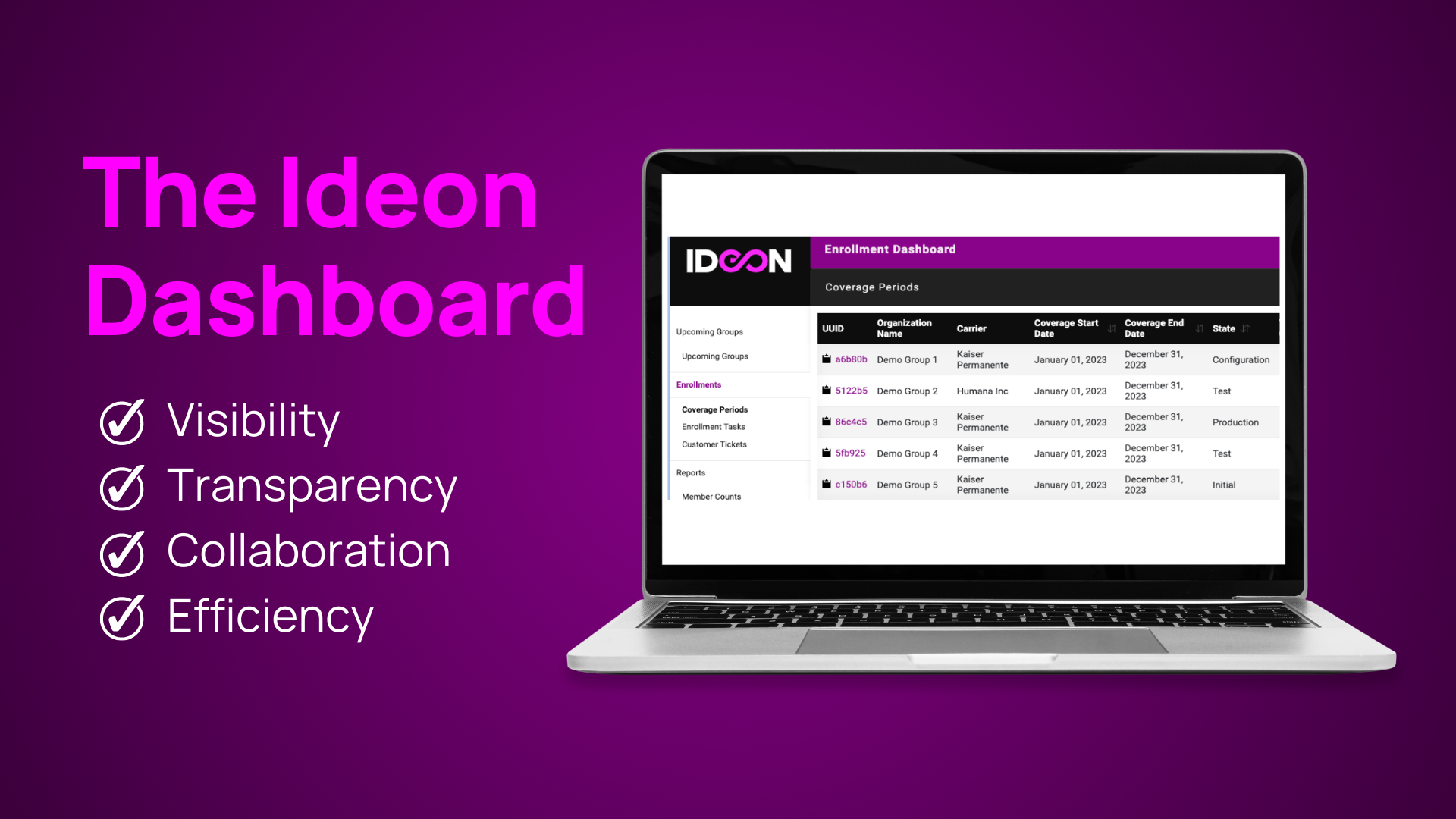
Introducing the Ideon Dashboard for real-time visibility of enrollment data

At Ideon, we’re dedicated to facilitating seamless enrollments and data exchange for our carrier and benefits platform customers. That means not only maintaining the fast, accurate, and scalable connections they expect, but also providing greater transparency and visibility—qualities that have been lacking in our industry.

That’s why we’re excited to introduce a major enhancement to our product suite: the Ideon Dashboard, a powerful new interface that compliments our existing API endpoints. With enhanced monitoring of group implementation statuses and the ability to submit, track, and resolve issues, this dashboard brings unparalleled visibility, efficiency, and collaboration to Ideon’s enrollment customers.

The dashboard enables effective three-way collaboration between carriers, benefits platforms, and Ideon, allowing for the swift resolution of issues when they arise. It eliminates the clutter of email threads and ensures no issues are overlooked, all in a centralized, user-friendly tool that keeps all parties in the loop.

Let’s take a closer look at some of the key features.


Improved Visibility with the Enrollment Tasks Manager

Historically, setting up and managing group enrollments required numerous steps and lots of back-and-forth communication between carriers and benefits platforms. Ideon’s dashboard changes this equation. Carriers and platforms can now access real-time updates on the status of enrollment data that’s been loaded into Ideon’s system. This added visibility minimizes confusion and prevents potential delays in member enrollment.

At a glance, customers can get an immediate overview of their data across all groups, including details such as carrier-specific identifiers and coverage start and end dates. For each coverage period, they can monitor the status and owner of all completed and upcoming setup tasks. 

Tasks can be assigned to specific users from the platform, Ideon, or the carrier, ensuring there’s alignment on next steps and responsibilities. Additionally, comments and attachments can be added to each task, providing necessary context and encouraging collaboration. This not only eliminates lengthy email exchanges but expedites the process of getting groups live.

Through the transparency and visibility provided by the Enrollment Tasks Manager, Ideon customers will always be informed about the status of their groups. They’ll have accurate and up-to-date information to share with members, brokers, and HR teams, ensuring a better enrollment experience with clear timelines and expectations.

Efficient Issue Resolution with the Customer Ticketing System

As carriers and benefits platforms’ operational teams know all too well, issues are bound to happen in our industry, whether it’s discrepant group information, a member inquiry, or another pressing matter.

The Ideon Dashboard offers streamlined issue resolution with its intuitive Customer Ticketing System. It centralizes communication and collaboration, allowing customers to easily submit, track, and resolve their questions, concerns, and escalations. With everything in one place, scattered communication channels like Slack and email are eliminated, and tickets are monitored right alongside the groups they belong to.

For each ticket, customers can provide notes, severity info, and useful attachments or documentation. Comment threads help maintain individualized communication with Ideon, and watcher functionality and email notifications keep customers in-the-know at all times.

Conclusion

The Ideon Dashboard is a powerful addition to Ideon’s enrollment solution, providing greater levels of visibility, efficiency, and collaboration to carriers and platforms—both during group setup and in production.

The new interface is designed to enhance the overall transparency and effectiveness of working with Ideon in a secure, centralized way. But it’s meant to complement, not replace Ideon’s suite of APIs.

All data and functionality offered by the dashboard are also available via Ideon’s existing API endpoints and webhooks. Using these features, our customers can seamlessly integrate status updates and other information into their own tooling and user experience. It’s all part of the unrivaled enrollment experience that Ideon delivers to our customers, their operations teams, and, ultimately, members, employers, and brokers.

Schedule a demo

The Ideon Dashboard has already seen great success among several of our carrier and benefits platform customers, and we can’t wait to show you all of its features. You can watch a short demo above, or reach out to schedule a personalized walkthrough.


Error management with Ideon, Part 2: Auto-reconciliation

By Jashan Ahuja
Group Product Manager – Enrollment

In Part 1 of our error management blog series, we explored Ideon’s ability to process errors in a centralized and consistent way. Now, in Part 2, we delve into our industry-leading auto-reconciliation feature, which proactively identifies discrepancies between platform and carrier systems.

It’s a scenario all too common in the group benefits industry: a benefits administration (BenAdmin) platform sends enrollment data to a carrier via an EDI file and waits a week or more — with no visibility into whether the information was accepted — only to receive back an unreadable report of errors and discrepancies.

Now imagine a world with lightning-fast data exchange, two-way communication, and seamless reconciliation between platforms and carriers. The platform would receive a notification within minutes that lists all discrepancies between the two systems.

Ideon’s automatic reconciliation system makes the above not only possible, but easy to implement and scalable across carriers. It’s an industry-first feature that offers the capability of proactive data reconciliation between the platform and carrier systems.

In our prior blog, we explored Ideon’s ability to standardize and expose errors generated by carrier systems, transforming them into a consistent, human-readable, and actionable format. That crucial feature forms the foundation for closing the feedback loop with carriers. But Ideon doesn’t stop there. In this blog, we examine auto-reconciliation, a revolutionary process that identifies and surfaces discrepancies in near real-time, even before the data has been sent to the carrier. 

What is auto-reconciliation?

Auto-reconciliation is an essential component of Ideon’s data exchange process, significantly streamlining the enrollment workflow for carriers and benefits platforms alike. This innovative process flags discrepancies before data reaches the carrier’s system, dramatically reducing downstream errors that could otherwise wreak havoc on carrier operations—and members.

Here’s how it works: Ideon’s reconciliation engine proactively pulls all member and coverage information for a group from the carrier, converts it to our data model, and compares it to the platform data on a field-by-field basis.

The comparison encompasses 18 data points, also known as “discrepancy parameters,” including demographic data (e.g., birth date, SSN), coverage details (e.g., plan start date, plan volume), or even the existence of a member or their coverage in one system but not the other. We’re able to specify the source of any discrepancies for our partners and provide both platform and carrier values, creating a clear, actionable pathway to resolution.

Consider the example below, where a carrier’s system contains a different birth date compared to the one entered on the benefits platform. Without validation, this discrepancy would inevitably lead to errors for this subscriber. However, by matching the carrier’s existing information with the enrollment record, Ideon can promptly detect the discrepancy and return the record to the platform for correction.

"errors": [
    {
      "id": "a37ecd06-5d97-46e4-9b4e-dcde6a03246f",
      "member_id": "a37ecd06-5d97-46e4-9b4e-dcde6a03246f",
      "plan_id": "a37ecd06-5d97-46e4-9b4e-dcde6a03246f",
      "coverage_period_id": "a37ecd06-5d97-46e4-9b4e-dcde6a03246f",
      "discrepancy": {
        "parameter": "birth date",
        "carrier": "1/1/93",
        "platform": "2/1/93"
      }
    ]


During our processing, we reconcile 18 different critical fields, as well as verify the presence of the member in the carrier’s database. 

Annual earnings

Birth date

Coverage

Dependent

Employment end date

Employment start date

Employment status

Gender 

Marital status

Plan ID

Plan end date

Plan start date

Plan volume

Primary care provider

Residential address

Social security number

Subscriber

Wage frequency


Additional features

Ideon’s auto-reconciliation system boasts several features for fast, accurate data exchange, smooth operations, and an enhanced member experience.

Deduplication

Automatic reconciliation operates daily, comparing new discrepancies against open ones from the previous run and resolving any that are no longer relevant. This keeps carrier and platform systems in sync with current data and ensures the list of open discrepancies is directly relevant.

Frequency + Timing

Automatic Reconciliation runs as frequently as daily for carriers supporting an API-based, automatic census retrieval. Resolved discrepancies are closed every morning, while newly identified ones are opened.

We are currently expanding our auto-reconciliation functionality with carrier partners that don’t yet support a daily census.

As part of our reconciliation process, we carefully consider the timing of data in and out of our system. When our system receives a data element that hasn’t been sent to the carrier yet, our reconciliation logic takes this into account by comparing the carrier’s data with the previous version of that data field. Once the field is transmitted to the carrier, it is incorporated into the next reconciliation cycle, with a buffer for carrier processing time. This thoughtful approach prevents noise, such as unwarranted and erroneous discrepancies.

Surfacing Discrepancies

All actionable enrollment discrepancies—originating from either auto-reconciliation or carrier error reports—are returned in a consistent, normalized format. Partners can access this information through:

      • direct GET requests via our API endpoints
      • proactive push notifications using webhooks, or
      • our standardized Enrollment Discrepancies CSV, delivered periodically

By centralizing Enrollment Discrepancies, we enable a more efficient and streamlined operational process, allowing benefits platforms to view errors generated by carriers and the results of auto-reconciliation all in one place.


Impact

Leveraging our unique, central position between platform and carrier systems, we have quantified the volume of out-of-sync data. After analyzing data from hundreds of groups and thousands of members, we found that about 8% of employee enrollments have a critical coverage issue, i.e. incorrect coverage dates, plan information, or birth date, or they’re missing entirely from either the carrier or platform system. For one specific platform-carrier combination, we saw 10.3% of subscribers with at least one error that affects enrollment accuracy. Additionally, 80% of groups with more than 20 subscribers had one or more critical errors.

Overall, proactively identifying coverage-affecting errors is critical for reducing inaccurate enrollments and downstream issues. Automatic reconciliation allows groups to detect and resolve discrepancies before the initial transmission to the carrier. This improves success rates for the initial transition of groups into production and allows for faster, more accurate group setups, ultimately resulting in a better member experience.

Coming soon – Part 3: Account structure consolidation and mapping

Enrolling members in the correct plans with the correct carriers all starts with precise, streamlined setup processes. In the next blog in this series, we’ll detail how Ideon enhances a platform’s mapping capabilities, making it easier to configure complex group setups when employers have multiple plans, classes, and divisions.

Error management with Ideon, Part 1: A centralized, consistent experience

By Jashan Ahuja
Group Product Manager – Enrollment

In Part 1 of a series detailing our enrollment API’s features and capabilities, Ideon’s product team examines error reporting and management — how it works, what benefits platforms can expect, and the advantages of a centralized workflow.

Historically, it’s been an operational and technical nightmare for benefits platforms to exchange group and employee enrollment information with medical and voluntary carriers. No matter the carrier’s method of data exchange — EDI, API, portals, etc. — getting data from platform to carrier was rarely a simple task.

But once connected, it’s smooth sailing, right? Not quite. As benefits platforms’ operational teams know all too well, sending data is only part of the equation. The carrier must accept and confirm the change, and that’s where things start to get really complicated. Usually, the biggest challenge is handling and rectifying enrollment data errors—every carrier sends discrepancies in a different format, and their error reports are rarely human-readable.

At Ideon, we’re powering a new era of connection between carriers and tech platforms. One that’s better, faster, and more secure than the industry status quo. In this blog, we explain Ideon’s error-handling features, from standardizing carrier error messages to resolving errors via API, and how they create a far more efficient and accurate enrollment experience.

What are enrollment discrepancies?

It’s hard to find someone with experience in benefits who doesn’t think that data errors and discrepancies are a problem. Some examples include account set up issues, incorrect employee demographic information (social security number, birth date, etc.), coverage date errors, and more.

Today, most carriers report errors in non-standard formats, often via email and spreadsheets. These reports are usually delivered on a weekly basis, and the information they contain is rarely easy to understand. The result is a slow, manual, and resource-intensive error-handling process that poses a challenge to benefits platforms and their operations teams.

What’s the impact?

We analyzed the data from hundreds of groups and thousands of members and found that about 8% of employee enrollments have a critical coverage issue, i.e. incorrect coverage dates, plan information, or birth date, or they’re missing entirely from either the carrier or platform system. Importantly, more than 80% of groups with 20+ members have critical errors.

And these errors have significant ramifications for the entire benefits ecosystem – from carriers and benefits platforms, to brokers, employers, and employees. The downstream impact ranges from lost revenue and broker commissions, to operational inefficiencies and employee experience issues.

Carriers are missing out on millions in potential premium. In one recent migration of about 200,000 employees onto the Ideon platform, our technology identified errors resulting in nearly $1 million in lost premium for the carrier.

For the employers in that migration, we saved more than 30K employees from potential coverage issues — all from one migration of approximately 200K lives. Ultimately, inaccurate data can cause serious problems for employees. Everyone in our industry can relate to the countless access-to-care issues that occur during open enrollment because of erroneous data. Or, imagine a life insurance claim for an employee who wasn’t enrolled accurately — there would be an emotional and financial impact on a grieving family, while the employer and platform would likely suffer reputational harm.

For a detailed look at how inaccurate data impacts every benefits industry stakeholder, read this recent blog by Ideon CEO Michael Levin.

Enrollment discrepancies via Ideon

The processes outlined above remain the industry status quo: manual error handling through spreadsheets and emails, inconsistent carrier formats, and a barrage of harmful errors that affect all stakeholders.

At Ideon, we’ve developed a revolutionary alternative for benefits platforms where enrollment discrepancies are centralized, standardized, and actionable. Here are three ways our solution differs from the typical process:

  • Many-to-one – Ideon translates all of the enrollment “errors” generated by carriers into a uniform and ingestible format.
  • Standardized messaging – Each enrollment discrepancy has a “message,” which is a standardized version of the carrier error translated into a human-readable format.
  • Centralized communication – Benefits platforms view and resolve all enrollment discrepancies, from multiple carriers, directly through Ideon’s API endpoint, allowing for a streamlined and centralized user experience and eliminating the need for other communication (e.g. e-mails and slack messages).

Centralized error management via Ideon’s API

Ideon’s error reporting solution helps platforms prioritize and rectify discrepancies by providing insight into the severity of each discrepancy and who’s responsible for fixing it. Regardless of the carrier or the original data source, platforms get a consistent, simple API experience.

In this section, we examine Ideon’s key error management features and highlight how platforms interact with our API.

(Image: Example of an API response sent from Ideon to a benefits platform. The response details an unresolved enrollment discrepancy, the party responsible for rectifying the issue, and other pertinent information.)

Severity – For each enrollment discrepancy we expose a Severity (“Info”, “Warning”, or “Failure”) that highlights the impact of the issue. A “Failure” enrollment discrepancy indicates a blocker to a member’s enrollment, whereas “Info” and “Warning” enrollment discrepancies provide visibility into informational updates or future changes required, for example when a dependent is due to age out in a couple of months.

Assignment – Each enrollment discrepancy has a Responsible Party and can be assigned to “Ideon” or “Partner”. This provides visibility into enrollment discrepancies that are currently being managed by our Enrollment Operations team and allows users to easily identify enrollment discrepancies that they need to address.

Status – Enrollment discrepancies have a status of “Unresolved”, “Resolved”, or “Returned”. This allows our teams to stay in-sync on each individual enrollment discrepancy. When we initially surface an enrollment discrepancy, it is in an “Unresolved” status. The status is updated to “Returned” when any comments are added and “Resolved” when a resolution message is provided.

Resolution – Partners are able to add a resolution message to an enrollment discrepancy via a simple API endpoint. This updates the status of the enrollment discrepancy to “Resolved”. If the issue still remains when the carrier re-attempts to process the data then the enrollment discrepancy can be reverted back to an “Unresolved” status so the history is retained.

Comments – Partners are able to interact with our operations team entirely via the enrollment discrepancies API endpoint by threading comments directly on the original enrollment discrepancy. This allows for efficient interaction between our respective Operational teams without needing additional tools or e-mails.

API and webhook transmission – Partners can pull down enrollment discrepancies directly from our API via a GET endpoint. We also provide enrollment discrepancies via Webhooks or a standard periodic CSV report.

(Image: Example of an API response sent from Ideon to a benefits platform. The response details a RESOLVED enrollment discrepancy.)

In summary, managing and rectifying enrollment data errors and discrepancies is a critical aspect of the benefits workflow. At Ideon, we understand the pain points of the industry and have developed a solution that streamlines the process by: standardizing error messaging; delivering a centralized resolution experience for benefits platforms; and helping them prioritize and, ultimately, resolve each discrepancy. Platforms can easily manage enrollment discrepancies, from multiple carriers, directly through our API endpoint, allowing for a streamlined experience without back-and-forth email communication.

Coming soon — Part 2: Auto reconciliation overview

Standardizing errors is a big step forward, but did you know Ideon can proactively identify them whether or not the carrier actually reports them? In the next blog in this series, we’ll dive into Ideon’s auto reconciliation feature, an industry-first capability that automatically compares data in the carrier and platform systems, surfacing discrepancies in near real-time.