‘Ghost Networks’ Are Breaking Care Navigation—Better Infrastructure is the Answer

If you’re building a care navigation, care routing, or digital front door experience, provider data accuracy isn’t optional—it’s foundational. Yet across the healthcare industry, many platforms are still guiding members using provider directories that don’t reflect real-world access.

A recent blog post from Zocdoc, “Ghost Networks Explained: Why Healthcare Provider Directories Fail,” clearly outlines the problem. Ghost networks occur when provider directories list doctors or facilities as in-network even though they aren’t realistically available—because they’ve moved, stopped accepting new patients, changed network participation, or are simply unreachable. The result is a directory that looks complete but fails members at the moment they try to act on it.

This isn’t a fringe issue. It’s systemic—and it’s breaking care navigation.

How Common Are Ghost Networks?

Ghost networks are far more prevalent than many platforms realize. According to audits cited by Zocdoc, 45–52% of Medicare Advantage provider listings contain at least one inaccuracy, such as an incorrect address, phone number, or network status. In a U.S. Senate Finance Committee secret shopper study focused on mental health access, patients were able to successfully book an appointment only 18% of the time, largely due to inaccurate directory information.

For care navigation and routing platforms, these numbers translate directly into:

  • Members routed to dead ends
  • Delays in care
  • Increased abandonment and frustration
  • Higher support costs and erosion of trust

Ghost networks don’t just degrade user experience—they undermine the core promise of guiding members to care.

Why Ghost Networks Break Care Navigation and Care Routing

Care navigation depends on actionable accuracy. It’s not enough to show that a provider is technically in-network. Members need confidence that:

  • The provider actually practices at the listed location
  • The plan truly covers them
  • The recommended route leads to real, accessible care

Ghost networks introduce false destinations into routing logic. Navigation flows may look correct, but members are forced to validate everything themselves—calling offices, rechecking coverage, and starting over when reality doesn’t match the directory.

As the Zocdoc post makes clear, this is less a UX issue and more a failure of access pathways. When directories aren’t trustworthy, navigation becomes trial-and-error instead of guidance.

What Solving Ghost Networks Actually Requires

Addressing ghost networks at an industry level requires better infrastructure—not just better interfaces. Specifically, platforms need:

  • Provider directory data delivered in a single, normalized format
  • Frequent refresh cycles that reflect how often provider data changes
  • Confidence signals to distinguish reliable listings from risky ones
  • Feedback loops that correct inaccuracies at the source, not just downstream

This is where API-first provider data and carrier relationships become critical.

How Ideon Helps Solve Ghost Networks at the Source

IdeonSelect provides provider directory data purpose-built for care navigation, care routing, digital front doors, and digital health platforms. Instead of trying to “patch” directory issues downstream in UX, Ideon focuses on the infrastructure that prevents bad listings from becoming routed destinations in the first place.

In practical terms, here’s what happens in your navigation experience when it’s powered by Ideon’s API:

  • Ingest normalized, accurate provider directory data that’s mapped at the carrier, network, plan, and provider levels.
  • Use built-in location accuracy signals to reduce risky results
  • Benefit from Ideon’s upstream data quality checks so issues don’t keep reappearing

One API for Normalized Provider Directory Data

IdeonSelect delivers provider directory data from every carrier nationwide through a single API, in one consistent schema. Instead of stitching together dozens of carrier-specific files, platforms receive a unified feed that includes:

  • Provider specialties and subspecialties
  • Locations and contact details
  • Network participation by plan

This makes it far easier to build reliable care navigation and routing logic without reconciling conflicting data sources.

Direct Carrier Relationships, Plus Rigorous QA

Ghost networks persist when inaccuracies are never corrected upstream. Ideon addresses this through a combination of:

  • Direct relationships with carriers, providing authoritative network data at scale
  • A rigorous QA process that evaluates provider directory data across multiple sources to detect inconsistencies

When issues are identified—such as incorrect network participation or stale locations—Ideon works directly with carriers to correct data at the source, preventing errors from propagating across the ecosystem.

Continuously Refreshed Data and Network‑Scale Coverage

Ideon’s provider directory API covers 8.5 million providers and more than 5,000 networks nationwide, spanning individual, group, Medicare Advantage, and Medicaid markets. Data is refreshed on an ongoing basis—multiple times per month on average—so platforms aren’t routing members based on stale snapshots.

This combination of scale, refresh cadence, and source-level correction helps platforms maintain healthier networks over time, not just cleaner search results.

Address Confidence Scores

One of the most common ghost-network failures is routing members to the wrong location. Ideon’s Address Confidence Scores assign a High, Medium, or Low confidence rating to every provider address using machine learning and verified data.

Platforms can use these scores to:

  • Filter or deprioritize low-confidence locations
  • Reduce misroutes and failed appointments
  • Build smarter routing logic without pretending the data is perfect

From Directory Accuracy to Real Access

As the Zocdoc post underscores, access isn’t real unless it can be acted on. For care navigation and care routing platforms, success shouldn’t be measured by how many providers appear in a directory—but by how often members actually reach appropriate, in-network care without friction.

Ghost networks are a systemic industry problem. But with normalized provider directory data, strong carrier relationships, rigorous QA, and continuous correction at the source, platforms can stop routing members to dead ends.

If you’re building or improving a platform with care navigation or provider search functionality, consider the following:

  • Do we receive directory data in a single normalized format?
  • How often is it refreshed?
  • Do we constantly experience data quality issues around provider locations and in-network status?
  • When we find inaccuracies, can they be corrected upstream—or do they keep reappearing in the next refresh?

Explore Ideon for Care Navigation and Digital Health
If you’re building care navigation, care routing, or a digital front door, IdeonSelect can help you reduce “false destinations” with normalized provider directory data delivered through a single API.

Learn more and request an API trial here.

Provider Data Quality: The Importance of Accurate Provider Data for Benefits Platforms in 2026

Provider data quality has become the invisible infrastructure determining whether benefits platforms succeed or fail. With four out of five provider directory entries containing inaccuracies and the healthcare industry spending $4 billion annually on data quality improvements, organizations face a strategic choice: invest 12-18 months building complex normalization infrastructure, or leverage API solutions that deliver enterprise-grade data quality in weeks.

Inaccurate provider data is creating a hidden crisis in healthcare—one that threatens patients’ access to timely care. The numbers are stark: 30% of provider records contain inaccurate or missing NPI numbers, 23% of provider addresses are wrong or missing, and provider data mismanagement contributes to nearly $17 billion annually in unnecessary healthcare costs through claims processing errors and denials.

Provider data quality encompasses six critical dimensions: accuracy, completeness, consistency, validity, timeliness, and uniqueness of provider information across systems. For benefits platforms, ICHRA administrators, and carriers, this is not simply an operational requirement—it’s foundational infrastructure that determines member satisfaction, regulatory compliance, and competitive positioning.

Organizations building benefits platforms face a fork in the road: build complex provider data quality infrastructure internally, or leverage API solutions like IdeonSelect with built-in normalization and validation.

The Six Dimensions of Provider Data Quality

Enterprise-grade provider data must meet standards across six critical dimensions—each representing potential failure points for platforms building quality infrastructure internally.

Accuracy requires valid NPI numbers, correct specialties, and accurate practice locations. The reality: 30% of provider records contain inaccurate or missing NPI numbers, and 23% of provider addresses are wrong or missing.

Completeness ensures all required data fields are populated. Missing credentials, incomplete practice information, and absent network affiliations prevent members from making informed decisions.

Consistency demands that provider information matches uniformly across directories, claims systems, and enrollment platforms. Research shows 81% of provider entries contain inconsistencies across major payers—building a consistency layer requires significant normalization infrastructure.

Timeliness means provider practice changes, credential updates, and network status changes reflect immediately. Without automated systems, inaccuracies persist an average of 540 days.

Validity requires data to adhere to correct formats and standards: phone numbers in proper format, valid ZIP codes, standardized taxonomy codes.

Uniqueness eliminates duplicate or conflicting records. Industry data shows 8-12% duplicate records create member confusion and operational waste.

Maintaining all six dimensions across hundreds of carriers requires sophisticated data pipelines—or an API solution with built-in quality controls.

Business Impact: How Data Quality Affects Performance

Provider data quality failures create measurable business impact across member experience, operational costs, and claims processing.

Member Experience and Retention

More than 50% of patients use provider directories to select physicians, making directory accuracy a direct driver of member satisfaction. When data fails, 30% of patients receive surprise bills due to provider directory errors. Mental health access is particularly affected—53% of mental health patients have encountered directory inaccuracies resulting in out-of-network care and treatment disruptions.

Recent research reveals the scope: 50% of “accepting new patients” statuses are inaccurate, 28% contain wrong practitioner contact information, and 26% list retired or deceased providers.

Operational Cost Burden

Health plans spend approximately $4 billion annually to improve provider data accuracy. Manual phone verification averages 4.22 minutes per provider at roughly $4 per provider per location. One-day delays in provider onboarding cost approximately $10,122 for a medical group. Physician practices collectively spend $2.76 billion annually on directory maintenance.

Claims Processing Failures

Provider data mismanagement drives nearly $17 billion annually in unnecessary healthcare costs through claims processing errors and denials. The average health system puts $4.9 million at risk per hospital due to denials from inaccurate data.

The upside: providers using standardized PDM platforms save an average of $1,250 in administrative costs per month, with potential savings exceeding $1.1 billion annually across U.S. healthcare.

Regulatory Compliance: The Non-Negotiable Standard

Provider data quality has become a regulatory mandate with enforcement mechanisms that make quality non-negotiable.

CMS Medicare Advantage Requirements

A 2018 CMS review found 48% of Medicare Advantage directory locations contained at least one inaccuracy. The current mandate requires Medicare Advantage plans to review and update directories every 90 days with documented outreach.

No Surprises Act

The No Surprises Act protects patients from surprise bills through accurate provider directory information. Health plans bear responsibility for directory accuracy regardless of data source—meaning platforms integrating carrier data must ensure compliance.

HIPAA and Additional Frameworks

Healthcare organizations must maintain HIPAA compliance with accurate, secure data. Penalty exposure is significant: healthcare providers have faced fines exceeding $1 million for inadequate data security. Additional frameworks including the 21st Century Cures Act, state-specific directory accuracy mandates, and network adequacy standards create layered compliance requirements.

Regulators expect consistency between reports and records. Poor data quality leads to audit failures, penalties, and reputational damage. Building internal compliance monitoring requires dedicated legal oversight and continuous updates—API solutions like IdeonSelect include automatic compliance updates as regulations evolve.

The Build vs. API Infrastructure Decision

Organizations face a strategic choice between building provider data quality infrastructure internally or leveraging API-driven solutions.

Building Provider Data Quality Infrastructure

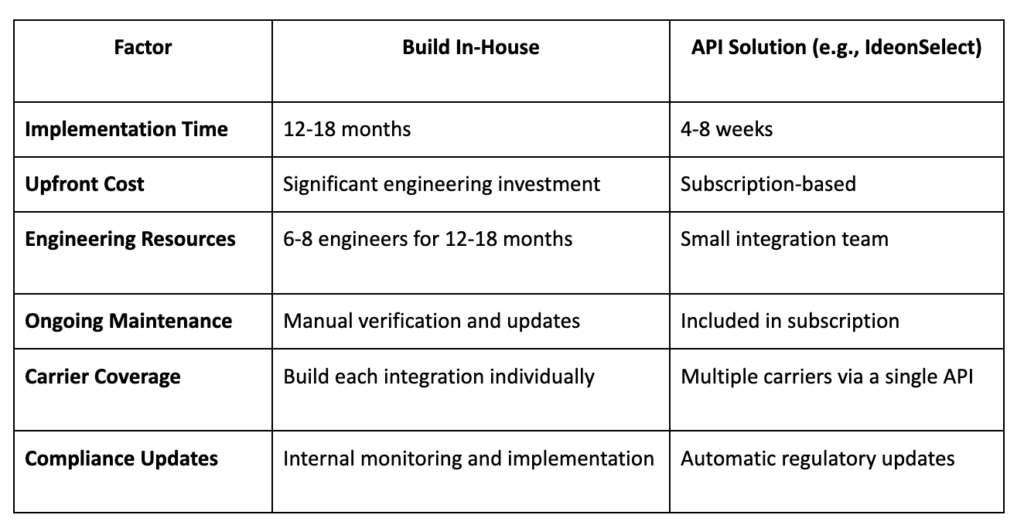
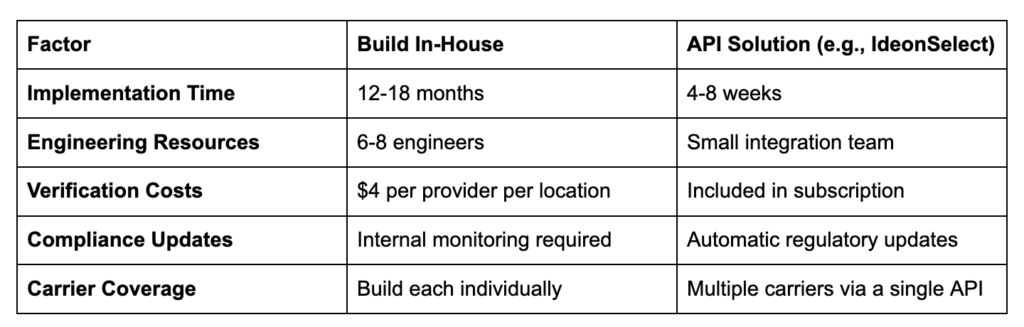
The traditional approach requires 6-8 engineers for 12-18 months constructing a normalization layer. Ongoing costs include $4 per provider per location for manual verification. The maintenance burden involves continuous carrier relationship management and format updates. Compliance overhead demands internal monitoring teams for 90-day CMS cycles and state requirements.

Modern API-Driven Approach

API infrastructure provides pre-normalized provider data across multiple carriers via single integration, built-in validation ensuring all six quality dimensions, automatic compliance updates, and real-time data quality monitoring. IdeonSelect delivers enterprise-grade provider network data with 4-8 week implementation.

Modern APi Data Approach

Organizations building custom infrastructure miss market opportunities during 12-18 month development cycles. Engineering teams freed from data plumbing can focus on product differentiation.

Real-World Impact of Data Quality Investment

Organizations investing in provider data quality infrastructure achieve measurable results.

A major health plan replaced over 1 million manual verification calls with automated outreach, achieving an 84% directory accuracy rate—significantly above national average—with substantial improvement in provider engagement and operational efficiency.

Ballad Health, an 800-physician network across 21 hospitals, implemented automated roster submission through CAQH Provider Data Portal. The result: 50% reduction in roster processing time, with data pulled weekly, standardized, quality-checked, and submitted to 30 different health plans.

The Future of Provider Data Quality

The industry is shifting toward API-first infrastructure. Manual processes are being replaced with AI-driven automation and real-time data validation. CAQH is incorporating AI and third-party data at point of entry to validate information in real-time—gathering information from 75-80% of U.S. healthcare providers.

The AI in healthcare market, worth $11+ billion in 2021, is forecast to reach $188 billion by 2030. Quality data is essential for AI algorithms to function properly—poor data quality leads to biased predictions and suboptimal outcomes.

Solving provider data quality requires commitment across the entire industry. The root cause is complex, fragmented, inconsistent data exchange between providers, payers, platforms, and vendors. Organizations with high-quality provider data achieve faster credentialing, superior member experiences, and improved compliance standing.

Platforms leveraging API infrastructure can launch with enterprise-grade data quality in 4-8 weeks. Competitors building internally face 12-18 month timelines. Modern infrastructure frees teams to focus on member experience innovation rather than data plumbing.

Conclusion: Provider Data Quality as Strategic Infrastructure

Provider data quality encompasses six critical dimensions: accuracy, completeness, consistency, validity, timeliness, and uniqueness. Poor quality costs the healthcare industry $17B+ annually in unnecessary expenses. Regulatory requirements—CMS 90-day cycles, the No Surprises Act, HIPAA—make quality non-negotiable.

Organizations face a strategic infrastructure decision. The build approach requires 12-18 months, 6-8 engineers, and contributes to the $4B+ annual industry spend on quality improvements. The API approach delivers 4-8 week implementation, subscription-based pricing, and built-in quality controls.

Organizations prioritizing provider data quality through modern infrastructure achieve faster time-to-market, superior member experiences, and reduced regulatory risk—while competitors struggle with manual verification burdens and compliance complexity.

Explore Ideon's IdeonSelect for Provider Data Quality

Ready to take the next step? See how Ideon works.

What Is Provider Data Management in Healthcare? A Complete Guide for 2026

Provider data management (PDM) is the foundational infrastructure determining whether patients find accurate provider information, whether claims process correctly, and whether organizations meet regulatory compliance. With 62% of members demanding precise provider data and CMS enforcement tightening through 2027, organizations face a strategic decision: spend 12-18 months building complex PDM infrastructure internally, or leverage API-driven solutions to launch in weeks with automatic compliance.

Healthcare consumers are making decisions with their feet. Over 33% of members will switch health plans for better digital capabilities and provider data access. This shift has transformed provider data management from back-office administrative function to competitive differentiator—the invisible infrastructure determining member satisfaction, regulatory standing, and operational efficiency.

The challenge is clear: provider information changes constantly, with inaccuracies persisting an average of 540 days in systems without automated verification. Meanwhile, regulatory requirements have accelerated dramatically. Medicare Advantage plans must verify directories every 90 days. The No Surprises Act demands 1-business-day response times. Medicaid programs require 30-day updates as of July 2025.

For benefits technology platforms, health plans, and TPAs, provider data management represents a fork in the road. Build complex infrastructure internally—requiring 12-18 months and significant engineering resources—or integrate API-driven solutions delivering accuracy, compliance, and scalability in weeks rather than months.

I. What Is Provider Data Management

Provider data management (PDM) is the systematic process of collecting, organizing, maintaining, and updating healthcare provider information across organizations. This data layer powers the provider directories patients use to find care, enables claims processing accuracy, and provides required infrastructure for regulatory compliance with CMS, state agencies, and federal mandates.

What PDM encompasses:

  • Provider credentials: NPI numbers, medical licenses, board certifications, DEA registrations
  • Practice information: Office locations, contact details, languages spoken, office hours
  • Network affiliations: Plan participation status, network tiers, panel capacity
  • Clinical capabilities: Hospital privileges, specialties, subspecialties, telehealth availability
  • Billing details: Tax IDs, group affiliations, claims submission requirements

Multiple stakeholders depend on effective PDM: health insurance carriers (Medicare Advantage, commercial plans, Medicaid programs), benefits technology platforms (HR tech vendors, ICHRA administrators, broker platforms), healthcare systems (hospitals, physician groups, integrated delivery networks), and third-party administrators.

The modern challenge is significant. Without automation, provider data inaccuracies persist an average of 540 days—creating compliance exposure, member frustration, and operational inefficiency. Organizations face a strategic choice: build complex PDM infrastructure in-house or leverage API-driven solutions that handle the data plumbing.

II. Why Provider Data Management Matters in 2025

For Patients and Members

Member expectations have fundamentally shifted. 62% of members now seek more precise provider information to make informed care decisions. Among younger demographics, demand is even more pronounced: 70% of Millennials and 64% of Gen Z want comprehensive provider details including locations, availability, and network status before selecting care.

The business impact is direct. Over 33% of members indicate willingness to switch health plans for better data access and digital capabilities. Inaccurate directories create tangible harm: delayed care, wrong provider visits, and surprise bills that erode member trust and drive churn.

For Health Plans and Payers

Regulatory compliance has become increasingly enforcement-focused. Medicare Advantage plans must verify and update provider directories every 90 days. The No Surprises Act requires response to provider inquiries within 1 business day. Medicaid programs mandate 30-day updates as of July 1, 2025. Non-compliance triggers penalties and audit exposure that compounds over time.

For Operations and Efficiency

Accurate provider data reduces claims denials and payment delays. Streamlined credentialing and network management translate directly to operational cost reduction. Organizations with centralized, accurate PDM systems report ROI of $753-$1,982 per attained enrollee through improved data quality—a measurable return on infrastructure investment.

III. Core Components of Provider Data Management Systems

Effective PDM systems integrate six interconnected components that work together to maintain accurate, compliant provider information.

Data Collection and Aggregation gathers provider information from multiple sources: initial credentialing applications, primary source verification (medical boards, DEA, NPPES), electronic health records, carrier enrollment forms, and claims systems. The challenge is that each source uses different formats, taxonomies, and identifiers—creating fragmentation that compounds over time.

Data Storage and Centralization creates a single source of truth for provider information. Cloud-based platforms provide accessibility across organizations while maintaining security and audit capabilities. Centralized repositories ensure updates propagate to all downstream systems simultaneously.

Data Normalization and Standardization converts disparate formats into unified schema. This includes mapping specialty taxonomies (NUCC codes, custom classifications), standardizing addresses and phone numbers, and resolving duplicate records and conflicting information.

Data Validation and Verification automates credential verification against primary sources, replacing manual phone calls and mail surveys. Network status validation with carriers confirms participation. Practice location confirmation verifies addresses and hours.

Data Distribution and Access flows verified data to provider directories (web, mobile, print), API endpoints for real-time search, care coordination systems, and claims processing platforms through real-time channels rather than batch transfers.

Data Governance and Quality Control establishes accountability, defines quality metrics, and maintains audit trails for compliance reporting readiness.

IV. Key Challenges in Healthcare PDM

Data Fragmentation Across Systems scatters provider information across disconnected platforms—EHR, billing, credentialing, claims—with no single source of truth. Each system holds partial information, and inconsistencies compound as data ages.

Manual Processes and Labor Intensity consume significant staff resources. Provider offices field data requests from dozens of health plans, each with different forms and timelines. Manual verification cycles are time-consuming and error-prone: phone calls go unanswered, faxes disappear, surveys are ignored.

Persistent Directory Inaccuracies including wrong addresses, outdated affiliations, and incorrect network status remain uncorrected for an average of 540 days without automated verification—well beyond regulatory compliance windows and long enough to frustrate members seeking care.

Regulatory Compliance Complexity creates overlapping requirements: Medicare Advantage 90-day verification cycles, No Surprises Act 1-business-day responses, Medicaid 30-day updates (effective July 2025), and the CMS Plan Finder mandate requiring MA plans to publish directories by 2027. Multi-state variations add another layer.

Real-World Patient Impact translates to patients unable to find accurate provider information, delayed or disrupted care from directory errors, and member frustration that drives plan switching..

V. Modern Approaches to Provider Data Management

Traditional Approach: Manual and Batch Processing relies on quarterly or annual directory update cycles, spreadsheet-based data collection, manual verification phone calls and surveys, and batch file transfers between systems. The result: slow, error-prone, labor-intensive processes that cannot keep pace with regulatory requirements or member expectations.

API-Driven Infrastructure: The Modern Standard enables real-time data exchange between systems, automated verification and validation, single integration to access multiple carrier networks, and continuous compliance monitoring. IdeonSelect exemplifies this modern standard, providing normalized provider data via unified API that eliminates the need to build and maintain individual carrier integrations.

Benefits of API-First Architecture:

  • Speed: 4-8 weeks implementation vs. 12-18 months for custom builds
  • Accuracy: Automated quality control and normalization eliminate manual errors
  • Compliance: Built-in regulatory update automation keeps pace with CMS, NSA, and state requirements
  • Scalability: Handle enrollment surges without manual intervention
  • Cost efficiency: Subscription model replaces expense of building and maintaining infrastructure

Cloud-based centralization provides single source of truth with real-time updates and enterprise-grade security (SOC 2 Type II, HIPAA compliance). API-driven PDM connects seamlessly to HRIS, payroll, benefits platforms, and claims processing systems.

VI. Implementing Effective PDM

Assessment Phase evaluates current data quality and accuracy rates, identifies system fragmentation and integration gaps, documents compliance requirements and deadlines, and calculates total cost of ownership for existing manual processes.

Strategic Decision: Build vs. API Infrastructure

Build vs. API Infrastructure

Implementation Best Practices include establishing data governance frameworks with clear ownership, defining quality metrics and monitoring processes, planning phased rollouts prioritizing compliance requirements, and monitoring member satisfaction alongside directory accuracy metrics.

VII. The Future of PDM

Regulatory Landscape Evolution continues with the CMS Plan Finder mandate (2027) requiring Medicare Advantage plans to publish directories to a centralized federal resource. State-level enforcement is intensifying with increasing penalties for directory inaccuracies.

Technology Acceleration makes API-first infrastructure the industry standard as real-time verification replaces quarterly batch updates. AI-powered data validation and automated compliance reporting add additional accuracy layers.

Member Expectations Rising demand real-time accuracy, comprehensive provider details, and integration with telehealth and digital care navigation that legacy systems cannot support.

Infrastructure as Competitive Advantage: Organizations leveraging modern API-driven PDM launch products faster, maintain compliance automatically, and deliver superior member experiences—while competitors struggle with 12-18 month build timelines and manual verification burdens.

Conclusion: Provider Data Management as Strategic Infrastructure

Provider data management has become strategic infrastructure determining competitive position. The requirements are clear: CMS 90-day verification cycles, No Surprises Act 1-day response times, Medicaid 30-day updates. Member expectations are equally demanding: 62% seek precise provider data, and over 33% will switch plans for better digital capabilities.

Organizations face a strategic choice. Build complex infrastructure internally—12-18 months development, significant engineering investment, ongoing operational costs for manual verification and compliance monitoring. Or integrate API solutions like IdeonSelect—4-8 weeks implementation, subscription-based pricing, automatic compliance updates included.

Modern API-driven infrastructure enables rapid implementation while ensuring accuracy, compliance, and scalability—freeing organizations to focus on product differentiation rather than data plumbing.

Explore Ideon's IdeonSelect for Provider Data Management

Ready to take the next step? See how Ideon works.

Explore Ideon’s ICHRA Solutions

The ICHRA market is growing fast. But manual processes, custom integrations, and a lack of visibility are holding carriers and ICHRA admin platforms back.

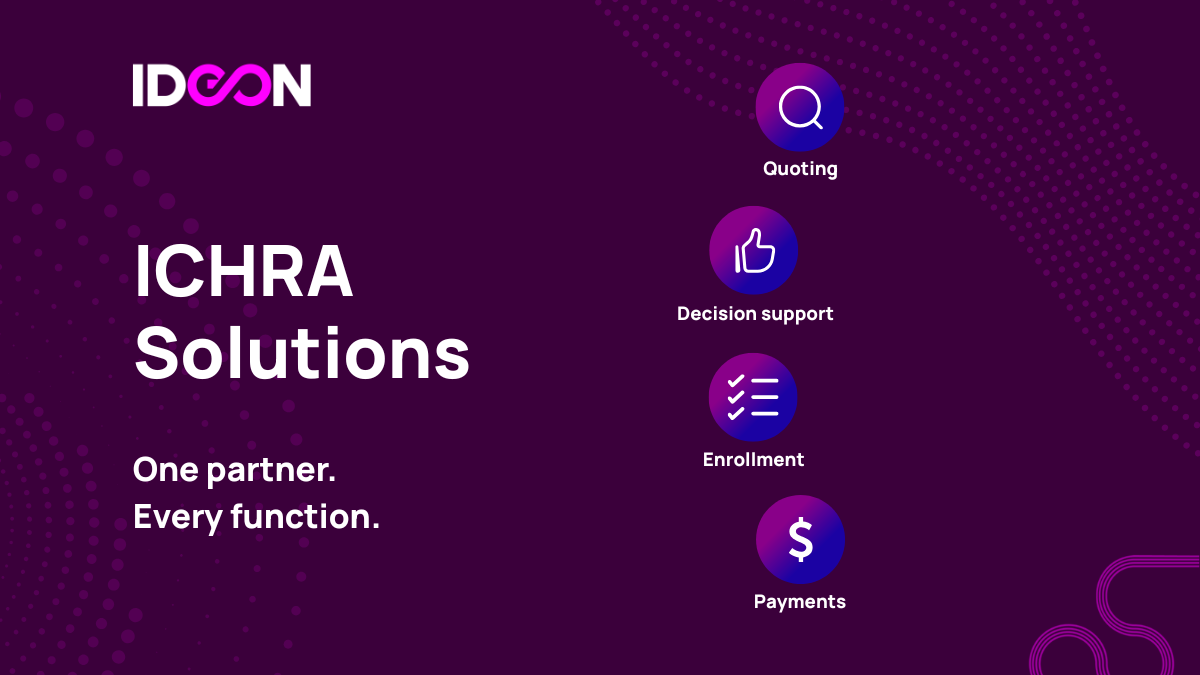
Ideon changes that dynamic. Our infrastructure powers the complete ICHRA experience—from plan shopping and decision support to enrollment and payments—so carriers can grow their ICHRA business and platforms can offer a seamless employee experience.

Ideon Expands ICHRA Enrollment Solution with Payment Automation from Ambient

NEW YORK, NY — April 16, 2025 — Ideon, the leader in data management and connectivity solutions for the health and benefits industry, today announced a strategic partnership with Ambient, the ICHRA payments and administration unit of Priority Technology Holdings, Inc. The partnership combines Ideon’s advanced enrollment technology with Ambient’s payment and administration solution, providing health insurance carriers and ICHRA administrators a unified, automated solution for managing ICHRA enrollment and payment data.

As the Individual Coverage Health Reimbursement Arrangement (ICHRA) market rapidly expands, carriers and ICHRA administrators face increasing complexity around enrollment integrations and premium payments. This partnership addresses these challenges by providing a consistent, scalable method for exchanging critical enrollment and payment data, resulting in fast, accurate processing and an improved employee experience.

“Our partnership with Ambient allows carriers and ICHRA platforms to rapidly scale their ICHRA business while enhancing the overall experience,” said Steve Swad, CEO of Ideon. “We’re now delivering an end-to-end ICHRA solution—from initial quoting through premium payments—that removes complexity for carriers, administrators, employers, and employees.”

IdeonEnroll for ICHRA builds upon Ideon’s proven success automating group benefit enrollments, extending these capabilities to the individual market. The solution significantly reduces integration costs, errors, and processing time, and offers greater visibility into ICHRA enrollments.

Ambient streamlines the ICHRA premium payment process—precisely deducting premiums from employer accounts, allocating funds for each employee, and distributing payments to carriers.

“Ambient simplifies premium payments and administration, empowering carriers and ICHRA administrators to scale efficiently,” said Jim Mrowka, Chief Operating Officer of Priority’s Ambient unit. “In partnership with Ideon, we’re delivering a comprehensive solution that transforms the entire ICHRA experience.”

This partnership further expands Ideon’s suite of ICHRA solutions. Combining IdeonQuote, IdeonSelect, and IdeonEnroll with Ambient’s payment product, Ideon provides the data and connectivity required to power ICHRA plan shopping, decision support, enrollment, and payments. Using this infrastructure, carriers and platforms can enter the ICHRA market faster with accurate data and pre-built integrations.

For more information, visit ideonapi.com/ichra-solutions.

About Ideon

Ideon provides modern data management and connectivity solutions to advance the health and benefits industry. Ideon’s centralized, API-powered solutions enable real-time, reliable data sharing from quote to renewal. With Ideon, insurance carriers and technology platforms benefit from streamlined operations and accurate data, which ultimately improves the consumer experience, drives more revenue, enables smarter decisions, and increases timely access to care. To learn more, visit ideonapi.com.

About Priority and Ambient

Priority is the payments and banking solution that enables businesses to collect, store, lend and send funds through a unified commerce engine. Our platform combines payables, merchant services, and banking and treasury solutions so leaders can streamline financial operations efficiently — and our innovative industry experts help businesses navigate and build momentum on the path to growth. With the Priority Commerce Engine, leaders can accelerate cash flow, optimize working capital, reduce unnecessary costs, and unlock new revenue opportunities. To learn more about Priority and its publicly traded parent, Priority Technology Holdings, Inc. (NASDAQ: PRTH), visit prioritycommerce.com.

Ambient, a dedicated unit within Priority, specializes in automating payments and administration for ICHRA plans, easing operational burdens for brokers, TPAs, and carriers. Learn more at ambienttpa.com.

Phil Carollo and Jamie Rockfeld join Ideon executive team

Health and benefits technology leaders to accelerate Ideon’s growth


NEW YORK — January 16, 2025 — Ideon, the leader in data management and connectivity solutions for the health and benefits industry, today announced two key additions to its executive team. Phil Carollo has been named Chief Growth Officer, and Jamie Rockfeld joins as Executive Vice President of Sales. 

Carollo and Rockfeld bring decades of industry expertise and sales leadership experience, positioning Ideon for its next phase of growth as it continues to modernize how carriers and benefits platforms connect, exchange, and manage critical data. 

Carollo spent 25 years at PlanSource, a leading benefits administration platform, where he served as Chief Operating Officer, EVP of Sales, and most recently, President of Sales, scaling the company into the industry leader it is today. Rockfeld, also from PlanSource, was instrumental in growing its reseller channel and was most recently VP of Reseller Sales. 

“I have seen firsthand the complexity and inefficiency that organizations face when managing benefits data,” said Carollo. “Ideon’s technology solves these challenges for its customers, empowering them to grow and scale efficiently. I’m thrilled to join a team that is bringing immense value to customers and helping to modernize the industry.” 

“I’m excited to join Ideon and help its customers eliminate data problems that have long plagued carriers and platforms, allowing them to focus on what matters most—delivering value to brokers, employers, and employees,” Rockfeld said. 

These hires come at a time of rapid growth across all three of Ideon’s main product lines: IdeonQuote, IdeonSelect, and IdeonEnroll. In 2024, the company launched IdeonEOI, secured partnerships with industry leaders like Prudential, and strengthened its position as the data solutions leader in the $1T+ health and benefits industry. 

About Ideon
Ideon provides modern data management and connectivity solutions to advance the health and benefits industry. Ideon’s centralized, API-powered solutions enable real-time, reliable data sharing from quote to renewal. With Ideon, insurance carriers and technology platforms benefit from streamlined operations and accurate data, which ultimately improves the consumer experience, drives more revenue, enables smarter decisions, and increases timely access to care. 

Headquartered in New York City, Ideon partners with more than 300 insurance carriers and 100 InsurTech companies to improve operational efficiencies and customer experience across the $1T+ insurance industry. To learn more, visit ideonapi.com. 

Prudential collaborates with Ideon for technology that will help simplify the workplace benefits experience

NEWARK, N.J. – Prudential Financial, Inc. (NYSE: PRU) announced today that its Group Insurance business has collaborated with Ideon, a leader in data exchange and connectivity solutions, to deliver unique technology solutions for benefits eligibility and enrollment processes for workplace clients and their employees.

As employers expand their benefits offerings to attract and retain top talent, the need for fast, safe and efficient benefits administration has never been greater, with high expectations around data exchange between providers, employers and the benefit administration systems they use. Through this strategic relationship with Ideon, Prudential aims to improve the accuracy of enrollment data, help reduce the administrative workload for human resources teams, and seek new and innovative ways to ensure accurate enrollment and eligibility data. The collaboration will also allow Prudential to expand integrations with certain benefit administration systems where connectivity is limited today.

“We are committed to providing a superior experience for our clients and their employees,” said Jess Gillespie, head of product and underwriting for Prudential Group Insurance. “Enhancing Prudential’s digital connectivity makes it faster and easier for groups, and their employees, to enroll in workplace benefits.”

The initial phase of the collaboration focuses on expediting the data exchange process that impacts the onboarding process, including enrollment and eligibility information.

“This relationship signifies a major step forward for Ideon and Prudential,” said Steve Swad, CEO of Ideon. “Our data solutions will enable Prudential to deliver a fast, seamless, and accurate benefits enrollment and administration experience. We are excited to support Prudential in enhancing their platform ecosystem.”

For more information, visit Prudential Group Insurance or Ideon.

About Prudential
Prudential Financial, Inc. (NYSE: PRU), a global financial services leader and premier active global investment manager with approximately $1.6 trillion in assets under management as of Sept. 30, 2024, has operations in the United States, Asia, Europe, and Latin America. Prudential’s diverse and talented employees help make lives better and create financial opportunity for more people by expanding access to investing, insurance, and retirement security. Prudential’s iconic Rock symbol has stood for strength, stability, expertise, and innovation for nearly 150 years. For more information, please visit news.prudential.com.

About Prudential Group Insurance
Prudential Group Insurance manufactures and distributes a full range of group life, long-term and short-term disability and corporate and trust-owned life insurance in the U.S. to institutional clients primarily for use within employee and membership benefit plans. The business also sells critical illness, accidental death and dismemberment and other ancillary coverages. In addition, the business provides plan administrative services in connection with its insurance coverages, and administrative services for employee paid and unpaid leave, including FMLA, ADA, and PFL.

About Ideon
Ideon’s data solutions allow health insurance carriers and employee benefits providers to connect with technology partners to deliver seamless consumer experiences at every stage of the member journey. Ideon serves as the infrastructure simplifying the exchange of quoting, provider, and enrollment data between carriers and the technology partners, so they can deliver health and employee benefits to hundreds of millions of Americans every day. Ideon transmits billions of data points between insurtechs and insurance carriers, powering an amazing benefits experience for all. To learn more, please visit ideonapi.com.

Ideon Releases 2025 ICHRA Map

Ideon’s 2025 ICHRA Map is Available here

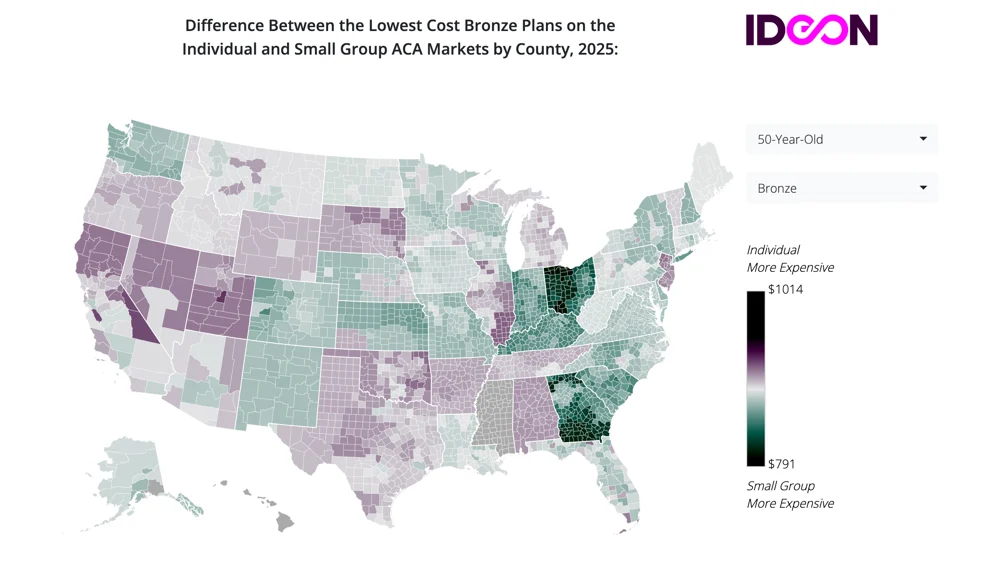
More than 60% of the U.S. is ICHRA-friendly in 2025

This year, our interactive map reveals exciting new insights into the ICHRA landscape:

📍 For bronze-level plans, 33 states are now “ICHRA-friendly” — up from 31 last year.
📍 Looking at silver-level plans, 21 states have market dynamics favorable to ICHRAs, up from 17 in 2024.

This map is an essential tool for benefits professionals to pinpoint where individual health insurance premiums are more affordable than small group market rates, suggesting opportunities for ICHRA adoption.

đź”— Explore the map here. Plus, you can see how the market has shifted since the inception of ICHRAs.

Explore Ideon’s ICHRA solutions  here.

Webinar: From Risk to Resolution—How EOI Auditing Protects Carriers & Members

Ideon and Prudential explore a new, proactive approach to uncovering EOI errors—before they cause claims issues.

Eliminating EOI Data Risk: Why Carriers Need EOI Auditing Now

Table of Contents

Managing Evidence of Insurability (EOI) data has become a critical—and challenging—priority for group benefits carriers. Traditional EOI processes often result in errors that expose carriers to significant risks, from Department of Labor (DOL) fines to reputational harm and poor member experiences.

This guide dives into the risks hiding within routine EOI data processing. We’ll examine why carriers struggle to identify missing EOI before it’s too late, and reveal how advanced EOI data auditing prevents errors, mitigates risk, and helps carriers stay ahead in a competitive market.

The Status Quo: Challenges in Identifying Incomplete EOI

Most carriers can’t effectively detect and resolve instances where a member has enrolled in coverage that requires EOI but hasn’t completed the EOI process. This problem is more common than many realize and has far-reaching implications.

The Problem: EOI errors are difficult to detect

      • Enrollment With Incomplete EOI: Members often select life or disability coverage that exceeds guaranteed issue amounts, triggering the need for EOI. However, due to gaps in enrollment data exchange, complex plan eligibility rules, the BenAdmin misconfiguring plans in its system, or miscommunication, the member may not complete the required EOI process.
      • Invisible Discrepancies: These incomplete EOI cases frequently go unnoticed because carriers rely on manual checks or systems that can’t flag these discrepancies.
      • Delayed Detection at Claims Time: The failure to identify these issues means that carriers often discover them only when a claim is filed. At this point, it’s too late to rectify the oversight without causing delays and member dissatisfaction.

The Impact: What happens when EOI errors go unnoticed

      • Financial Risk: Carriers can face lawsuits and fines from the Department of Labor (DOL) if claims are denied due to missing EOI, especially if the member was paying a premium for supplemental coverage. In just the last two years, several large carriers have reached settlements with the DOL over their EOI practices.
      • Poor Claims Experience: Mistakes in EOI collection lead to negative member experiences, especially at claims time—when a slow process or wrongly denied claim can be disastrous for the member and their family. And, these negative experiences could result in brokers and employers taking their business elsewhere.
      • Reputational Damage: Brokers increasingly prioritize carriers with automated, advanced EOI capabilities. Those who don’t meet this expectation may find themselves losing out on key business opportunities and RFPs

Simply put, the status quo is no longer sustainable for carriers looking to remain competitive and compliant in the modern benefits landscape.

Making EOI Data Management a Strategic Priority

The consequences of mishandling EOI are extensive. But there’s light at the end of the tunnel — carriers, with the right auditing technology, can solve EOI data challenges and mitigate risk. Here’s why it should be a top priority:

      • Rising Demand for Automation: Brokers and employers expect streamlined, automated EOI processes to enhance the member experience, speed up enrollment, and reduce errors. Some RFPs even request information about EOI automation, including API capabilities.
      • Revenue Growth Opportunities: Carriers that simplify EOI processes see higher adoption rates for supplemental benefits like life and disability coverage—opening new revenue streams.
      • Mounting Regulatory Pressure: With increased scrutiny from the DOL, carriers face a higher risk of costly fines and reputational damage if EOI data errors aren’t addressed proactively.

EOI Audit by Ideon: An Industry-First Solution to De-Risk EOI Data

Better technology is the only way to minimize the financial and reputational risk of EOI errors.

Ideon’s EOI Audit solution offers a unique, automated approach to solving this industry-wide challenge. It addresses two key areas: data auditing and decision return. Here’s how it works:

      • Identifies Members Requiring EOI: Ideon’s system pinpoints members whose elections require EOI.
      • Audits Groups for Missing EOI: The audit function flags members who require EOI but didn’t complete it. Errors and discrepancies include why someone needs EOI, based on the carrier’s plan eligibility rules, decisions already in the carrier’s system, and group enrollment data.
      • Error Resolution: All discrepancies are surfaced through automated reports and dashboards. Each issue has a clear, actionable resolution path, allowing carriers to avoid downstream problems.
      • Decision synching: EOI statuses and decisions are synched between carriers and BenAdmin platforms, ensuring up-to-date, accurate data across all systems.

This process not only improves data accuracy but also prevents costly errors that lead to DOL fines and poor member outcomes.

Results with EOI Audit

By implementing Ideon’s EOI Audit solution, carriers not only improve compliance and enhance claims experiences, but also strengthen their competitive position by offering a more reliable EOI process. Here are the key benefits they can expect:

      • Risk Mitigation: Proactively address EOI discrepancies to avoid DOL fines, reputational harm, and operational disruptions.
      • Faster Resolution: Early detection and actionable insights mean carriers resolve EOI discrepancies quickly, avoid downstream problems, and process claims accurately.
      • Stronger Market Position: Showcase advanced EOI capabilities to stand out in RFPs, win more business, and build stronger broker relationships.

Success in Action: How Prudential is Using Ideon’s EOI Audit Solution

Carriers like Prudential are already seeing positive results with Ideon’s EOI Audit solution. As Sherri Bycroft, Director of Benefit Technology Partnerships at Prudential, shared in a recent Ideon Insights interview:

“We’re really excited about the fact that it’s going to flush out issues much earlier on,” she said. “We can have full confidence that we have the right information about the members in our system, and at the time of claim, be able to pay that without delays.”

Get a Demo of EOI Audit by Ideon

See how Ideon’s EOI Audit solution can help you reduce risk, identify missing EOI, and provide a better claims experience. Schedule a demo below.


Employee Spotlight: Christie Lickert

At Ideon, we’re proud to have such a talented, diverse team leading the charge for a better and more connected health insurance and employee benefits industry. Our ongoing Employee Spotlight series showcases the people behind our product and unveils what life is like at Ideon. Next up… Christie Lickert, our Senior Operations Analyst!

Name: Christie Lickert
Department: Enrollment Operations
Title: Senior Operations Analyst
Location: Omaha, NE

Work

How long have you worked at Ideon?

I have worked at Ideon in Enrollment Operations for two years.

Tell us about your day-to-day.

I work with carriers and platforms, specifically with configurations for EDI and API feeds. Each day, the work I do is different. I can be working on anything from a brand-new implementation with testing to creating documentation on processes and training new team members.

What projects are you excited to work on?

I love working on projects that are challenging and give me a sense of accomplishment. I enjoy it when I can contribute to solving issues with an out-of-box approach.

What excites you about the future of Ideon?

Ideon has many partnerships that are so influential to the growth of our company. We are constantly trying to make the customer experience as seamless and efficient as possible. I am excited to see what innovative ideas my colleagues and I produce to help support that.

Describe your onboarding experience.

What’s great about Ideon is that we have every new employee meet with each department to get a look at what we do. It was interesting and informative to see what each team member’s purpose is. The team is also very welcoming and inclusive. Ideon is very thorough with onboarding and makes sure everyone has what they need to be successful.

Life

Favorite activity when you’re not working? 

I love reading and am part of a book club. My favorite genre of books is a tie between autobiographies and thrillers.

Favorite place you’ve traveled?

My favorite place I have traveled to is Sedona, Arizona. I absolutely love the red rock and enjoyed going on a “Pink Jeep Tour” which drove me up and down cliffs.

Interesting fact about yourself… Go!

I am obsessed with the Golden Girls. I still have all their box set DVDs, and my first dog was named after Sophia Petrillo.


Webinar: The Future of Group Benefits Quoting

How are quoting platforms transforming the ancillary and voluntary benefits space?

Carriers and brokers are rapidly evolving their engagement—and third-party quoting platforms are at the heart of this shift. Join this webinar as experts from Guardian, Acrisure, and Ideon explore how these platforms are shaping the future of group benefits quoting.

🗓 Date: Tuesday, Oct. 22
🕒 Time: 1:00 PM ET
👉 Register here.

What you’ll learn:

  • The rise of quoting platforms and their role in benefits distribution
  • How carriers are partnering with platforms to reach more brokers
  • Key opportunities in the small group market
  • Success stories and trends
  • How APIs and automation are streamlining group benefits quoting