
How to Embed ICHRA Logic into Your SaaS Platform: A Developer Guide

Article Summary:

Building ICHRA into a SaaS platform isn’t just connecting to a few insurance APIs—it’s orchestrating eligibility rules, reimbursements, plan sourcing, and compliance under one roof. This guide breaks down the core systems (eligibility engine, reimbursement workflows, carrier integrations, and compliance automation), shows practical API patterns, and outlines the technical blueprint you’ll need to build scalable, audit-ready ICHRA features that work in production.

Building an ICHRA platform isn’t just about connecting to a few carrier APIs. It’s like trying to orchestrate a symphony where every instrument plays by different rules, speaks different languages, and changes their tune without warning.

Think about it: You need eligibility calculations that adapt to constantly shifting IRS regulations. Reimbursement processing that handles everything from receipt scanning to payroll integration. Quote engines that pull live data from 300+ insurance carriers. And compliance automation that keeps you out of regulatory hot water.

If your platform can’t handle this complexity while maintaining audit-grade compliance and real-time performance, you’re building on shaky ground. This guide walks through the essential building blocks, shows you practical API patterns, and gives you the technical blueprint to build ICHRA features that actually work in production.

Who’s Likely to Embed ICHRA Logic?

ICHRA integration isn’t just for benefits-first startups. Companies most likely to find value  embedding this functionality into existing platforms span a wide range:

  1. (1) HRIS and payroll providers looking to expand into health benefits
  2. (2) PEOs and benefit administrators seeking scalable compliance tools
  3. (3) Digital brokers and private exchanges that want to offer individual market coverage alongside group plans
  4. (4) Fintech or workforce platforms where health benefits complement financial wellness offerings. 

In each case, the motivation is the same—adding ICHRA capabilities strengthens retention, expands revenue opportunities, and creates stickier relationships with employers who increasingly demand flexible, compliance-ready benefit options.

Core ICHRA Functions: What You Need to Build

Every ICHRA platform rests on the same building blocks—but how you frame them depends on your audience. At a high level, the platform must deliver for employers, for employees, and through the infrastructure that powers both. Under the hood, those pillars map directly to the three foundational systems developers need to get right: eligibility determination, reimbursement automation, and plan sourcing, all reinforced by compliance automation. Miss any one of these, and your platform crumbles under real-world pressure.

Employer Experience (Eligibility Determination)
For employers, the platform’s first responsibility is making sure only eligible employees can participate—and that IRS affordability rules are applied consistently. Your eligibility system is the gatekeeper. It ingests employee data from the HRIS, classifies workers by compliant criteria, and applies affordability rules that change year to year. Every decision must be logged with audit-grade detail: full-time vs part-time status, geographic rules, union classifications, even tricky edge cases like mid-year status changes. If this function fails, employers face compliance penalties and loss of trust.

Employee Experience (Reimbursement Automation)
Employees experience ICHRA through reimbursements. If this process is clunky or error-prone, adoption tanks. Reimbursement automation is where the rubber meets the road: employees submit receipts, your system validates them, checks allowance limits, routes approvals, and pushes payments through payroll. From the employee’s perspective, this needs to feel seamless—claims accepted, balances updated in real time, reimbursements paid on time. From a developer’s perspective, it’s a multi-step workflow with OCR scanning, fraud detection, approval routing, and payroll integration. One broken link here leads to angry employees and compliance headaches.

Infrastructure (Plan Sourcing & Compliance)
Behind both experiences sits infrastructure that makes the whole system reliable. Plan sourcing connects your platform to hundreds of carriers, each with their own quirks—different APIs, formats, and schedules. Your job is to normalize this chaos into clean, comparable plan data so employees can make side-by-side choices with confidence. And underneath it all lies compliance automation: ACA reporting, 1095-C form generation, audit trails, and regulatory updates. This runs quietly in the background but is what keeps the entire operation legal, auditable, and scalable.

Together, these pillars—employer experience through eligibility, employee experience through reimbursements, and infrastructure through plan sourcing and compliance—define what every ICHRA platform must deliver. The difference in this guide is that we’re not just describing the blocks; we’re showing you how to wire them into an existing SaaS product at a production-ready level.

Employee Eligibility Engine

Your eligibility engine is the brain of your ICHRA platform. It needs to be smart enough to handle complex classification rules but flexible enough to adapt when regulations change overnight.

Start with employee classification logic. Full-time, part-time, geographic regions, union status – your system needs to categorize workers based on configurable rules that pull from live HRIS data. When someone gets promoted or moves states, eligibility should update automatically.

The affordability calculation is where things get tricky. You’re following IRS safe harbor rules, factoring in household income, family size, and geographic rating areas. Get this wrong, and you’re not just dealing with unhappy employees – you’re looking at potential penalties.

Here’s what a basic eligibility check looks like in practice:

{python]

def check_employee_eligibility(employee):

    # Get current classification

    class_type = determine_class(employee)

    if not class_type:

        log_decision(employee.id, “No valid classification”)

        return False    

    # Apply affordability test

    is_affordable = calculate_affordability(employee, class_type)

    if not is_affordable:

        log_decision(employee.id, “Fails affordability test”)

        return False

    log_decision(employee.id, “Eligible for ICHRA”)

    return True

Your audit trail needs to capture every decision with timestamps and reasoning. When auditors come knocking, you want to show exactly why each eligibility determination was made.

Reimbursement Processing System

Think of reimbursement processing as an assembly line with multiple quality checkpoints. Receipt comes in, gets validated, checked against allowances, routed for approval, and eventually becomes a payment in someone’s paycheck.

Your receipt processing starts with file uploads – images, PDFs, whatever employees throw at you. OCR technology extracts the key details, but you need business logic to categorize expenses and flag anything suspicious. Duplicate receipts, non-eligible expenses, amounts that exceed allowances – catch these early to avoid downstream problems.

Allowance tracking happens in real-time. Every approved expense reduces the employee’s remaining balance, and you need to handle edge cases like retroactive adjustments and year-end rollovers. Your database schema should track every transaction with full audit trails.

The approval workflow can be as simple as automatic processing for small amounts or as complex as multi-level sign-offs for larger claims. Use event-driven architecture to trigger status updates and notifications without manual intervention.

Integration with payroll systems is your final challenge. Tax-advantaged reimbursements, proper deduction timing, handling of payment cycles – this needs to work seamlessly with whatever payroll platform your customers use.

Plan Sourcing & Quote Engine

Your plan sourcing engine is like a universal translator for the insurance world. Carriers speak different languages, use different data formats, and update their information on different schedules. Your job is to make sense of this chaos.

Carrier API integration means handling dozens of authentication methods, rate schemas, and data structures. Build adapters that normalize everything into a consistent internal format. When Aetna changes their API structure, you want to update one adapter, not rebuild your entire system.

Rate calculations pull together geography, age bands, family composition, and network specifics. Cache strategically during open enrollment periods when traffic spikes, but make sure your data stays current. Stale rates lead to enrollment failures and frustrated users.

Plan availability verification runs continuously in the background. Carriers drop plans, change networks, and update product codes without much notice. Your system needs to catch these changes before users try to enroll in non-existent plans.

Here’s a simplified example of plan data normalization:

{python]

def normalize_carrier_data(carrier_response, carrier_type):

    “””Convert carrier-specific data to standard format”””

    if carrier_type == “aetna”:

        return {

            “plan_id”: carrier_response[“product_id”],

            “monthly_premium”: carrier_response[“rate”],

            “network_type”: map_aetna_network(carrier_response[“network”])

        }

    elif carrier_type == “anthem”:

        return {

            “plan_id”: carrier_response[“plan_code”],

            “monthly_premium”: carrier_response[“premium”],

            “network_type”: map_anthem_network(carrier_response[“network_id”])

        }

    # Handle other carriers…

Compliance & Reporting Logic

Compliance automation runs quietly in the background, but it’s what keeps your platform legally sound. ACA reporting, 1095-C generation, ERISA documentation – this stuff needs to happen automatically and accurately.

Your compliance engine monitors regulatory changes and adapts logic accordingly. When the IRS updates affordability thresholds or reporting requirements change, your system should adjust without manual intervention. Build this as a configurable rule engine, not hardcoded business logic.

Audit trail systems capture everything. Every eligibility decision, every reimbursement approval, every plan selection – timestamp it, version it, and link it to source data. When regulators ask questions, you want to provide answers instantly.

Form generation runs as background jobs triggered by calendar events or workflow milestones. 1095-C forms, ACA reports, compliance summaries – generate these automatically and store them in accessible formats.

API Integration Patterns for ICHRA Logic

Your API architecture determines whether your ICHRA platform scales smoothly or crumbles under pressure. Use RESTful endpoints with consistent JSON payloads, implement webhook subscriptions for real-time updates, and build error handling that actually helps developers troubleshoot problems.

RESTful endpoints should follow predictable patterns. Eligibility checks, reimbursement submissions, plan queries – each operation gets a dedicated endpoint with standardized request/response formats. Use proper HTTP status codes and include correlation IDs for tracking requests across systems.

Webhooks eliminate the need for constant polling. When eligibility changes, reimbursements get approved, or plan data updates, push notifications to subscribed endpoints immediately. Include signature validation and timestamp checking to prevent security issues.

Error handling needs to be developer-friendly. Return machine-readable error codes with clear descriptions and suggested fixes. When a carrier API fails, your error response should help the calling system decide whether to retry, escalate, or fail gracefully.

Here’s a webhook handler that does it right:

{python]

@app.route(‘/webhook/ichra’, methods=[‘POST’])

def handle_ichra_webhook():

    # Validate signature and timestamp

    if not verify_webhook_signature(request):

        return {“error”: “Invalid signature”}, 401


    if not verify_timestamp(request):

        return {“error”: “Request too old”}, 400


    # Check for duplicate events

    event_id = request.json.get(“event_id”)

    if is_duplicate_event(event_id):

        return {“status”: “duplicate”}, 200


    # Process the event

    try:

        process_ichra_event(request.json)

        return {“status”: “processed”}, 200

    except Exception as e:

        log_error(event_id, str(e))

        return {“error”: “Processing failed”}, 500

Implementation Guide: Building ICHRA Features

Building ICHRA functionality is like assembling a complex machine – each component needs to work perfectly on its own and integrate seamlessly with the others. Start with modular development, build comprehensive testing suites, and plan for the complexity you’ll encounter.

Step 1: Implementing Eligibility Calculations

Your eligibility engine starts with employee classification. Build a flexible rule system that can handle your current needs but adapts as requirements change. Pull live data from HRIS systems, apply IRS affordability calculations, and log every decision for audit purposes.

Classification logic should be configurable, not hardcoded. When business rules change – new employee types, different geographic regions, updated compliance requirements – you want to update configuration, not rewrite code.

Affordability calculations follow IRS safe harbor rules, but these rules update annually. Build your calculation engine to handle parameter changes without requiring new deployments. Factor in household income, family size, and local market conditions.

Step 2: Building Reimbursement Workflows

Reimbursement processing spans multiple systems and involves several decision points. Design your workflow as a state machine with clear transitions, error handling, and rollback capabilities.

Receipt processing starts with file uploads and OCR extraction. Validate extracted data against business rules, check for duplicates, and categorize expenses automatically. Build in manual review processes for edge cases that automated logic can’t handle.

Allowance tracking needs real-time accuracy. Every approved expense reduces available balances, and employees need to see current allowances before submitting new claims. Handle year-end rollovers, mid-year adjustments, and retroactive changes without creating data inconsistencies.

Integration with payroll systems requires careful coordination. Tax treatment, payment timing, and reconciliation logic need to work with multiple payroll vendors. Design abstraction layers that handle vendor-specific requirements without cluttering your core business logic.

Step 3: Integrating Plan Sourcing

Plan sourcing connects your platform to the broader insurance ecosystem. Each carrier has unique API characteristics, data formats, and reliability patterns. Build adapter layers that normalize this complexity into consistent internal interfaces.

Authentication patterns vary by carrier – API keys, OAuth2 tokens, custom schemes. Create authentication managers that handle credential rotation, token refresh, and failure recovery automatically.

Data normalization transforms carrier-specific responses into standardized formats your application can consume. Plan details, pricing, networks, provider directories – everything needs consistent structure regardless of source.

Caching strategies balance data freshness with performance requirements. Cache plan data aggressively during stable periods, but refresh frequently when carriers push updates. Build cache invalidation logic that responds to carrier notifications and scheduled refresh cycles.

Step 4: Adding Compliance Automation

Compliance features work behind the scenes but require careful implementation. ACA reporting, tax form generation, audit trail maintenance – these systems need to be bulletproof and maintainable.

Automated reporting pulls data from multiple sources, applies business logic, and generates required forms on schedule. Build reporting pipelines that handle data validation, error reporting, and retry logic for failed operations.

Audit logging captures every significant action with sufficient detail for regulatory review. Structure log data for easy retrieval and analysis. When auditors request specific information, you want to provide comprehensive answers quickly.

Regulatory updates require ongoing attention. Build monitoring systems that track relevant regulation changes and alert your team when logic updates are needed. Automate where possible, but maintain human oversight for critical compliance decisions.

Code Examples & API Specifications

Real-world ICHRA integration requires practical code examples that handle common scenarios and edge cases. Here are production-ready patterns for the most critical functions.

Eligibility API Integration:

{JSON]

POST /api/v1/ichra/eligibility

{

  “employee_id”: “EMP12345”,

  “plan_selection”: “PLAN67890”,

  “household_income”: 75000,

  “family_size”: 3,

  “effective_date”: “2025-01-01”

}

\

Response:

{

  “eligible”: true,

  “affordable”: true,

  “reason”: null,

  “audit_reference”: “AUD_20250101_001”

}

Reimbursement Processing:

{JSON]

POST /api/v1/ichra/reimbursement

{

  “employee_id”: “EMP12345”,

  “expense_date”: “2025-01-15”,

  “amount”: 125.50,

  “category”: “prescription”,

  “receipt_data”: “base64_encoded_receipt_image”

}

Response:

{

  “claim_id”: “CLM_789123”,

  “status”: “pending_review”,

  “remaining_allowance”: 874.50,

  “estimated_processing_time”: “2-3 business days”

}

Plan Data Retrieval:

{JSON]

GET /api/v1/ichra/plans?zip_code=90210&employee_id=EMP12345&family_size=2

{

  “plans”: [

    {

      “plan_id”: “PLAN67890”,

      “carrier_name”: “Aetna”,

      “plan_name”: “Gold PPO 2025″,

      “monthly_premium”: 420.50,

      “deductible”: 2000,

      “network_type”: “PPO”

    }

  ],

  “total_count”: 1,

  “last_updated”: “2025-01-20T10:30:00Z”

}

Common Development Challenges & Solutions

ICHRA platform development presents unique challenges that can derail projects if not addressed early. Here’s how to handle the most common obstacles.

Complex Eligibility Rules: Build configurable rule engines instead of hardcoding business logic. Use decision tables, rule chains, and versioned configuration that can adapt to changing requirements without code deployments.

Reimbursement Workflow Complexity: Implement state machines to manage multi-step approval processes. Use event-driven architecture to coordinate between receipt processing, approval routing, and payment systems. Build comprehensive error handling and rollback capabilities.

Carrier Data Inconsistencies: Create normalization layers that transform diverse carrier data into standardized formats. Use adapter patterns to isolate carrier-specific logic. Build data validation and quality monitoring to catch issues before they impact users.

Compliance Testing: Develop automated test suites that cover regulatory scenarios, edge cases, and audit requirements. Use mock data that represents realistic employee populations and business scenarios. Test compliance logic against known regulatory requirements and audit criteria.

Final Thoughts

Building ICHRA platform integration requires balancing technical complexity with business requirements. Focus on modular architecture, robust error handling, and compliance automation. The teams that succeed prioritize data normalization, workflow automation, and real-time carrier connectivity.

The right technical foundation transforms ICHRA complexity into manageable, scalable systems. Plan for the complexity upfront, build with compliance in mind, and design for the scale you’ll eventually need.

FAQs on ichra platform integration briefing

Q: What is an ICHRA platform?

A: An ICHRA platform is a software solution that lets employers offer defined health reimbursements for employees, automating eligibility calculations, reimbursement processing, and plan sourcing through carrier API integrations.

Q: How much does ICHRA platform integration cost?

A: ICHRA platform integration costs vary, but building direct connections for every carrier can run into millions in development and years of maintenance. Unified APIs significantly reduce both cost and integration timelines.

Q: What companies provide ICHRA software?

A: Leading ICHRA software providers include HealthSherpa, Take Command, PeopleKeep, and platforms that leverage unified API infrastructure for carrier connectivity and compliance automation.

Q: What are the top ICHRA platforms?

A: Top ICHRA platforms focus on seamless plan sourcing, automated compliance, and robust reimbursement engines, offering high connectivity with multiple carriers and integration-ready APIs.

Q: How does ICHRA software process reimbursements?

A: ICHRA software automates reimbursement by validating employee receipts, tracking allowance usage, and integrating with payroll for payment – all managed through API-driven workflows and compliance checks.

Q: What carriers offer ICHRA-compatible plans?oftware process reimbursements?

A: Most national and regional health insurance carriers, such as Aetna, UnitedHealthcare, and Anthem, provide ACA-compliant plans eligible for ICHRA reimbursement when accessed through qualified platforms..

Q: What are the downsides of ICHRA for employers or employees?

A: ICHRA downsides can include regional plan availability gaps, potential administrative complexity, and the need for robust software to manage compliance, eligibility, and reimbursement processes efficiently.

Q: How do you implement an ICHRA solution?

A: Implementing ICHRA requires integrating eligibility engines, reimbursement workflows, and plan sourcing via carrier APIs. Robust platforms use normalized data models, compliance automation, and developer-friendly APIs for rapid deployment.

Q: Can ICHRA be used for on-exchange and retiree health plans?

A: Yes, ICHRA can fund both on-exchange ACA plans and retiree health coverage, provided the offerings meet IRS eligibility criteria and are supported by the platform’s plan sourcing logic.

Launch a White Label ICHRA Solution Fast: How APIs Power Your Branded Benefits Platform

Article Summary:

Building ICHRA functionality in-house takes 12–18 months and millions per carrier integration. White label ICHRA APIs cut that to 4–8 weeks, delivering full eligibility, premium aggregation, enrollment, compliance, and branding under your own name. Platforms, carriers, and TPAs can launch fast, scale cost-effectively, and retain complete brand control—while redirecting resources to customer experience and growth instead of backend infrastructure.

Building a benefits platform with full ICHRA functionality under your own brand used to mean one thing: a painful 12-18 month development marathon. While you’re hiring engineers and wrestling with carrier integrations, your competitors are already in market, serving customers.

In benefits technology, we sometimes use the term ‘white label’ to describe an API-driven infrastructure that disappears behind your brand — not the lighter, logo-swap definition used in other industries. It’s with that interpretation in mind for white label that this article is written.

White label ICHRA API solutions flip that entire dynamic. With the right API-driven infrastructure, benefits platforms, insurance carriers, and TPAs can launch a fully branded ICHRA offering in weeks—not years—with zero third-party visibility to end users.

This isn’t about slapping a logo on someone else’s product. It’s about leveraging proven infrastructure to build something that’s genuinely yours, faster and smarter than building from scratch.

What is a White Label ICHRA API Solution?

Think of white label ICHRA APIs like this: you get all the complex backend infrastructure—eligibility engines, carrier connections, compliance reporting—but your customers only see your brand. No “powered by” footers. No redirect URLs. No shared support desks.

It’s the difference between renting office space in a building with someone else’s name on it versus having your own building with your name on the door. Your customers interact with your platform, your support team, your branding—even though the underlying infrastructure is managed by specialists who’ve already solved the hard problems.

Who uses white label ICHRA APIs?

  • Benefits technology vendors who want to add ICHRA without rebuilding their entire platform
  • Insurance carriers looking to launch digital ICHRA offerings quickly
  • TPAs who need to scale ICHRA administration without proportional headcount increases

The key advantage: you can focus on what differentiates your business—customer experience, sales, unique features—while someone else handles the commodity infrastructure that just needs to work reliably. 

Why White Label? The Business Reality

Here’s the fork in the road every benefits platform faces: build comprehensive ICHRA infrastructure in-house, or leverage existing APIs to get to market faster.

The build-from-scratch path:

  • 12-18 months of development time
  • $1.5M+ per carrier integration
  • Ongoing maintenance and regulatory updates
  • Risk of technical debt and compliance gaps

The white label API path:

  • 4-8 weeks to market
  • Subscription-based pricing with predictable costs
  • Automated compliance and regulatory updates
  • Focus resources on customer experience and growth

But here’s what makes white label particularly compelling: you’re not sacrificing control for speed. True white label solutions give you complete brand ownership and customer relationship control. Your users never know there’s infrastructure running behind the scenes—they just experience a fast, reliable platform that happens to carry your brand.

Cost-effective scaling: Instead of building separate integrations for 300+ carriers, you get them all through one API. Instead of hiring compliance specialists, you get automated regulatory updates. Instead of building redundant infrastructure, you leverage enterprise-grade systems that are already battle-tested.

Complete Brand Control

White label means your customers interact with your brand at every touchpoint—enrollment portals, email communications, support documentation, even error messages. There’s no “powered by” language anywhere in the user experience.

This level of brand control matters because trust is everything in benefits. When an employee is choosing health coverage for their family, they need to feel confident in the platform they’re using. If they see third-party branding or get redirected to external sites, it creates friction and doubt.

What complete brand control looks like:

    • Custom URLs (yourcompany.com/benefits, not vendor.com/client-portal)
    • Branded email templates and communications
    • Your support team handling all customer interactions
    • Your logo and color scheme throughout the entire user journey
    • Direct customer relationships with no intermediary

This isn’t just about vanity—it’s about owning the customer experience end-to-end, which is critical for retention and growth in competitive benefits markets.

Focus on Your Core Strengths

Every hour your engineering team spends maintaining carrier integrations or updating compliance logic is an hour they’re not building features that differentiate your platform.

White label ICHRA APIs let you redirect those resources toward what actually moves your business forward: better user experiences, sales tools, customer success programs, and unique platform features that competitors can’t easily copy.

Resource optimization in practice:

    • Engineering focuses on front-end innovation instead of backend maintenance
    • Operations teams handle customer success instead of data reconciliation
    • Product teams build differentiating features instead of commodity infrastructure
    • Sales teams have more compelling demos because the platform actually works reliably

The companies winning in benefits technology aren’t the ones with the most impressive backend infrastructure—they’re the ones solving customer problems most effectively. White label APIs let you focus on solving those problems while someone else handles the plumbing.

Core Functional Blocks of a White Label ICHRA API

Every comprehensive ICHRA platform needs these essential components, whether built from scratch or powered by APIs:

Eligibility and Class Logic

Automatically classifies employees into ICHRA-eligible groups based on business rules, location, job type, and custom employer criteria. Handles complex scenarios like mid-year employment changes, COBRA transitions, and multi-state workforces.

Premium Aggregation and Subsidy Calculation

Collects real-time, ACA-compliant rates from hundreds of carriers and calculates individualized subsidies based on income, location, and family composition. Updates automatically as carrier rates change or regulations shift.

Enrollment and Data Sync

Powers seamless, real-time data transfer between carriers, HRIS systems, and employee portals. Eliminates manual file uploads and reduces enrollment errors through automated validation and error handling.

Compliance and Reporting

Auto-generates all required documentation—1095-C forms, PCORI filings, ACA verification—with built-in audit trails. Adapts automatically as IRS and ACA requirements evolve, reducing compliance risk.

Custom Branding and UI

Supports complete interface customization, branded communications, and custom URLs. Enables platforms to deliver consistent, organization-specific experiences without any visible third-party elements.

The integration advantage: Instead of building and maintaining each of these systems separately, white label APIs deliver all functionality through unified endpoints. One integration gives you access to enterprise-grade versions of every component.

Implementation: From API to Branded Product

Transforming a white label ICHRA API into your branded product follows a systematic process designed for speed and reliability:

Week 1: Foundation Setup

    • Generate API credentials for sandbox and production environments
    • Upload brand assets (logos, colors, typography) to establish visual consistency
    • Configure custom URLs and navigation to match your platform architecture demos because the platform actually works reliably

Week 2-3: Data Integration

    • Map your HRIS data fields to API endpoints using flexible schema design
    • Set up webhook notifications for real-time status updates and branded communications
    • Customize email and SMS templates to reflect your brand voice and design standards

Week 4-6: Testing and Refinement

    • Validate data flow accuracy and error handling across all user scenarios
    • Test branded interfaces across devices and browsers
    • Conduct security and compliance verification
    • Train support teams on new ICHRA functionality

Week 6-8: Launch and Monitor

    • Deploy to production with real-time monitoring
    • Track system performance and user engagement
    • Collect feedback and iterate on user experience
    • Scale infrastructure based on actual usage patterns

The key to successful implementation is treating it like a product launch, not just a technical integration. Your customers should experience a seamless addition to your existing platform, not a bolted-on third-party tool.

Hidden Challenges (And How to Avoid Them)

Even with white label APIs, certain challenges require careful planning:

Regulatory Compliance Evolution ICHRA regulations change annually—affordability calculations, reporting requirements, tax implications. Your API provider should handle these updates automatically, but you need to ensure your customer communications and support documentation stay current.

Multi-State Premium Data Accuracy Insurance rates vary by location and update frequently. Manual rate management becomes unmanageable at scale. Look for APIs that provide automated rate updates with quality assurance built-in.

Brand Consistency Across All Touchpoints As your platform grows and integrates with more systems, maintaining brand consistency becomes complex. Every email template, error message, and support interaction needs to reinforce your brand identity.

Security and Uptime Requirements Benefits platforms handle sensitive personal and financial data. Your API solution needs enterprise-grade security (SOC 2 Type II, HIPAA compliance) and reliability (99.9%+ uptime) from day one.

Customer Success and Change Management New ICHRA functionality means training your support team, updating help documentation, and potentially changing how customers interact with your platform. Plan for this operational impact alongside technical implementation.

Build vs. Buy: The Real Numbers

The financial case for white label ICHRA APIs becomes clear when you factor in opportunity cost and hidden expenses:

Factor Build In-House Use API Platform
Time-to-Market 12-18 months minimum 4-8 weeks
Up-Front Cost $1.5M+ per carrier integration Subscription-based pricing
Ongoing Maintenance Dedicated engineering team Handled by API provider
Regulatory Updates Internal compliance expertise required Automated updates included
Security Compliance SOC 2 and HIPAA certification costs Enterprise-grade security included
Opportunity Cost 18 months not building differentiating features Focus on core product innovation

But here’s the hidden cost that kills most build-from-scratch projects: they take so long that market conditions change before you launch. The ICHRA market is growing 34% year-over-year. Spending 18 months building infrastructure means missing 18 months of market opportunity.

How Ideon Powers Branded ICHRA Solutions

Ideon enables rapid white label ICHRA deployment through a unified API that connects 300+ insurance carriers with comprehensive compliance and enrollment capabilities.

What makes Ideon different:

    • True white label: Zero third-party branding in any user-facing element
    • Complete customization: Full control over UI, communications, and workflows
    • Enterprise security: SOC 2 Type II and HIPAA compliance built-in
    • Proven scalability: Powers platforms serving millions of employees nationwide

Real results: Benefits platforms using Ideon have launched branded ICHRA solutions in 4-6 weeks, handling open enrollment at scale without technical issues or compliance problems.

The infrastructure handles the complex backend requirements—real-time eligibility verification, automated compliance reporting, carrier connectivity—while you maintain complete control over customer experience and branding.

Implementation Checklist

Use this step-by-step checklist to ensure successful white label ICHRA deployment:

Technical Setup:

    • [ ] Generate API credentials for development and production
    • [ ] Configure authentication and secure token management
    • [ ] Set up sandbox environment for testing and stakeholder demos

Brand Configuration:

    • [ ] Upload logo files and define color schemes
    • [ ] Configure custom URLs and navigation structure
    • [ ] Customize email and SMS templates for branded communications

Data Integration:

    • [ ] Map HRIS employee data fields to API endpoints
    • [ ] Configure eligibility rules and employee classification logic
    • [ ] Set up webhook notifications for real-time status updates

Testing and Validation:

      • [ ] Test all user workflows from eligibility through enrollment
      • [ ] Validate data accuracy and error handling
      • [ ] Conduct security and compliance verification
      • [ ] Train support team on new ICHRA functionality

Launch Preparation:

      • [ ] Deploy to production with monitoring systems active
      • [ ] Establish performance benchmarks and alerting
      • [ ] Document support procedures for common user scenarios
      • [ ] Plan customer communication and feature announcement

The Bottom Line

White label ICHRA APIs solve the fundamental challenge every benefits platform faces: how to offer comprehensive ICHRA functionality without diverting engineering resources from core product development.

By leveraging proven infrastructure, you can launch branded ICHRA solutions in weeks instead of months, at a fraction of the cost and risk of building from scratch.

More importantly, you can focus your team on what actually differentiates your business—customer experience, unique features, and market growth—while someone else handles the complex but commodity infrastructure that just needs to work reliably.

The ICHRA market is expanding rapidly. The question isn’t whether you need ICHRA capabilities—it’s whether you’ll build them fast enough to capitalize on the opportunity.

FAQs on White Label ICHRA API Solutions

What is a white label ICHRA API solution and how does it work?

A white label ICHRA API solution provides complete Individual Coverage HRA functionality under your brand, with all backend infrastructure, carrier integrations, and compliance handling managed invisibly—enabling rapid deployment of branded ICHRA platforms

What does “white label” mean for benefits technology platforms?

White label means the solution operates entirely under your brand and control. No “powered by” tags, no third-party logos, no external redirects—your customers interact only with your branded platform, even though sophisticated infrastructure runs behind the scenes.

How does white label differ from co-branded or partnership solutions?

White label gives you complete brand ownership throughout the entire customer journey. Co-branded solutions display partner logos or “powered by” references, while white label solutions are indistinguishable from internally built platforms.

What are the main business advantages of using a white label ICHRA API?

White label ICHRA APIs dramatically reduce time-to-market (4-8 weeks vs. 12-18 months), eliminate upfront development costs ($1.5M+ savings per carrier), and let your team focus on customer experience and differentiation instead of commodity infrastructure.

How much does a white label ICHRA API cost compared to building internally?

White label solutions use subscription-based pricing that costs a fraction of internal development. Building carrier integrations internally requires $1.5M+ per carrier and 12-18 months of development time—white label eliminates both.

Who typically uses white label ICHRA API solutions?

Primary users include benefits technology companies, insurance carriers, TPAs, and InsurTech startups who need branded ICHRA platforms without the cost and complexity of building infrastructure from scratch.

What core features should a white label ICHRA API include?

Essential features include automated eligibility logic, real-time premium aggregation across carriers, seamless enrollment and data sync, automated compliance reporting, and complete UI customization capabilities for branded customer experiences.

What’s the implementation process for a white label ICHRA API?

Implementation typically takes 4-8 weeks and involves API setup and authentication, brand asset configuration, HRIS data mapping, custom UI development, webhook integration for notifications, and comprehensive testing before production launch.

How does white label ensure complete brand control?

White label solutions provide customizable portals, communications, URLs, and interfaces with zero third-party references. Every customer touchpoint—from eligibility checking to enrollment to support—reflects only your brand identity.

What compliance and security standards do white label ICHRA APIs meet?

Enterprise-grade white label solutions include SOC 2 Type II and HIPAA compliance, continuous security monitoring, 99.9%+ uptime guarantees, and comprehensive audit trails—eliminating the need for separate security infrastructure investment.

How are regulatory changes and premium updates handled?

Automated systems continuously monitor IRS and ACA requirement changes, update affordability calculations, and sync carrier rate changes across all 50 states—maintaining compliance and pricing accuracy without internal management overhead.

What challenges might companies face with white label ICHRA deployment?

Common challenges include maintaining brand consistency across all touchpoints, managing ongoing feature requests and customizations, ensuring seamless integration with existing platforms, and training support teams on new ICHRA functionality and workflows.

Explore Ideon’s ICHRA Solutions

The ICHRA market is growing fast. But manual processes, custom integrations, and a lack of visibility are holding carriers and ICHRA admin platforms back.

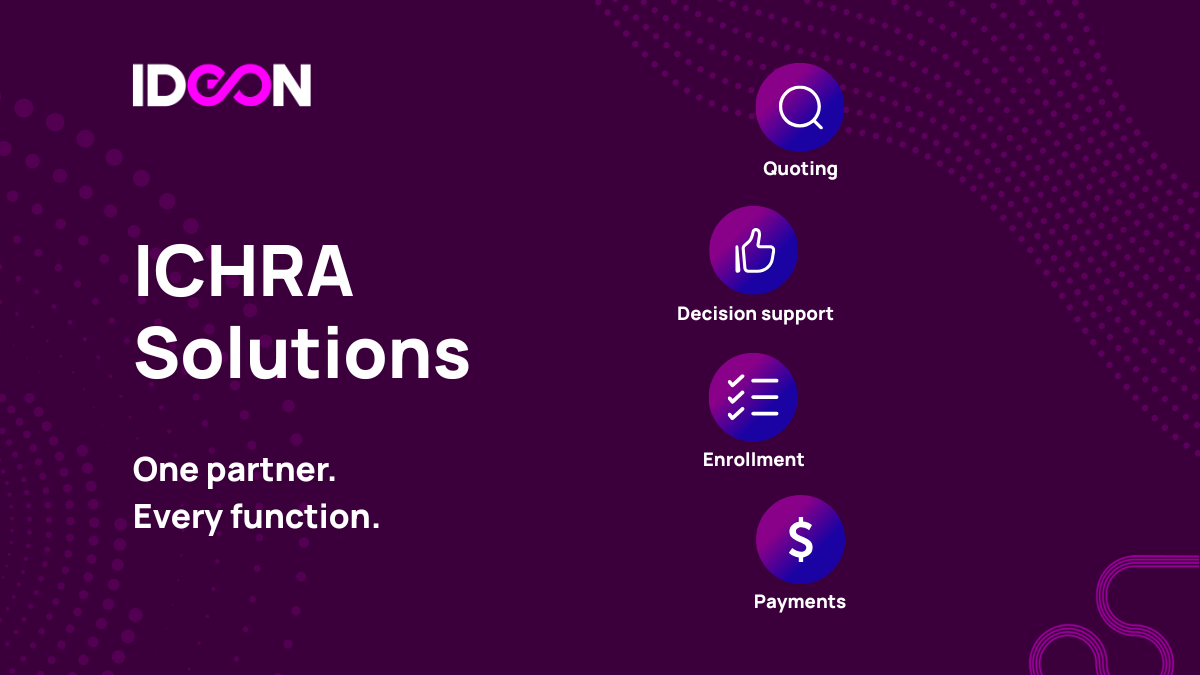
Ideon changes that dynamic. Our infrastructure powers the complete ICHRA experience—from plan shopping and decision support to enrollment and payments—so carriers can grow their ICHRA business and platforms can offer a seamless employee experience.

Ideon Expands ICHRA Enrollment Solution with Payment Automation from Ambient

NEW YORK, NY — April 16, 2025 — Ideon, the leader in data management and connectivity solutions for the health and benefits industry, today announced a strategic partnership with Ambient, the ICHRA payments and administration unit of Priority Technology Holdings, Inc. The partnership combines Ideon’s advanced enrollment technology with Ambient’s payment and administration solution, providing health insurance carriers and ICHRA administrators a unified, automated solution for managing ICHRA enrollment and payment data.

As the Individual Coverage Health Reimbursement Arrangement (ICHRA) market rapidly expands, carriers and ICHRA administrators face increasing complexity around enrollment integrations and premium payments. This partnership addresses these challenges by providing a consistent, scalable method for exchanging critical enrollment and payment data, resulting in fast, accurate processing and an improved employee experience.

“Our partnership with Ambient allows carriers and ICHRA platforms to rapidly scale their ICHRA business while enhancing the overall experience,” said Steve Swad, CEO of Ideon. “We’re now delivering an end-to-end ICHRA solution—from initial quoting through premium payments—that removes complexity for carriers, administrators, employers, and employees.”

IdeonEnroll for ICHRA builds upon Ideon’s proven success automating group benefit enrollments, extending these capabilities to the individual market. The solution significantly reduces integration costs, errors, and processing time, and offers greater visibility into ICHRA enrollments.

Ambient streamlines the ICHRA premium payment process—precisely deducting premiums from employer accounts, allocating funds for each employee, and distributing payments to carriers.

“Ambient simplifies premium payments and administration, empowering carriers and ICHRA administrators to scale efficiently,” said Jim Mrowka, Chief Operating Officer of Priority’s Ambient unit. “In partnership with Ideon, we’re delivering a comprehensive solution that transforms the entire ICHRA experience.”

This partnership further expands Ideon’s suite of ICHRA solutions. Combining IdeonQuote, IdeonSelect, and IdeonEnroll with Ambient’s payment product, Ideon provides the data and connectivity required to power ICHRA plan shopping, decision support, enrollment, and payments. Using this infrastructure, carriers and platforms can enter the ICHRA market faster with accurate data and pre-built integrations.

For more information, visit ideonapi.com/ichra-solutions.

About Ideon

Ideon provides modern data management and connectivity solutions to advance the health and benefits industry. Ideon’s centralized, API-powered solutions enable real-time, reliable data sharing from quote to renewal. With Ideon, insurance carriers and technology platforms benefit from streamlined operations and accurate data, which ultimately improves the consumer experience, drives more revenue, enables smarter decisions, and increases timely access to care. To learn more, visit ideonapi.com.

About Priority and Ambient

Priority is the payments and banking solution that enables businesses to collect, store, lend and send funds through a unified commerce engine. Our platform combines payables, merchant services, and banking and treasury solutions so leaders can streamline financial operations efficiently — and our innovative industry experts help businesses navigate and build momentum on the path to growth. With the Priority Commerce Engine, leaders can accelerate cash flow, optimize working capital, reduce unnecessary costs, and unlock new revenue opportunities. To learn more about Priority and its publicly traded parent, Priority Technology Holdings, Inc. (NASDAQ: PRTH), visit prioritycommerce.com.

Ambient, a dedicated unit within Priority, specializes in automating payments and administration for ICHRA plans, easing operational burdens for brokers, TPAs, and carriers. Learn more at ambienttpa.com.

Phil Carollo and Jamie Rockfeld join Ideon executive team

Health and benefits technology leaders to accelerate Ideon’s growth


NEW YORK — January 16, 2025 — Ideon, the leader in data management and connectivity solutions for the health and benefits industry, today announced two key additions to its executive team. Phil Carollo has been named Chief Growth Officer, and Jamie Rockfeld joins as Executive Vice President of Sales. 

Carollo and Rockfeld bring decades of industry expertise and sales leadership experience, positioning Ideon for its next phase of growth as it continues to modernize how carriers and benefits platforms connect, exchange, and manage critical data. 

Carollo spent 25 years at PlanSource, a leading benefits administration platform, where he served as Chief Operating Officer, EVP of Sales, and most recently, President of Sales, scaling the company into the industry leader it is today. Rockfeld, also from PlanSource, was instrumental in growing its reseller channel and was most recently VP of Reseller Sales. 

“I have seen firsthand the complexity and inefficiency that organizations face when managing benefits data,” said Carollo. “Ideon’s technology solves these challenges for its customers, empowering them to grow and scale efficiently. I’m thrilled to join a team that is bringing immense value to customers and helping to modernize the industry.” 

“I’m excited to join Ideon and help its customers eliminate data problems that have long plagued carriers and platforms, allowing them to focus on what matters most—delivering value to brokers, employers, and employees,” Rockfeld said. 

These hires come at a time of rapid growth across all three of Ideon’s main product lines: IdeonQuote, IdeonSelect, and IdeonEnroll. In 2024, the company launched IdeonEOI, secured partnerships with industry leaders like Prudential, and strengthened its position as the data solutions leader in the $1T+ health and benefits industry. 

About Ideon
Ideon provides modern data management and connectivity solutions to advance the health and benefits industry. Ideon’s centralized, API-powered solutions enable real-time, reliable data sharing from quote to renewal. With Ideon, insurance carriers and technology platforms benefit from streamlined operations and accurate data, which ultimately improves the consumer experience, drives more revenue, enables smarter decisions, and increases timely access to care. 

Headquartered in New York City, Ideon partners with more than 300 insurance carriers and 100 InsurTech companies to improve operational efficiencies and customer experience across the $1T+ insurance industry. To learn more, visit ideonapi.com. 

Prudential collaborates with Ideon for technology that will help simplify the workplace benefits experience

NEWARK, N.J. – Prudential Financial, Inc. (NYSE: PRU) announced today that its Group Insurance business has collaborated with Ideon, a leader in data exchange and connectivity solutions, to deliver unique technology solutions for benefits eligibility and enrollment processes for workplace clients and their employees.

As employers expand their benefits offerings to attract and retain top talent, the need for fast, safe and efficient benefits administration has never been greater, with high expectations around data exchange between providers, employers and the benefit administration systems they use. Through this strategic relationship with Ideon, Prudential aims to improve the accuracy of enrollment data, help reduce the administrative workload for human resources teams, and seek new and innovative ways to ensure accurate enrollment and eligibility data. The collaboration will also allow Prudential to expand integrations with certain benefit administration systems where connectivity is limited today.

“We are committed to providing a superior experience for our clients and their employees,” said Jess Gillespie, head of product and underwriting for Prudential Group Insurance. “Enhancing Prudential’s digital connectivity makes it faster and easier for groups, and their employees, to enroll in workplace benefits.”

The initial phase of the collaboration focuses on expediting the data exchange process that impacts the onboarding process, including enrollment and eligibility information.

“This relationship signifies a major step forward for Ideon and Prudential,” said Steve Swad, CEO of Ideon. “Our data solutions will enable Prudential to deliver a fast, seamless, and accurate benefits enrollment and administration experience. We are excited to support Prudential in enhancing their platform ecosystem.”

For more information, visit Prudential Group Insurance or Ideon.

About Prudential
Prudential Financial, Inc. (NYSE: PRU), a global financial services leader and premier active global investment manager with approximately $1.6 trillion in assets under management as of Sept. 30, 2024, has operations in the United States, Asia, Europe, and Latin America. Prudential’s diverse and talented employees help make lives better and create financial opportunity for more people by expanding access to investing, insurance, and retirement security. Prudential’s iconic Rock symbol has stood for strength, stability, expertise, and innovation for nearly 150 years. For more information, please visit news.prudential.com.

About Prudential Group Insurance
Prudential Group Insurance manufactures and distributes a full range of group life, long-term and short-term disability and corporate and trust-owned life insurance in the U.S. to institutional clients primarily for use within employee and membership benefit plans. The business also sells critical illness, accidental death and dismemberment and other ancillary coverages. In addition, the business provides plan administrative services in connection with its insurance coverages, and administrative services for employee paid and unpaid leave, including FMLA, ADA, and PFL.

About Ideon
Ideon’s data solutions allow health insurance carriers and employee benefits providers to connect with technology partners to deliver seamless consumer experiences at every stage of the member journey. Ideon serves as the infrastructure simplifying the exchange of quoting, provider, and enrollment data between carriers and the technology partners, so they can deliver health and employee benefits to hundreds of millions of Americans every day. Ideon transmits billions of data points between insurtechs and insurance carriers, powering an amazing benefits experience for all. To learn more, please visit ideonapi.com.

Ideon Releases 2025 ICHRA Map

Ideon’s 2025 ICHRA Map is Available here

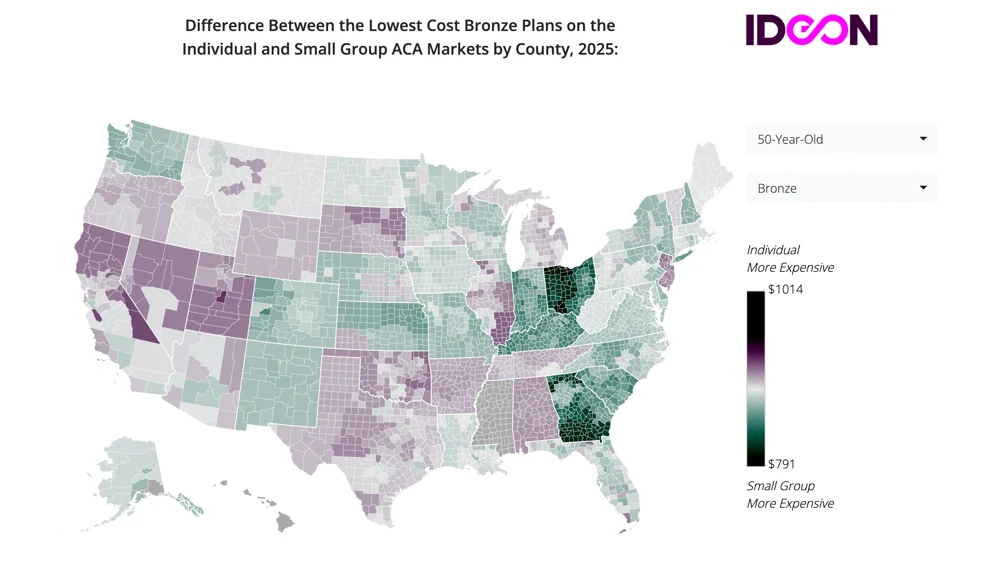
More than 60% of the U.S. is ICHRA-friendly in 2025

This year, our interactive map reveals exciting new insights into the ICHRA landscape:

📍 For bronze-level plans, 33 states are now “ICHRA-friendly” — up from 31 last year.
📍 Looking at silver-level plans, 21 states have market dynamics favorable to ICHRAs, up from 17 in 2024.

This map is an essential tool for benefits professionals to pinpoint where individual health insurance premiums are more affordable than small group market rates, suggesting opportunities for ICHRA adoption.

🔗 Explore the map here. Plus, you can see how the market has shifted since the inception of ICHRAs.

Explore Ideon’s ICHRA solutions  here.

Webinar: From Risk to Resolution—How EOI Auditing Protects Carriers & Members

Ideon and Prudential explore a new, proactive approach to uncovering EOI errors—before they cause claims issues.

Eliminating EOI Data Risk: Why Carriers Need EOI Auditing Now

Table of Contents

Managing Evidence of Insurability (EOI) data has become a critical—and challenging—priority for group benefits carriers. Traditional EOI processes often result in errors that expose carriers to significant risks, from Department of Labor (DOL) fines to reputational harm and poor member experiences.

This guide dives into the risks hiding within routine EOI data processing. We’ll examine why carriers struggle to identify missing EOI before it’s too late, and reveal how advanced EOI data auditing prevents errors, mitigates risk, and helps carriers stay ahead in a competitive market.

The Status Quo: Challenges in Identifying Incomplete EOI

Most carriers can’t effectively detect and resolve instances where a member has enrolled in coverage that requires EOI but hasn’t completed the EOI process. This problem is more common than many realize and has far-reaching implications.

The Problem: EOI errors are difficult to detect

      • Enrollment With Incomplete EOI: Members often select life or disability coverage that exceeds guaranteed issue amounts, triggering the need for EOI. However, due to gaps in enrollment data exchange, complex plan eligibility rules, the BenAdmin misconfiguring plans in its system, or miscommunication, the member may not complete the required EOI process.
      • Invisible Discrepancies: These incomplete EOI cases frequently go unnoticed because carriers rely on manual checks or systems that can’t flag these discrepancies.
      • Delayed Detection at Claims Time: The failure to identify these issues means that carriers often discover them only when a claim is filed. At this point, it’s too late to rectify the oversight without causing delays and member dissatisfaction.

The Impact: What happens when EOI errors go unnoticed

      • Financial Risk: Carriers can face lawsuits and fines from the Department of Labor (DOL) if claims are denied due to missing EOI, especially if the member was paying a premium for supplemental coverage. In just the last two years, several large carriers have reached settlements with the DOL over their EOI practices.
      • Poor Claims Experience: Mistakes in EOI collection lead to negative member experiences, especially at claims time—when a slow process or wrongly denied claim can be disastrous for the member and their family. And, these negative experiences could result in brokers and employers taking their business elsewhere.
      • Reputational Damage: Brokers increasingly prioritize carriers with automated, advanced EOI capabilities. Those who don’t meet this expectation may find themselves losing out on key business opportunities and RFPs

Simply put, the status quo is no longer sustainable for carriers looking to remain competitive and compliant in the modern benefits landscape.

Making EOI Data Management a Strategic Priority

The consequences of mishandling EOI are extensive. But there’s light at the end of the tunnel — carriers, with the right auditing technology, can solve EOI data challenges and mitigate risk. Here’s why it should be a top priority:

      • Rising Demand for Automation: Brokers and employers expect streamlined, automated EOI processes to enhance the member experience, speed up enrollment, and reduce errors. Some RFPs even request information about EOI automation, including API capabilities.
      • Revenue Growth Opportunities: Carriers that simplify EOI processes see higher adoption rates for supplemental benefits like life and disability coverage—opening new revenue streams.
      • Mounting Regulatory Pressure: With increased scrutiny from the DOL, carriers face a higher risk of costly fines and reputational damage if EOI data errors aren’t addressed proactively.

EOI Audit by Ideon: An Industry-First Solution to De-Risk EOI Data

Better technology is the only way to minimize the financial and reputational risk of EOI errors.

Ideon’s EOI Audit solution offers a unique, automated approach to solving this industry-wide challenge. It addresses two key areas: data auditing and decision return. Here’s how it works:

      • Identifies Members Requiring EOI: Ideon’s system pinpoints members whose elections require EOI.
      • Audits Groups for Missing EOI: The audit function flags members who require EOI but didn’t complete it. Errors and discrepancies include why someone needs EOI, based on the carrier’s plan eligibility rules, decisions already in the carrier’s system, and group enrollment data.
      • Error Resolution: All discrepancies are surfaced through automated reports and dashboards. Each issue has a clear, actionable resolution path, allowing carriers to avoid downstream problems.
      • Decision synching: EOI statuses and decisions are synched between carriers and BenAdmin platforms, ensuring up-to-date, accurate data across all systems.

This process not only improves data accuracy but also prevents costly errors that lead to DOL fines and poor member outcomes.

Results with EOI Audit

By implementing Ideon’s EOI Audit solution, carriers not only improve compliance and enhance claims experiences, but also strengthen their competitive position by offering a more reliable EOI process. Here are the key benefits they can expect:

      • Risk Mitigation: Proactively address EOI discrepancies to avoid DOL fines, reputational harm, and operational disruptions.
      • Faster Resolution: Early detection and actionable insights mean carriers resolve EOI discrepancies quickly, avoid downstream problems, and process claims accurately.
      • Stronger Market Position: Showcase advanced EOI capabilities to stand out in RFPs, win more business, and build stronger broker relationships.

Success in Action: How Prudential is Using Ideon’s EOI Audit Solution

Carriers like Prudential are already seeing positive results with Ideon’s EOI Audit solution. As Sherri Bycroft, Director of Benefit Technology Partnerships at Prudential, shared in a recent Ideon Insights interview:

“We’re really excited about the fact that it’s going to flush out issues much earlier on,” she said. “We can have full confidence that we have the right information about the members in our system, and at the time of claim, be able to pay that without delays.”

Get a Demo of EOI Audit by Ideon

See how Ideon’s EOI Audit solution can help you reduce risk, identify missing EOI, and provide a better claims experience. Schedule a demo below.


Employee Spotlight: Christie Lickert

At Ideon, we’re proud to have such a talented, diverse team leading the charge for a better and more connected health insurance and employee benefits industry. Our ongoing Employee Spotlight series showcases the people behind our product and unveils what life is like at Ideon. Next up… Christie Lickert, our Senior Operations Analyst!

Name: Christie Lickert
Department: Enrollment Operations
Title: Senior Operations Analyst
Location: Omaha, NE

Work

How long have you worked at Ideon?

I have worked at Ideon in Enrollment Operations for two years.

Tell us about your day-to-day.

I work with carriers and platforms, specifically with configurations for EDI and API feeds. Each day, the work I do is different. I can be working on anything from a brand-new implementation with testing to creating documentation on processes and training new team members.

What projects are you excited to work on?

I love working on projects that are challenging and give me a sense of accomplishment. I enjoy it when I can contribute to solving issues with an out-of-box approach.

What excites you about the future of Ideon?

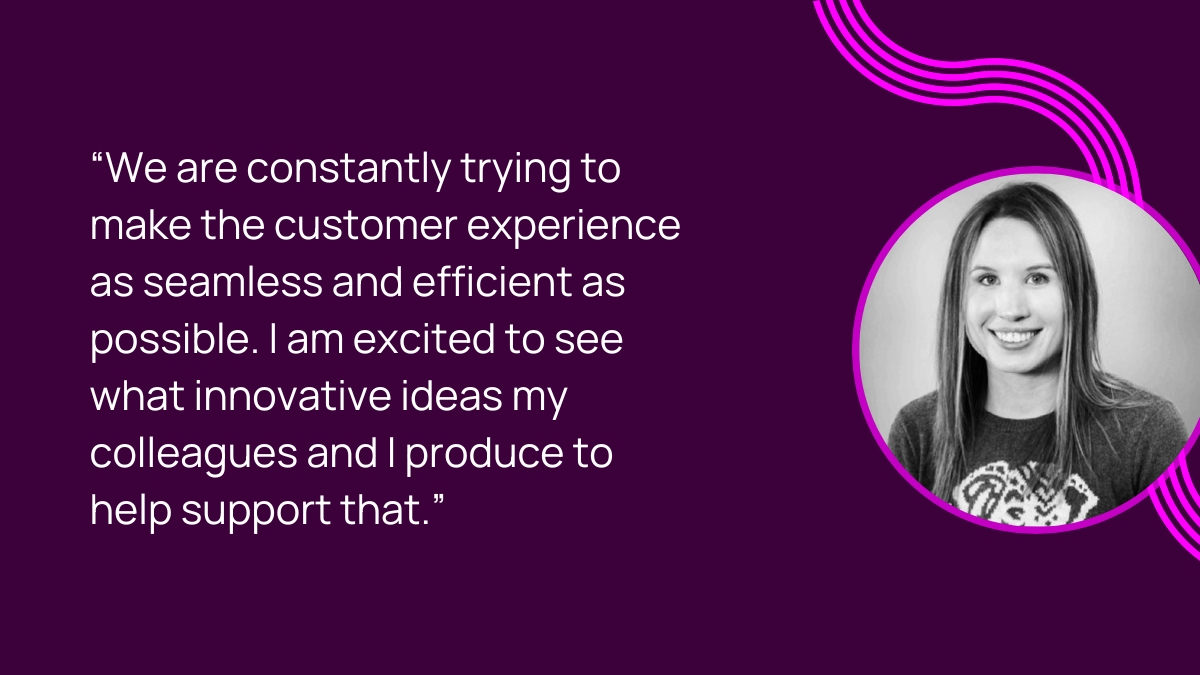
Ideon has many partnerships that are so influential to the growth of our company. We are constantly trying to make the customer experience as seamless and efficient as possible. I am excited to see what innovative ideas my colleagues and I produce to help support that.

Describe your onboarding experience.

What’s great about Ideon is that we have every new employee meet with each department to get a look at what we do. It was interesting and informative to see what each team member’s purpose is. The team is also very welcoming and inclusive. Ideon is very thorough with onboarding and makes sure everyone has what they need to be successful.

Life

Favorite activity when you’re not working? 

I love reading and am part of a book club. My favorite genre of books is a tie between autobiographies and thrillers.

Favorite place you’ve traveled?

My favorite place I have traveled to is Sedona, Arizona. I absolutely love the red rock and enjoyed going on a “Pink Jeep Tour” which drove me up and down cliffs.

Interesting fact about yourself… Go!

I am obsessed with the Golden Girls. I still have all their box set DVDs, and my first dog was named after Sophia Petrillo.


Webinar: The Future of Group Benefits Quoting

How are quoting platforms transforming the ancillary and voluntary benefits space?

Carriers and brokers are rapidly evolving their engagement—and third-party quoting platforms are at the heart of this shift. Join this webinar as experts from Guardian, Acrisure, and Ideon explore how these platforms are shaping the future of group benefits quoting.

🗓 Date: Tuesday, Oct. 22
🕒 Time: 1:00 PM ET
👉 Register here.

What you’ll learn:

  • The rise of quoting platforms and their role in benefits distribution
  • How carriers are partnering with platforms to reach more brokers
  • Key opportunities in the small group market
  • Success stories and trends
  • How APIs and automation are streamlining group benefits quoting

De-risk Your EOI Data: Introducing IdeonEOI

IdeonEOI detects missing and incomplete EOI, protecting carriers from unrecognized risk.