
Why Provider Data Accuracy Matters for Healthcare Navigation Platforms

Article Summary:

Provider data accuracy is the make-or-break factor for healthcare navigation platforms. Bad records (wrong specialty, stale locations, missing credentials) derail patient journeys, inflate ops costs, and create compliance risk.

This guide shows how to reach ~99.5% integrity with a unified schema, normalization and ontology mapping (e.g., SNOMED/FHIR), automated deduping and primary-source verification, versioned audit trails, and real-time validation/monitoring—so your recommendations, eligibility checks, and claims workflows stay trustworthy at scale. 

Provider data quality is the single biggest source of friction – and failure – for health care navigation platforms at scale. Incorrect specialties, outdated locations, or missing credentials in a provider record lead to broken patient experiences, compliance headaches, and unforeseen operational costs. For CTOs, product managers, and platform architects, delivering real-time, reliable provider data is not just a workflow enhancement – it’s the foundation that determines whether your navigation system can be trusted to make critical care recommendations.

This technical guide breaks down the data accuracy standards, normalization frameworks, and automation strategies that enterprise platforms use to achieve 99.5% provider data integrity, maintain digital record consistency, and support robust practitioner profile validation – at volume and speed. If your roadmap depends on trusted provider information, here’s how to build it right.

Understanding health care navigation provider data quality

Health care navigation provider data quality measures the accuracy, completeness, and ongoing maintenance of information tied to practitioners – such as specialties, locations, credentials, and network participation. Enterprise benefits platforms and navigation systems rely on this data to power provider search, plan recommendations, and care guidance. When a provider’s record is inaccurate or incomplete, digital record consistency breaks down: patients may be routed to outdated locations, matched with out-of-network practitioners, or denied timely access to care.

The cost of low-quality provider data goes beyond administrative friction. Incorrect specialties or misclassified network status can cause delays, denied claims, and misinformed care decisions. Practitioner profile validation is critical; even a single error can erode trust and trigger compliance risks for carriers and benefits technology platforms. As the industry moves towards real-time, API-driven data exchange, the need for comprehensive provider record enrichment and automated validation has become a technical mandate.

    • Accuracy: Provider details – such as specialty, location, network participation, and credentialing status – must be correct and up to date for safe patient guidance.
    • Completeness: Every practitioner profile needs all critical fields populated, from NPI to accepted plans and availability.
    • Timeliness: Updates to status, contact information, and network participation should be reflected in near real time.
    • Standardization: Data formats and terminologies must be normalized to a unified schema for consistent processing across platforms.
    • Traceability: Every data change should be auditable, with a clear record of source, timestamp, and update reason.

High-quality provider data underpins the reliability of navigation platforms. Consistent, validated, and enriched records enable accurate search, credentialing, and care recommendations – delivering the confidence technical leaders need to build scalable, compliant, and user-centric health benefits experiences.

Challenges impacting provider data quality in health care navigation

Provider data quality in health care navigation is undermined by fragmented processes and inconsistent data entry. Manual workflows across departments and disconnected systems introduce duplicate records, conflicting provider profiles, and errors in network participation status. Without systematic digital health record cleansing and network roster auditing, inaccuracies quickly propagate, compromising medical network record integrity and leading to misrouted care or denied claims.

Legacy infrastructure compounds these problems. Many organizations still rely on outdated ETL tools, multiple subsystems, and hundreds of loosely integrated database tables. These architectures create data silos and batch processing backlogs, making near real-time updates nearly impossible. Infrequent data refreshes – sometimes only monthly – make it difficult to reconcile records or maintain a reliable single source of truth, resulting in slow error remediation and persistent inconsistencies.

Complex coding standards and healthcare ontologies further complicate data normalization. Variations between US-based codes, SNOMED, and local adaptations require constant mapping and validation. Incompatible data structures and evolving standards create interoperability gaps, forcing manual reconciliation and increasing the risk of errors slipping through. This complexity drives up operational burden and slows platform scalability.

ChallengeImpactExample
Duplicate Provider RecordsFragmented network roster; confused patient searchSame practitioner listed multiple times with different specialties or locations
Infrequent Data UpdatesOutdated or stale provider information in navigation toolsNew providers not appearing, or terminated practitioners still searchable weeks after changes
Identity VerificationEnsures provider credential and NPI accuracyNPPES API, third-party verification services
Legacy System ConstraintsSlow processing and delayed data synchronizationBatch jobs extend processing to days, delaying access to updated network rosters
Ontology and Coding MismatchesInconsistent data normalization, increased manual reconciliationConflicting specialty codes between SNOMED and local system implementations

Legacy infrastructure limitations

Legacy system constraints directly impact provider data quality by introducing slow processing cycles and inconsistencies. Many healthcare organizations still operate with multiple subsystems, each maintaining hundreds of database tables. This fragmented environment leads to infrastructure processing delays as data must be consolidated and reconciled across silos. Batch processing jobs, often running nightly or even weekly, make it impossible to deliver real-time provider updates or correct errors quickly.

Outdated ETL tool limitations further degrade data quality. Older ETL frameworks lack modern validation, transformation, and automation features required by navigation platforms. As a result, errors and inconsistencies slip through the cracks, requiring manual intervention to resolve. These manual processes stretch IT resources and increase the risk of incorrect provider information being surfaced to end users.

System integration challenges are multiplied when legacy subsystems are involved. Incompatible data formats, limited API support, and inadequate error handling force organizations to build complex, fragile integration layers. This not only slows down onboarding of new data sources but also undermines the reliability and scalability of healthcare navigation systems.

Coding and ontology complexity

Healthcare navigation platforms face significant data standardization challenges due to disparate healthcare coding standards and ontologies. Each carrier, EMR, and health system may use a different schema or classification – ranging from SNOMED CT and FHIR to proprietary or locally adapted codes – creating barriers to seamless ontology interoperability.

Mapping between these systems is not a one-off project. Regional coding variations, ongoing updates to standards, and custom implementations require constant maintenance. SNOMED FHIR integration, for example, demands precise mapping to avoid data loss or misclassification when synchronizing provider records across platforms.

These coding complexities directly impact navigation platform data consistency. Inconsistent mappings lead to mismatched specialties, incorrect provider attributes, and unreliable search results. As new standards evolve and local adaptations proliferate, integration complexity multiplies, making scalable, real-time interoperability a persistent technical challenge.

Common data quality issues

Provider data quality problems undermine the reliability of health care navigation platforms at scale. Duplicate records, outdated contact details, and inconsistent network participation status are the primary sources of data consistency issues. These provider information errors directly impact user experience and operational outcomes.

Duplicate provider records fragment profiles, leading to multiple, conflicting entries for the same practitioner. Outdated contact information results in failed appointment bookings and erodes trust in the platform. Incorrect network participation status causes insurance verification failures and unexpected patient costs. Missing specialty information leads to poor provider matching and inaccurate care recommendations.

Data Quality Problem Impact on Navigation Example
Duplicate Provider Records Confused user experience, fragmented provider history Same doctor listed twice with different specialties
Outdated Contact Information Failed appointments, lost patient trust Phone number no longer in service
Incorrect Network Participation Insurance claim denials, unexpected costs Provider shown as in-network after contract termination
Missing Specialty Information Poor provider recommendations, inaccurate matching Users can’t filter search by needed specialty

Systematic quality improvement is required to address these recurring data consistency issues and support reliable healthcare navigation.

Data normalization and standardization for provider data quality

Normalization and standardization are essential for transforming fragmented provider records into a unified, actionable data asset across healthcare navigation systems. Information normalization techniques align data formats, field definitions, and terminologies from hospitals, EMRs, telehealth, and insurance carriers. By consolidating provider attributes – such as specialties, locations, and network participation – into a single schema, platforms eliminate conflicts introduced by source-specific formats and legacy system quirks. This alignment reduces provider mapping analytics complexity, streamlining eligibility record standardization and digital claims standardization workflows.

Standardization addresses a second layer of complexity: diverse healthcare ontologies and coding systems. Platforms must interpret and reconcile data from standards like SNOMED and FHIR, along with regional or proprietary formats. A metadata-driven schema on read, coupled with logical data zones (raw, staged, gold), ensures that both structured and unstructured data are consistently ingested, validated, and enriched. Enhanced fuzzy matching algorithms raise provider matching accuracy from under 80% to 95%, while robust data lineage and provenance features track every transformation for audit and compliance. These health data standard metrics are critical for supporting real-time navigation, eligibility checks, and claims workflows.

Normalize all provider data to a unified schema before ingestion, addressing field discrepancies and terminological conflicts.

Implement metadata-driven processing to separate raw, staged, and final (gold) data zones for quality control and auditability.

Apply advanced fuzzy matching algorithms to unify duplicate provider records and improve mapping accuracy.

Map and validate all provider data against established coding standards (such as SNOMED, FHIR) for interoperability.

Capture detailed data lineage and provenance at every transformation step to support compliance and troubleshooting.

Aligning disparate data sources

Normalization techniques are the backbone of data source alignment for healthcare navigation platforms. Provider data integration requires reconciling formats and terminologies from hospitals, EMRs, telehealth systems, and insurance carriers. Without a unified approach, inconsistent identifiers, specialty codes, and contact details erode multi-source normalization efforts and lead to unreliable search, eligibility, and claims workflows.

To achieve healthcare data consolidation, integration processes must handle varying data structures and field mappings. This means standardizing provider identifiers, unifying specialty classifications, and transforming contact information into a single, consistent schema. Automated data pipelines resolve conflicts by scoring data quality, prioritizing authoritative sources, and eliminating duplicates to create a reliable provider profile.

Consistent provider information depends on strict consolidation requirements: conflict resolution logic, continuous validation, and synchronized updates across all input sources. By enforcing these standards, navigation platforms deliver accurate, up-to-date provider records – removing ambiguity and supporting every eligibility check, appointment booking, and care recommendation.

Implementing standardization frameworks

Standardization frameworks are essential for eliminating fragmentation across healthcare navigation platforms. By adopting industry standards such as SNOMED and FHIR, organizations align diverse coding systems into a unified structure that supports true interoperability. This approach reduces integration friction and delivers a consistent data layer across internal systems and external partners.

Effective framework implementation depends on robust mapping between coding systems, ongoing compliance with evolving standards, and proactive management of version updates. Terminology management and automated code validation ensure that provider records remain accurate and consistent, even as carriers and networks adopt new codes or make schema changes.

Interoperability standards power seamless data exchange between navigation platforms and external systems. Standardization processes – such as cross-reference maintenance and validation routines – safeguard data quality and prevent inconsistencies from propagating across provider profiles, supporting reliable search, eligibility, and claims workflows at scale

Best-practice normalization techniques

Normalization is the backbone of scalable, high-quality provider data infrastructure. Leading platforms use automated data processing and quality improvement techniques to consolidate, validate, and enhance provider records at scale. These proven methods deliver consistent, reliable data for healthcare navigation and benefits platforms.

Metadata-driven schema on read: Ingest both structured and unstructured data by applying a flexible schema at processing time, eliminating rigid requirements and reducing onboarding friction for new data sources.

Logical data zones: Partition data into raw, staged, and gold layers to isolate ingested records, execute validation and enrichment, and only promote high-quality data to active use, supporting systematic provider data enhancement.

Enhanced fuzzy matching algorithms: Leverage advanced pattern recognition to unify duplicate records and reconcile minor discrepancies, raising provider matching accuracy from 80% to 95%.

Data lineage tracking: Maintain a full audit trail of every transformation, mapping each change by timestamp and source for regulatory compliance and rapid debugging.

Automated quality scoring: Continuously score provider records against accuracy and completeness benchmarks, triggering automated remediation workflows for any data falling below thresholds.

These normalization steps form the technical foundation for trustworthy provider data, reducing manual intervention and powering real-time, scalable healthcare navigation.

Automated verification, auditing, and data quality monitoring

Automated record deduplication and real-time data inspection are now critical for provider data accuracy at enterprise scale. Modern systems process up to 30,000 automated updates monthly, eliminating the delays and error rates that plague manual call center verification. Real-time validation rules and stateful transformations identify inconsistencies as they occur, locking in data accuracy and reducing operational overhead. Every update is logged, maintaining 10–12 historical versions of provider records for instant rollback and full audit trail reliability.

Centralized analytics environments deliver continuous provider audit methodology and data flow optimization. Real-time dashboards monitor data quality metrics, giving technical teams immediate insights and the ability to act on anomalies before they disrupt downstream workflows. Audit trails track every data change – timestamp, source, transformation – ensuring compliance and supporting rapid troubleshooting. Automated verification, historical versioning, and real-time monitoring together create a closed feedback loop, sustaining high-quality provider data across navigation platforms.

Replacing manual verification processes

Automated verification systems transform large-scale data maintenance by replacing manual review with continuous, rules-driven processes. These systems support thousands of provider updates each month, enabling platforms to validate credentialing status, network participation, and contact information through direct API integrations – without relying on legacy spreadsheets or call center teams.

Process automation eliminates manual data entry and reduces error rates across provider databases. Credential and participation checks are triggered in real time as new data arrives, accelerating update cycles and ensuring current information is always available to users. This approach delivers substantial operational efficiency: high-volume data maintenance is achieved without expanding staff, freeing technical teams to focus on infrastructure improvements rather than routine data cleansing.

Scalable verification workflows ensure that as provider directories grow, data quality remains high – supporting reliable navigation, eligibility, and claims processes at enterprise scale.

Centralized analytics environments deliver continuous provider audit methodology and data flow optimization. Real-time dashboards monitor data quality metrics, giving technical teams immediate insights and the ability to act on anomalies before they disrupt downstream workflows. Audit trails track every data change – timestamp, source, transformation – ensuring compliance and supporting rapid troubleshooting. Automated verification, historical versioning, and real-time monitoring together create a closed feedback loop, sustaining high-quality provider data across navigation platforms.

Real-time validation and quality control

Real-time data validation drives accuracy by detecting errors and inconsistencies at the moment provider records are ingested or updated. Automated validation rules check for missing fields, invalid credentials, and mismatched network status before information enters the navigation platform, preventing error propagation and eliminating the need for manual review cycles.

Stateful data transformations enable platforms to continuously track changes and maintain accurate provider histories. Each update is evaluated in context – comparing new input against existing records – so that only verified changes are accepted. Quality control automation runs in parallel, scanning for duplicate entries, conflicting specialty codes, or outdated contact details, and triggering real-time correction workflows.

This approach reduces operational burden by eliminating manual intervention and accelerating error resolution. Immediate feedback loops empower technical teams to sustain high data accuracy standards, while navigation users benefit from reliable, up-to-date provider information with every search or eligibility check.

Enterprise verification methods

Enterprise healthcare navigation platforms depend on verification approaches that deliver real-time accuracy and measurable data quality improvements across provider records. Automated record deduplication leverages machine learning algorithms for continuous, high-volume processing, reducing duplicate provider profiles by 90%. Primary source verification uses API integrations with credentialing authorities, providing weekly updates and sustaining 95% credential accuracy. Network participation validation is driven by daily checks against insurance carrier APIs, ensuring live network status and minimizing outdated participation errors for users and administrators.

These enterprise-grade verification specifications are critical for optimizing data quality measurement and sustaining platform reliability at scale.

Integration techniques and API infrastructure for provider data quality

API-driven carrier coordination is the backbone of scalable, reliable provider data in modern healthcare navigation. Unified APIs integrate data from hospitals, EMRs, telehealth platforms, and insurance carriers, eliminating custom point-to-point connections and reducing operational overhead. With a single interface, platforms can access normalized, real-time provider profiles – removing the complexity of managing hundreds of disparate data feeds. Standardized APIs power over a million requests monthly, enabling navigation system interoperability and seamless interface connectivity at enterprise scale.

Modern benefits connectivity architecture leverages control planes, structured streaming, and Delta Lake frameworks to synchronize provider data with high throughput and consistency. Distributed processing and event-driven data flows ensure that eligibility checks, claims processing, and provider lookups reflect the most current network participation and credentials. API-driven systems enforce compliance, deliver built-in audit trails, and scale on demand, making them essential for platforms that require real-time data accuracy and uptime during peak enrollment or regulatory cycles.

Real-time carrier connectivity: Instantly synchronize provider networks for eligibility, claims, and search workflows.

Standardized data formats: Normalize provider attributes, specialties, and credentialing status across every integrated source.

Scalable request handling: Support millions of transactions monthly without performance degradation.

Compliance-ready architecture: Maintain audit trails, data security, and regulatory adherence across all data exchanges.

This infrastructure transforms provider data from a bottleneck into a competitive advantage, delivering reliability, speed, and accuracy for every healthcare navigation use case.

Unified API architecture for data integration

Unified API architecture transforms healthcare data integration by centralizing provider data from hospitals, EMRs, telehealth platforms, and insurance carriers into a single, accessible layer. This approach eliminates the need for custom integrations with each partner, streamlining provider data consolidation and ensuring every navigation system operates from a single source of truth.

Standardized endpoints and consistent data formats simplify onboarding and maintenance, while unified authentication mechanisms secure every connection and reduce the engineering effort required to manage credentials across sources. Integration capabilities extend to real-time data synchronization and automated updates, so every change – whether a new provider joins the network or a credential is updated – immediately propagates across all connected systems.

Consolidation through unified APIs supports seamless navigation capabilities at scale, providing platforms with reliable, up-to-date provider information and accelerating the development of new features and workflows. This architecture is the foundation for responsive, scalable, and future-ready healthcare navigation platforms.

Scalable data exchange infrastructure

Modern architecture frameworks drive scalable data infrastructure for health care navigation, delivering provider data synchronization and high-volume data processing without lag or downtime. Control planes orchestrate data ingestion and routing across distributed systems, ensuring each provider record is processed, validated, and made available in real time.

Structured streaming pipelines ingest and synchronize millions of provider updates monthly, using event-driven workflows to minimize latency and maximize reliability. Delta Lake frameworks provide robust data versioning, transaction consistency, and schema enforcement, making it possible to manage both batch and real-time streams at scale. Distributed processing capabilities automatically scale infrastructure during open enrollment surges or regulatory changes, maintaining data quality standards even during peak loads.

Navigation platforms require this level of infrastructure to manage batch uploads, real-time streaming, and live provider data corrections simultaneously. Automated scaling ensures demand spikes never degrade performance, while event-driven synchronization keeps every provider attribute current and accurate across all connected systems.

Key benefits of API-driven provider data quality

API-driven provider data quality turns fragmented, error-prone workflows into a streamlined infrastructure advantage for navigation platforms. Carrier connectivity, eligibility checks, and provider lookup processes all depend on real-time, normalized data flowing through a scalable architecture. Performance and reliability hinge on these technical fundamentals.

Real-time carrier connectivity delivers immediate updates on provider network participation and eligibility, powering accurate search, claims, and authorization workflows without lag.

Standardized data formats eliminate inconsistencies and conflicts across carrier feeds, enabling seamless integration and reducing the engineering effort required to reconcile differences.

Scalable data architecture supports high-volume queries and transaction spikes – such as during open enrollment – while maintaining sub-second response times and uninterrupted platform operation.

Compliance-ready systems feature integrated audit trails and robust security controls, simplifying healthcare data management and meeting regulatory demands for HIPAA, SOC 2, and other standards.

These advantages enable platforms to scale with confidence, deliver consistent user experiences, and maintain the highest standards of data accuracy and security.

Best practices for maintaining high health care navigation provider data quality

End-to-end system validation and systematic data review are the backbone of benefits operational excellence. Regular audits, automated data cleaning, and compliance-driven verification protocols are essential for sustaining provider data accuracy as platforms scale. Without disciplined accuracy control protocols, even advanced navigation systems become vulnerable to outdated or incomplete provider profiles, jeopardizing user experience and exposing carriers to compliance risks.

Operational teams realize significant data aggregation efficiencies by embedding navigation tools directly into the benefits structure and leveraging trusted provider directories. Hybrid models – where digital automation is paired with human support – ensure routine and complex scenarios are handled with validated, high-quality data. Personalizing provider recommendations through clear communication and attention to social determinants of health further improves accuracy and relevance.

Conduct systematic data reviews and automated validation cycles to catch errors before they impact eligibility, search, or claims workflows.

Integrate trusted provider directories and authoritative data sources for real-time updates and enhanced data reliability.

Implement end-to-end system validation, confirming accuracy from ingestion through user-facing workflows.

Use hybrid verification models that combine digital automation with targeted human oversight for complex or exception cases.

Incentivize high-quality provider selection by surfacing reliable providers and offering cost-sharing advantages to reinforce data-driven decisions.

Operational excellence strategies

Regular audits and automated data cleaning form the backbone of sustainable data quality maintenance in health care navigation platforms. Scheduled quality assessments identify inconsistencies before they impact users, while automated error detection removes manual bottlenecks and drives continuous data correction. These operational excellence approaches support scalable, high-performing systems capable of adapting to new data sources and network changes without compromising provider data integrity.

Systematic validation processes are critical for ongoing quality assurance. Automated validation routines monitor provider records for missing credentials, outdated contact details, or mismatched network participation, triggering proactive updates and corrections. Comprehensive monitoring and performance tracking ensure that every data change meets strict quality standards, reducing manual intervention and maintaining reliable, up-to-date provider information for navigation users. Sustainable quality workflows like these underpin platform reliability and support long-term operational success.

Integration and validation approaches

Integrating navigation platforms with trusted provider directories is foundational for data reliability enhancement. Direct connections to authoritative sources – such as national registries and leading carrier-maintained directories – ensure that every provider record is anchored to the most current and accurate information available. Primary source verification systems validate credentials, network participation, and status changes in real time, reducing the risk of outdated or incorrect provider details reaching end users.

Comprehensive validation approaches combine automated directory updates, real-time verification checks, and multi-source data reconciliation processes. Automated workflows systematically cross-reference provider information across multiple databases, flagging discrepancies and triggering corrective actions before issues impact user experience. Consistent accuracy verification and trusted source prioritization build user confidence, as navigation platforms can demonstrate that every provider recommendation is rooted in validated, up-to-date data. This level of integration and validation is essential for delivering reliable, scalable healthcare navigation.

Proven data quality best practices

Modern health care navigation platforms rely on disciplined operational and technical practices to maintain high standards for provider data validation and quality assurance automation. The following best practices drive sustained data quality, reduce manual intervention, and support scalable growth for benefits platforms and carriers:

Automated daily validation: Run real-time data checks against primary sources to continuously verify provider credentials, network participation, and contact details, reducing lag and error rates in provider directories.

Multi-source data reconciliation: Cross-reference provider information across multiple authoritative databases to identify discrepancies, unify fragmented records, and enforce data consistency at scale.

User feedback integration: Capture reports from end users and administrators to flag data inconsistencies, enabling crowd-sourced correction and rapid resolution of emerging quality issues.

Hybrid verification models: Combine automated quality assurance with targeted human oversight for complex cases – such as conflicting specialties or credential changes – where manual review ensures data integrity.

Incentive-based data accuracy: Prioritize high-quality provider records in search rankings and recommendations, and structure incentives to encourage ongoing data quality improvements from network partners and contributors.

Implementing these practices creates a comprehensive quality management system that delivers reliable, high-accuracy provider data for every navigation workflow.

Measuring and benchmarking provider data quality in navigation systems

Dashboards for quality metrics are central to provider data quality benchmarking in healthcare navigation platforms. Organizations rely on real-time analytics to assess the critical dimensions of information accuracy, record matching efficiency, and health plan integration metrics. With modern infrastructure supporting high-velocity data loads – up to 20 million records in 20 minutes – technical teams can track and benchmark performance at scale. Metrics are visualized in centralized dashboards, allowing rapid detection of anomalies and immediate operational response.

Continuous improvement and regulatory alignment depend on ongoing measurement against these benchmarks. Detailed lineage and provenance tracking are embedded in reporting workflows, ensuring every attribute meets compliance requirements and supports transparent, audit-ready quality management.

Analytics and monitoring infrastructure

Centralized analytics monitoring infrastructure delivers real-time operational visibility into provider data quality metrics for healthcare navigation platforms. Dashboards aggregate performance data, status alerts, and trend analysis, enabling technical teams to pinpoint anomalies and data integrity issues as they arise.

Operational visibility systems integrate automated alerting and real-time tracking to flag quality deviations before they impact users. Comprehensive reporting capabilities empower teams to drill into data quality metrics, identify recurring patterns, and prioritize remediation based on business impact.

Analytics capabilities extend beyond basic measurement, supporting predictive quality monitoring and proactive issue resolution. Trend analysis surfaces potential risks early, while automated correction workflows address errors at scale. This infrastructure underpins rapid response capabilities and enables continuous quality improvement, ensuring provider data remains reliable, current, and actionable for every navigation workflow.

Key data quality metrics

Data quality measurement criteria are foundational for maintaining accuracy and reliability across health care navigation platforms. Tracking the right performance metrics ensures that provider information remains actionable and trustworthy at scale. To meet operational and compliance requirements, platforms should monitor data accuracy, completeness, timeliness, and matching efficiency – each mapped to clear benchmarks and measured with specialized quality assessment tools.

Performance tracking metrics like these allow technical teams to identify gaps, automate quality assurance, and maintain provider information benchmarks across the entire navigation stack.

Continuous improvement and compliance

Continuous quality improvement is mandatory for maintaining healthcare data accuracy and supporting patient safety requirements. Navigation platforms must implement regular quality assessments, compliance monitoring, and systematic enhancements to data validation procedures, ensuring that provider information remains current and reliable as new data sources or regulations emerge.

Regulatory compliance alignment is non-negotiable. Every update to provider records must meet rigorous healthcare data standards and audit requirements, including HIPAA, SOC 2, and relevant state or federal mandates. Compliance frameworks are built into the infrastructure, enforcing data protection, privacy, and quality protocols at every stage. Comprehensive quality management systems safeguard patient safety and operational integrity, positioning the platform to respond rapidly to regulatory changes or audit demands.

How Ideon ensures superior provider data quality

Ideon provider data quality is built on a comprehensive data infrastructure that delivers continuous validation, normalization, and enrichment across all connected carriers and networks. Through a unified API, Ideon streamlines access to clean, normalized provider data – eliminating the integration and maintenance challenges that strain engineering resources at benefits platforms and carriers.

Real-time data accuracy is achieved by synchronizing provider information as soon as updates occur, ensuring every navigation workflow – eligibility checks, provider search, or claims – uses current and validated records. Automated verification processes monitor each data change, leveraging enterprise-grade quality assurance to detect errors, enforce compliance protocols, and maintain data lineage for full auditability.

Every API response is designed for reliability and speed, supporting scalable healthcare navigation and reducing the operational burden on technical teams. Developer-friendly documentation and support resources accelerate platform development, letting product teams focus on innovation instead of managing data complexity. Ideon’s architecture transforms provider data quality from a problem to a solved infrastructure standard..

Comprehensive data infrastructure and validation

Ideon’s unified API infrastructure delivers continuous data validation, normalization, and multi-carrier data enrichment at scale. Every provider record is automatically checked against quality standards – across hundreds of carriers and networks – using real-time validation processes that catch errors before they disrupt eligibility, search, or claims workflows.

The infrastructure supports comprehensive data enhancement by ingesting, transforming, and enriching provider data from all integrated sources. Automated quality checks and normalization routines ensure that records remain consistent, regardless of carrier-specific formats or network changes. This systematic approach guarantees that every navigation platform receives reliable, up-to-date provider information with minimal engineering effort.

Multi-carrier integration means platforms benefit from broad coverage and a single, standardized data model. Consistent quality assurance is built in, reducing operational overhead and accelerating the deployment of new navigation features. Unified APIs abstract away complexity, enabling technical teams to build on a foundation of trusted, always-current provider data.

Real-time data accuracy and freshness

Real-time data synchronization keeps provider information current and accurate across every connected healthcare navigation platform. IDEON’s infrastructure pushes immediate updates for provider status changes, network participation modifications, and contact detail corrections, so users and systems always operate on the latest available data.

Accuracy maintenance systems continuously monitor incoming information, trigger automated validation checks, and perform real-time correction of any inconsistencies. This automated, event-driven process eliminates manual intervention and reduces the risk of outdated or erroneous provider details surfacing in user workflows.

Integrated platform updates ensure that every change – regardless of origin – propagates instantly throughout the ecosystem. This approach delivers reliable, up-to-date provider information for eligibility checks, care navigation, and claims processing, supporting operational excellence and user trust at scale.

Enterprise-grade data quality assurance

IDEON’s enterprise data quality standards are enforced through automated verification processes and a compliance-ready architecture that meets the demands of healthcare navigation at scale. Every provider record is validated using built-in quality controls – automated error detection, systematic quality checks, and real-time monitoring ensure sustained data accuracy across all integrated sources.

Comprehensive audit trails and automated compliance monitoring are core components of IDEON’s infrastructure. Every data change is tracked with full data lineage, providing a transparent record of source, timestamp, and modification reason. This makes every aspect of provider data traceable for regulatory review and rapid troubleshooting.

The platform’s architecture integrates robust security frameworks and regulatory compliance measures, supporting HIPAA and SOC 2 requirements. Performance guarantees and continuous quality validation workflows deliver both operational reliability and audit-ready confidence for benefits platforms, carriers, and InsurTech teams building on IDEON’s foundation.

Developer-friendly data access

IDEON delivers developer-friendly APIs that provide clean, normalized provider data, eliminating the friction of integrating with fragmented carrier feeds. With a unified data model, every API response is consistent – no custom mapping or transformation layer required. This simplicity accelerates platform development and reduces engineering overhead.

Comprehensive documentation, live code examples, and a robust sandbox environment give technical teams what they need to move from proof of concept to production in weeks, not months. IDEON’s support resources are built for engineers – offering fast technical support and clear integration guides for each workflow.

Normalized provider data means less time spent resolving format inconsistencies and more time delivering new features. Rapid integration cycles and predictable API behavior let teams focus on user experience and business growth, not data wrangling.

Final words

Tackling the complexities of health care navigation provider data quality means mastering accuracy, consistency, and real-time updates across sprawling, disparate sources.

This article broke down the essential quality attributes, technical barriers, and normalization strategies required for scalable, compliant navigation platforms – while underscoring how automation, unified APIs, and operational best practices transform persistent challenges into competitive advantages.

Reliable provider data quality underpins trustworthy decision support, operational efficiency, and better patient outcomes.

With the right infrastructure and continuous quality improvement, health care navigation provider data quality becomes a foundation for scalable growth and industry leadership.

FAQs

What is data quality in health care?

Data quality in health care measures the accuracy, completeness, and maintenance of provider information – such as specialties, credentials, and locations – essential for reliable health system operations and patient care.

What does PDM mean in healthcare?

PDM in healthcare stands for “Provider Data Management,” which refers to processes and systems that collect, validate, update, and manage healthcare provider information used in claims, credentialing, and navigation platforms.

What are the sources of quality data for healthcare?

Sources of quality healthcare data include provider master files, EMRs, health plan directories, credentialing databases, and third-party data aggregators that regularly update and validate provider information.

What is the quality data model in healthcare?

A quality data model in healthcare defines standardized data structures and rules – such as accuracy, completeness, and traceability – to ensure provider information is reliable, consistent, and interoperable across navigation systems and platforms.

What is the LexisNexis Provider Data and how is it used?

LexisNexis Provider Data is a commercial database aggregating and validating healthcare provider information. It is used by navigation platforms, carriers, and TPAs to enrich, verify, and maintain accurate provider records at scale.

What is the Provider Master File in healthcare navigation?

The Provider Master File is the authoritative repository of healthcare provider records, containing verified details such as specialties, credentials, and network participation, supporting accurate recommendations and benefit administration.

What is H1 Healthcare data in the context of provider information?

H1 Healthcare data focuses on compiling detailed practitioner profiles – including clinical experience and network status – to improve the accuracy and integrity of provider directories and healthcare navigation systems

Choosing the Best Healthcare Provider Search API for Your Navigation Platform

Article Summary:

Point-to-point provider directories can’t keep up with modern health IT. A unified provider search API replaces static lists with real-time, normalized, HIPAA-compliant connectivity—supporting faster integrations, reduced costs, and higher data accuracy. With RESTful endpoints, JSON/XML support, FHIR/HL7 compliance, and scalable architecture, platforms can search, verify, and sync provider data instantly—delivering speed, security, and reliability across benefits, carrier, and care networks

Legacy point-to-point connections, batch directories, and static provider lists can’t keep pace with the demands of modern health IT. As digital platforms scale across multiple carriers and health systems, manual provider directory management introduces risk, delays provider matching, and limits interoperability. A modern healthcare provider search API integration delivers secure, real-time connectivity – enabling platforms to search, verify, and synchronize provider data instantly across the healthcare ecosystem. This technical guide breaks down the architectural fundamentals behind scalable, compliant provider search integrations, including RESTful endpoints, normalized data, and security frameworks, so engineering teams can deliver unified provider lookup at enterprise speed and accuracy

Healthcare Provider Search API Integration: Technical Overview and Core Architecture

Healthcare provider search API integration replaces fragmented, point-to-point connections with a unified framework designed for secure, scalable connectivity across the health benefits ecosystem.

A healthcare provider search API enables real-time lookup and directory management by exposing RESTful endpoints that aggregate provider data from disparate carrier and platform sources. This unified provider lookup framework reduces integration complexity, eliminates the need for custom connectors per carrier, and creates a single, normalized layer for accessing provider networks.

Technical leaders prioritize HIPAA-compliant API architecture. REST endpoints must use secure authentication (OAuth2, API keys) and transmit only encrypted data. Normalized data formats – JSON and XML – are now the standard for interoperability. By normalizing provider data, the API resolves inconsistencies in naming, specialty codes, and credentialing across hundreds of source systems, ensuring downstream applications receive a consistent, reliable view of each provider.

Scalability is achieved through modular architecture, stateless endpoints, intelligent caching, and horizontal scaling. Modern solutions support both multi-vendor and multi-store environments, allowing benefits platforms, TPAs, and carriers to connect to hundreds of networks via a single integration point. This approach reduces operational overhead, shortens implementation cycles, and supports rapid onboarding of new partners.

Unified APIs built on FHIR, HL7, and other industry standards guarantee compliance while future-proofing integrations for regulatory changes. By abstracting carrier-specific protocols, a provider lookup API integration delivers real-time updates, high data accuracy, and secure access – without the need for ongoing point-to-point maintenance.

Key architectural principles for healthcare provider search API integration include:

  • RESTful, secure endpoints
  • Data normalization and mapping
  • Support for JSON/XML formats
  • Scalable, multi-tenant deployment
  • Compliance with HIPAA, FHIR, and HL7 standards

Why Healthcare Provider Search API Integration Matters for Modern Health IT

Healthcare provider search API integration is the cornerstone of efficient, resilient health IT infrastructure. Technical leaders face constant pressure to deliver scalable connectivity and real-time data exchange between carriers, TPAs, and benefits platforms. Point-to-point integrations are slow, error-prone, and unsustainable at scale.

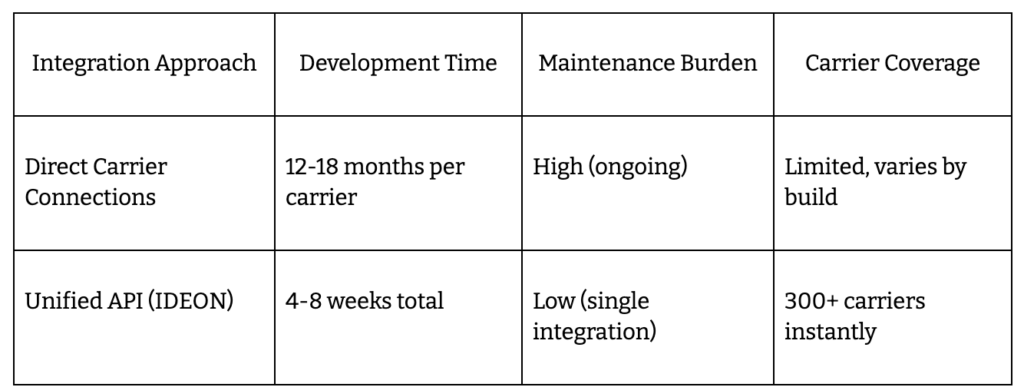
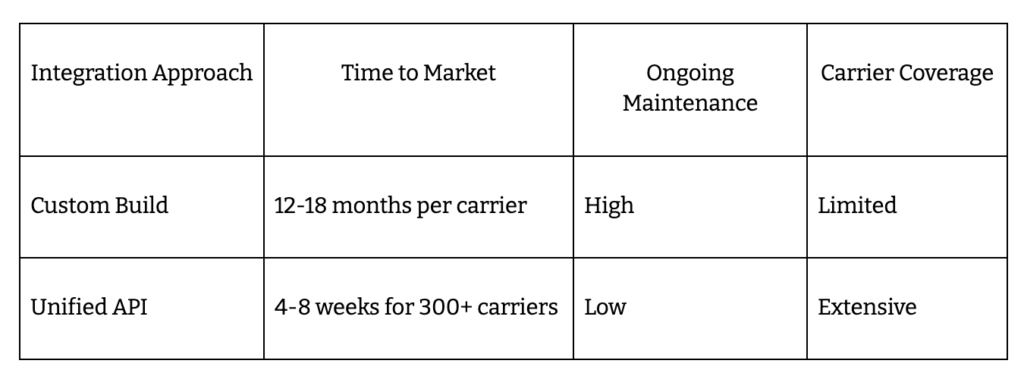
Switching to a unified provider search API transforms delivery timelines and operational economics. Instead of spending 12–18 months building one-off connections, teams can deploy a single integration in 4–8 weeks that unlocks access to hundreds of provider networks. This shift reduces integration costs by up to 75% and virtually eliminates the ongoing maintenance burden of disparate systems.

The impact extends beyond IT budgets. Unified APIs drive higher data accuracy and real-time synchronization, which improves patient safety and care coordination. Automated normalization services standardize provider data, reducing manual intervention and mitigating medical errors. Secure, compliant data exchange is built in, supporting both HIPAA and SOC 2 requirements demanded by modern health benefits connectivity platforms.

Technical and business advantages of healthcare provider search API integration:

  • Accelerates platform launches and feature rollouts with rapid provider network access 
  • Cuts operational costs and integration timelines by consolidating legacy connections  
  • Increases provider data accuracy and reduces manual reconciliation 
  • Supports secure, compliant data sharing across all partners and systems
  • Enhances care coordination and reduces risk of medical errors with up-to-date, normalized provider records

Core Components of a Robust Provider Search API Integration Solution

A scalable, secure provider discovery platform API is built on a foundation of modular, standards-based architecture. The right provider connection architecture delivers real-time search, seamless interoperability, and resilient performance at scale – without sacrificing compliance or developer agility.

Provider data harmonization interfaces standardize the structure, terminology, and attributes of provider data received from hundreds of disparate sources. This normalization eliminates mismatched specialty codes, inconsistent credentialing, and non-standard naming conventions. With a harmonized data model, downstream systems consume a single, reliable JSON or XML schema – enabling rapid integration and reducing manual reconciliation.

Cache acceleration is essential for high-volume, API-enabled provider search platforms. An intelligent caching layer stores recent search results and high-frequency queries, minimizing latency and offloading repetitive requests from source systems. This approach reduces API response times, supports burst traffic during open enrollment, and drives infrastructure efficiency for both partners and end-users.

Compliance with healthcare data standards is non-negotiable. Robust healthcare provider interface solutions must fully support FHIR and HL7 specifications, guaranteeing interoperability with EHRs like Epic, Cerner, Athena, and Allscripts. Secure authentication (OAuth2/API keys), encrypted transmission, and audit logging are required to meet HIPAA and SOC 2 requirements.

Sandbox environments and developer-ready documentation empower engineering teams to test, iterate, and deploy integrations quickly. Leading platforms provide SDKs, sample code, and guided onboarding to streamline the development lifecycle.

Component Function Example Technology
Real-Time Search Instant lookup and filtering of provider networks Elasticsearch, REST API endpoints
Data Normalization Standardizes provider data formats and codes Custom mapping engines, FHIR data models
Identity Verification Ensures provider credential and NPI accuracy NPPES API, third-party verification services
Cache Acceleration Reduces latency and improves performance Redis, in-memory cache layers
Compliance & Security Meets HIPAA, FHIR, HL7, and SOC 2 standards OAuth2, encrypted endpoints, audit loggingd

Step-by-Step Guide to Implementing Healthcare Provider Search API Integration

Engineering teams building scalable and secure provider search experiences need a clear, proven integration path. Accelerating API integration for health directories means reducing risk, deployment time, and manual overhead with a repeatable process and robust support at every step.

  1. 1.Define integration requirements

Identify target use cases, compliance needs (HIPAA, SOC 2), and expected provider data sources. Document user flows, performance targets, and data fields required by downstream systems.

  1. 2. Evaluate and select the provider search API  

Assess leading APIs for medical directory management, focusing on normalization capabilities, real-time search features, and support for sandbox testing. Review documentation, SDKs, and available reference guides.

  1. 3.Provision sandbox and credentials  

Obtain sandbox access and API keys from your chosen platform. Use sample code and SDKs to explore functionality and validate authentication flows.

  1. 4.Configure endpoints and mapping  

Set up endpoint URLs, request parameters, and data field mappings. Leverage provider registry API innovations for normalization and identity verification.

  1. 5.Develop robust error handling

Implement logic for retrying failed requests, handling rate limits, and logging errors. Ensure error responses are actionable for both engineering and support teams.

  1. 6.Enable real-time data synchronization  

Deploy event-driven patterns or polling schedules to keep provider records up to date. Test for latency, data freshness, and system performance under load.

  1. 7.Move to production and monitor  

Transition from sandbox to production, applying API keys and endpoint changes. Monitor API usage, latency, and error rates. Use provider lookup API reference guides to troubleshoot and optimize.

Sample API Call (REST, JSON):

. . . 

GET /api/v2/providers/search?name=smith&specialty=cardiology&location=NY

Authorization: Bearer {api_key}

Accept: application/json

“`  

A stepwise, checklist-driven approach streamlines provider search integration and positions your platform for long-term scalability.

Real-World Use Cases for Provider Search API Integration

Provider search API integration powers seamless, scalable connectivity for both patient-facing and admin-facing health IT platforms. By centralizing and normalizing provider data, these APIs eliminate manual reconciliation, reduce operational overhead, and deliver high-accuracy results – whether for enrollment, care delivery, or claims.

Modern provider matching platform design enables benefits enrollment systems, ICHRA marketplaces, telehealth applications, and payer portals to orchestrate real-time provider lookup and network validation. Platforms like Human API and DrChrono demonstrate the scale of this approach, supporting millions of users and integrating with hundreds of health systems.

  • Benefits enrollment platforms: Instantly validate in-network providers during plan selection, reducing coverage errors and call center volume.
  • Patient care provider search tools: Power digital directories and appointment scheduling with real-time filtering by specialty, location, and network status.
  • Telehealth solutions: Match patients to available, credentialed providers for virtual visits, ensuring compliance with network and licensure rules.
  • Payer and TPA systems: Automate provider eligibility, insurance verification, and referral workflows with seamless provider search orchestration.

Unified APIs now underpin every critical workflow – delivering reliability, speed, and compliance for every stakeholder in the healthcare benefits ecosystem.

Technical Requirements and Integration Considerations for Healthcare Provider Search APIs

Provider search API integration demands a disciplined approach to security, scalability, and data fidelity. Engineering teams must architect for both rapid deployment and long-term reliability – especially when supporting high-volume connectivity across benefits platforms, TPAs, and carrier networks.  

Critical technical requirements for scalable, secure provider search integration:

  • RESTful API endpoints with stateless architecture for horizontal scalability
  • Secure authentication using OAuth2 or API key strategies  .
  • Support for JSON and XML payloads to maximize compatibility 
  • Compliance with HIPAA and SOC 2 for protected health information and audit readiness 
  • High-availability infrastructure with 99.9%+ uptime and automated failover

RequirementIntegration Value
RESTful EndpointsEnables modular, scalable microservices deployment
OAuth2/API Key AuthenticationProtects sensitive data and supports least-privilege access
JSON/XML SupportAccelerates interoperability across legacy and modern systems
HIPAA/SOC 2 ComplianceMitigates regulatory risk and supports partner trust
High AvailabilityDelivers uninterrupted access to provider data

IDEON’s developer resources streamline the integration lifecycle: unified API endpoints, detailed SDKs, and a dedicated sandbox environment for testing and validation. Teams benefit from rapid onboarding, comprehensive documentation, and performance metrics that prove reliability – backed by a 99.9%+ uptime SLA and low-latency architecture.

Common Challenges and Solutions in Provider Search API Integration

consistently slow down provider integration lifecycles. Technical teams must address these issues to deliver reliable, scalable connectivity and seamless provider lookup system compliance

  • Legacy system integration: Bridge EHRs and outdated platforms with middleware that translates legacy protocols into modern API calls.
  • Data format inconsistencies: Deploy normalization engines to standardize provider attributes, codes, and identifiers across disparate sources
  • Network latency and rate limits: Implement intelligent caching and asynchronous sync to reduce round trips and smooth traffic spikes.
  • Maintaining compliance and reliability: Enforce end-to-end encryption, automated audit logging, and continuous monitoring to support HIPAA and SOC 2 requirements

Architecting for reliability centers on modular, microservices-driven infrastructure. Event-driven data sync, stateless endpoints, and distributed cache layers cut latency, mitigate rate limits, and ensure continuous uptime. Well-documented APIs and responsive developer support further accelerate troubleshooting, reducing the friction of onboarding and ongoing maintenance across high-stakes healthcare integrations.

Best Practices for Optimizing Healthcare Provider Search API Integration

Provider search performance optimization depends on proven engineering practices that maximize uptime, data integrity, and deployment speed. Teams building for digital transformation must prioritize efficient provider data synchronization and resilient system architecture from day one.

    1. 1. Use sandbox environments for all integration development and QA to catch issues before production rollout.
    2. 2. Implement robust error handling and clear retry logic to minimize disruptions from transient network or system failures.
    3. 3. Subscribe to real-time webhooks for instant updates to provider records, reducing lag and manual sync cycles. 
    4. 4. Continuously monitor API performance and set SLA alerts to proactively address latency or downtime – aim for 99.999% uptime. 
    5. 5. Enforce consistent data validation and audit logging to maintain a single source of truth and support compliance reviews.

Ongoing monitoring and automated quality checks are critical for reliable provider search system uptime. Proactive performance benchmarking and audit trails enable engineering teams to spot anomalies, maintain data quality, and deliver uninterrupted access for all health benefits stakeholders.

Final Words

Implementing healthcare provider search API integration transforms fragmented data silos into unified, reliable connectivity across platforms.

Technical leaders gain rapid deployment, greater accuracy, and significant operational savings through normalized APIs and modern security structures.

With robust architecture, modular components, and comprehensive documentation, teams can reduce complexity and accelerate scalable solutions for real-world provider search workflows.

Reliable healthcare provider search API integration is now foundational for digital health transformation – delivering speed, compliance, and confidence to every touchpoint in the benefits ecosystem.

FAQs

Q: What is healthcare provider search API integration?

Healthcare provider search API integration is a unified framework that enables real-time provider lookup across multiple health networks, standardizing data formats and streamlining access to up-to-date provider directories through secure REST endpoints.

Q: Are there free healthcare APIs available?

Several open-source and public healthcare APIs are available for non-production use, but enterprise-grade provider search APIs typically require commercial agreements to deliver HIPAA-compliant, highly reliable, and scalable solutions for regulated environments.

Q: How do you integrate a healthcare provider search API using cloud architectures?

API integration with cloud healthcare services involves connecting to secure, scalable REST endpoints, supporting normalized data formats (JSON/XML), and ensuring compliance with standards like FHIR, OAuth2, and SOC 2 for robust cloud implementation.

Q: How does a unified provider lookup API differ from direct EDI connections?

A unified provider lookup API consolidates access to multiple carrier networks using a single standard interface, while direct EDI connections require separate, complex integrations for each network – resulting in longer timelines, higher costs, and more maintenance.

Q: What are common use cases for provider lookup API integrations?

Provider lookup APIs are used for health plan directory management, benefits enrollment, insurance verification, real-time appointment scheduling, and powering digital provider search tools for both administrative systems and patient-facing apps.

Q: What reliability and security metrics should I look for in a provider search API platform?

Look for platforms delivering 99.9%+ uptime, fast API response times, encrypted data transport, robust access controls, and alignment with HIPAA and SOC 2 compliance standards for maximum data integrity and operational stability.

How to Embed ICHRA Logic into Your SaaS Platform: A Developer Guide

Article Summary:

Building ICHRA into a SaaS platform isn’t just connecting to a few insurance APIs—it’s orchestrating eligibility rules, reimbursements, plan sourcing, and compliance under one roof. This guide breaks down the core systems (eligibility engine, reimbursement workflows, carrier integrations, and compliance automation), shows practical API patterns, and outlines the technical blueprint you’ll need to build scalable, audit-ready ICHRA features that work in production.

Building an ICHRA platform isn’t just about connecting to a few carrier APIs. It’s like trying to orchestrate a symphony where every instrument plays by different rules, speaks different languages, and changes their tune without warning.

Think about it: You need eligibility calculations that adapt to constantly shifting IRS regulations. Reimbursement processing that handles everything from receipt scanning to payroll integration. Quote engines that pull live data from 300+ insurance carriers. And compliance automation that keeps you out of regulatory hot water.

If your platform can’t handle this complexity while maintaining audit-grade compliance and real-time performance, you’re building on shaky ground. This guide walks through the essential building blocks, shows you practical API patterns, and gives you the technical blueprint to build ICHRA features that actually work in production.

Who’s Likely to Embed ICHRA Logic?

ICHRA integration isn’t just for benefits-first startups. Companies most likely to find value  embedding this functionality into existing platforms span a wide range:

  1. (1) HRIS and payroll providers looking to expand into health benefits
  2. (2) PEOs and benefit administrators seeking scalable compliance tools
  3. (3) Digital brokers and private exchanges that want to offer individual market coverage alongside group plans
  4. (4) Fintech or workforce platforms where health benefits complement financial wellness offerings. 

In each case, the motivation is the same—adding ICHRA capabilities strengthens retention, expands revenue opportunities, and creates stickier relationships with employers who increasingly demand flexible, compliance-ready benefit options.

Core ICHRA Functions: What You Need to Build

Every ICHRA platform rests on the same building blocks—but how you frame them depends on your audience. At a high level, the platform must deliver for employers, for employees, and through the infrastructure that powers both. Under the hood, those pillars map directly to the three foundational systems developers need to get right: eligibility determination, reimbursement automation, and plan sourcing, all reinforced by compliance automation. Miss any one of these, and your platform crumbles under real-world pressure.

Employer Experience (Eligibility Determination)
For employers, the platform’s first responsibility is making sure only eligible employees can participate—and that IRS affordability rules are applied consistently. Your eligibility system is the gatekeeper. It ingests employee data from the HRIS, classifies workers by compliant criteria, and applies affordability rules that change year to year. Every decision must be logged with audit-grade detail: full-time vs part-time status, geographic rules, union classifications, even tricky edge cases like mid-year status changes. If this function fails, employers face compliance penalties and loss of trust.

Employee Experience (Reimbursement Automation)
Employees experience ICHRA through reimbursements. If this process is clunky or error-prone, adoption tanks. Reimbursement automation is where the rubber meets the road: employees submit receipts, your system validates them, checks allowance limits, routes approvals, and pushes payments through payroll. From the employee’s perspective, this needs to feel seamless—claims accepted, balances updated in real time, reimbursements paid on time. From a developer’s perspective, it’s a multi-step workflow with OCR scanning, fraud detection, approval routing, and payroll integration. One broken link here leads to angry employees and compliance headaches.

Infrastructure (Plan Sourcing & Compliance)
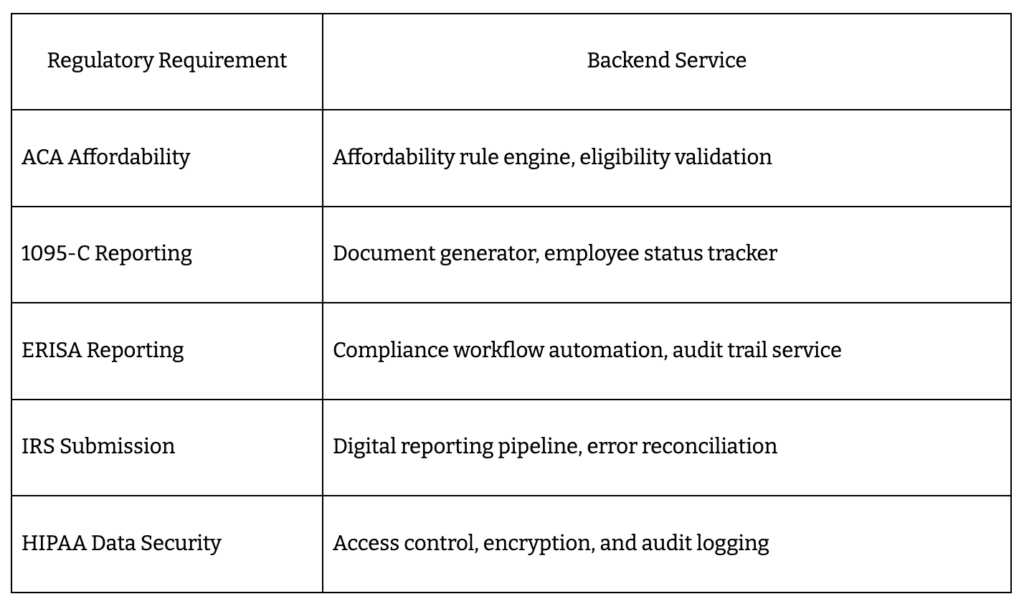
Behind both experiences sits infrastructure that makes the whole system reliable. Plan sourcing connects your platform to hundreds of carriers, each with their own quirks—different APIs, formats, and schedules. Your job is to normalize this chaos into clean, comparable plan data so employees can make side-by-side choices with confidence. And underneath it all lies compliance automation: ACA reporting, 1095-C form generation, audit trails, and regulatory updates. This runs quietly in the background but is what keeps the entire operation legal, auditable, and scalable.

Together, these pillars—employer experience through eligibility, employee experience through reimbursements, and infrastructure through plan sourcing and compliance—define what every ICHRA platform must deliver. The difference in this guide is that we’re not just describing the blocks; we’re showing you how to wire them into an existing SaaS product at a production-ready level.

Employee Eligibility Engine

Your eligibility engine is the brain of your ICHRA platform. It needs to be smart enough to handle complex classification rules but flexible enough to adapt when regulations change overnight.

Start with employee classification logic. Full-time, part-time, geographic regions, union status – your system needs to categorize workers based on configurable rules that pull from live HRIS data. When someone gets promoted or moves states, eligibility should update automatically.

The affordability calculation is where things get tricky. You’re following IRS safe harbor rules, factoring in household income, family size, and geographic rating areas. Get this wrong, and you’re not just dealing with unhappy employees – you’re looking at potential penalties.

Here’s what a basic eligibility check looks like in practice:

{python]

def check_employee_eligibility(employee):

    # Get current classification

    class_type = determine_class(employee)

    if not class_type:

        log_decision(employee.id, “No valid classification”)

        return False    

    # Apply affordability test

    is_affordable = calculate_affordability(employee, class_type)

    if not is_affordable:

        log_decision(employee.id, “Fails affordability test”)

        return False

    log_decision(employee.id, “Eligible for ICHRA”)

    return True

Your audit trail needs to capture every decision with timestamps and reasoning. When auditors come knocking, you want to show exactly why each eligibility determination was made.

Reimbursement Processing System

Think of reimbursement processing as an assembly line with multiple quality checkpoints. Receipt comes in, gets validated, checked against allowances, routed for approval, and eventually becomes a payment in someone’s paycheck.

Your receipt processing starts with file uploads – images, PDFs, whatever employees throw at you. OCR technology extracts the key details, but you need business logic to categorize expenses and flag anything suspicious. Duplicate receipts, non-eligible expenses, amounts that exceed allowances – catch these early to avoid downstream problems.

Allowance tracking happens in real-time. Every approved expense reduces the employee’s remaining balance, and you need to handle edge cases like retroactive adjustments and year-end rollovers. Your database schema should track every transaction with full audit trails.

The approval workflow can be as simple as automatic processing for small amounts or as complex as multi-level sign-offs for larger claims. Use event-driven architecture to trigger status updates and notifications without manual intervention.

Integration with payroll systems is your final challenge. Tax-advantaged reimbursements, proper deduction timing, handling of payment cycles – this needs to work seamlessly with whatever payroll platform your customers use.

Plan Sourcing & Quote Engine

Your plan sourcing engine is like a universal translator for the insurance world. Carriers speak different languages, use different data formats, and update their information on different schedules. Your job is to make sense of this chaos.

Carrier API integration means handling dozens of authentication methods, rate schemas, and data structures. Build adapters that normalize everything into a consistent internal format. When Aetna changes their API structure, you want to update one adapter, not rebuild your entire system.

Rate calculations pull together geography, age bands, family composition, and network specifics. Cache strategically during open enrollment periods when traffic spikes, but make sure your data stays current. Stale rates lead to enrollment failures and frustrated users.

Plan availability verification runs continuously in the background. Carriers drop plans, change networks, and update product codes without much notice. Your system needs to catch these changes before users try to enroll in non-existent plans.

Here’s a simplified example of plan data normalization:

{python]

def normalize_carrier_data(carrier_response, carrier_type):

    “””Convert carrier-specific data to standard format”””

    if carrier_type == “aetna”:

        return {

            “plan_id”: carrier_response[“product_id”],

            “monthly_premium”: carrier_response[“rate”],

            “network_type”: map_aetna_network(carrier_response[“network”])

        }

    elif carrier_type == “anthem”:

        return {

            “plan_id”: carrier_response[“plan_code”],

            “monthly_premium”: carrier_response[“premium”],

            “network_type”: map_anthem_network(carrier_response[“network_id”])

        }

    # Handle other carriers…

Compliance & Reporting Logic

Compliance automation runs quietly in the background, but it’s what keeps your platform legally sound. ACA reporting, 1095-C generation, ERISA documentation – this stuff needs to happen automatically and accurately.

Your compliance engine monitors regulatory changes and adapts logic accordingly. When the IRS updates affordability thresholds or reporting requirements change, your system should adjust without manual intervention. Build this as a configurable rule engine, not hardcoded business logic.

Audit trail systems capture everything. Every eligibility decision, every reimbursement approval, every plan selection – timestamp it, version it, and link it to source data. When regulators ask questions, you want to provide answers instantly.

Form generation runs as background jobs triggered by calendar events or workflow milestones. 1095-C forms, ACA reports, compliance summaries – generate these automatically and store them in accessible formats.

API Integration Patterns for ICHRA Logic

Your API architecture determines whether your ICHRA platform scales smoothly or crumbles under pressure. Use RESTful endpoints with consistent JSON payloads, implement webhook subscriptions for real-time updates, and build error handling that actually helps developers troubleshoot problems.

RESTful endpoints should follow predictable patterns. Eligibility checks, reimbursement submissions, plan queries – each operation gets a dedicated endpoint with standardized request/response formats. Use proper HTTP status codes and include correlation IDs for tracking requests across systems.

Webhooks eliminate the need for constant polling. When eligibility changes, reimbursements get approved, or plan data updates, push notifications to subscribed endpoints immediately. Include signature validation and timestamp checking to prevent security issues.

Error handling needs to be developer-friendly. Return machine-readable error codes with clear descriptions and suggested fixes. When a carrier API fails, your error response should help the calling system decide whether to retry, escalate, or fail gracefully.

Here’s a webhook handler that does it right:

{python]

@app.route(‘/webhook/ichra’, methods=[‘POST’])

def handle_ichra_webhook():

    # Validate signature and timestamp

    if not verify_webhook_signature(request):

        return {“error”: “Invalid signature”}, 401


    if not verify_timestamp(request):

        return {“error”: “Request too old”}, 400


    # Check for duplicate events

    event_id = request.json.get(“event_id”)

    if is_duplicate_event(event_id):

        return {“status”: “duplicate”}, 200


    # Process the event

    try:

        process_ichra_event(request.json)

        return {“status”: “processed”}, 200

    except Exception as e:

        log_error(event_id, str(e))

        return {“error”: “Processing failed”}, 500

Implementation Guide: Building ICHRA Features

Building ICHRA functionality is like assembling a complex machine – each component needs to work perfectly on its own and integrate seamlessly with the others. Start with modular development, build comprehensive testing suites, and plan for the complexity you’ll encounter.

Step 1: Implementing Eligibility Calculations

Your eligibility engine starts with employee classification. Build a flexible rule system that can handle your current needs but adapts as requirements change. Pull live data from HRIS systems, apply IRS affordability calculations, and log every decision for audit purposes.

Classification logic should be configurable, not hardcoded. When business rules change – new employee types, different geographic regions, updated compliance requirements – you want to update configuration, not rewrite code.

Affordability calculations follow IRS safe harbor rules, but these rules update annually. Build your calculation engine to handle parameter changes without requiring new deployments. Factor in household income, family size, and local market conditions.

Step 2: Building Reimbursement Workflows

Reimbursement processing spans multiple systems and involves several decision points. Design your workflow as a state machine with clear transitions, error handling, and rollback capabilities.

Receipt processing starts with file uploads and OCR extraction. Validate extracted data against business rules, check for duplicates, and categorize expenses automatically. Build in manual review processes for edge cases that automated logic can’t handle.

Allowance tracking needs real-time accuracy. Every approved expense reduces available balances, and employees need to see current allowances before submitting new claims. Handle year-end rollovers, mid-year adjustments, and retroactive changes without creating data inconsistencies.

Integration with payroll systems requires careful coordination. Tax treatment, payment timing, and reconciliation logic need to work with multiple payroll vendors. Design abstraction layers that handle vendor-specific requirements without cluttering your core business logic.

Step 3: Integrating Plan Sourcing

Plan sourcing connects your platform to the broader insurance ecosystem. Each carrier has unique API characteristics, data formats, and reliability patterns. Build adapter layers that normalize this complexity into consistent internal interfaces.

Authentication patterns vary by carrier – API keys, OAuth2 tokens, custom schemes. Create authentication managers that handle credential rotation, token refresh, and failure recovery automatically.

Data normalization transforms carrier-specific responses into standardized formats your application can consume. Plan details, pricing, networks, provider directories – everything needs consistent structure regardless of source.

Caching strategies balance data freshness with performance requirements. Cache plan data aggressively during stable periods, but refresh frequently when carriers push updates. Build cache invalidation logic that responds to carrier notifications and scheduled refresh cycles.

Step 4: Adding Compliance Automation

Compliance features work behind the scenes but require careful implementation. ACA reporting, tax form generation, audit trail maintenance – these systems need to be bulletproof and maintainable.

Automated reporting pulls data from multiple sources, applies business logic, and generates required forms on schedule. Build reporting pipelines that handle data validation, error reporting, and retry logic for failed operations.

Audit logging captures every significant action with sufficient detail for regulatory review. Structure log data for easy retrieval and analysis. When auditors request specific information, you want to provide comprehensive answers quickly.

Regulatory updates require ongoing attention. Build monitoring systems that track relevant regulation changes and alert your team when logic updates are needed. Automate where possible, but maintain human oversight for critical compliance decisions.

Code Examples & API Specifications

Real-world ICHRA integration requires practical code examples that handle common scenarios and edge cases. Here are production-ready patterns for the most critical functions.

Eligibility API Integration:

{JSON]

POST /api/v1/ichra/eligibility

{

  “employee_id”: “EMP12345”,

  “plan_selection”: “PLAN67890”,

  “household_income”: 75000,

  “family_size”: 3,

  “effective_date”: “2025-01-01”

}

\

Response:

{

  “eligible”: true,

  “affordable”: true,

  “reason”: null,

  “audit_reference”: “AUD_20250101_001”

}

Reimbursement Processing:

{JSON]

POST /api/v1/ichra/reimbursement

{

  “employee_id”: “EMP12345”,

  “expense_date”: “2025-01-15”,

  “amount”: 125.50,

  “category”: “prescription”,

  “receipt_data”: “base64_encoded_receipt_image”

}

Response:

{

  “claim_id”: “CLM_789123”,

  “status”: “pending_review”,

  “remaining_allowance”: 874.50,

  “estimated_processing_time”: “2-3 business days”

}

Plan Data Retrieval:

{JSON]

GET /api/v1/ichra/plans?zip_code=90210&employee_id=EMP12345&family_size=2

{

  “plans”: [

    {

      “plan_id”: “PLAN67890”,

      “carrier_name”: “Aetna”,

      “plan_name”: “Gold PPO 2025″,

      “monthly_premium”: 420.50,

      “deductible”: 2000,

      “network_type”: “PPO”

    }

  ],

  “total_count”: 1,

  “last_updated”: “2025-01-20T10:30:00Z”

}

Common Development Challenges & Solutions

ICHRA platform development presents unique challenges that can derail projects if not addressed early. Here’s how to handle the most common obstacles.

Complex Eligibility Rules: Build configurable rule engines instead of hardcoding business logic. Use decision tables, rule chains, and versioned configuration that can adapt to changing requirements without code deployments.

Reimbursement Workflow Complexity: Implement state machines to manage multi-step approval processes. Use event-driven architecture to coordinate between receipt processing, approval routing, and payment systems. Build comprehensive error handling and rollback capabilities.

Carrier Data Inconsistencies: Create normalization layers that transform diverse carrier data into standardized formats. Use adapter patterns to isolate carrier-specific logic. Build data validation and quality monitoring to catch issues before they impact users.

Compliance Testing: Develop automated test suites that cover regulatory scenarios, edge cases, and audit requirements. Use mock data that represents realistic employee populations and business scenarios. Test compliance logic against known regulatory requirements and audit criteria.

Final Thoughts

Building ICHRA platform integration requires balancing technical complexity with business requirements. Focus on modular architecture, robust error handling, and compliance automation. The teams that succeed prioritize data normalization, workflow automation, and real-time carrier connectivity.

The right technical foundation transforms ICHRA complexity into manageable, scalable systems. Plan for the complexity upfront, build with compliance in mind, and design for the scale you’ll eventually need.

FAQs on ichra platform integration briefing

Q: What is an ICHRA platform?

A: An ICHRA platform is a software solution that lets employers offer defined health reimbursements for employees, automating eligibility calculations, reimbursement processing, and plan sourcing through carrier API integrations.

Q: How much does ICHRA platform integration cost?

A: ICHRA platform integration costs vary, but building direct connections for every carrier can run into millions in development and years of maintenance. Unified APIs significantly reduce both cost and integration timelines.

Q: What companies provide ICHRA software?

A: Leading ICHRA software providers include HealthSherpa, Take Command, PeopleKeep, and platforms that leverage unified API infrastructure for carrier connectivity and compliance automation.

Q: What are the top ICHRA platforms?

A: Top ICHRA platforms focus on seamless plan sourcing, automated compliance, and robust reimbursement engines, offering high connectivity with multiple carriers and integration-ready APIs.

Q: How does ICHRA software process reimbursements?

A: ICHRA software automates reimbursement by validating employee receipts, tracking allowance usage, and integrating with payroll for payment – all managed through API-driven workflows and compliance checks.

Q: What carriers offer ICHRA-compatible plans?oftware process reimbursements?

A: Most national and regional health insurance carriers, such as Aetna, UnitedHealthcare, and Anthem, provide ACA-compliant plans eligible for ICHRA reimbursement when accessed through qualified platforms..

Q: What are the downsides of ICHRA for employers or employees?

A: ICHRA downsides can include regional plan availability gaps, potential administrative complexity, and the need for robust software to manage compliance, eligibility, and reimbursement processes efficiently.

Q: How do you implement an ICHRA solution?

A: Implementing ICHRA requires integrating eligibility engines, reimbursement workflows, and plan sourcing via carrier APIs. Robust platforms use normalized data models, compliance automation, and developer-friendly APIs for rapid deployment.

Q: Can ICHRA be used for on-exchange and retiree health plans?

A: Yes, ICHRA can fund both on-exchange ACA plans and retiree health coverage, provided the offerings meet IRS eligibility criteria and are supported by the platform’s plan sourcing logic.

Launch a White Label ICHRA Solution Fast: How APIs Power Your Branded Benefits Platform

Article Summary:

Building ICHRA functionality in-house takes 12–18 months and millions per carrier integration. White label ICHRA APIs cut that to 4–8 weeks, delivering full eligibility, premium aggregation, enrollment, compliance, and branding under your own name. Platforms, carriers, and TPAs can launch fast, scale cost-effectively, and retain complete brand control—while redirecting resources to customer experience and growth instead of backend infrastructure.

Building a benefits platform with full ICHRA functionality under your own brand used to mean one thing: a painful 12-18 month development marathon. While you’re hiring engineers and wrestling with carrier integrations, your competitors are already in market, serving customers.

In benefits technology, we sometimes use the term ‘white label’ to describe an API-driven infrastructure that disappears behind your brand — not the lighter, logo-swap definition used in other industries. It’s with that interpretation in mind for white label that this article is written.

White label ICHRA API solutions flip that entire dynamic. With the right API-driven infrastructure, benefits platforms, insurance carriers, and TPAs can launch a fully branded ICHRA offering in weeks—not years—with zero third-party visibility to end users.

This isn’t about slapping a logo on someone else’s product. It’s about leveraging proven infrastructure to build something that’s genuinely yours, faster and smarter than building from scratch.

What is a White Label ICHRA API Solution?

Think of white label ICHRA APIs like this: you get all the complex backend infrastructure—eligibility engines, carrier connections, compliance reporting—but your customers only see your brand. No “powered by” footers. No redirect URLs. No shared support desks.

It’s the difference between renting office space in a building with someone else’s name on it versus having your own building with your name on the door. Your customers interact with your platform, your support team, your branding—even though the underlying infrastructure is managed by specialists who’ve already solved the hard problems.

Who uses white label ICHRA APIs?

  • Benefits technology vendors who want to add ICHRA without rebuilding their entire platform
  • Insurance carriers looking to launch digital ICHRA offerings quickly
  • TPAs who need to scale ICHRA administration without proportional headcount increases

The key advantage: you can focus on what differentiates your business—customer experience, sales, unique features—while someone else handles the commodity infrastructure that just needs to work reliably. 

Why White Label? The Business Reality

Here’s the fork in the road every benefits platform faces: build comprehensive ICHRA infrastructure in-house, or leverage existing APIs to get to market faster.

The build-from-scratch path:

  • 12-18 months of development time
  • $1.5M+ per carrier integration
  • Ongoing maintenance and regulatory updates
  • Risk of technical debt and compliance gaps

The white label API path:

  • 4-8 weeks to market
  • Subscription-based pricing with predictable costs
  • Automated compliance and regulatory updates
  • Focus resources on customer experience and growth

But here’s what makes white label particularly compelling: you’re not sacrificing control for speed. True white label solutions give you complete brand ownership and customer relationship control. Your users never know there’s infrastructure running behind the scenes—they just experience a fast, reliable platform that happens to carry your brand.

Cost-effective scaling: Instead of building separate integrations for 300+ carriers, you get them all through one API. Instead of hiring compliance specialists, you get automated regulatory updates. Instead of building redundant infrastructure, you leverage enterprise-grade systems that are already battle-tested.

Complete Brand Control

White label means your customers interact with your brand at every touchpoint—enrollment portals, email communications, support documentation, even error messages. There’s no “powered by” language anywhere in the user experience.

This level of brand control matters because trust is everything in benefits. When an employee is choosing health coverage for their family, they need to feel confident in the platform they’re using. If they see third-party branding or get redirected to external sites, it creates friction and doubt.

What complete brand control looks like:

    • Custom URLs (yourcompany.com/benefits, not vendor.com/client-portal)
    • Branded email templates and communications
    • Your support team handling all customer interactions
    • Your logo and color scheme throughout the entire user journey
    • Direct customer relationships with no intermediary

This isn’t just about vanity—it’s about owning the customer experience end-to-end, which is critical for retention and growth in competitive benefits markets.

Focus on Your Core Strengths

Every hour your engineering team spends maintaining carrier integrations or updating compliance logic is an hour they’re not building features that differentiate your platform.

White label ICHRA APIs let you redirect those resources toward what actually moves your business forward: better user experiences, sales tools, customer success programs, and unique platform features that competitors can’t easily copy.

Resource optimization in practice:

    • Engineering focuses on front-end innovation instead of backend maintenance
    • Operations teams handle customer success instead of data reconciliation
    • Product teams build differentiating features instead of commodity infrastructure
    • Sales teams have more compelling demos because the platform actually works reliably

The companies winning in benefits technology aren’t the ones with the most impressive backend infrastructure—they’re the ones solving customer problems most effectively. White label APIs let you focus on solving those problems while someone else handles the plumbing.

Core Functional Blocks of a White Label ICHRA API

Every comprehensive ICHRA platform needs these essential components, whether built from scratch or powered by APIs:

Eligibility and Class Logic

Automatically classifies employees into ICHRA-eligible groups based on business rules, location, job type, and custom employer criteria. Handles complex scenarios like mid-year employment changes, COBRA transitions, and multi-state workforces.

Premium Aggregation and Subsidy Calculation

Collects real-time, ACA-compliant rates from hundreds of carriers and calculates individualized subsidies based on income, location, and family composition. Updates automatically as carrier rates change or regulations shift.

Enrollment and Data Sync

Powers seamless, real-time data transfer between carriers, HRIS systems, and employee portals. Eliminates manual file uploads and reduces enrollment errors through automated validation and error handling.

Compliance and Reporting

Auto-generates all required documentation—1095-C forms, PCORI filings, ACA verification—with built-in audit trails. Adapts automatically as IRS and ACA requirements evolve, reducing compliance risk.

Custom Branding and UI

Supports complete interface customization, branded communications, and custom URLs. Enables platforms to deliver consistent, organization-specific experiences without any visible third-party elements.

The integration advantage: Instead of building and maintaining each of these systems separately, white label APIs deliver all functionality through unified endpoints. One integration gives you access to enterprise-grade versions of every component.

Implementation: From API to Branded Product

Transforming a white label ICHRA API into your branded product follows a systematic process designed for speed and reliability:

Week 1: Foundation Setup

    • Generate API credentials for sandbox and production environments
    • Upload brand assets (logos, colors, typography) to establish visual consistency
    • Configure custom URLs and navigation to match your platform architecture demos because the platform actually works reliably

Week 2-3: Data Integration

    • Map your HRIS data fields to API endpoints using flexible schema design
    • Set up webhook notifications for real-time status updates and branded communications
    • Customize email and SMS templates to reflect your brand voice and design standards

Week 4-6: Testing and Refinement

    • Validate data flow accuracy and error handling across all user scenarios
    • Test branded interfaces across devices and browsers
    • Conduct security and compliance verification
    • Train support teams on new ICHRA functionality

Week 6-8: Launch and Monitor

    • Deploy to production with real-time monitoring
    • Track system performance and user engagement
    • Collect feedback and iterate on user experience
    • Scale infrastructure based on actual usage patterns

The key to successful implementation is treating it like a product launch, not just a technical integration. Your customers should experience a seamless addition to your existing platform, not a bolted-on third-party tool.

Hidden Challenges (And How to Avoid Them)

Even with white label APIs, certain challenges require careful planning:

Regulatory Compliance Evolution ICHRA regulations change annually—affordability calculations, reporting requirements, tax implications. Your API provider should handle these updates automatically, but you need to ensure your customer communications and support documentation stay current.

Multi-State Premium Data Accuracy Insurance rates vary by location and update frequently. Manual rate management becomes unmanageable at scale. Look for APIs that provide automated rate updates with quality assurance built-in.

Brand Consistency Across All Touchpoints As your platform grows and integrates with more systems, maintaining brand consistency becomes complex. Every email template, error message, and support interaction needs to reinforce your brand identity.

Security and Uptime Requirements Benefits platforms handle sensitive personal and financial data. Your API solution needs enterprise-grade security (SOC 2 Type II, HIPAA compliance) and reliability (99.9%+ uptime) from day one.

Customer Success and Change Management New ICHRA functionality means training your support team, updating help documentation, and potentially changing how customers interact with your platform. Plan for this operational impact alongside technical implementation.

Build vs. Buy: The Real Numbers

The financial case for white label ICHRA APIs becomes clear when you factor in opportunity cost and hidden expenses:

Factor Build In-House Use API Platform
Time-to-Market 12-18 months minimum 4-8 weeks
Up-Front Cost $1.5M+ per carrier integration Subscription-based pricing
Ongoing Maintenance Dedicated engineering team Handled by API provider
Regulatory Updates Internal compliance expertise required Automated updates included
Security Compliance SOC 2 and HIPAA certification costs Enterprise-grade security included
Opportunity Cost 18 months not building differentiating features Focus on core product innovation

But here’s the hidden cost that kills most build-from-scratch projects: they take so long that market conditions change before you launch. The ICHRA market is growing 34% year-over-year. Spending 18 months building infrastructure means missing 18 months of market opportunity.

How Ideon Powers Branded ICHRA Solutions

Ideon enables rapid white label ICHRA deployment through a unified API that connects 300+ insurance carriers with comprehensive compliance and enrollment capabilities.

What makes Ideon different:

    • True white label: Zero third-party branding in any user-facing element
    • Complete customization: Full control over UI, communications, and workflows
    • Enterprise security: SOC 2 Type II and HIPAA compliance built-in
    • Proven scalability: Powers platforms serving millions of employees nationwide

Real results: Benefits platforms using Ideon have launched branded ICHRA solutions in 4-6 weeks, handling open enrollment at scale without technical issues or compliance problems.

The infrastructure handles the complex backend requirements—real-time eligibility verification, automated compliance reporting, carrier connectivity—while you maintain complete control over customer experience and branding.

Implementation Checklist

Use this step-by-step checklist to ensure successful white label ICHRA deployment:

Technical Setup:

    • [ ] Generate API credentials for development and production
    • [ ] Configure authentication and secure token management
    • [ ] Set up sandbox environment for testing and stakeholder demos

Brand Configuration:

    • [ ] Upload logo files and define color schemes
    • [ ] Configure custom URLs and navigation structure
    • [ ] Customize email and SMS templates for branded communications

Data Integration:

    • [ ] Map HRIS employee data fields to API endpoints
    • [ ] Configure eligibility rules and employee classification logic
    • [ ] Set up webhook notifications for real-time status updates

Testing and Validation:

      • [ ] Test all user workflows from eligibility through enrollment
      • [ ] Validate data accuracy and error handling
      • [ ] Conduct security and compliance verification
      • [ ] Train support team on new ICHRA functionality

Launch Preparation:

      • [ ] Deploy to production with monitoring systems active
      • [ ] Establish performance benchmarks and alerting
      • [ ] Document support procedures for common user scenarios
      • [ ] Plan customer communication and feature announcement

The Bottom Line

White label ICHRA APIs solve the fundamental challenge every benefits platform faces: how to offer comprehensive ICHRA functionality without diverting engineering resources from core product development.

By leveraging proven infrastructure, you can launch branded ICHRA solutions in weeks instead of months, at a fraction of the cost and risk of building from scratch.

More importantly, you can focus your team on what actually differentiates your business—customer experience, unique features, and market growth—while someone else handles the complex but commodity infrastructure that just needs to work reliably.

The ICHRA market is expanding rapidly. The question isn’t whether you need ICHRA capabilities—it’s whether you’ll build them fast enough to capitalize on the opportunity.

FAQs on White Label ICHRA API Solutions

What is a white label ICHRA API solution and how does it work?

A white label ICHRA API solution provides complete Individual Coverage HRA functionality under your brand, with all backend infrastructure, carrier integrations, and compliance handling managed invisibly—enabling rapid deployment of branded ICHRA platforms

What does “white label” mean for benefits technology platforms?

White label means the solution operates entirely under your brand and control. No “powered by” tags, no third-party logos, no external redirects—your customers interact only with your branded platform, even though sophisticated infrastructure runs behind the scenes.

How does white label differ from co-branded or partnership solutions?

White label gives you complete brand ownership throughout the entire customer journey. Co-branded solutions display partner logos or “powered by” references, while white label solutions are indistinguishable from internally built platforms.

What are the main business advantages of using a white label ICHRA API?

White label ICHRA APIs dramatically reduce time-to-market (4-8 weeks vs. 12-18 months), eliminate upfront development costs ($1.5M+ savings per carrier), and let your team focus on customer experience and differentiation instead of commodity infrastructure.

How much does a white label ICHRA API cost compared to building internally?

White label solutions use subscription-based pricing that costs a fraction of internal development. Building carrier integrations internally requires $1.5M+ per carrier and 12-18 months of development time—white label eliminates both.

Who typically uses white label ICHRA API solutions?

Primary users include benefits technology companies, insurance carriers, TPAs, and InsurTech startups who need branded ICHRA platforms without the cost and complexity of building infrastructure from scratch.

What core features should a white label ICHRA API include?

Essential features include automated eligibility logic, real-time premium aggregation across carriers, seamless enrollment and data sync, automated compliance reporting, and complete UI customization capabilities for branded customer experiences.

What’s the implementation process for a white label ICHRA API?

Implementation typically takes 4-8 weeks and involves API setup and authentication, brand asset configuration, HRIS data mapping, custom UI development, webhook integration for notifications, and comprehensive testing before production launch.

How does white label ensure complete brand control?

White label solutions provide customizable portals, communications, URLs, and interfaces with zero third-party references. Every customer touchpoint—from eligibility checking to enrollment to support—reflects only your brand identity.

What compliance and security standards do white label ICHRA APIs meet?

Enterprise-grade white label solutions include SOC 2 Type II and HIPAA compliance, continuous security monitoring, 99.9%+ uptime guarantees, and comprehensive audit trails—eliminating the need for separate security infrastructure investment.

How are regulatory changes and premium updates handled?

Automated systems continuously monitor IRS and ACA requirement changes, update affordability calculations, and sync carrier rate changes across all 50 states—maintaining compliance and pricing accuracy without internal management overhead.

What challenges might companies face with white label ICHRA deployment?

Common challenges include maintaining brand consistency across all touchpoints, managing ongoing feature requests and customizations, ensuring seamless integration with existing platforms, and training support teams on new ICHRA functionality and workflows.

Explore Ideon’s ICHRA Solutions

The ICHRA market is growing fast. But manual processes, custom integrations, and a lack of visibility are holding carriers and ICHRA admin platforms back.

Ideon changes that dynamic. Our infrastructure powers the complete ICHRA experience—from plan shopping and decision support to enrollment and payments—so carriers can grow their ICHRA business and platforms can offer a seamless employee experience.

Ideon Expands ICHRA Enrollment Solution with Payment Automation from Ambient

NEW YORK, NY — April 16, 2025 — Ideon, the leader in data management and connectivity solutions for the health and benefits industry, today announced a strategic partnership with Ambient, the ICHRA payments and administration unit of Priority Technology Holdings, Inc. The partnership combines Ideon’s advanced enrollment technology with Ambient’s payment and administration solution, providing health insurance carriers and ICHRA administrators a unified, automated solution for managing ICHRA enrollment and payment data.

As the Individual Coverage Health Reimbursement Arrangement (ICHRA) market rapidly expands, carriers and ICHRA administrators face increasing complexity around enrollment integrations and premium payments. This partnership addresses these challenges by providing a consistent, scalable method for exchanging critical enrollment and payment data, resulting in fast, accurate processing and an improved employee experience.

“Our partnership with Ambient allows carriers and ICHRA platforms to rapidly scale their ICHRA business while enhancing the overall experience,” said Steve Swad, CEO of Ideon. “We’re now delivering an end-to-end ICHRA solution—from initial quoting through premium payments—that removes complexity for carriers, administrators, employers, and employees.”

IdeonEnroll for ICHRA builds upon Ideon’s proven success automating group benefit enrollments, extending these capabilities to the individual market. The solution significantly reduces integration costs, errors, and processing time, and offers greater visibility into ICHRA enrollments.

Ambient streamlines the ICHRA premium payment process—precisely deducting premiums from employer accounts, allocating funds for each employee, and distributing payments to carriers.

“Ambient simplifies premium payments and administration, empowering carriers and ICHRA administrators to scale efficiently,” said Jim Mrowka, Chief Operating Officer of Priority’s Ambient unit. “In partnership with Ideon, we’re delivering a comprehensive solution that transforms the entire ICHRA experience.”

This partnership further expands Ideon’s suite of ICHRA solutions. Combining IdeonQuote, IdeonSelect, and IdeonEnroll with Ambient’s payment product, Ideon provides the data and connectivity required to power ICHRA plan shopping, decision support, enrollment, and payments. Using this infrastructure, carriers and platforms can enter the ICHRA market faster with accurate data and pre-built integrations.

For more information, visit ideonapi.com/ichra-solutions.

About Ideon

Ideon provides modern data management and connectivity solutions to advance the health and benefits industry. Ideon’s centralized, API-powered solutions enable real-time, reliable data sharing from quote to renewal. With Ideon, insurance carriers and technology platforms benefit from streamlined operations and accurate data, which ultimately improves the consumer experience, drives more revenue, enables smarter decisions, and increases timely access to care. To learn more, visit ideonapi.com.

About Priority and Ambient

Priority is the payments and banking solution that enables businesses to collect, store, lend and send funds through a unified commerce engine. Our platform combines payables, merchant services, and banking and treasury solutions so leaders can streamline financial operations efficiently — and our innovative industry experts help businesses navigate and build momentum on the path to growth. With the Priority Commerce Engine, leaders can accelerate cash flow, optimize working capital, reduce unnecessary costs, and unlock new revenue opportunities. To learn more about Priority and its publicly traded parent, Priority Technology Holdings, Inc. (NASDAQ: PRTH), visit prioritycommerce.com.

Ambient, a dedicated unit within Priority, specializes in automating payments and administration for ICHRA plans, easing operational burdens for brokers, TPAs, and carriers. Learn more at ambienttpa.com.

Phil Carollo and Jamie Rockfeld join Ideon executive team

Health and benefits technology leaders to accelerate Ideon’s growth


NEW YORK — January 16, 2025 — Ideon, the leader in data management and connectivity solutions for the health and benefits industry, today announced two key additions to its executive team. Phil Carollo has been named Chief Growth Officer, and Jamie Rockfeld joins as Executive Vice President of Sales. 

Carollo and Rockfeld bring decades of industry expertise and sales leadership experience, positioning Ideon for its next phase of growth as it continues to modernize how carriers and benefits platforms connect, exchange, and manage critical data. 

Carollo spent 25 years at PlanSource, a leading benefits administration platform, where he served as Chief Operating Officer, EVP of Sales, and most recently, President of Sales, scaling the company into the industry leader it is today. Rockfeld, also from PlanSource, was instrumental in growing its reseller channel and was most recently VP of Reseller Sales. 

“I have seen firsthand the complexity and inefficiency that organizations face when managing benefits data,” said Carollo. “Ideon’s technology solves these challenges for its customers, empowering them to grow and scale efficiently. I’m thrilled to join a team that is bringing immense value to customers and helping to modernize the industry.” 

“I’m excited to join Ideon and help its customers eliminate data problems that have long plagued carriers and platforms, allowing them to focus on what matters most—delivering value to brokers, employers, and employees,” Rockfeld said. 

These hires come at a time of rapid growth across all three of Ideon’s main product lines: IdeonQuote, IdeonSelect, and IdeonEnroll. In 2024, the company launched IdeonEOI, secured partnerships with industry leaders like Prudential, and strengthened its position as the data solutions leader in the $1T+ health and benefits industry. 

About Ideon
Ideon provides modern data management and connectivity solutions to advance the health and benefits industry. Ideon’s centralized, API-powered solutions enable real-time, reliable data sharing from quote to renewal. With Ideon, insurance carriers and technology platforms benefit from streamlined operations and accurate data, which ultimately improves the consumer experience, drives more revenue, enables smarter decisions, and increases timely access to care. 

Headquartered in New York City, Ideon partners with more than 300 insurance carriers and 100 InsurTech companies to improve operational efficiencies and customer experience across the $1T+ insurance industry. To learn more, visit ideonapi.com. 

Prudential collaborates with Ideon for technology that will help simplify the workplace benefits experience

NEWARK, N.J. – Prudential Financial, Inc. (NYSE: PRU) announced today that its Group Insurance business has collaborated with Ideon, a leader in data exchange and connectivity solutions, to deliver unique technology solutions for benefits eligibility and enrollment processes for workplace clients and their employees.

As employers expand their benefits offerings to attract and retain top talent, the need for fast, safe and efficient benefits administration has never been greater, with high expectations around data exchange between providers, employers and the benefit administration systems they use. Through this strategic relationship with Ideon, Prudential aims to improve the accuracy of enrollment data, help reduce the administrative workload for human resources teams, and seek new and innovative ways to ensure accurate enrollment and eligibility data. The collaboration will also allow Prudential to expand integrations with certain benefit administration systems where connectivity is limited today.

“We are committed to providing a superior experience for our clients and their employees,” said Jess Gillespie, head of product and underwriting for Prudential Group Insurance. “Enhancing Prudential’s digital connectivity makes it faster and easier for groups, and their employees, to enroll in workplace benefits.”

The initial phase of the collaboration focuses on expediting the data exchange process that impacts the onboarding process, including enrollment and eligibility information.

“This relationship signifies a major step forward for Ideon and Prudential,” said Steve Swad, CEO of Ideon. “Our data solutions will enable Prudential to deliver a fast, seamless, and accurate benefits enrollment and administration experience. We are excited to support Prudential in enhancing their platform ecosystem.”

For more information, visit Prudential Group Insurance or Ideon.

About Prudential
Prudential Financial, Inc. (NYSE: PRU), a global financial services leader and premier active global investment manager with approximately $1.6 trillion in assets under management as of Sept. 30, 2024, has operations in the United States, Asia, Europe, and Latin America. Prudential’s diverse and talented employees help make lives better and create financial opportunity for more people by expanding access to investing, insurance, and retirement security. Prudential’s iconic Rock symbol has stood for strength, stability, expertise, and innovation for nearly 150 years. For more information, please visit news.prudential.com.

About Prudential Group Insurance
Prudential Group Insurance manufactures and distributes a full range of group life, long-term and short-term disability and corporate and trust-owned life insurance in the U.S. to institutional clients primarily for use within employee and membership benefit plans. The business also sells critical illness, accidental death and dismemberment and other ancillary coverages. In addition, the business provides plan administrative services in connection with its insurance coverages, and administrative services for employee paid and unpaid leave, including FMLA, ADA, and PFL.

About Ideon
Ideon’s data solutions allow health insurance carriers and employee benefits providers to connect with technology partners to deliver seamless consumer experiences at every stage of the member journey. Ideon serves as the infrastructure simplifying the exchange of quoting, provider, and enrollment data between carriers and the technology partners, so they can deliver health and employee benefits to hundreds of millions of Americans every day. Ideon transmits billions of data points between insurtechs and insurance carriers, powering an amazing benefits experience for all. To learn more, please visit ideonapi.com.

Ideon Releases 2025 ICHRA Map

Ideon’s 2025 ICHRA Map is Available here

More than 60% of the U.S. is ICHRA-friendly in 2025

This year, our interactive map reveals exciting new insights into the ICHRA landscape:

📍 For bronze-level plans, 33 states are now “ICHRA-friendly” — up from 31 last year.
📍 Looking at silver-level plans, 21 states have market dynamics favorable to ICHRAs, up from 17 in 2024.

This map is an essential tool for benefits professionals to pinpoint where individual health insurance premiums are more affordable than small group market rates, suggesting opportunities for ICHRA adoption.

🔗 Explore the map here. Plus, you can see how the market has shifted since the inception of ICHRAs.

Explore Ideon’s ICHRA solutions  here.

Webinar: From Risk to Resolution—How EOI Auditing Protects Carriers & Members

Ideon and Prudential explore a new, proactive approach to uncovering EOI errors—before they cause claims issues.

Eliminating EOI Data Risk: Why Carriers Need EOI Auditing Now

Table of Contents

Managing Evidence of Insurability (EOI) data has become a critical—and challenging—priority for group benefits carriers. Traditional EOI processes often result in errors that expose carriers to significant risks, from Department of Labor (DOL) fines to reputational harm and poor member experiences.

This guide dives into the risks hiding within routine EOI data processing. We’ll examine why carriers struggle to identify missing EOI before it’s too late, and reveal how advanced EOI data auditing prevents errors, mitigates risk, and helps carriers stay ahead in a competitive market.

The Status Quo: Challenges in Identifying Incomplete EOI

Most carriers can’t effectively detect and resolve instances where a member has enrolled in coverage that requires EOI but hasn’t completed the EOI process. This problem is more common than many realize and has far-reaching implications.

The Problem: EOI errors are difficult to detect

      • Enrollment With Incomplete EOI: Members often select life or disability coverage that exceeds guaranteed issue amounts, triggering the need for EOI. However, due to gaps in enrollment data exchange, complex plan eligibility rules, the BenAdmin misconfiguring plans in its system, or miscommunication, the member may not complete the required EOI process.
      • Invisible Discrepancies: These incomplete EOI cases frequently go unnoticed because carriers rely on manual checks or systems that can’t flag these discrepancies.
      • Delayed Detection at Claims Time: The failure to identify these issues means that carriers often discover them only when a claim is filed. At this point, it’s too late to rectify the oversight without causing delays and member dissatisfaction.

The Impact: What happens when EOI errors go unnoticed

      • Financial Risk: Carriers can face lawsuits and fines from the Department of Labor (DOL) if claims are denied due to missing EOI, especially if the member was paying a premium for supplemental coverage. In just the last two years, several large carriers have reached settlements with the DOL over their EOI practices.
      • Poor Claims Experience: Mistakes in EOI collection lead to negative member experiences, especially at claims time—when a slow process or wrongly denied claim can be disastrous for the member and their family. And, these negative experiences could result in brokers and employers taking their business elsewhere.
      • Reputational Damage: Brokers increasingly prioritize carriers with automated, advanced EOI capabilities. Those who don’t meet this expectation may find themselves losing out on key business opportunities and RFPs

Simply put, the status quo is no longer sustainable for carriers looking to remain competitive and compliant in the modern benefits landscape.

Making EOI Data Management a Strategic Priority

The consequences of mishandling EOI are extensive. But there’s light at the end of the tunnel — carriers, with the right auditing technology, can solve EOI data challenges and mitigate risk. Here’s why it should be a top priority:

      • Rising Demand for Automation: Brokers and employers expect streamlined, automated EOI processes to enhance the member experience, speed up enrollment, and reduce errors. Some RFPs even request information about EOI automation, including API capabilities.
      • Revenue Growth Opportunities: Carriers that simplify EOI processes see higher adoption rates for supplemental benefits like life and disability coverage—opening new revenue streams.
      • Mounting Regulatory Pressure: With increased scrutiny from the DOL, carriers face a higher risk of costly fines and reputational damage if EOI data errors aren’t addressed proactively.

EOI Audit by Ideon: An Industry-First Solution to De-Risk EOI Data

Better technology is the only way to minimize the financial and reputational risk of EOI errors.

Ideon’s EOI Audit solution offers a unique, automated approach to solving this industry-wide challenge. It addresses two key areas: data auditing and decision return. Here’s how it works:

      • Identifies Members Requiring EOI: Ideon’s system pinpoints members whose elections require EOI.
      • Audits Groups for Missing EOI: The audit function flags members who require EOI but didn’t complete it. Errors and discrepancies include why someone needs EOI, based on the carrier’s plan eligibility rules, decisions already in the carrier’s system, and group enrollment data.
      • Error Resolution: All discrepancies are surfaced through automated reports and dashboards. Each issue has a clear, actionable resolution path, allowing carriers to avoid downstream problems.
      • Decision synching: EOI statuses and decisions are synched between carriers and BenAdmin platforms, ensuring up-to-date, accurate data across all systems.

This process not only improves data accuracy but also prevents costly errors that lead to DOL fines and poor member outcomes.

Results with EOI Audit

By implementing Ideon’s EOI Audit solution, carriers not only improve compliance and enhance claims experiences, but also strengthen their competitive position by offering a more reliable EOI process. Here are the key benefits they can expect:

      • Risk Mitigation: Proactively address EOI discrepancies to avoid DOL fines, reputational harm, and operational disruptions.
      • Faster Resolution: Early detection and actionable insights mean carriers resolve EOI discrepancies quickly, avoid downstream problems, and process claims accurately.
      • Stronger Market Position: Showcase advanced EOI capabilities to stand out in RFPs, win more business, and build stronger broker relationships.

Success in Action: How Prudential is Using Ideon’s EOI Audit Solution

Carriers like Prudential are already seeing positive results with Ideon’s EOI Audit solution. As Sherri Bycroft, Director of Benefit Technology Partnerships at Prudential, shared in a recent Ideon Insights interview:

“We’re really excited about the fact that it’s going to flush out issues much earlier on,” she said. “We can have full confidence that we have the right information about the members in our system, and at the time of claim, be able to pay that without delays.”

Get a Demo of EOI Audit by Ideon

See how Ideon’s EOI Audit solution can help you reduce risk, identify missing EOI, and provide a better claims experience. Schedule a demo below.


Employee Spotlight: Christie Lickert

At Ideon, we’re proud to have such a talented, diverse team leading the charge for a better and more connected health insurance and employee benefits industry. Our ongoing Employee Spotlight series showcases the people behind our product and unveils what life is like at Ideon. Next up… Christie Lickert, our Senior Operations Analyst!

Name: Christie Lickert
Department: Enrollment Operations
Title: Senior Operations Analyst
Location: Omaha, NE

Work

How long have you worked at Ideon?

I have worked at Ideon in Enrollment Operations for two years.

Tell us about your day-to-day.

I work with carriers and platforms, specifically with configurations for EDI and API feeds. Each day, the work I do is different. I can be working on anything from a brand-new implementation with testing to creating documentation on processes and training new team members.

What projects are you excited to work on?

I love working on projects that are challenging and give me a sense of accomplishment. I enjoy it when I can contribute to solving issues with an out-of-box approach.

What excites you about the future of Ideon?

Ideon has many partnerships that are so influential to the growth of our company. We are constantly trying to make the customer experience as seamless and efficient as possible. I am excited to see what innovative ideas my colleagues and I produce to help support that.

Describe your onboarding experience.

What’s great about Ideon is that we have every new employee meet with each department to get a look at what we do. It was interesting and informative to see what each team member’s purpose is. The team is also very welcoming and inclusive. Ideon is very thorough with onboarding and makes sure everyone has what they need to be successful.

Life

Favorite activity when you’re not working? 

I love reading and am part of a book club. My favorite genre of books is a tie between autobiographies and thrillers.

Favorite place you’ve traveled?

My favorite place I have traveled to is Sedona, Arizona. I absolutely love the red rock and enjoyed going on a “Pink Jeep Tour” which drove me up and down cliffs.

Interesting fact about yourself… Go!

I am obsessed with the Golden Girls. I still have all their box set DVDs, and my first dog was named after Sophia Petrillo.