Eliminating EOI Data Risk: Why Carriers Need EOI Auditing Now

Table of Contents

Managing Evidence of Insurability (EOI) data has become a critical—and challenging—priority for group benefits carriers. Traditional EOI processes often result in errors that expose carriers to significant risks, from Department of Labor (DOL) fines to reputational harm and poor member experiences.

This guide dives into the risks hiding within routine EOI data processing. We’ll examine why carriers struggle to identify missing EOI before it’s too late, and reveal how advanced EOI data auditing prevents errors, mitigates risk, and helps carriers stay ahead in a competitive market.

The Status Quo: Challenges in Identifying Incomplete EOI

Most carriers can’t effectively detect and resolve instances where a member has enrolled in coverage that requires EOI but hasn’t completed the EOI process. This problem is more common than many realize and has far-reaching implications.

The Problem: EOI errors are difficult to detect

      • Enrollment With Incomplete EOI: Members often select life or disability coverage that exceeds guaranteed issue amounts, triggering the need for EOI. However, due to gaps in enrollment data exchange, complex plan eligibility rules, the BenAdmin misconfiguring plans in its system, or miscommunication, the member may not complete the required EOI process.
      • Invisible Discrepancies: These incomplete EOI cases frequently go unnoticed because carriers rely on manual checks or systems that can’t flag these discrepancies.
      • Delayed Detection at Claims Time: The failure to identify these issues means that carriers often discover them only when a claim is filed. At this point, it’s too late to rectify the oversight without causing delays and member dissatisfaction.

The Impact: What happens when EOI errors go unnoticed

      • Financial Risk: Carriers can face lawsuits and fines from the Department of Labor (DOL) if claims are denied due to missing EOI, especially if the member was paying a premium for supplemental coverage. In just the last two years, several large carriers have reached settlements with the DOL over their EOI practices.
      • Poor Claims Experience: Mistakes in EOI collection lead to negative member experiences, especially at claims time—when a slow process or wrongly denied claim can be disastrous for the member and their family. And, these negative experiences could result in brokers and employers taking their business elsewhere.
      • Reputational Damage: Brokers increasingly prioritize carriers with automated, advanced EOI capabilities. Those who don’t meet this expectation may find themselves losing out on key business opportunities and RFPs

Simply put, the status quo is no longer sustainable for carriers looking to remain competitive and compliant in the modern benefits landscape.

Making EOI Data Management a Strategic Priority

The consequences of mishandling EOI are extensive. But there’s light at the end of the tunnel — carriers, with the right auditing technology, can solve EOI data challenges and mitigate risk. Here’s why it should be a top priority:

      • Rising Demand for Automation: Brokers and employers expect streamlined, automated EOI processes to enhance the member experience, speed up enrollment, and reduce errors. Some RFPs even request information about EOI automation, including API capabilities.
      • Revenue Growth Opportunities: Carriers that simplify EOI processes see higher adoption rates for supplemental benefits like life and disability coverage—opening new revenue streams.
      • Mounting Regulatory Pressure: With increased scrutiny from the DOL, carriers face a higher risk of costly fines and reputational damage if EOI data errors aren’t addressed proactively.

EOI Audit by Ideon: An Industry-First Solution to De-Risk EOI Data

Better technology is the only way to minimize the financial and reputational risk of EOI errors.

Ideon’s EOI Audit solution offers a unique, automated approach to solving this industry-wide challenge. It addresses two key areas: data auditing and decision return. Here’s how it works:

      • Identifies Members Requiring EOI: Ideon’s system pinpoints members whose elections require EOI.
      • Audits Groups for Missing EOI: The audit function flags members who require EOI but didn’t complete it. Errors and discrepancies include why someone needs EOI, based on the carrier’s plan eligibility rules, decisions already in the carrier’s system, and group enrollment data.
      • Error Resolution: All discrepancies are surfaced through automated reports and dashboards. Each issue has a clear, actionable resolution path, allowing carriers to avoid downstream problems.
      • Decision synching: EOI statuses and decisions are synched between carriers and BenAdmin platforms, ensuring up-to-date, accurate data across all systems.

This process not only improves data accuracy but also prevents costly errors that lead to DOL fines and poor member outcomes.

Results with EOI Audit

By implementing Ideon’s EOI Audit solution, carriers not only improve compliance and enhance claims experiences, but also strengthen their competitive position by offering a more reliable EOI process. Here are the key benefits they can expect:

      • Risk Mitigation: Proactively address EOI discrepancies to avoid DOL fines, reputational harm, and operational disruptions.
      • Faster Resolution: Early detection and actionable insights mean carriers resolve EOI discrepancies quickly, avoid downstream problems, and process claims accurately.
      • Stronger Market Position: Showcase advanced EOI capabilities to stand out in RFPs, win more business, and build stronger broker relationships.

Success in Action: How Prudential is Using Ideon’s EOI Audit Solution

Carriers like Prudential are already seeing positive results with Ideon’s EOI Audit solution. As Sherri Bycroft, Director of Benefit Technology Partnerships at Prudential, shared in a recent Ideon Insights interview:

“We’re really excited about the fact that it’s going to flush out issues much earlier on,” she said. “We can have full confidence that we have the right information about the members in our system, and at the time of claim, be able to pay that without delays.”

Get a Demo of EOI Audit by Ideon

See how Ideon’s EOI Audit solution can help you reduce risk, identify missing EOI, and provide a better claims experience. Schedule a demo below.


Webinar: The Future of Group Benefits Quoting

How are quoting platforms transforming the ancillary and voluntary benefits space?

Carriers and brokers are rapidly evolving their engagement—and third-party quoting platforms are at the heart of this shift. Join this webinar as experts from Guardian, Acrisure, and Ideon explore how these platforms are shaping the future of group benefits quoting.

🗓 Date: Tuesday, Oct. 22
🕒 Time: 1:00 PM ET
👉 Register here.

What you’ll learn:

  • The rise of quoting platforms and their role in benefits distribution
  • How carriers are partnering with platforms to reach more brokers
  • Key opportunities in the small group market
  • Success stories and trends
  • How APIs and automation are streamlining group benefits quoting

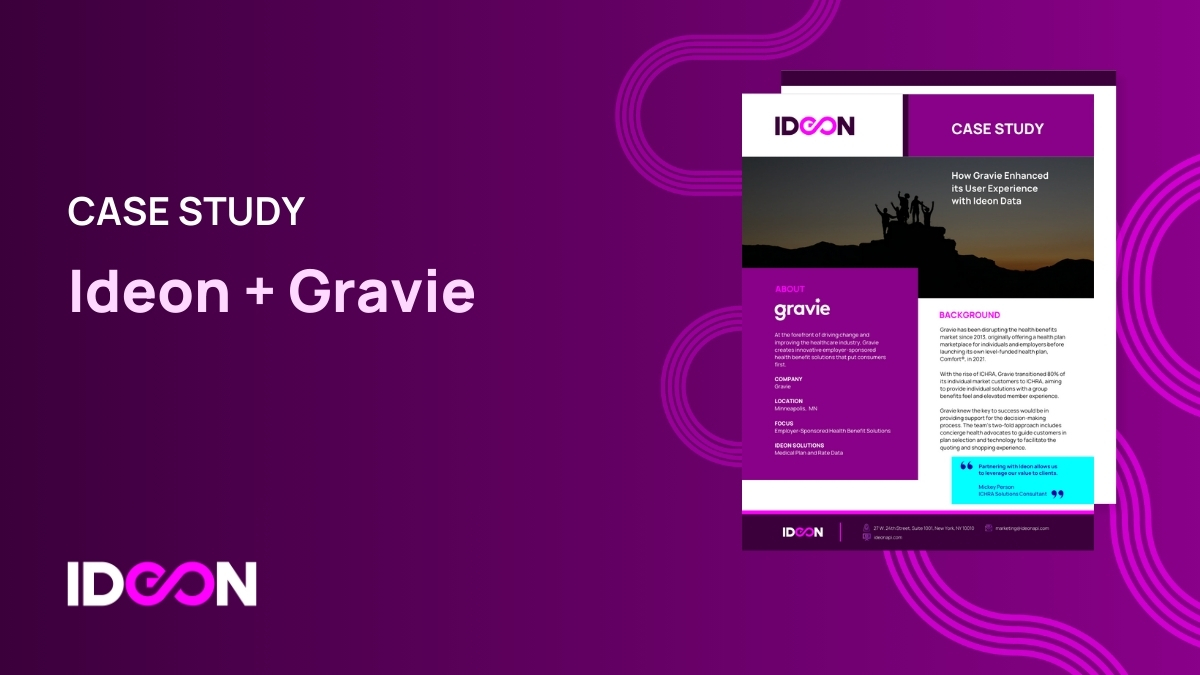
How Gravie Enhanced its User Experience with Ideon Data

Learn how Ideon powers Gravie’s ICHRA experience with accurate and timely data, helping people find a health insurance plan that meets their needs.

Click here to view as a PDF.

Five datasets powering today’s healthcare navigation platforms

Summary

Healthcare navigation platforms are transforming how employees make informed healthcare decisions. To do so, they’re integrating data elements like provider network data, doctor quality metrics, cost information, patient reviews, and claims data.

Over the past few years, three trends have intersected: healthcare costs increased, the healthcare system became more complex, and digitally native employees started expecting employers to provide technology for HR and benefits tasks.

Enter healthcare navigation platforms — digital tools that guide employees to better, more informed healthcare decisions based on cost, quality, and other criteria.

These platforms provide a wealth of information on doctors, hospitals, prescription drugs, and medical procedures. They also help employers to manage their healthcare costs by providing transparency into the pricing and quality of healthcare services.

Of course, offering an intuitive, modern user interface is essential for any healthcare navigation platform. But the breadth and quality of data behind the scenes, powering the features, often have the biggest impact on the overall user experience.

Here are five key data elements that some leading navigation platforms have integrated into their experience.

Provider network data
This includes information about the doctors and hospitals in a particular health plan’s network, including provider locations, specialties, and more. This is a foundational dataset, providing employees with detailed information about the PCPs and other healthcare providers in their network. Navigation platforms can help employees to make more informed decisions about where to receive care, as in-network providers are usually more cost-efficient than out-of-network.

Provider quality data
This covers the quality of care provided by different doctors and hospitals, as well as patient satisfaction ratings. This may also include outcome-based metrics. Platforms integrate provider quality data into their experiences to help employees choose healthcare providers that are more likely to provide excellent care.

Cost information
This is data about the cost of different medical procedures, prescription drugs, and other healthcare services. By providing employees with transparent pricing information, these platforms can help them shop for healthcare and make more cost-effective choices.

Patient reviews
Reviews and ratings of different healthcare providers from other patients who have received care from them. Armed with this information, employees can find healthcare providers that are more likely to provide a positive patient experience.

Claims data
Information about the healthcare services that employees have received, including the cost of those services and any out-of-pocket expenses that they may have incurred. By giving employees access to claims data, these platforms can enable them to better understand their healthcare benefits and how to use them.

All of these data sources are crucial for powering the new age of healthcare navigation platforms. By aggregating this data and presenting it to employees in an easily understandable format, these platforms can help to demystify the healthcare system and empower employees to make better decisions, resulting in significant cost savings for employers and improved health outcomes for employees.

For navigation platforms, collecting and integrating all of this data from disparate sources may seem like a colossal undertaking, but that’s generally not the case. Much of this information is now readily available via APIs. For example, Ideon offers structured, normalized provider-network data to navigation platforms via an API.

There are several healthcare navigation platforms on the market today, each with its own unique set of features and capabilities. Some examples include Healthcare Bluebook, Garner Health, HealthJoy, Accolade, Castlight Health, and others. Though their user experiences vary significantly, all rely on the power of data.

Test the industry’s most accurate provider-network data

Digital health, healthcare navigation, and analytics platforms rely on Ideon for the highest quality provider-network data. Download a data sample below.


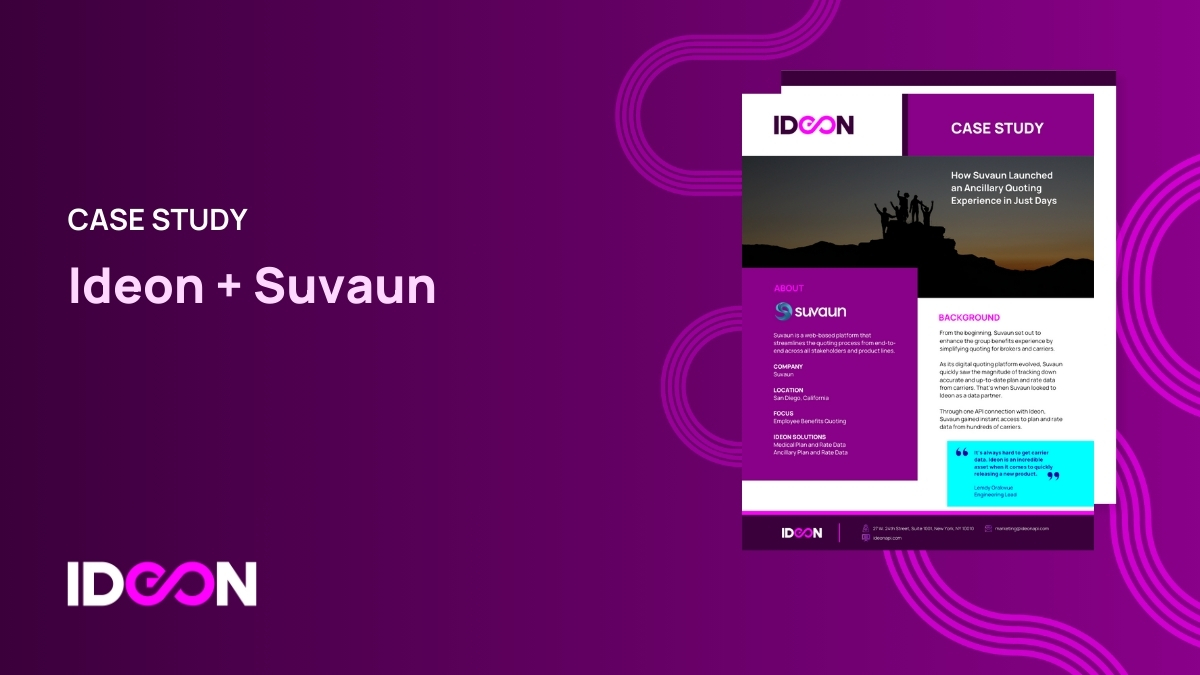
How Ideon’s data helped Suvaun quickly launch an ancillary quoting experience

Learn about how Ideon helped Suvaun launch an ancillary quoting experience in just days, resulting in better scalability, improved connectivity, and an enhanced broker experience.

View the full case study here or below.


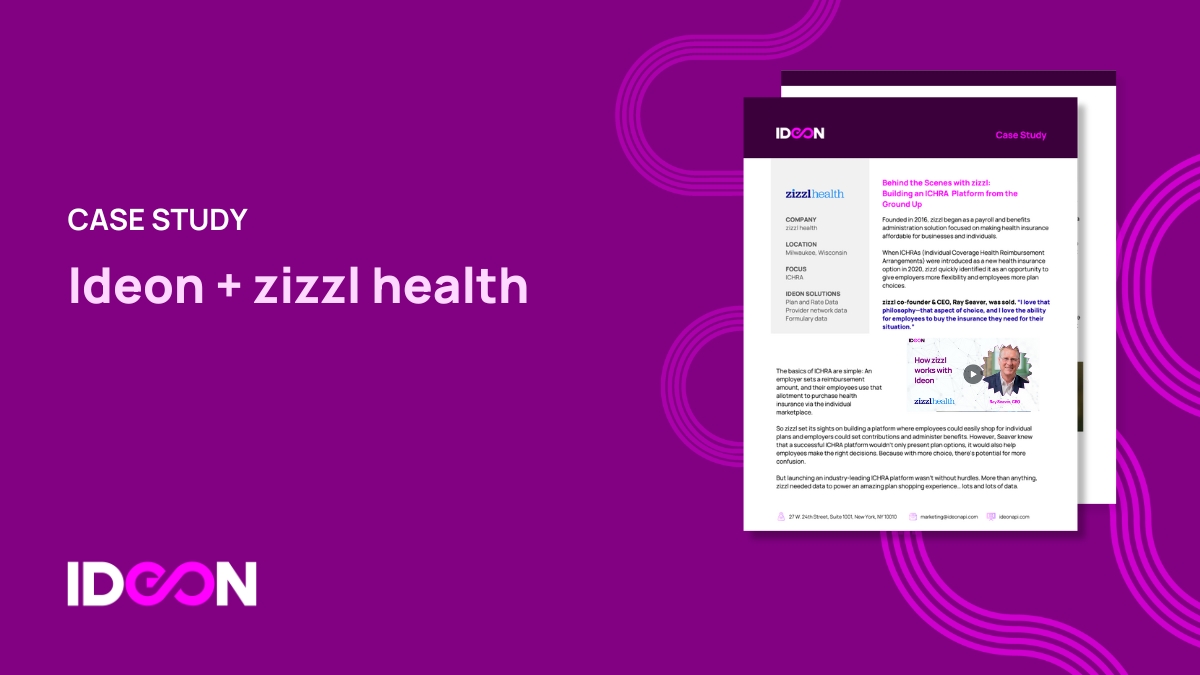
zizzl health’s Story: Developing the ultimate ICHRA experience with Ideon

Learn how Zizzl enhanced its ICHRA experience with Ideon’s data solutions. Click between the pages and see what Ray Seaver, Zizzl’s co-founder and CEO, has to say about innovating with Ideon and Zizzl’s core features!


Click here to view as a PDF.

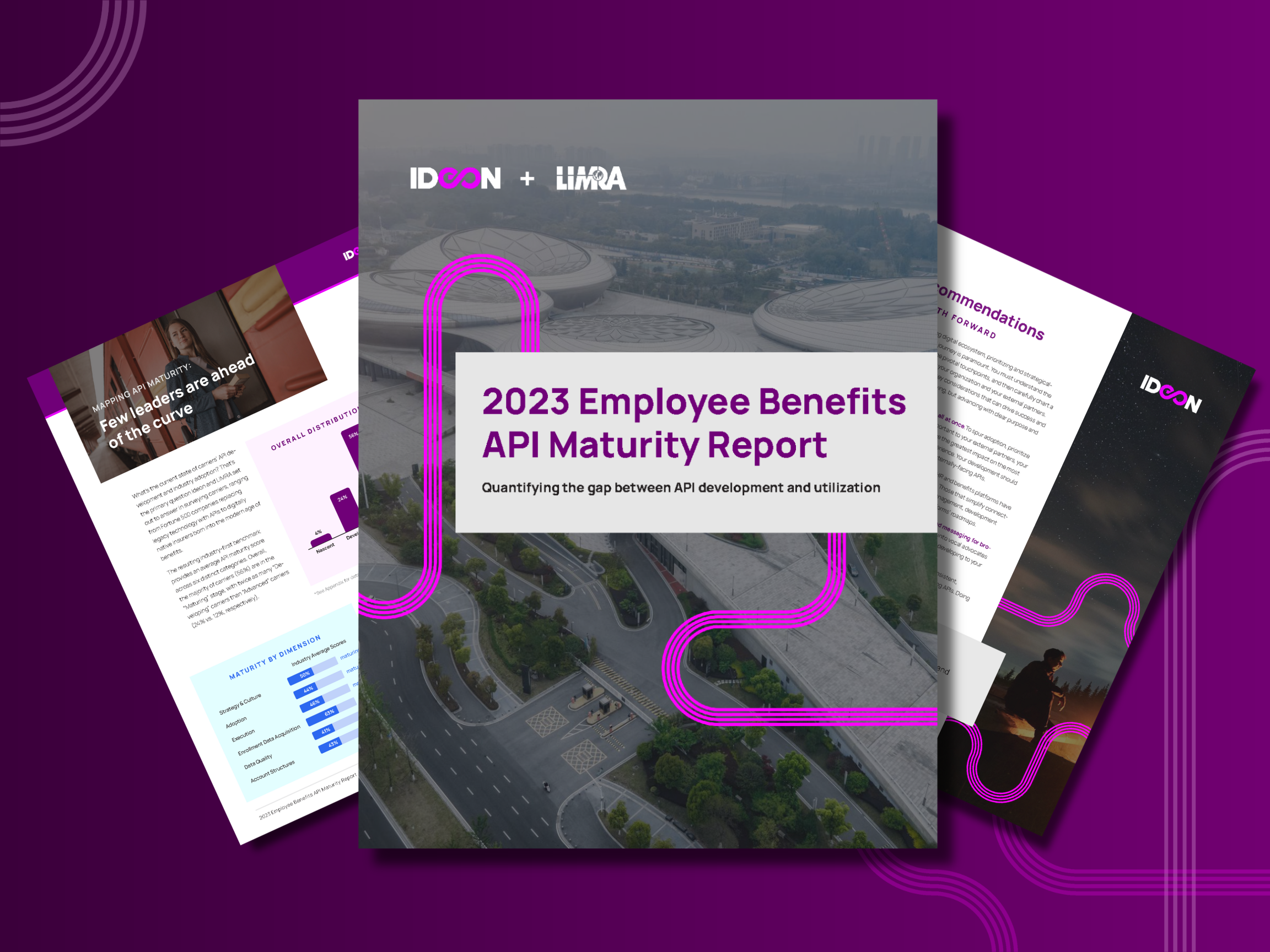
The 2023 Employee Benefits API Maturity Report

Download the report, here.

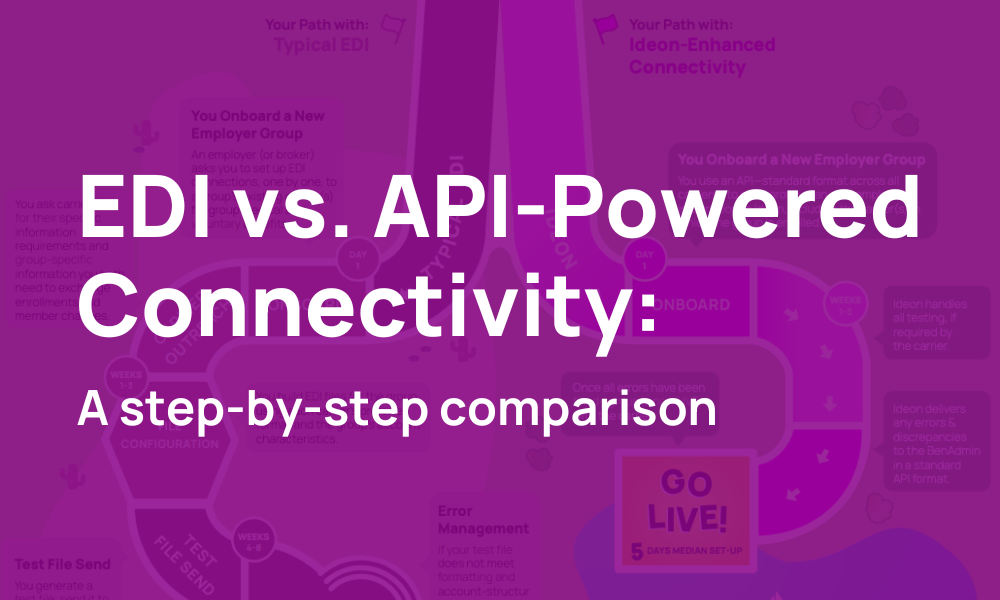
How BenAdmin Platforms Setup Carrier Connections in 5 Days

In the competitive world of benefits administration, setting up carrier connections can be an operational nightmare. What if you had a strategic guide to a better process?

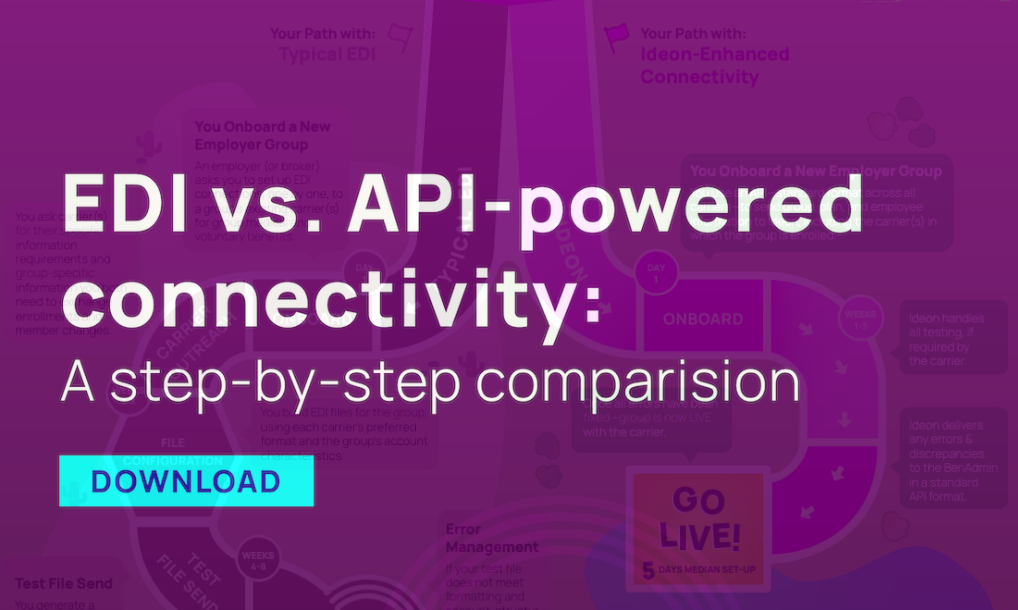
This infographic is a gameboard for a BenAdmin’s operational life. Read it, play along, and compare two pathways side-by-side:

  • Navigate the EDI path: This industry standard typically takes an 8-12 week journey filled with building and testing files, errors, and constant communication with carriers.
  • Take a shortcut and win with API-powered connectivity: This alternate route reduces connection setup to around five days, optimizing your operational efficiency.

Save this resource for later


How technology partnerships improve member experience and the bottom line

Watch the Webinar
On Demand

Today’s leading carriers leverage an expansive (and growing) benefits technology ecosystem. But choosing and integrating with the right partners can be challenging.

In this webinar, Ideon hosts executives from Prudential, PlanSource, and Brella to discuss how carriers successfully develop robust 3rd-party partnership strategies to meet members’ needs and increase revenue.

Discussion points include:

  • Balancing in-house development with external technology partnerships
  • Meeting members where they are (the case for carrier-BenTech partnerships)
  • Industry-leading examples of successful carrier-BenTech partnerships
  • Key challenges in choosing the right partners, and integrating with external systems


Save video for later

Introducing the Ideon Dashboard for real-time visibility of enrollment data

At Ideon, we’re dedicated to facilitating seamless enrollments and data exchange for our carrier and benefits platform customers. That means not only maintaining the fast, accurate, and scalable connections they expect, but also providing greater transparency and visibility—qualities that have been lacking in our industry.

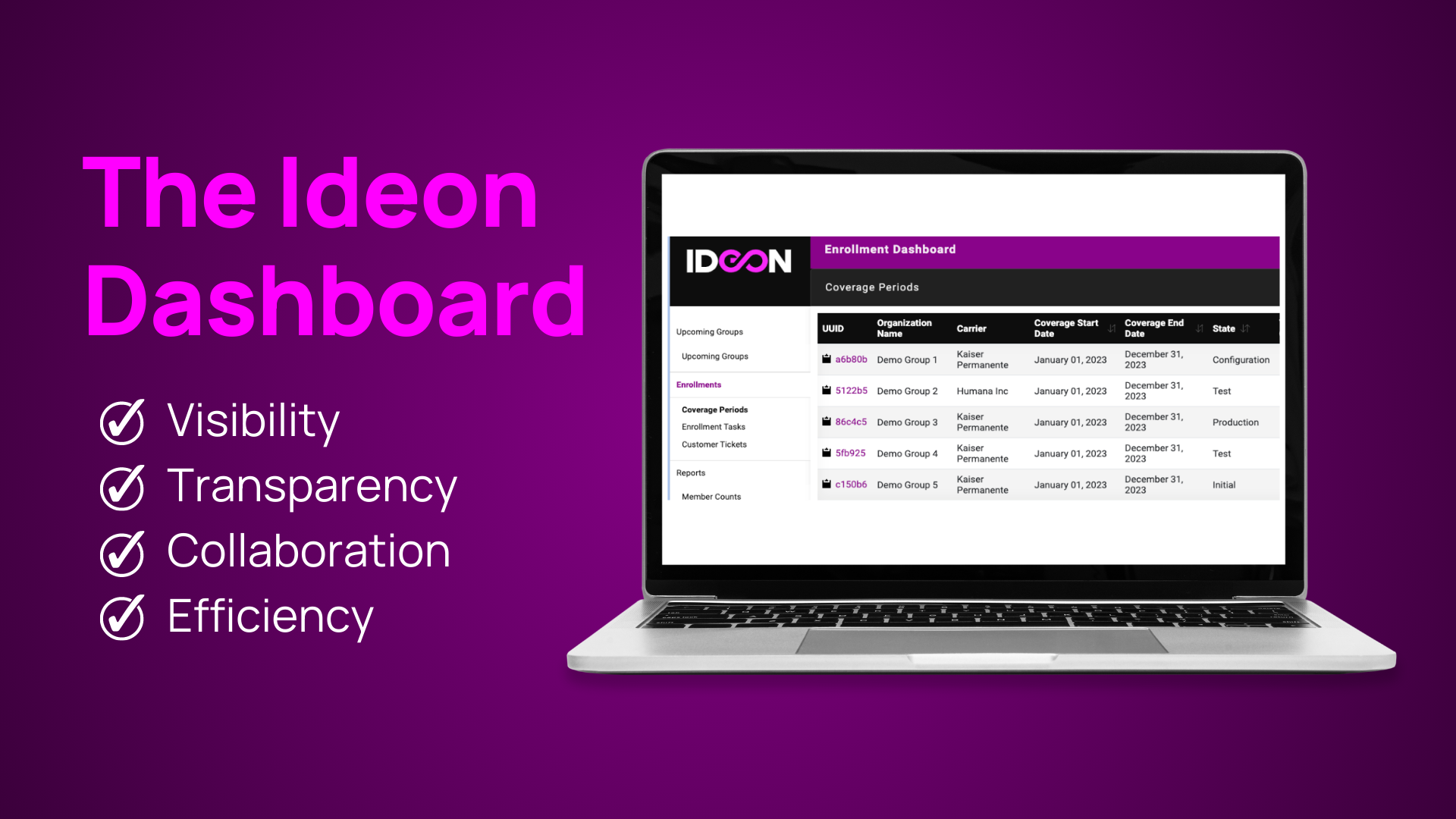
That’s why we’re excited to introduce a major enhancement to our product suite: the Ideon Dashboard, a powerful new interface that compliments our existing API endpoints. With enhanced monitoring of group implementation statuses and the ability to submit, track, and resolve issues, this dashboard brings unparalleled visibility, efficiency, and collaboration to Ideon’s enrollment customers.

The dashboard enables effective three-way collaboration between carriers, benefits platforms, and Ideon, allowing for the swift resolution of issues when they arise. It eliminates the clutter of email threads and ensures no issues are overlooked, all in a centralized, user-friendly tool that keeps all parties in the loop.

Let’s take a closer look at some of the key features.


Improved Visibility with the Enrollment Tasks Manager

Historically, setting up and managing group enrollments required numerous steps and lots of back-and-forth communication between carriers and benefits platforms. Ideon’s dashboard changes this equation. Carriers and platforms can now access real-time updates on the status of enrollment data that’s been loaded into Ideon’s system. This added visibility minimizes confusion and prevents potential delays in member enrollment.

At a glance, customers can get an immediate overview of their data across all groups, including details such as carrier-specific identifiers and coverage start and end dates. For each coverage period, they can monitor the status and owner of all completed and upcoming setup tasks. 

Tasks can be assigned to specific users from the platform, Ideon, or the carrier, ensuring there’s alignment on next steps and responsibilities. Additionally, comments and attachments can be added to each task, providing necessary context and encouraging collaboration. This not only eliminates lengthy email exchanges but expedites the process of getting groups live.

Through the transparency and visibility provided by the Enrollment Tasks Manager, Ideon customers will always be informed about the status of their groups. They’ll have accurate and up-to-date information to share with members, brokers, and HR teams, ensuring a better enrollment experience with clear timelines and expectations.

Efficient Issue Resolution with the Customer Ticketing System

As carriers and benefits platforms’ operational teams know all too well, issues are bound to happen in our industry, whether it’s discrepant group information, a member inquiry, or another pressing matter.

The Ideon Dashboard offers streamlined issue resolution with its intuitive Customer Ticketing System. It centralizes communication and collaboration, allowing customers to easily submit, track, and resolve their questions, concerns, and escalations. With everything in one place, scattered communication channels like Slack and email are eliminated, and tickets are monitored right alongside the groups they belong to.

For each ticket, customers can provide notes, severity info, and useful attachments or documentation. Comment threads help maintain individualized communication with Ideon, and watcher functionality and email notifications keep customers in-the-know at all times.

Conclusion

The Ideon Dashboard is a powerful addition to Ideon’s enrollment solution, providing greater levels of visibility, efficiency, and collaboration to carriers and platforms—both during group setup and in production.

The new interface is designed to enhance the overall transparency and effectiveness of working with Ideon in a secure, centralized way. But it’s meant to complement, not replace Ideon’s suite of APIs.

All data and functionality offered by the dashboard are also available via Ideon’s existing API endpoints and webhooks. Using these features, our customers can seamlessly integrate status updates and other information into their own tooling and user experience. It’s all part of the unrivaled enrollment experience that Ideon delivers to our customers, their operations teams, and, ultimately, members, employers, and brokers.

Schedule a demo

The Ideon Dashboard has already seen great success among several of our carrier and benefits platform customers, and we can’t wait to show you all of its features. You can watch a short demo above, or reach out to schedule a personalized walkthrough.


Five takeaways: Ancillary quoting and the rise of 3rd-party platforms

Third-party platforms are modernizing how brokers quote voluntary and ancillary benefits, providing an intuitive digital experience to instantly quote and select multiple carriers and lines of coverage.

Sounds amazing, right? Some carriers have embraced this transformation, partnering with tech platforms to ensure their products are distributed to brokers via today’s growing digital ecosystem. But for others, there’s been hesitancy to adopt a 3rd-party strategy.

What factors are leading to these varied outlooks and strategies?

Ideon, an API company that connects carriers and platforms in an easy and scalable way, recently hosted a webinar where a panel of experts explored the evolution of ancillary benefits quoting, the value of 3rd-party partnerships, the digital demands of today’s brokers, and more.

In this blog, we highlight five key takeaways from the event, which featured:
–   Jeremy McLendon — Sr. Vice President at MyHealthily
–   Hannah Thompson — Sr. Manager of Solution Architecture at Beam Benefits
–   Eric Weiford –– Sr. Relationship Manager at Principal Financial Group

A full recording of the webinar is available for download, here.

1. The fear of spreadsheeting is overblown.

One prevalent reluctance among carriers, as they consider offering their products through 3rd-party platforms: Won’t this just lead to my plans being spreadsheeted?

All three panelists agreed — spreadsheeting is happening regardless, and carriers may as well empower it through distribution and great digital experiences.

“Distribution means some change in tradition,” McLendon said. “You’re probably going to be spreadsheeted as it is. So why not win and do it a little faster?”

Beam approaches spreadsheeting from a similar perspective, Thompson said. “Cool, put us on the spreadsheet, especially if that broker is getting a quote through a digital platform where we’re API-connected. Spreadsheeting is unavailable, but the shift over to API quoting is making it a lot more advantageous to carriers like Beam.”

“If brokers and general agents aren’t doing that, they are going to lose that business at some point anyway,” Weiford added. “From a broker’s due diligence, they have to spreadsheet every now and then.”

2. API-powered, fully-underwritten quoting is the new frontier.

APIs allow carriers and platforms to communicate and exchange information in real time. The technology is becoming favored for a range of benefits-related tasks, including enrollment, EOI decisions, claims, and more.

Recently, APIs have made their way to the ancillary quoting space, allowing users of platforms like MyHealthily to generate instant, underwritten quotes based on group-specific criteria. The platform submits group information via a carrier API, and the carrier’s algorithm spits out underwritten quotes, all within seconds.

“We have prioritized platforms that can connect to our APIs,” Thompson said. “Through API quoting integrations, we can ingest census data, which means we can provide custom, underwritten, real-time bindable rates to these platforms.”

3. There’s untapped potential in the small group market.

Digital quoting solutions were historically available only in the large group space, but according to Thompson, that’s beginning to change.

“That ability to deliver real-time, custom, underwritten rates through an API connection—or even via Beam’s own tools for small groups—it’s huge, it’s an underserved market,” Thompson said. “The ability to provide really sharp rates to small groups, in a way that the large group space has benefited from in the past, is a unique opportunity for our industry.”

Like Beam, Principal has designed its digital strategy to win business down market and bring modern technology to small businesses.

“Our bread and butter is in the small group space,” Weiford said. “We’re constantly having conversations with the intermediaries who are adopting these platforms, looking at what is and isn’t working, so we can be agile in trying to make things work for them and for Principal.”

4. Getting started requires gaining organizational alignment.

Custom underwriting is seen by many carrier reps as a differentiator. So, internally, how do carrier executives get buy-in and explain the value of 3rd-party quoting?

“Distribution via 3rd-party platforms is only going to get more eyeballs to your products,” Thompson said. “And that hopefully means more RFP conversions for your team. The way we position it internally, is if a broker is going to go through a platform, we will still associate a rep to those opportunities. Oftentimes, there’s still consultation that needs to happen, from the rep to the broker, to ensure the broker is positioning the product appropriately. We still plug our reps into that flow.”

Carriers, Weiford explained, can alleviate concerns among their reps by including them in conversations about third-party quoting, explaining that it will lead to more opportunities, and showing them detailed reporting. But, it might take time for total organizational buy-in.

“Adoption isn’t always there at first,” Weiford said. “When reps start seeing that they can get additional swings, then it starts getting a little bit more palpable. And then you start showing them reports, ‘hey, here’s 100 new opportunities, go win that business by working with the broker.’ Platforms are not the enemy—you’re working alongside them.”

5. The right strategy and partnerships can mitigate scalability concerns.

For third-party platforms that have ancillary quoting functionality, scaling up can be challenging. Platforms want to offer brokers lots of carriers and products, but doing so requires partnership discussions, relationship management, and technical integrations.

“We tend to be carrier-agnostic, as we want to offer a large marketplace to our brokers,” McLendon said. “But constantly vetting and integrating with carriers can take time away from our development team. We look for the carriers that are willing to adopt early — from our experience, those are the opportunities where we can grow together.”

Ideon, McLendon explained, has helped MyHealthily solve the scalability problem.

“Working with partners like Ideon, a middleware so to speak, is nice because it allows us to integrate with more carriers more quickly. That way we can take on other projects.”

For carriers, the value of working with Ideon is similar. It enables them to integrate with numerous downstream quoting platforms without building direct integrations to each system.

To watch the full webinar recording, click here. To learn more about how Ideon helps carriers and platforms grow in the ancillary quoting space, contact us and we’ll be in touch.

How BenAdmin platforms turn carrier connectivity into a competitive advantage

Benefits administration platforms’ (BenAdmins) sales, operations, and product teams have a ton to think about these days: 

  • How do we become a year-round benefits destination for employees? 
  • How do we take advantage of the growing popularity of voluntary benefits? 
  • How do we ensure our employee experience is a competitive differentiator?

One topic that is all too often overlooked: carrier connectivity. On one hand, carrier connectivity has become table stakes — after all, doesn’t every BenAdmin platform communicate enrollments and member changes to carriers digitally, mostly via EDI feeds?

Yes, but leading BenAdmins view carrier connectivity as much more than a technical requirement: done correctly, it’s a competitive advantage, enabling scalability, efficient operations, and a fast, accurate enrollment experience.

In the benefits industry, “fast” and “scalable” are rarely used to describe group setup and implementation. We know from speaking with our customers that it takes most BenAdmins 8-12 weeks — and often longer — to build typical BenAdmin-to-carrier EDI feeds. But that’s all changing now. We’ve seen several platforms reduce their group setup timeline to as few as five days. 

The obvious question: How are BenAdmins reducing group setup to days, instead of months?

The answer lies in a new way of managing carrier connections, a strategic decision to partner with companies that specialize in exchanging enrollment data between BenAdmins and carriers. 

The results for BenAdmins speak for themselves:

  • Group setup completed in five days
  • The ability to send enrollment data in a consistent format
  • Elimination of several manual steps that typically prolong EDI implementation

Our new infographic compares, side-by-side, this enhanced carrier connectivity strategy vs. traditional EDI setup. Fast, accurate, and scalable — it’s a new world of connectivity without complexity. Download the infographic to learn more.

DOWNLOAD