
CMS Provider Directory Requirements: A Complete Compliance Guide for 2026-2027

CMS provider directory requirements now mandate 85% accuracy, 30-day updates, and annual attestation for Medicare Advantage, Medicaid, and ACA marketplace plans. Beginning plan year 2027, provider directory data will appear publicly on Medicare Plan Finder, transforming accuracy from an internal compliance function into a competitive differentiator. Organizations that treat directory infrastructure as strategic investment gain compounding advantages over those relying on manual verification.

Provider directory accuracy faces federal scrutiny at an unprecedented level. CMS’s national review found that 48.74% of provider locations in Medicare Advantage online directories contained at least one inaccuracy—wrong phone numbers, incorrect addresses, or outdated patient acceptance status.

That failure rate persists despite the healthcare industry spending more than $2 billion annually to maintain provider data. Manual verification processes cannot keep pace with the velocity of provider information changes or the escalating demands of federal regulators.

The regulatory landscape has intensified dramatically. The No Surprises Act requires 90-day verification cycles and 2-business-day directory updates. The Consolidated Appropriations Act 2023 established baseline Medicaid directory standards. And the CMS Final Rule CMS-4208-F2, finalized September 2025, mandates that Medicare Advantage organizations submit provider directory data directly to CMS for publication on Medicare Plan Finder by 2027.

For health plans, benefits technology platforms, and ICHRA administrators, this convergence of requirements creates a clear decision point: build verification infrastructure internally—a 12-18 month undertaking requiring specialized HL7 expertise—or integrate API-driven compliance solutions that deliver accuracy, scalability, and automatic regulatory updates in weeks.

This guide breaks down every requirement organizations must meet across Medicare Advantage, Medicaid, and ACA marketplace programs, and examines how modern infrastructure transforms compliance from an operational burden into strategic advantage.

What are CMS provider directory requirements?

CMS provider directory requirements: Federal regulations mandating that Medicare Advantage plans, Medicaid programs, and ACA marketplace plans maintain accurate, publicly accessible provider directories. These requirements specify what information organizations must include, how frequently they must verify it, and the consequences of non-compliance.

What directories must include. Provider identification details—name, National Provider Identifier (NPI), specialty, and board certifications—form the foundation. Practice location data encompasses physical addresses, phone numbers, and fax numbers. Accessibility information covers facility accommodations for individuals with physical disabilities. Service delivery details specify telehealth availability. Patient acceptance status indicates whether a provider accepts new patients. Cultural and linguistic capabilities include languages spoken, American Sign Language availability, and interpreter services. Network participation data encompasses network status, plan affiliations, and tier designations.

Who must comply. Medicare Advantage organizations offering coverage to Medicare beneficiaries face the most stringent standards. Medicaid managed care programs—including state Medicaid and CHIP agencies—must meet CAA 2023 requirements. ACA marketplace plans offering qualified health plans on federal and state exchanges face parallel accuracy obligations. Benefits technology platforms—ICHRA administrators, broker platforms, and HR tech vendors distributing these plan types—inherit compliance exposure through their carrier relationships.

The regulatory evolution. Three milestones define the current landscape. The Consolidated Appropriations Act 2023 established baseline provider directory standards for Medicaid and CHIP programs. CMS Final Rule CMS-4208-F2, finalized September 19, 2025, mandated Medicare Plan Finder integration for plan year 2027. The November 2025 CMS Technical Implementation Guide specified data formats, submission protocols, and implementation timelines.

CMS provider directory accuracy standards

The 85% accuracy threshold. CMS requires a minimum 85% directory accuracy rate for Medicare Advantage and ACA marketplace plans. Accuracy measurements span practice locations, phone numbers, specialty designations, and network participation status. Failing to meet the 85% threshold triggers regulatory action, corrective measures, and potential enrollment freezes.

National accuracy challenges. The gap between the 85% requirement and current performance remains significant. CMS’s national review found that 48.74% of provider locations in MA online directories had at least one inaccuracy. The most common errors include wrong phone numbers, incorrect addresses, and outdated acceptance status. Industry data indicates that only one in five health plans has achieved significant accuracy improvements despite dedicated verification efforts.

Location accuracy as critical challenge. CMS data shows that at least 45% of locations reported in directories are incorrect, with the most common issue being providers not actually practicing at published locations. Location-specific verification requires providers to accept or reject location information and provide reasons for rejections—a process that manual outreach cannot execute efficiently at scale.

CMS testing and monitoring. CMS conducts quarterly secret shopper surveys without advance warning to health plans. Random provider sampling across entire networks tests for discrepancies in contact information, location accuracy, and patient acceptance status. Monthly directory updates represent the minimum compliance obligation.

What CMS considers “accurate.” Five criteria define an accurate directory entry: the provider actively practices at the listed location; contact information (phone, fax, email) functions and remains current; specialty and credential information reflects verification against primary sources; network participation status reflects current contracts; and patient acceptance status meets required update timeframes.

Medicare Plan Finder integration for 2027

The 2027 mandate. Beginning plan year 2027, all Medicare Advantage organizations must submit provider directory data directly to CMS for publication on Medicare Plan Finder (MPF). This rule, finalized September 19, 2025 under CMS-4208-F2 and codified at 42 C.F.R. § 422.111, establishes four core obligations: make provider directory information available to CMS for publication online; submit data in a format, manner, and at times determined by CMS; update provider directory information within 30 days of becoming aware of any change; and attest at least annually that all submitted information is accurate and complete.

Implementation timeline. As of January 1, 2026, MA organizations must make directory data available to CMS. During 2026, CMS conducts validation testing to ensure directory data accurately reflects MA organization submissions. For the 2026 Plan Finder update, CMS partnered with SunFire Matrix, Inc. to populate provider details using third-party data sources, establishing a benchmark for data completeness and reliability. By the 2027 open enrollment period, provider directories sourced directly from MA organizations appear publicly on Medicare Plan Finder.

CMS issued the provider directory requirement through a separate final rule to provide MA plans “maximum lead time” for preparation. That lead time narrows with each passing quarter.

Why this integration matters. This mandate transforms provider directory accuracy from an internal audit metric into a public-facing quality indicator. Beneficiaries compare provider networks across all MA plans on a single platform for the first time. Directory quality directly affects plan selection, member trust, and competitive positioning. Plans with incomplete or inaccurate data visible on Medicare Plan Finder face reputational consequences that compound through lower enrollment.

Data format and technical submission requirements

FHIR-based API standard. CMS requires the Health Level Seven International (HL7) FHIR standard for provider directory APIs. MA organizations have maintained provider directory APIs since July 1, 2021, under the Interoperability and Patient Access Final Rule. For Medicare Plan Finder integration, CMS accepts data via MA plans’ existing FHIR-based JSON APIs—aligning the submission standard with infrastructure that compliant organizations already operate.

National provider directory vision. CMS intends for the National Provider Directory, once fully implemented, to consume MA plan FHIR-based APIs directly. Data feeds to Medicare Plan Finder enable real-time provider information updates across all plans. The November 2025 CMS Technical Implementation Guide provides specifications for data formats, submission protocols, and timing milestones.

Required data elements. CMS requires all information described in § 422.111(b)(3)(i): provider identification and credentials, all practice locations with contact information, network participation and tier status, accessibility and telehealth capabilities, patient acceptance status, and cultural and linguistic accommodations. Each data element must meet the format specifications outlined in the November 2025 CMS Technical Implementation Guide, which organizations must follow when making provider information available.

Consistency between submissions. CMS did not finalize the proposal requiring direct attestation that directory data matches network adequacy submissions. However, plans must maintain consistency between the two. Discrepancies between provider directory submissions and Health Service Delivery (HSD) network filings trigger compliance review and audit exposure.

Medicaid and ACA marketplace directory requirements

CAA 2023 requirements. The Consolidated Appropriations Act 2023 requires both fee-for-service (FFS) and managed care Medicaid programs to update network provider directories quarterly. Directories must include each provider’s name, address, phone number, and specialty. Medicaid directories carry additional data requirements: facility accommodations for individuals with physical disabilities, provider website URLs, telehealth availability, whether providers accept new Medicaid or CHIP patients, and American Sign Language availability along with other cultural and linguistic capabilities.

State agency obligations. State Medicaid and CHIP agencies providing FFS services must incorporate required information into provider directories. Enhanced federal financial participation supports the design, development, implementation, and maintenance of state Medicaid IT systems for FFS provider directories.

30-day update requirement. Medicaid managed care programs must update directories within 30 days of becoming aware of changes. This requirement took effect July 1, 2025, for Medicaid CAA compliance.

ACA marketplace standards. ACA marketplace plans face the same 85% accuracy threshold as Medicare Advantage plans. Monthly update cycles represent the minimum obligation. CMS conducts secret shopper testing without advance notice across marketplace plans, applying the same verification methodology used for MA directory reviews.

Corrective action plans. CMS July 2024 guidance established corrective action plan requirements for organizations failing to meet directory accuracy standards. These procedures outline the steps for returning to compliance after directory accuracy failures, including documentation requirements and remediation timelines.

Enforcement mechanisms and penalties

Escalating penalty structure. CMS enforces directory accuracy through a progressive framework. Warning letters represent the initial enforcement action. Corrective action plans follow for organizations failing the 85% threshold. Repeated failures trigger enrollment freezes—stopping new member acquisition during critical growth periods. Plan termination remains a possibility for organizations demonstrating persistent non-compliance.

Audit landscape. At least half of surveyed health plans reported audits since January 2016, when CMS directory regulations took effect. Among those audited, nearly 70% measure directory accuracy quarterly or monthly. The audit landscape intensifies with Medicare Plan Finder integration: beginning 2027, directory accuracy becomes publicly visible, enabling beneficiaries to directly assess provider network quality when comparing plans.

Financial impact. Non-compliance creates cascading costs: regulatory penalties and fines, accelerated member disenrollment, reputational damage in competitive markets, and increased call center volume addressing member complaints from directory errors. For organizations operating in multiple states, the compounding effect of multi-jurisdictional non-compliance accelerates these costs further.

Public accountability through Medicare Plan Finder. Beginning 2027, directory accuracy becomes publicly visible on Medicare Plan Finder. Beneficiaries directly assess provider network quality when comparing plans, making poor directory accuracy a measurable competitive disadvantage in a transparent marketplace.

Documentation obligations. MA organizations must attest annually to directory accuracy, maintain audit trails demonstrating continuous monitoring, and document all verification processes and update procedures.

Compliance challenges and operational burden

Resource-intensive manual verification. Provider practices field outreach from multiple health plans, all seeking the same information through different channels and timelines. Health plans allocate significant resources to phone, mail, and fax outreach—efforts that collectively account for a portion of the $2 billion the commercial healthcare industry spends annually maintaining provider data. Only one out of five health plans has achieved significant improvements from these verification efforts.

Data fragmentation. Provider information scatters across credentialing, enrollment, claims, and directory systems with no single source of truth. Inconsistencies compound as data ages. Batch processing creates delays between provider changes and directory updates—delays that regularly exceed regulatory timelines.

Provider engagement difficulties. Low response rates to verification outreach persist across the industry. Providers lack direct incentive to prioritize directory update requests among competing administrative demands. Multi-plan coordination—where providers must respond to verification requests from every health plan in their network—creates confusion and incomplete responses. Without a standardized process, information updates submitted to one plan do not automatically propagate to all relevant plans.

Technical barriers. FHIR API implementation requires specialized HL7 expertise that many organizations lack internally. Legacy systems may not support real-time data exchange. The 2027 Medicare Plan Finder deadline compresses implementation timelines for organizations that have not yet built compliant infrastructure. Testing and validation periods add further complexity to an already constrained compliance timeline.

Regulatory timeline pressures. The 30-day update requirement proves difficult to achieve with manual processes. Annual attestation obligations demand continuous accuracy monitoring rather than point-in-time corrections. The convergence of the 2027 Medicare Plan Finder deadline with existing No Surprises Act requirements creates overlapping compliance obligations that strain operational capacity.

Modern compliance solutions and best practices

Centralized provider data platforms. A single source of truth eliminates the inconsistencies that plague distributed systems. Providers update information once, and changes propagate to all participating health plans automatically. CAQH DirectAssure demonstrates this model: leveraging data from CAQH ProView, conducting provider outreach aligned with regulatory reporting requirements, and enabling providers to review, update, and attest to practice information shared with all participating plans.

The results from centralized approaches are measurable. One health plan achieved 84% directory accuracy for Medicare Advantage plans using the CAQH solution—far exceeding the national average of 50% or lower. Nearly 40,000 providers completed profiles and attested to accuracy within three months, with a Net Promoter Score of 70 indicating strong provider preference for automated workflows over manual outreach.

API-driven compliance infrastructure. Real-time data exchange replaces batch processing and manual outreach. FHIR-based APIs meet CMS technical requirements for the National Provider Directory and Medicare Plan Finder integration. Automated verification against primary sources—NPPES, medical boards, DEA registries—replaces phone calls and fax surveys. Continuous monitoring identifies changes and triggers update workflows within regulatory timeframes.

Implementation considerations. Organizations face a clear build-versus-integrate decision. Building FHIR API infrastructure internally requires specialized HL7 expertise, 12-18 months of development, and ongoing maintenance as CMS requirements evolve. Integrating third-party compliance platforms accelerates time-to-compliance through subscription models that include automatic regulatory updates. For organizations approaching the 2027 Medicare Plan Finder deadline, timeline alone often determines the path.

Location-specific validation. Enhanced verification functionality addresses CMS’s identified location accuracy challenge. Location-specific questions require providers to accept or reject location information and provide reasons for rejections. This approach enables health plans to reconcile discrepancies systematically—addressing the most persistent compliance failure point in CMS audit findings.

How Ideon addresses CMS directory compliance

IdeonSelect delivers normalized provider directory data through a unified API, providing the infrastructure layer that health plans, ICHRA administrators, and benefits technology platforms need to meet CMS directory requirements without building verification systems from scratch.

  • Unified provider data access: Single API integration provides access to provider networks across 300+ carriers, eliminating the need to build and maintain individual carrier connections for directory data
  • Real-time provider search: Normalized provider data—specialties, locations, credentials, network status—meets CMS accuracy and timeliness requirements through continuous data updates
  • Compliance-aligned update cycles: Automated verification workflows align with CMS 30-day, quarterly, and annual requirements, ensuring directory accuracy meets the 85% threshold
  • FHIR-compatible architecture: Infrastructure designed for interoperability supports Medicare Plan Finder integration timelines and CMS technical submission requirements
  • Enterprise-grade security: SOC 2 Type II certified and HIPAA compliant infrastructure removes months of compliance certification work

For benefits technology platforms distributing Medicare Advantage, Medicaid, or ACA marketplace plans, IdeonSelect enables compliant provider search without building verification infrastructure internally. The 4-8 week implementation timeline supports organizations preparing for the 2027 Medicare Plan Finder deadline—while competitors spend 12-18 months building the same capabilities from scratch. Automated compliance monitoring and multi-carrier integration through a single API reduce the operational burden that manual verification processes impose on health plan and provider staff alike.

Final words

CMS provider directory requirements have evolved from periodic audit exercises into continuous compliance obligations with public accountability. The 2027 Medicare Plan Finder mandate transforms directory accuracy from an internal metric into a competitive differentiator visible to every Medicare beneficiary comparing plans.

Manual verification cannot achieve the accuracy, timeliness, or scale these requirements demand. Organizations using centralized API platforms achieve 84% directory accuracy versus the 50% national average, while reducing operational burden and compliance risk.

The decision is straightforward: build specialized FHIR infrastructure internally over 12-18 months, or integrate proven API solutions that deliver compliant provider data in weeks. Organizations that act now position themselves to meet 2027 deadlines and convert directory accuracy into a member trust advantage.

Explore Ideon's IdeonSelect for health plans and benefits platforms

Ready to take the next step? See how Ideon works.

‘Ghost Networks’ Are Breaking Care Navigation—Better Infrastructure is the Answer

If you’re building a care navigation, care routing, or digital front door experience, provider data accuracy isn’t optional—it’s foundational. Yet across the healthcare industry, many platforms are still guiding members using provider directories that don’t reflect real-world access.

A recent blog post from Zocdoc, Ghost Networks Explained: Why Healthcare Provider Directories Fail,” clearly outlines the problem. Ghost networks occur when provider directories list doctors or facilities as in-network even though they aren’t realistically available—because they’ve moved, stopped accepting new patients, changed network participation, or are simply unreachable. The result is a directory that looks complete but fails members at the moment they try to act on it.

This isn’t a fringe issue. It’s systemic—and it’s breaking care navigation.

How Common Are Ghost Networks?

Ghost networks are far more prevalent than many platforms realize. According to audits cited by Zocdoc, 45–52% of Medicare Advantage provider listings contain at least one inaccuracy, such as an incorrect address, phone number, or network status. In a U.S. Senate Finance Committee secret shopper study focused on mental health access, patients were able to successfully book an appointment only 18% of the time, largely due to inaccurate directory information.

For care navigation and routing platforms, these numbers translate directly into:

  • Members routed to dead ends
  • Delays in care
  • Increased abandonment and frustration
  • Higher support costs and erosion of trust

Ghost networks don’t just degrade user experience—they undermine the core promise of guiding members to care.

Why Ghost Networks Break Care Navigation and Care Routing

Care navigation depends on actionable accuracy. It’s not enough to show that a provider is technically in-network. Members need confidence that:

  • The provider actually practices at the listed location
  • The plan truly covers them
  • The recommended route leads to real, accessible care

Ghost networks introduce false destinations into routing logic. Navigation flows may look correct, but members are forced to validate everything themselves—calling offices, rechecking coverage, and starting over when reality doesn’t match the directory.

As the Zocdoc post makes clear, this is less a UX issue and more a failure of access pathways. When directories aren’t trustworthy, navigation becomes trial-and-error instead of guidance.

What Solving Ghost Networks Actually Requires

Addressing ghost networks at an industry level requires better infrastructure—not just better interfaces. Specifically, platforms need:

  • Provider directory data delivered in a single, normalized format
  • Frequent refresh cycles that reflect how often provider data changes
  • Confidence signals to distinguish reliable listings from risky ones
  • Feedback loops that correct inaccuracies at the source, not just downstream

This is where API-first provider data and carrier relationships become critical.

How Ideon Helps Solve Ghost Networks at the Source

IdeonSelect provides provider directory data purpose-built for care navigation, care routing, digital front doors, and digital health platforms. Instead of trying to “patch” directory issues downstream in UX, Ideon focuses on the infrastructure that prevents bad listings from becoming routed destinations in the first place.

In practical terms, here’s what happens in your navigation experience when it’s powered by Ideon’s API:

  • Ingest normalized, accurate provider directory data that’s mapped at the carrier, network, plan, and provider levels.
  • Use built-in location accuracy signals to reduce risky results
  • Benefit from Ideon’s upstream data quality checks so issues don’t keep reappearing

One API for Normalized Provider Directory Data

IdeonSelect delivers provider directory data from every carrier nationwide through a single API, in one consistent schema. Instead of stitching together dozens of carrier-specific files, platforms receive a unified feed that includes:

  • Provider specialties and subspecialties
  • Locations and contact details
  • Network participation by plan

This makes it far easier to build reliable care navigation and routing logic without reconciling conflicting data sources.

Direct Carrier Relationships, Plus Rigorous QA

Ghost networks persist when inaccuracies are never corrected upstream. Ideon addresses this through a combination of:

  • Direct relationships with carriers, providing authoritative network data at scale
  • A rigorous QA process that evaluates provider directory data across multiple sources to detect inconsistencies

When issues are identified—such as incorrect network participation or stale locations—Ideon works directly with carriers to correct data at the source, preventing errors from propagating across the ecosystem.

Continuously Refreshed Data and Network‑Scale Coverage

Ideon’s provider directory API covers 8.5 million providers and more than 5,000 networks nationwide, spanning individual, group, Medicare Advantage, and Medicaid markets. Data is refreshed on an ongoing basis—multiple times per month on average—so platforms aren’t routing members based on stale snapshots.

This combination of scale, refresh cadence, and source-level correction helps platforms maintain healthier networks over time, not just cleaner search results.

Address Confidence Scores

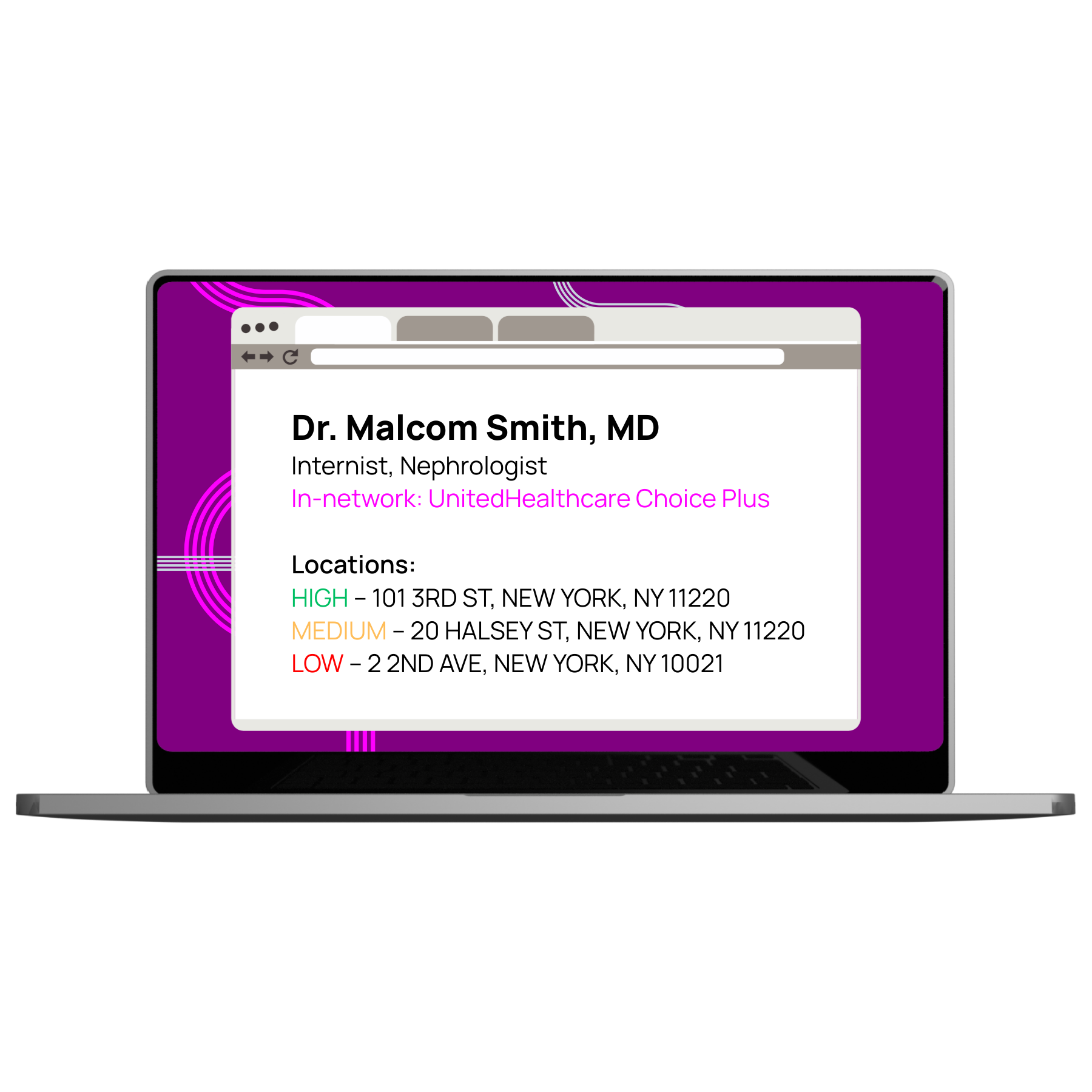
One of the most common ghost-network failures is routing members to the wrong location. Ideon’s Address Confidence Scores assign a High, Medium, or Low confidence rating to every provider address using machine learning and verified data.

Platforms can use these scores to:

  • Filter or deprioritize low-confidence locations
  • Reduce misroutes and failed appointments
  • Build smarter routing logic without pretending the data is perfect

From Directory Accuracy to Real Access

As the Zocdoc post underscores, access isn’t real unless it can be acted on. For care navigation and care routing platforms, success shouldn’t be measured by how many providers appear in a directory—but by how often members actually reach appropriate, in-network care without friction.

Ghost networks are a systemic industry problem. But with normalized provider directory data, strong carrier relationships, rigorous QA, and continuous correction at the source, platforms can stop routing members to dead ends.

If you’re building or improving a platform with care navigation or provider search functionality, consider the following:

  • Do we receive directory data in a single normalized format?
  • How often is it refreshed?
  • Do we constantly experience data quality issues around provider locations and in-network status?
  • When we find inaccuracies, can they be corrected upstream—or do they keep reappearing in the next refresh?

Explore Ideon for Care Navigation and Digital Health
If you’re building care navigation, care routing, or a digital front door, IdeonSelect can help you reduce “false destinations” with normalized provider directory data delivered through a single API.

Learn more and request an API trial here.

Provider Data Quality: The Importance of Accurate Provider Data for Benefits Platforms in 2026

Provider data quality has become the invisible infrastructure determining whether benefits platforms succeed or fail. With four out of five provider directory entries containing inaccuracies and the healthcare industry spending $4 billion annually on data quality improvements, organizations face a strategic choice: invest 12-18 months building complex normalization infrastructure, or leverage API solutions that deliver enterprise-grade data quality in weeks.

Inaccurate provider data is creating a hidden crisis in healthcare—one that threatens patients’ access to timely care. The numbers are stark: 30% of provider records contain inaccurate or missing NPI numbers, 23% of provider addresses are wrong or missing, and provider data mismanagement contributes to nearly $17 billion annually in unnecessary healthcare costs through claims processing errors and denials.

Provider data quality encompasses six critical dimensions: accuracy, completeness, consistency, validity, timeliness, and uniqueness of provider information across systems. For benefits platforms, ICHRA administrators, and carriers, this is not simply an operational requirement—it’s foundational infrastructure that determines member satisfaction, regulatory compliance, and competitive positioning.

Organizations building benefits platforms face a fork in the road: build complex provider data quality infrastructure internally, or leverage API solutions like IdeonSelect with built-in normalization and validation.

The Six Dimensions of Provider Data Quality

Enterprise-grade provider data must meet standards across six critical dimensions—each representing potential failure points for platforms building quality infrastructure internally.

Accuracy requires valid NPI numbers, correct specialties, and accurate practice locations. The reality: 30% of provider records contain inaccurate or missing NPI numbers, and 23% of provider addresses are wrong or missing.

Completeness ensures all required data fields are populated. Missing credentials, incomplete practice information, and absent network affiliations prevent members from making informed decisions.

Consistency demands that provider information matches uniformly across directories, claims systems, and enrollment platforms. Research shows 81% of provider entries contain inconsistencies across major payers—building a consistency layer requires significant normalization infrastructure.

Timeliness means provider practice changes, credential updates, and network status changes reflect immediately. Without automated systems, inaccuracies persist an average of 540 days.

Validity requires data to adhere to correct formats and standards: phone numbers in proper format, valid ZIP codes, standardized taxonomy codes.

Uniqueness eliminates duplicate or conflicting records. Industry data shows 8-12% duplicate records create member confusion and operational waste.

Maintaining all six dimensions across hundreds of carriers requires sophisticated data pipelines—or an API solution with built-in quality controls.

Business Impact: How Data Quality Affects Performance

Provider data quality failures create measurable business impact across member experience, operational costs, and claims processing.

Member Experience and Retention

More than 50% of patients use provider directories to select physicians, making directory accuracy a direct driver of member satisfaction. When data fails, 30% of patients receive surprise bills due to provider directory errors. Mental health access is particularly affected—53% of mental health patients have encountered directory inaccuracies resulting in out-of-network care and treatment disruptions.

Recent research reveals the scope: 50% of “accepting new patients” statuses are inaccurate, 28% contain wrong practitioner contact information, and 26% list retired or deceased providers.

Operational Cost Burden

Health plans spend approximately $4 billion annually to improve provider data accuracy. Manual phone verification averages 4.22 minutes per provider at roughly $4 per provider per location. One-day delays in provider onboarding cost approximately $10,122 for a medical group. Physician practices collectively spend $2.76 billion annually on directory maintenance.

Claims Processing Failures

Provider data mismanagement drives nearly $17 billion annually in unnecessary healthcare costs through claims processing errors and denials. The average health system puts $4.9 million at risk per hospital due to denials from inaccurate data.

The upside: providers using standardized PDM platforms save an average of $1,250 in administrative costs per month, with potential savings exceeding $1.1 billion annually across U.S. healthcare.

Regulatory Compliance: The Non-Negotiable Standard

Provider data quality has become a regulatory mandate with enforcement mechanisms that make quality non-negotiable.

CMS Medicare Advantage Requirements

A 2018 CMS review found 48% of Medicare Advantage directory locations contained at least one inaccuracy. The current mandate requires Medicare Advantage plans to review and update directories every 90 days with documented outreach.

No Surprises Act

The No Surprises Act protects patients from surprise bills through accurate provider directory information. Health plans bear responsibility for directory accuracy regardless of data source—meaning platforms integrating carrier data must ensure compliance.

HIPAA and Additional Frameworks

Healthcare organizations must maintain HIPAA compliance with accurate, secure data. Penalty exposure is significant: healthcare providers have faced fines exceeding $1 million for inadequate data security. Additional frameworks including the 21st Century Cures Act, state-specific directory accuracy mandates, and network adequacy standards create layered compliance requirements.

Regulators expect consistency between reports and records. Poor data quality leads to audit failures, penalties, and reputational damage. Building internal compliance monitoring requires dedicated legal oversight and continuous updates—API solutions like IdeonSelect include automatic compliance updates as regulations evolve.

The Build vs. API Infrastructure Decision

Organizations face a strategic choice between building provider data quality infrastructure internally or leveraging API-driven solutions.

Building Provider Data Quality Infrastructure

The traditional approach requires 6-8 engineers for 12-18 months constructing a normalization layer. Ongoing costs include $4 per provider per location for manual verification. The maintenance burden involves continuous carrier relationship management and format updates. Compliance overhead demands internal monitoring teams for 90-day CMS cycles and state requirements.

Modern API-Driven Approach

API infrastructure provides pre-normalized provider data across multiple carriers via single integration, built-in validation ensuring all six quality dimensions, automatic compliance updates, and real-time data quality monitoring. IdeonSelect delivers enterprise-grade provider network data with 4-8 week implementation.

Modern APi Data Approach

Organizations building custom infrastructure miss market opportunities during 12-18 month development cycles. Engineering teams freed from data plumbing can focus on product differentiation.

Real-World Impact of Data Quality Investment

Organizations investing in provider data quality infrastructure achieve measurable results.

A major health plan replaced over 1 million manual verification calls with automated outreach, achieving an 84% directory accuracy rate—significantly above national average—with substantial improvement in provider engagement and operational efficiency.

Ballad Health, an 800-physician network across 21 hospitals, implemented automated roster submission through CAQH Provider Data Portal. The result: 50% reduction in roster processing time, with data pulled weekly, standardized, quality-checked, and submitted to 30 different health plans.

The Future of Provider Data Quality

The industry is shifting toward API-first infrastructure. Manual processes are being replaced with AI-driven automation and real-time data validation. CAQH is incorporating AI and third-party data at point of entry to validate information in real-time—gathering information from 75-80% of U.S. healthcare providers.

The AI in healthcare market, worth $11+ billion in 2021, is forecast to reach $188 billion by 2030. Quality data is essential for AI algorithms to function properly—poor data quality leads to biased predictions and suboptimal outcomes.

Solving provider data quality requires commitment across the entire industry. The root cause is complex, fragmented, inconsistent data exchange between providers, payers, platforms, and vendors. Organizations with high-quality provider data achieve faster credentialing, superior member experiences, and improved compliance standing.

Platforms leveraging API infrastructure can launch with enterprise-grade data quality in 4-8 weeks. Competitors building internally face 12-18 month timelines. Modern infrastructure frees teams to focus on member experience innovation rather than data plumbing.

Conclusion: Provider Data Quality as Strategic Infrastructure

Provider data quality encompasses six critical dimensions: accuracy, completeness, consistency, validity, timeliness, and uniqueness. Poor quality costs the healthcare industry $17B+ annually in unnecessary expenses. Regulatory requirements—CMS 90-day cycles, the No Surprises Act, HIPAA—make quality non-negotiable.

Organizations face a strategic infrastructure decision. The build approach requires 12-18 months, 6-8 engineers, and contributes to the $4B+ annual industry spend on quality improvements. The API approach delivers 4-8 week implementation, subscription-based pricing, and built-in quality controls.

Organizations prioritizing provider data quality through modern infrastructure achieve faster time-to-market, superior member experiences, and reduced regulatory risk—while competitors struggle with manual verification burdens and compliance complexity.

Explore Ideon's IdeonSelect for Provider Data Quality

Ready to take the next step? See how Ideon works.

What Is Provider Data Management in Healthcare? A Complete Guide for 2026

Provider data management (PDM) is the foundational infrastructure determining whether patients find accurate provider information, whether claims process correctly, and whether organizations meet regulatory compliance. With 62% of members demanding precise provider data and CMS enforcement tightening through 2027, organizations face a strategic decision: spend 12-18 months building complex PDM infrastructure internally, or leverage API-driven solutions to launch in weeks with automatic compliance.

Healthcare consumers are making decisions with their feet. Over 33% of members will switch health plans for better digital capabilities and provider data access. This shift has transformed provider data management from back-office administrative function to competitive differentiator—the invisible infrastructure determining member satisfaction, regulatory standing, and operational efficiency.

The challenge is clear: provider information changes constantly, with inaccuracies persisting an average of 540 days in systems without automated verification. Meanwhile, regulatory requirements have accelerated dramatically. Medicare Advantage plans must verify directories every 90 days. The No Surprises Act demands 1-business-day response times. Medicaid programs require 30-day updates as of July 2025.

For benefits technology platforms, health plans, and TPAs, provider data management represents a fork in the road. Build complex infrastructure internally—requiring 12-18 months and significant engineering resources—or integrate API-driven solutions delivering accuracy, compliance, and scalability in weeks rather than months.

I. What Is Provider Data Management

Provider data management (PDM) is the systematic process of collecting, organizing, maintaining, and updating healthcare provider information across organizations. This data layer powers the provider directories patients use to find care, enables claims processing accuracy, and provides required infrastructure for regulatory compliance with CMS, state agencies, and federal mandates.

What PDM encompasses:

  • Provider credentials: NPI numbers, medical licenses, board certifications, DEA registrations
  • Practice information: Office locations, contact details, languages spoken, office hours
  • Network affiliations: Plan participation status, network tiers, panel capacity
  • Clinical capabilities: Hospital privileges, specialties, subspecialties, telehealth availability
  • Billing details: Tax IDs, group affiliations, claims submission requirements

Multiple stakeholders depend on effective PDM: health insurance carriers (Medicare Advantage, commercial plans, Medicaid programs), benefits technology platforms (HR tech vendors, ICHRA administrators, broker platforms), healthcare systems (hospitals, physician groups, integrated delivery networks), and third-party administrators.

The modern challenge is significant. Without automation, provider data inaccuracies persist an average of 540 days—creating compliance exposure, member frustration, and operational inefficiency. Organizations face a strategic choice: build complex PDM infrastructure in-house or leverage API-driven solutions that handle the data plumbing.

II. Why Provider Data Management Matters in 2025

For Patients and Members

Member expectations have fundamentally shifted. 62% of members now seek more precise provider information to make informed care decisions. Among younger demographics, demand is even more pronounced: 70% of Millennials and 64% of Gen Z want comprehensive provider details including locations, availability, and network status before selecting care.

The business impact is direct. Over 33% of members indicate willingness to switch health plans for better data access and digital capabilities. Inaccurate directories create tangible harm: delayed care, wrong provider visits, and surprise bills that erode member trust and drive churn.

For Health Plans and Payers

Regulatory compliance has become increasingly enforcement-focused. Medicare Advantage plans must verify and update provider directories every 90 days. The No Surprises Act requires response to provider inquiries within 1 business day. Medicaid programs mandate 30-day updates as of July 1, 2025. Non-compliance triggers penalties and audit exposure that compounds over time.

For Operations and Efficiency

Accurate provider data reduces claims denials and payment delays. Streamlined credentialing and network management translate directly to operational cost reduction. Organizations with centralized, accurate PDM systems report ROI of $753-$1,982 per attained enrollee through improved data quality—a measurable return on infrastructure investment.

III. Core Components of Provider Data Management Systems

Effective PDM systems integrate six interconnected components that work together to maintain accurate, compliant provider information.

Data Collection and Aggregation gathers provider information from multiple sources: initial credentialing applications, primary source verification (medical boards, DEA, NPPES), electronic health records, carrier enrollment forms, and claims systems. The challenge is that each source uses different formats, taxonomies, and identifiers—creating fragmentation that compounds over time.

Data Storage and Centralization creates a single source of truth for provider information. Cloud-based platforms provide accessibility across organizations while maintaining security and audit capabilities. Centralized repositories ensure updates propagate to all downstream systems simultaneously.

Data Normalization and Standardization converts disparate formats into unified schema. This includes mapping specialty taxonomies (NUCC codes, custom classifications), standardizing addresses and phone numbers, and resolving duplicate records and conflicting information.

Data Validation and Verification automates credential verification against primary sources, replacing manual phone calls and mail surveys. Network status validation with carriers confirms participation. Practice location confirmation verifies addresses and hours.

Data Distribution and Access flows verified data to provider directories (web, mobile, print), API endpoints for real-time search, care coordination systems, and claims processing platforms through real-time channels rather than batch transfers.

Data Governance and Quality Control establishes accountability, defines quality metrics, and maintains audit trails for compliance reporting readiness.

IV. Key Challenges in Healthcare PDM

Data Fragmentation Across Systems scatters provider information across disconnected platforms—EHR, billing, credentialing, claims—with no single source of truth. Each system holds partial information, and inconsistencies compound as data ages.

Manual Processes and Labor Intensity consume significant staff resources. Provider offices field data requests from dozens of health plans, each with different forms and timelines. Manual verification cycles are time-consuming and error-prone: phone calls go unanswered, faxes disappear, surveys are ignored.

Persistent Directory Inaccuracies including wrong addresses, outdated affiliations, and incorrect network status remain uncorrected for an average of 540 days without automated verification—well beyond regulatory compliance windows and long enough to frustrate members seeking care.

Regulatory Compliance Complexity creates overlapping requirements: Medicare Advantage 90-day verification cycles, No Surprises Act 1-business-day responses, Medicaid 30-day updates (effective July 2025), and the CMS Plan Finder mandate requiring MA plans to publish directories by 2027. Multi-state variations add another layer.

Real-World Patient Impact translates to patients unable to find accurate provider information, delayed or disrupted care from directory errors, and member frustration that drives plan switching..

V. Modern Approaches to Provider Data Management

Traditional Approach: Manual and Batch Processing relies on quarterly or annual directory update cycles, spreadsheet-based data collection, manual verification phone calls and surveys, and batch file transfers between systems. The result: slow, error-prone, labor-intensive processes that cannot keep pace with regulatory requirements or member expectations.

API-Driven Infrastructure: The Modern Standard enables real-time data exchange between systems, automated verification and validation, single integration to access multiple carrier networks, and continuous compliance monitoring. IdeonSelect exemplifies this modern standard, providing normalized provider data via unified API that eliminates the need to build and maintain individual carrier integrations.

Benefits of API-First Architecture:

  • Speed: 4-8 weeks implementation vs. 12-18 months for custom builds
  • Accuracy: Automated quality control and normalization eliminate manual errors
  • Compliance: Built-in regulatory update automation keeps pace with CMS, NSA, and state requirements
  • Scalability: Handle enrollment surges without manual intervention
  • Cost efficiency: Subscription model replaces expense of building and maintaining infrastructure

Cloud-based centralization provides single source of truth with real-time updates and enterprise-grade security (SOC 2 Type II, HIPAA compliance). API-driven PDM connects seamlessly to HRIS, payroll, benefits platforms, and claims processing systems.

VI. Implementing Effective PDM

Assessment Phase evaluates current data quality and accuracy rates, identifies system fragmentation and integration gaps, documents compliance requirements and deadlines, and calculates total cost of ownership for existing manual processes.

Strategic Decision: Build vs. API Infrastructure

Build vs. API Infrastructure

Implementation Best Practices include establishing data governance frameworks with clear ownership, defining quality metrics and monitoring processes, planning phased rollouts prioritizing compliance requirements, and monitoring member satisfaction alongside directory accuracy metrics.

VII. The Future of PDM

Regulatory Landscape Evolution continues with the CMS Plan Finder mandate (2027) requiring Medicare Advantage plans to publish directories to a centralized federal resource. State-level enforcement is intensifying with increasing penalties for directory inaccuracies.

Technology Acceleration makes API-first infrastructure the industry standard as real-time verification replaces quarterly batch updates. AI-powered data validation and automated compliance reporting add additional accuracy layers.

Member Expectations Rising demand real-time accuracy, comprehensive provider details, and integration with telehealth and digital care navigation that legacy systems cannot support.

Infrastructure as Competitive Advantage: Organizations leveraging modern API-driven PDM launch products faster, maintain compliance automatically, and deliver superior member experiences—while competitors struggle with 12-18 month build timelines and manual verification burdens.

Conclusion: Provider Data Management as Strategic Infrastructure

Provider data management has become strategic infrastructure determining competitive position. The requirements are clear: CMS 90-day verification cycles, No Surprises Act 1-day response times, Medicaid 30-day updates. Member expectations are equally demanding: 62% seek precise provider data, and over 33% will switch plans for better digital capabilities.

Organizations face a strategic choice. Build complex infrastructure internally—12-18 months development, significant engineering investment, ongoing operational costs for manual verification and compliance monitoring. Or integrate API solutions like IdeonSelect—4-8 weeks implementation, subscription-based pricing, automatic compliance updates included.

Modern API-driven infrastructure enables rapid implementation while ensuring accuracy, compliance, and scalability—freeing organizations to focus on product differentiation rather than data plumbing.

Explore Ideon's IdeonSelect for Provider Data Management

Ready to take the next step? See how Ideon works.

Provider Network Management: A Complete Guide for 2026

The healthcare provider network management market is surging toward $10 billion by 2030, driven by regulatory pressure, cost containment demands, and the shift to value-based care. Organizations managing provider networks face a strategic choice: continue manual processes that produce 50% data accuracy and 3+ month credentialing delays, or integrate API-driven infrastructure that delivers automated verification, real-time updates, and built-in compliance. This guide explains what provider network management encompasses, why it matters for payers and platforms, and how modern API infrastructure transforms network operations from administrative burden to competitive advantage.

The healthcare industry wastes $4 billion annually trying to achieve accurate provider data. Directories contain errors in 81% of entries across major payers, forcing members to encounter wrong addresses, disconnected phone numbers, and outdated network status information. One regional health plan discovered that over 40% of claims were being mistakenly denied solely because of inaccurate provider data.

Traditional provider network management relies on quarterly credentialing cycles, phone-based verification, spreadsheet tracking, and batch file transfers between disconnected systems. This approach creates credentialing delays averaging 3+ months, directory accuracy hovering at 50%, and administrative costs that climb as networks expand. Organizations face bottlenecks in provider onboarding, gaps in network adequacy, compliance risks from directory inaccuracies, and member dissatisfaction when patients cannot find or access their preferred providers.

Modern provider network management operates differently. API-driven infrastructure enables real-time data exchange, automated credential verification, unified access to multiple carrier networks, and continuous compliance monitoring. The strategic question facing health plans, third-party administrators, and benefits platforms: spend 12-18 months building complex network management systems internally, or integrate proven API infrastructure in 4-8 weeks?

Provider network management evolved from back-office administrative function to strategic infrastructure that determines member access, regulatory compliance, and operational efficiency throughout 2026 and beyond.

What Is Provider Network Management?

Provider network management: The strategic process of building, maintaining, and optimizing relationships between healthcare payers and contracted providers through credentialing, enrollment, data maintenance, and performance monitoring.

Provider network management encompasses several essential capabilities that payers, TPAs, and benefits platforms must deliver regardless of whether systems are built from scratch or powered by APIs. Network development recruits and contracts providers to meet member needs across required geographies and specialties. Provider credentialing verifies qualifications, licenses, and certifications through primary source verification. Provider enrollment registers verified providers with insurance plans and payer systems. Contract management negotiates reimbursement rates and service agreements while maintaining renewal cycles. Provider data maintenance updates directory information, network status, and practice details continuously. Network adequacy ensures sufficient provider coverage meets regulatory requirements and member access standards. Performance monitoring tracks quality metrics, utilization patterns, and provider satisfaction.

Provider network management sits at the foundation of healthcare operations. Networks provide the framework for member access to qualified care, enable accurate claims processing and payment, create required infrastructure for regulatory compliance with CMS, NCQA, and state agencies, and support value-based care models through provider performance data. Organizations managing these networks include health insurance payers operating commercial plans, Medicare Advantage, and Medicaid MCOs; third-party administrators providing benefits administration services; provider organizations including ACOs and physician groups; and benefits platforms leveraging API infrastructure to offer network management capabilities.

The modern challenge creates a fork in the road: organizations can spend 12-18 months building network management infrastructure in-house with dedicated engineering teams, or leverage API-driven solutions that deliver faster implementation and automated compliance.

Why Provider Network Management Matters

Health plans and payers rely on effective network management to avoid regulatory penalties, maintain member satisfaction, contain costs, and process claims accurately. Medicare Advantage plans face 90-day directory update requirements from CMS. NCQA accreditation demands documented network adequacy standards. State regulations impose specific provider enrollment and credentialing requirements. Regulatory penalties for directory inaccuracies create financial risk beyond operational inefficiency.

Member satisfaction depends on accurate network information. Research shows 62% of members seek more precise provider information from their health plans, while over 33% would switch plans for better network access and digital capabilities. Directory errors force patients to encounter incorrect addresses, disconnected phone numbers, and providers no longer accepting patients—frustrations that drive plan switching.

Cost containment requires strategic network design that secures favorable contract rates without sacrificing member access. Provider network management enables value-based care arrangements through performance tracking and alternative payment models. Claims accuracy depends on proper enrollment preventing payment delays, denials, and costly rework cycles.

Providers benefit from streamlined network management through faster credentialing that accelerates revenue cycle, reduced administrative burden from efficient processes, clear communication channels with payers, and network participation providing access to patient populations.

Patients experience better care access when adequate networks ensure timely appointments with qualified providers. In-network care prevents surprise billing and cost unpredictability. Credentialing processes verify providers meet quality standards, giving patients confidence in care quality.

The healthcare provider network management market is projected to reach $10 billion by 2030, driven by regulatory enforcement pressure, cost containment needs through automation, and the operational requirements of value-based care models.

Core Components of Provider Network Management

Network Development and Strategy
Strategic network development begins with analyzing member demographics and care utilization patterns to identify gaps. Organizations recruit providers by specialty and geography based on network adequacy requirements and competitive positioning. Market analysis benchmarks reimbursement rates against competitors. Network design decisions determine structure—broad access networks versus narrow high-performance networks, tiered provider arrangements, and specialty network configurations.

Provider Credentialing and Enrollment
Credentialing processes verify credentials through primary source verification of medical licenses, DEA registration, and board certifications. Ongoing monitoring tracks licensure status, malpractice history, and sanctions. CAQH integration provides standardized credentialing data, reducing redundant verification. Payer enrollment executes contracts and registers providers in payment systems.

Credentialing delays create significant bottlenecks. Organizations report credentialing processes taking 3+ months on average from enrollment request to contract effective date. Each day of delay costs facilities $10,122 per provider in lost revenue, while physicians lose up to $122,144 during 120-day credentialing delays.

Contract Management
Contract negotiation establishes reimbursement rates, fee schedules, and service terms with individual providers and provider groups. Contract lifecycle management tracks renewal cycles, amendments, and terminations. Rate updates maintain current fee schedules aligned with market conditions. Alternative payment models require contract structures supporting capitation, shared savings arrangements, and quality incentive payments.

Provider Data Management
Maintaining accurate provider directories requires continuous updates to practice locations, specialties, contact information, and network status. Keeping “accepting new patients” status current proves especially challenging—research shows this information is inaccurate 50% of the time. Claims submission requirements, billing details, hospital affiliations, and facility privileges must stay synchronized across multiple systems. Directory inaccuracies create member frustration, regulatory compliance risks, and operational inefficiencies.

Network Adequacy Monitoring
Regulatory compliance requires documented network adequacy. Geographic access analysis measures time and distance standards for member access to primary care, specialists, and facilities. Provider-to-member ratios track capacity across specialties. Gap identification reveals coverage deficiencies requiring recruitment. Compliance documentation supports CMS audits, NCQA accreditation, and state regulatory reporting.

Performance Management
Quality metrics and provider scorecards track clinical outcomes, adherence to evidence-based guidelines, and patient safety measures. Member satisfaction monitoring analyzes grievances, appeals, and patient feedback. Utilization management identifies cost and quality outliers. Provider relationship management maintains engagement through clear communication and collaborative improvement initiatives.

Key Challenges in Provider Network Management

Traditional provider network management creates operational complexity through heavy reliance on manual data entry and phone-based verification. Spreadsheet-based tracking across disconnected systems forces organizations to reconcile conflicting information manually. Research shows some health plans report provider data accuracy hovering at 50% due to manual processes that cannot keep pace with provider changes. Services like Ideon’s help solve for this.

Credentialing delays and bottlenecks slow provider onboarding to 3+ months on average. Administrative burden affects both payer and provider organizations. Manual verification workflows, incomplete documentation, and repeated requests for the same credentials across multiple payers create friction that delays revenue for providers and limits network expansion for payers.

Siloed data and system fragmentation scatter provider information across credentialing platforms, contract management systems, claims engines, and directory databases with no single source of truth. Poor integration between these systems allows inconsistencies and duplicate records to persist. When credentialing updates a provider address, that change may not propagate to the directory for months because no automated synchronization exists.

Directory inaccuracies and compliance risk stem from wrong addresses, outdated affiliations, and incorrect network status. Research examining directories of five major national health insurers found 81% of provider entries contained inconsistencies or inaccuracies. One analysis discovered 40% of provider records contain errors. Regulatory penalties for directory inaccuracies create financial exposure beyond operational costs. Member frustration from directory errors drives plan switching when patients cannot locate or access providers listed as in-network.

Provider dissatisfaction grows from communication gaps, support service issues, low reimbursement rates, restrictive network requirements, administrative complexity, compliance burden, and concerns about patient access limitations imposed by narrow networks.

Cost and resource constraints limit network management improvements. High deployment and integration costs for comprehensive network management systems create budget obstacles, especially for smaller organizations. Limited IT budgets force difficult trade-offs between network management infrastructure and other priorities. Ongoing maintenance and technology updates require continuous investment beyond initial implementation.

Modern Approaches to Provider Network Management

Traditional approaches to provider network management rely on quarterly or annual credentialing cycles, phone-based verification and mail surveys, spreadsheet tracking and manual data entry, and batch file transfers between disconnected systems. The result: slow processes, error-prone data, and high administrative costs that increase proportionally as networks expand.

API-Driven Infrastructure: The Modern Standard
Modern provider network management leverages API-driven infrastructure enabling real-time data exchange between payer and provider systems. Automated credential verification connects directly to primary sources including state medical boards, NPPES, and DEA databases. Unified API access provides normalized data from multiple carrier networks through a single integration. Continuous compliance monitoring automatically tracks licensure renewals, sanctions, and credential expirations.

IdeonSelect provides normalized provider network data via unified API, giving benefits platforms and health plans access to comprehensive provider directories, network adequacy data, and specialty verification across 300+ carriers without building individual integrations.

Benefits of API-first architecture include dramatic speed improvements—weeks versus months for network integration and provider onboarding. Accuracy increases through automated data validation and normalization that eliminates manual transcription errors. Scalability allows organizations to handle network growth without proportional staff increases. Compliance automation handles regulatory updates including CMS requirements, state mandates, and NCQA standards. Cost efficiency delivers predictable subscription pricing versus capital investment in building and maintaining custom infrastructure.

Cloud-Based Centralization
Cloud platforms create a single source of truth for provider data across the entire organization. Real-time updates propagate automatically to all connected systems—credentialing, claims, directories, member portals. Enterprise-grade security includes SOC 2 Type II certification and HIPAA compliance. Centralized data management eliminates the reconciliation burden from maintaining provider information across multiple disconnected databases.


Automation and AI Integration
Automated credentialing workflows track application status from submission through approval without manual status checks. AI-powered data validation identifies anomalies, missing information, and potential duplicates before they create downstream problems. Predictive analytics support network adequacy planning by forecasting member demand and identifying recruitment priorities. Intelligent provider matching improves member referrals by considering provider expertise, availability, and historical outcomes.


Integration with Existing Systems
Modern provider network management platforms connect seamlessly to HRIS, benefits platforms, and claims systems through standard APIs. Care coordination and referral management integration enables closed-loop workflows from authorization through appointment scheduling. Member portal and provider directory publishing provide real-time information to patients searching for care. Value-based care reporting and analytics aggregate performance data across quality, cost, and utilization dimensions.

Organizations face a strategic infrastructure decision: build network management capabilities internally requiring 12-18 months, significant engineering investment, ongoing maintenance, and continuous regulatory updates, or integrate API solutions like IdeonSelect delivering weeks implementation, subscription-based pricing, and automatic compliance updates.

Best Practices for Provider Network Management

Centralizing data management creates a single source of truth for all provider information across the organization. Implementing robust provider network management systems that integrate with existing healthcare IT infrastructure reduces errors and inconsistencies. Organizations should eliminate duplicate systems maintaining separate provider databases and consolidate to unified platforms accessible to credentialing, claims, directories, and member services.

Automating credentialing and verification integrates with primary source databases including state medical boards, NPPES, DEA registration systems, and specialty board certifications. Automated workflows handle credential monitoring and renewal tracking without manual calendar management. Reducing manual data entry and verification phone calls speeds provider onboarding from months to weeks while improving accuracy.

Establishing strong data governance defines clear ownership and accountability for data updates. Creating quality metrics and accuracy monitoring dashboards provides visibility into data health. Implementing audit trails supports compliance reporting and root cause analysis when errors occur. Regular data quality assessments identify systemic issues requiring process improvements.

Prioritizing provider experience streamlines enrollment and credentialing processes by eliminating redundant information requests and clarifying requirements upfront. Providing clear communication channels and responsive support reduces provider frustration. Self-service portals allow providers to update demographic information, practice locations, and specialties directly. Minimizing administrative burden on provider offices builds stronger relationships and improves data quality through direct provider engagement.

Monitoring network performance requires tracking network adequacy metrics including time/distance access standards and specialty provider-to-member ratios. Monitoring provider satisfaction and engagement identifies relationship issues requiring attention. Analyzing utilization patterns and cost trends reveals network performance and identifies optimization opportunities. Conducting regular network gap assessments ensures adequate coverage as member populations and care needs evolve.

Leveraging strategic partnerships accelerates implementation and reduces risk. Organizations should evaluate API infrastructure providers like IdeonSelect for rapid deployment of proven network management capabilities. Specialized provider network management platforms offer comprehensive solutions including Assured, Constellation4, HealthEdge, and Atlas PRIME. Partnering with CAQH provides access to standardized credentialing data reducing verification burden.

How IdeonSelect Transforms Provider Network Management

IdeonSelect delivers normalized provider network data through unified API infrastructure, eliminating the need for benefits platforms and health plans to build and maintain hundreds of individual carrier integrations. The platform provides comprehensive provider directories, network adequacy validation, and specialty verification across 300+ insurance carriers.

Technical Capabilities:

  • Unified API Access: Single integration provides normalized provider data from 300+ carriers, eliminating custom carrier-by-carrier development
  • Real-Time Data Updates: Automated refresh cycles ensure provider information stays current without manual verification processes
  • Comprehensive Directory Information: Practice locations, specialties, credentials, network status, and panel capacity across all connected carriers
  • Network Adequacy Tools: Geographic coverage analysis, provider-to-member ratios, and specialty availability reporting
  • Enterprise Security: SOC 2 Type II certified infrastructure with HIPAA compliance and 99.9% uptime SLA

Measurable Outcomes:

  • 4-8 week implementation instead of 12-18 months building carrier integrations
  • 300+ carrier connectivity through single API versus individual integration efforts
  • Automated compliance handling CMS directory requirements, state mandates, and NCQA standards
  • Subscription-based pricing eliminating capital investment in custom development
  • Continuous updates managed by Ideon without internal engineering resources

IdeonSelect enables benefits platforms, TPAs, and health plans to offer comprehensive provider network functionality without building complex infrastructure. Organizations gain access to enterprise-grade provider data management while focusing engineering resources on product differentiation and member experience.

The Future of Provider Network Management

Technology acceleration continues reshaping provider network management as API-first infrastructure becomes the industry standard. Real-time verification replaces batch update cycles. AI and machine learning support predictive network planning, automated quality monitoring, and intelligent provider-member matching. Blockchain exploration addresses credential verification through distributed ledger approaches providing tamper-proof credential records.

Regulatory evolution increases enforcement of network adequacy standards and directory accuracy requirements. Greater transparency in provider network information becomes mandatory through machine-readable formats and standardized data structures. Value-based care regulations expand, requiring more sophisticated provider performance tracking and payment model management.

Payer-provider collaboration strengthens as organizations recognize shared incentives for accurate data. Closer partnerships enable improved data sharing through trusted relationships and standardized processes. Reduced friction in credentialing and enrollment benefits both payers and providers. Stronger relationships across networks support joint quality improvement initiatives.

Digital-first member experience emerges as competitive differentiator. Real-time provider search with availability and scheduling integration provides seamless member journeys. Telehealth and virtual care platforms require network management systems handling hybrid care models. Personalized provider recommendations leverage member preferences, historical outcomes, and provider expertise. Seamless care coordination across network providers depends on accurate, real-time provider data.

Competitive advantage through infrastructure separates market leaders from laggards. Organizations leveraging modern API-driven network management onboard providers faster, maintain compliance automatically, and deliver superior member experiences while competitors struggle with manual processes, credentialing delays, and directory inaccuracies.

Final Words

Provider network management is the strategic process of building and maintaining payer-provider relationships through credentialing, enrollment, data maintenance, and performance monitoring. Effective network management is critical for regulatory compliance including CMS Medicare Advantage requirements and NCQA accreditation, member satisfaction when accurate directories enable care access, operational efficiency through automated workflows, and claims accuracy preventing denials and payment delays.

Traditional manual approaches create significant challenges: credentialing delays averaging 3+ months from application to approval, directory accuracy hovering at 50% due to manual verification limitations, regulatory compliance risks from outdated information, and high administrative costs that scale linearly with network size. Research shows 81% of provider directory entries contain inconsistencies across major payers, while health plans spend $4 billion annually trying to achieve accurate provider data.

Modern API-driven infrastructure transforms network management through capabilities traditional systems cannot match. Rapid implementation delivers production-ready systems in 4-8 weeks instead of 12-18 months of custom development. Automated verification connects directly to primary sources eliminating phone-based verification. Continuous compliance monitoring handles CMS requirements, state mandates, and NCQA standards automatically. Real-time updates propagate changes across all systems without batch processing delays.

Organizations face the strategic infrastructure decision: build complex network management systems internally requiring significant engineering investment and ongoing maintenance, or integrate API solutions like IdeonSelect delivering rapid deployment, subscription-based pricing, and automatic compliance updates.

Assessing current network management maturity reveals operational performance gaps and improvement opportunities. Identifying bottlenecks in credentialing workflows, data accuracy challenges, and compliance risks clarifies where traditional approaches create friction. Calculating total cost of manual processes including staff time, credentialing delays, claim denials from directory errors, and compliance penalties quantifies the business case for change. Evaluating API infrastructure solutions like IdeonSelect provides comparison against build-from-scratch approaches.

Modern API-driven provider network management enables faster provider onboarding reducing time-to-revenue, higher data accuracy eliminating member frustration and regulatory risk, and automatic compliance freeing organizations to focus on network strategy and member satisfaction rather than administrative operations and manual verification.

FAQs: Provider Network Management Essentials

Q: What is provider network management in healthcare?

Provider network management is the strategic process of building, maintaining, and optimizing relationships between healthcare payers and contracted providers. It encompasses network development, provider credentialing and enrollment, contract negotiation, data maintenance, network adequacy monitoring, and performance management to ensure members have access to qualified providers.

Q: Who is responsible for provider network management?

Health insurance payers including commercial plans, Medicare Advantage, and Medicaid MCOs manage provider networks directly. Third-party administrators handle network management for self-funded employer plans. Benefits platforms and HR tech vendors increasingly offer network management capabilities through API infrastructure. Provider organizations including ACOs and physician groups participate in network management activities.

Q: What is the difference between provider network management and provider data management?

Provider network management is the comprehensive strategic process of building and maintaining payer-provider relationships including credentialing, contracting, and performance monitoring. Provider data management focuses specifically on maintaining accurate provider information including demographics, credentials, locations, and network status. Provider data management is one component within the broader provider network management function.

Q: Why is provider network management important?

Effective provider network management ensures regulatory compliance with CMS, NCQA, and state requirements; maintains member satisfaction through accurate directories and adequate access; contains costs through strategic contracting; processes claims accurately preventing denials; supports value-based care models; and reduces administrative burden through efficient workflows.

Q: What are the biggest challenges in provider network management?

Organizations face credentialing delays averaging 3+ months, directory accuracy around 50% with manual processes, siloed data across disconnected systems, regulatory compliance risks from outdated information, provider dissatisfaction from administrative burden, and high costs that scale with network size. Manual verification processes cannot keep pace with provider changes.

Q: How long does provider credentialing take?

Traditional credentialing processes average 3+ months from enrollment request to contract effective date. Each day of delay costs facilities $10,122 per provider in lost revenue. API-driven credentialing workflows reduce this timeline to weeks through automated primary source verification and real-time status tracking.

Q: What is network adequacy in provider network management?

Network adequacy ensures sufficient provider coverage across geographies and specialties to meet member access needs and regulatory requirements. It includes time/distance standards for accessing care, provider-to-member ratios by specialty, and documented gaps requiring provider recruitment. CMS, NCQA, and state agencies enforce network adequacy standards.

Q: How can organizations improve provider directory accuracy?

Organizations improve directory accuracy through centralized data management creating single source of truth, automated verification against primary sources, API integration enabling real-time updates, provider self-service portals for direct updates, continuous monitoring identifying outdated information, and strong data governance defining accountability.

Q: What is the role of APIs in provider network management?

APIs enable real-time data exchange between systems replacing batch file transfers, automated credential verification from primary sources eliminating manual phone calls, unified access to multiple carrier networks through single integration, continuous compliance monitoring with automatic regulatory updates, and scalable infrastructure handling network growth without proportional cost increases.

Q: Is Ideon a provider network management platform?

Ideon is not a consumer-facing network management platform. Instead, Ideon provides the API infrastructure that connects insurance carriers with benefits technology platforms. IdeonSelect delivers normalized provider network data from 300+ carriers through unified API, enabling benefits platforms, TPAs, and health plans to offer comprehensive network management functionality without building complex carrier integrations.

Q: How much does provider network management cost?

Cost varies by approach. Building custom network management infrastructure requires 12-18 months of engineering effort plus ongoing maintenance and regulatory updates. Health plans spend approximately $4 billion annually on provider data accuracy initiatives. API-driven solutions like IdeonSelect offer subscription-based pricing with 4-8 week implementation, eliminating capital investment and reducing total cost of ownership.

Q: What regulations apply to provider network management?

Medicare Advantage requires 90-day directory update cycles per CMS mandate. NCQA accreditation establishes network adequacy standards. State regulations vary but typically include provider enrollment, credentialing requirements, and directory accuracy standards. The No Surprises Act mandates accurate provider information to prevent surprise billing. Federal and state enforcement includes audits and financial penalties for non-compliance.

Explore Ideon's IdeonSelect for health plans and benefits platforms

Ready to take the next step? See how Ideon works.

Ideon Releases 2026 ICHRA Map

Explore which states and counties are primed for ICHRA adoption

The 2026 ICHRA Map is here! (View the interactive tool)


Each year, Ideon’s ICHRA map tracks where individual market premiums are lower than (or equal to) small-group premiums — a key signal of ICHRA viability across the U.S. And for 2026, the landscape is shifting:

2025 → 2026 market snapshot

Number of states where the lowest-cost individual plans ≤ small-group, by metal level:

  • 🥉 Bronze: 30 → 25
  • 🥈 Silver: 21 → 18
  • 🥇 Gold: 21 → 17

Percentage of counties where the lowest-cost individual plans ≤ small-group, by metal level:

  • 🥉 Bronze: 59.9% → 54.0%
  • 🥈 Silver: 49.9% → 43.9%
  • 🥇 Gold: 50.6% → 42.0%

But it’s not all about premiums…

ICHRA adoption continues to grow as employers lean into choice, portability, and personalized benefits — especially in markets where individual coverage remains strong or where off-exchange plan options offset cost trends. And despite premium fluctuations, the ICHRA ecosystem continues to accelerate at a record pace:

  • 🚀 About 40 ICHRA platforms now use Ideon’s APIs to power quoting and plan selection — including 14 new platforms this year alone.
  • 📈 ICHRA quoting volume is up ~120% year over year via the IdeonQuote API.

Explore Ideon’s 2026 ICHRA map here: 2026 ICHRA Insights, powered by Ideon

How to Build an ICHRA Platform via API: A Practical Guide for 2025

The Individual Coverage Health Reimbursement Arrangement (ICHRA) market is no longer a niche experiment. Adoption jumped 34% from 2024 to 2025 among large employers, with even small businesses entering the space. That growth is fueling an explosion of new ICHRA platforms—some spun up by startups, others by established benefits and HR technology providers

But here’s the fork in the road: Do you spend 12–18 months building from scratch, hiring engineers, and wrangling carrier integrations? Or do you stand up your platform in weeks by leveraging existing API infrastructure?

This guide will show why API-driven infrastructure is the more scalable path to building an ICHRA platform—and how to think about the functional blocks every platform must deliver.

ICHRA Platform Fundamentals

Every ICHRA platform needs to deliver several essential capabilities, regardless of whether it’s been created from scratch or is powered by APIs. Those elements are:

1. The Employer Experience

This is the front door for companies offering ICHRAs. Employers need to:

  • Create employee classes & allowances: Segment workers by compliant criteria (age, geography, job type) and set contribution levels.
  • Design the ICHRA benefit: Decide how much funding employees receive and whether to vary contributions across classes.
  • Stay compliant: Ensure affordability rules are applied correctly and reporting requirements are met.
  • Simplify setup & admin: Integrate with payroll and HR systems, reduce manual data entry, and generate transparent reports on allowances and payments.

2. The Employee Experience

For employees, the platform must feel intuitive and empowering. At its core, this means:

  • Plan discovery & comparison: Access to on-exchange and off-exchange individual plans across carriers, normalized into apples-to-apples comparisons.
  • Decision support: Tools, filters, or even AI-powered guidance that helps employees choose the right plan based on budget and coverage of doctors and prescriptions.
  • Frictionless enrollment and payments: Seamless submission of applications to carriers, with real-time status updates, as well as easy premium payment processing.
  • Ongoing support: From concierge services to clear visibility into premium payments, employees want confidence that they’re covered.

3. The Infrastructure Behind the Scenes

The polished experiences for employers and employees are only possible because of the infrastructure humming in the background. A strong ICHRA platform needs:

  • Real-time plan design data: Always-current rates, benefits, and contribution structures for individual market health plans—normalized and refreshed automatically so employers and employees can trust what they see.
  • Accurate provider data: Comprehensive, standardized details on doctors, specialties, and networks to ensure employees know which plans cover their preferred providers.
  • Enrollment connectivity: Carrier integrations that automatically submit applications, validate eligibility, and confirm enrollment without manual file transfers.
  • Payment automation: Built-in tools that route and reconcile premium payments to carriers on time, with full transparency and auditability.
  • Security and reliability: Enterprise-grade infrastructure with SOC 2 certification, HIPAA compliance, and the scalability to handle open enrollment surges without downtime.

These layers together define a complete ICHRA platform. The employer and employee experiences differentiate the front end. But it’s the infrastructure that makes them actually work.

Why APIs Matter

Building benefits software the old way meant relying on manual data collection and batch file processing. This made platform development challenging, and created delays and inconsistencies that could leave employees without coverage during critical moments.

But in the ICHRA space, most leading platforms have developed core functionality using pre-existing APIs. These ICHRA platforms process data in real-time, offering instant eligibility verification, immediate plan quotes, and a smooth enrollment experience. They handle thousands of requests concurrently and cut the risk of an employee being unable to access their benefits when they need them most.

Key API Components for ICHRA Platforms

Every ICHRA platform relies on a set of core building blocks. These APIs do the heavy lifting behind the scenes, turning complex data into a smooth experience for employers and employees.

Health Plan Data Normalization

Carriers deliver plan data in dozens of formats. An effective ICHRA platform must unify this into a single, consistent model, ensuring that employers and employees always see accurate, comparable rates and benefits.

The API value: APIs normalize messy carrier data automatically, so your platform can deliver clean plan comparisons without maintaining hundreds of custom mappings.

Real-time Eligibility Engine

ICHRA rules are complicated and change every year. An eligibility engine applies affordability rules, employee class rules, and ACA requirements automatically, handling scenarios like mid-month employee changes, COBRA transitions, and other complexities. The system has to account for carrier-specific eligibility requirements that vary between states too.

The API Value: APIs keep your platform compliant out of the box, saving months of development time and ensuring your customers always have up-to-date eligibility and affordability calculations.

Premium and Subsidy Calculator

ACA affordability calculations involve complex math, and they change annually. The calculator must process household income, apply federal poverty level thresholds, and account for geographic variations in pricing to ensure employers meet contribution requirements.

The API Value: APIs like Ideon’s calculate the minimum employer contribution in real time, applying FPL thresholds and returning both employer- and member-level results.

Carrier and Marketplace Connectivity

Submitting employee plan elections to insurance carriers is one of the hardest parts of ICHRA administration. Without APIs, it means manual data entry and file transfers. Where possible, modern platforms rely on automated carrier integrations that handle applications, eligibility checks, and enrollment confirmations.

The API Value: APIs give you advanced, plug-and-play connections to multiple carriers, eliminating the need to build and maintain integrations yourself.

Payment Processing

Moving premium dollars from employees to carriers is complex and high-stakes. Payment APIs automate these flows, reconcile transactions, and provide full visibility into payment status.

The API Value: APIs automate payments at scale, reduce errors, and give your platform transparent auditability—without custom payment rails or manual reconciliation.

Data Validation

ICHRA platforms rely on accurate plan, provider, and enrollment data. Without strong validation and monitoring, errors can lead to employees enrolling in the wrong plan, payments being misapplied, or employers making non-compliant contributions.

The API Value: The best APIs enforce accuracy at every step—validating carrier data and enrollment submissions, and surfacing real-time error visibility. This ensures your platform delivers clean data and builds trust with employers and employees.

Build vs Buy: Finding the Right Balance

The reality is that most ICHRA platforms take a hybrid approach—building in areas where they want to differentiate and relying on pre-existing APIs where efficiency and scale matter most. The key is knowing where to invest engineering resources versus where to leverage proven infrastructure.

Here’s the trade-off: 67% of software projects fail due to poor buy/build decisions. And the cost isn’t just in dollars—a company that spends 18 months building core ICHRA capabilities from scratch also loses 18 months of growth in a market expanding at 30% year over year.

Factor Build In-House Use API Platform
Time-to-Market 12-18 months of development 6-12 weeks of integration work
Up-Front Cost $200,000+ in engineering Usage-based pricing
Ongoing Maintenance Continuous data updates, bug fixes, and carrier relations Managed by the API provider
Carrier Coverage Ingest data from each carrier individually; manually handle enrollment submissions 300+ carriers via one integration
Development Resources Product leader and several developers for 12+ months Small integration team for 1-3 months
Scalability Each new carrier and function requires additional builds Add carriers and capabilities with no incremental effort
Data Accuracy Must build carrier-specific validations for plan data and enrollments Automated validation of all data and real-time visibility into errors

While building from scratch offers control, API-driven solutions offer a much better balance of efficiency and resource allocation—while freeing your team to focus on the parts of the platform that truly differentiate.

How Ideon Accelerates Your ICHRA Roadmap

Recent customer implementations have shown the speed and efficiency gains that come with IDEON, with organizations launching their ICHRA platforms in 6-12 weeks compared to the 12-18 month timeline typically required for building the same capabilities internally.

Here’s how:

Single API Covering All Functional Blocks

IDEON’s comprehensive API eliminates the need to build and maintain dozens of individual carrier integrations. A single connection gives access to plan information, eligibility verification, enrollment and payment connections, and more.

Built-in Affordability Calculator

With an integrated, pre-configured ACA affordability calculator API that automatically updates with regulation changes, IDEON helps you build tools to ensure employers offer ICHRA-compliant contributions and plans.

Enterprise-grade Security

All data processing happens within IDEON’s SOC 2 Type II certified and HITRUST-certified infrastructure, removing risk and giving ICHRA platforms the confidence to leverage a third-party API.

Developer Resources for Rapid Implementation

IDEON offers comprehensive developer documentation, sandbox environments, and technical support, allowing teams to build proof-of-concept implementations in days rather than months.

Implementation Checklist

To successfully build your ICHRA system with IDEON, follow this checklist:

  1. Secure API access and Sandbox Environment: Request API credentials and access the developer sandbox. Here you’ll find test data that allows experimentation without risk.
  2. Map Employee Census to API Endpoints: Connect your HRIS fields (employee ID, job type, ZIP code, salary) to Ideon’s standardized endpoints. This enables accurate rating area, class, and allowance assignments.
  3. Integrate Plan Options Feed: Pull in real-time plan and rate data across carriers so employees can compare options with confidence.
  4. Test Affordability Outputs vs Sample Cases: Ensure your platform applies ACA rules correctly by running tests, especially edge cases like part-time workers and mid-year changes.
  5. Configure Employee Classes and Allowances: Set up segmentation rules using class management tools. Define allowances by employee type, geography, or other criteria that align with your ICHRA strategy.
  6. Review enrollment and payment workflows: Study IDEON’s documentation for enrollment submissions and premium payment processing. Plan how these workflows will fit into your platform’s user experience and operational model.
  7. Go Live, Monitor, and Iterate: Launch your platform, but remember to monitor and log to track performance. Use analytics tools to find opportunities to optimize and ensure better experiences.

Conclusion and Next Steps

API-first approaches, like those you get with IDEON, allow companies to offer timely access to ICHRA benefits while leveraging proven, compliant infrastructure. Rather than spending 12-18 months building, your team can focus on offering unique value propositions that mark your platform out in a rapidly expanding market.

The choice is yours: spend over a year wrestling with carrier integrations and compliance requirements, or launch your ICHRA platform in weeks with battle-tested infrastructure that scales with your business.

FAQs on Building ICHRA Platforms Through APIs

Q: How do you build an ICHRA platform with APIs and carrier connectivity?

A: Building an ICHRA platform via API means implementing unified endpoints, real-time carrier data exchange, and normalized data models, eliminating custom integrations and manual uploads. This enables interoperability across 300+ insurance carriers with a single scalable solution.

Q: What is the IDEON ICHRA Map 2025, and how does it impact integration projects?

A: The Ideon ICHRA Map 2025 highlights the states, carriers, and markets most favorable to ICHRA adoption. For integration projects, it helps platforms and carriers prioritize where to launch first, ensuring technical efforts align with the biggest market opportunities.

Q: What is the role of the IDEON API in ICHRA administration?

A: ICHRA administration platforms use the Ideon API as a single source for carrier plan data, real-time eligibility, pricing, enrollment, and payments. It abstracts legacy complexity, supports rapid onboarding, and maintains 99.9% uptime for enterprise-grade benefits administration.

Q: What are the technical steps to set up an ICHRA platform using API-driven workflows?

A: Setting up an ICHRA platform with APIs involves configuring employer and employee data, enabling carrier and marketplace connections, and integrating health plan data, affordability calculations, enrollment, and payment endpoints. This creates a real-time, automated workflow that replaces manual file handling and accelerates platform development.

Explore Ideon’s ICHRA Solutions

The ICHRA market is growing fast. But manual processes, custom integrations, and a lack of visibility are holding carriers and ICHRA admin platforms back.

Ideon changes that dynamic. Our infrastructure powers the complete ICHRA experience—from plan shopping and decision support to enrollment and payments—so carriers can grow their ICHRA business and platforms can offer a seamless employee experience.

Ideon Expands ICHRA Enrollment Solution with Payment Automation from Ambient

NEW YORK, NY — April 16, 2025 — Ideon, the leader in data management and connectivity solutions for the health and benefits industry, today announced a strategic partnership with Ambient, the ICHRA payments and administration unit of Priority Technology Holdings, Inc. The partnership combines Ideon’s advanced enrollment technology with Ambient’s payment and administration solution, providing health insurance carriers and ICHRA administrators a unified, automated solution for managing ICHRA enrollment and payment data.

As the Individual Coverage Health Reimbursement Arrangement (ICHRA) market rapidly expands, carriers and ICHRA administrators face increasing complexity around enrollment integrations and premium payments. This partnership addresses these challenges by providing a consistent, scalable method for exchanging critical enrollment and payment data, resulting in fast, accurate processing and an improved employee experience.

“Our partnership with Ambient allows carriers and ICHRA platforms to rapidly scale their ICHRA business while enhancing the overall experience,” said Steve Swad, CEO of Ideon. “We’re now delivering an end-to-end ICHRA solution—from initial quoting through premium payments—that removes complexity for carriers, administrators, employers, and employees.”

IdeonEnroll for ICHRA builds upon Ideon’s proven success automating group benefit enrollments, extending these capabilities to the individual market. The solution significantly reduces integration costs, errors, and processing time, and offers greater visibility into ICHRA enrollments.

Ambient streamlines the ICHRA premium payment process—precisely deducting premiums from employer accounts, allocating funds for each employee, and distributing payments to carriers.

“Ambient simplifies premium payments and administration, empowering carriers and ICHRA administrators to scale efficiently,” said Jim Mrowka, Chief Operating Officer of Priority’s Ambient unit. “In partnership with Ideon, we’re delivering a comprehensive solution that transforms the entire ICHRA experience.”

This partnership further expands Ideon’s suite of ICHRA solutions. Combining IdeonQuote, IdeonSelect, and IdeonEnroll with Ambient’s payment product, Ideon provides the data and connectivity required to power ICHRA plan shopping, decision support, enrollment, and payments. Using this infrastructure, carriers and platforms can enter the ICHRA market faster with accurate data and pre-built integrations.

For more information, visit ideonapi.com/ichra-solutions.

About Ideon

Ideon provides modern data management and connectivity solutions to advance the health and benefits industry. Ideon’s centralized, API-powered solutions enable real-time, reliable data sharing from quote to renewal. With Ideon, insurance carriers and technology platforms benefit from streamlined operations and accurate data, which ultimately improves the consumer experience, drives more revenue, enables smarter decisions, and increases timely access to care. To learn more, visit ideonapi.com.

About Priority and Ambient

Priority is the payments and banking solution that enables businesses to collect, store, lend and send funds through a unified commerce engine. Our platform combines payables, merchant services, and banking and treasury solutions so leaders can streamline financial operations efficiently — and our innovative industry experts help businesses navigate and build momentum on the path to growth. With the Priority Commerce Engine, leaders can accelerate cash flow, optimize working capital, reduce unnecessary costs, and unlock new revenue opportunities. To learn more about Priority and its publicly traded parent, Priority Technology Holdings, Inc. (NASDAQ: PRTH), visit prioritycommerce.com.

Ambient, a dedicated unit within Priority, specializes in automating payments and administration for ICHRA plans, easing operational burdens for brokers, TPAs, and carriers. Learn more at ambienttpa.com.

Employee Spotlight: Cory Freshour

At Ideon, we’re proud to have such a talented, diverse team leading the charge for a better and more connected health insurance and employee benefits industry. Our ongoing Employee Spotlight series showcases the people behind our product and unveils what life is like at Ideon. This month we’re featuring Cory Freshour, Sr. Director of Enrollment Operations!

Name: Cory Freshour
Department: Enrollment Operations
Title: Sr. Director of Enrollment Operations
Location: Atlanta, GA

Work

How long have you worked at Ideon?

I joined Ideon in April 2024.

Tell us about your day-to-day.

As the Senior Director of Enrollment Operations, I lead a team responsible for building and managing the enrollment data exchange between InsurTech platforms and insurance carriers. 

How have you grown professionally while on our team?

Over the past eight months, we’ve completed a team restructuring that has resulted in significant improvements and efficiency gains. The team quickly adapted to this new model and has shown remarkable resilience as we continue refining our processes and products. Leading this restructuring has been a major opportunity for personal growth and has also contributed to the growth and development of members on the Enrollment Operations team.  

What excites you about the future of Ideon?

Better Data. Better Benefits. I’m excited about the future of Ideon because we have the opportunity to drive meaningful change in an industry that still faces challenges in accuracy and member experience. By leveraging better data, we can improve benefits delivery and ensure members have the coverage they need when it matters most. 

What do you like about Ideon’s company culture?

I appreciate the thoughtfulness and intentionality that everyone at Ideon brings to their work. The team stays focused on the bigger picture, even when it means taking the more challenging path to achieve our goals. 

What attracted you to Ideon’s mission?

I’ve seen firsthand how impactful issues with benefits data exchange can be—whether it’s incomplete EOI forms that result in policies not being in place when families depend on them, or inactive medical coverage at a critical time for members. We have to do better, and Ideon is on a mission to make that change. 

Life

Favorite activity when you’re not working? 

My favorite activity outside of work is waterskiing, particularly barefoot waterskiing. I’m also enjoying the process of teaching my 6-year-old daughter, Meadow, and 8-year-old son, Dash, how to waterski. 

Favorite place you’ve traveled?

Telluride, CO. Snowboarding is another hobby.  

Interesting fact about yourself?

An interesting fact about me—I’ve managed to rupture both of my Achilles tendons, but thankfully, I’ve come back stronger and healthier than ever! 😁 


Phil Carollo and Jamie Rockfeld join Ideon executive team

Health and benefits technology leaders to accelerate Ideon’s growth


NEW YORK — January 16, 2025 — Ideon, the leader in data management and connectivity solutions for the health and benefits industry, today announced two key additions to its executive team. Phil Carollo has been named Chief Growth Officer, and Jamie Rockfeld joins as Executive Vice President of Sales. 

Carollo and Rockfeld bring decades of industry expertise and sales leadership experience, positioning Ideon for its next phase of growth as it continues to modernize how carriers and benefits platforms connect, exchange, and manage critical data. 

Carollo spent 25 years at PlanSource, a leading benefits administration platform, where he served as Chief Operating Officer, EVP of Sales, and most recently, President of Sales, scaling the company into the industry leader it is today. Rockfeld, also from PlanSource, was instrumental in growing its reseller channel and was most recently VP of Reseller Sales. 

“I have seen firsthand the complexity and inefficiency that organizations face when managing benefits data,” said Carollo. “Ideon’s technology solves these challenges for its customers, empowering them to grow and scale efficiently. I’m thrilled to join a team that is bringing immense value to customers and helping to modernize the industry.” 

“I’m excited to join Ideon and help its customers eliminate data problems that have long plagued carriers and platforms, allowing them to focus on what matters most—delivering value to brokers, employers, and employees,” Rockfeld said. 

These hires come at a time of rapid growth across all three of Ideon’s main product lines: IdeonQuote, IdeonSelect, and IdeonEnroll. In 2024, the company launched IdeonEOI, secured partnerships with industry leaders like Prudential, and strengthened its position as the data solutions leader in the $1T+ health and benefits industry. 

About Ideon
Ideon provides modern data management and connectivity solutions to advance the health and benefits industry. Ideon’s centralized, API-powered solutions enable real-time, reliable data sharing from quote to renewal. With Ideon, insurance carriers and technology platforms benefit from streamlined operations and accurate data, which ultimately improves the consumer experience, drives more revenue, enables smarter decisions, and increases timely access to care. 

Headquartered in New York City, Ideon partners with more than 300 insurance carriers and 100 InsurTech companies to improve operational efficiencies and customer experience across the $1T+ insurance industry. To learn more, visit ideonapi.com. 

Prudential collaborates with Ideon for technology that will help simplify the workplace benefits experience

NEWARK, N.J. – Prudential Financial, Inc. (NYSE: PRU) announced today that its Group Insurance business has collaborated with Ideon, a leader in data exchange and connectivity solutions, to deliver unique technology solutions for benefits eligibility and enrollment processes for workplace clients and their employees.

As employers expand their benefits offerings to attract and retain top talent, the need for fast, safe and efficient benefits administration has never been greater, with high expectations around data exchange between providers, employers and the benefit administration systems they use. Through this strategic relationship with Ideon, Prudential aims to improve the accuracy of enrollment data, help reduce the administrative workload for human resources teams, and seek new and innovative ways to ensure accurate enrollment and eligibility data. The collaboration will also allow Prudential to expand integrations with certain benefit administration systems where connectivity is limited today.

“We are committed to providing a superior experience for our clients and their employees,” said Jess Gillespie, head of product and underwriting for Prudential Group Insurance. “Enhancing Prudential’s digital connectivity makes it faster and easier for groups, and their employees, to enroll in workplace benefits.”

The initial phase of the collaboration focuses on expediting the data exchange process that impacts the onboarding process, including enrollment and eligibility information.

“This relationship signifies a major step forward for Ideon and Prudential,” said Steve Swad, CEO of Ideon. “Our data solutions will enable Prudential to deliver a fast, seamless, and accurate benefits enrollment and administration experience. We are excited to support Prudential in enhancing their platform ecosystem.”

For more information, visit Prudential Group Insurance or Ideon.

About Prudential
Prudential Financial, Inc. (NYSE: PRU), a global financial services leader and premier active global investment manager with approximately $1.6 trillion in assets under management as of Sept. 30, 2024, has operations in the United States, Asia, Europe, and Latin America. Prudential’s diverse and talented employees help make lives better and create financial opportunity for more people by expanding access to investing, insurance, and retirement security. Prudential’s iconic Rock symbol has stood for strength, stability, expertise, and innovation for nearly 150 years. For more information, please visit news.prudential.com.

About Prudential Group Insurance
Prudential Group Insurance manufactures and distributes a full range of group life, long-term and short-term disability and corporate and trust-owned life insurance in the U.S. to institutional clients primarily for use within employee and membership benefit plans. The business also sells critical illness, accidental death and dismemberment and other ancillary coverages. In addition, the business provides plan administrative services in connection with its insurance coverages, and administrative services for employee paid and unpaid leave, including FMLA, ADA, and PFL.

About Ideon
Ideon’s data solutions allow health insurance carriers and employee benefits providers to connect with technology partners to deliver seamless consumer experiences at every stage of the member journey. Ideon serves as the infrastructure simplifying the exchange of quoting, provider, and enrollment data between carriers and the technology partners, so they can deliver health and employee benefits to hundreds of millions of Americans every day. Ideon transmits billions of data points between insurtechs and insurance carriers, powering an amazing benefits experience for all. To learn more, please visit ideonapi.com.

WEBINAR: APRIL 14, 1:30 PM ET

The Care Navigation Advantage: Accurate Provider Data + Quality Scores