

Provider Data Quality: The Importance of Accurate Provider Data for Benefits Platforms in 2026
Published on February 18, 2026
By: Ideon

Provider data quality has become the invisible infrastructure determining whether benefits platforms succeed or fail. With four out of five provider directory entries containing inaccuracies and the healthcare industry spending $4 billion annually on data quality improvements, organizations face a strategic choice: invest 12-18 months building complex normalization infrastructure, or leverage API solutions that deliver enterprise-grade data quality in weeks.
Inaccurate provider data is creating a hidden crisis in healthcare—one that threatens patients’ access to timely care. The numbers are stark: 30% of provider records contain inaccurate or missing NPI numbers, 23% of provider addresses are wrong or missing, and provider data mismanagement contributes to nearly $17 billion annually in unnecessary healthcare costs through claims processing errors and denials.
Provider data quality encompasses six critical dimensions: accuracy, completeness, consistency, validity, timeliness, and uniqueness of provider information across systems. For benefits platforms, ICHRA administrators, and carriers, this is not simply an operational requirement—it’s foundational infrastructure that determines member satisfaction, regulatory compliance, and competitive positioning.
Organizations building benefits platforms face a fork in the road: build complex provider data quality infrastructure internally, or leverage API solutions like IdeonSelect with built-in normalization and validation.
The Six Dimensions of Provider Data Quality
Enterprise-grade provider data must meet standards across six critical dimensions—each representing potential failure points for platforms building quality infrastructure internally.
Accuracy requires valid NPI numbers, correct specialties, and accurate practice locations. The reality: 30% of provider records contain inaccurate or missing NPI numbers, and 23% of provider addresses are wrong or missing.
Completeness ensures all required data fields are populated. Missing credentials, incomplete practice information, and absent network affiliations prevent members from making informed decisions.
Consistency demands that provider information matches uniformly across directories, claims systems, and enrollment platforms. Research shows 81% of provider entries contain inconsistencies across major payers—building a consistency layer requires significant normalization infrastructure.
Timeliness means provider practice changes, credential updates, and network status changes reflect immediately. Without automated systems, inaccuracies persist an average of 540 days.
Validity requires data to adhere to correct formats and standards: phone numbers in proper format, valid ZIP codes, standardized taxonomy codes.
Uniqueness eliminates duplicate or conflicting records. Industry data shows 8-12% duplicate records create member confusion and operational waste.
Maintaining all six dimensions across hundreds of carriers requires sophisticated data pipelines—or an API solution with built-in quality controls.
Business Impact: How Data Quality Affects Performance
Provider data quality failures create measurable business impact across member experience, operational costs, and claims processing.
Member Experience and Retention
More than 50% of patients use provider directories to select physicians, making directory accuracy a direct driver of member satisfaction. When data fails, 30% of patients receive surprise bills due to provider directory errors. Mental health access is particularly affected—53% of mental health patients have encountered directory inaccuracies resulting in out-of-network care and treatment disruptions.
Recent research reveals the scope: 50% of “accepting new patients” statuses are inaccurate, 28% contain wrong practitioner contact information, and 26% list retired or deceased providers.
Operational Cost Burden
Health plans spend approximately $4 billion annually to improve provider data accuracy. Manual phone verification averages 4.22 minutes per provider at roughly $4 per provider per location. One-day delays in provider onboarding cost approximately $10,122 for a medical group. Physician practices collectively spend $2.76 billion annually on directory maintenance.
Claims Processing Failures
Provider data mismanagement drives nearly $17 billion annually in unnecessary healthcare costs through claims processing errors and denials. The average health system puts $4.9 million at risk per hospital due to denials from inaccurate data.
The upside: providers using standardized PDM platforms save an average of $1,250 in administrative costs per month, with potential savings exceeding $1.1 billion annually across U.S. healthcare.
Regulatory Compliance: The Non-Negotiable Standard
Provider data quality has become a regulatory mandate with enforcement mechanisms that make quality non-negotiable.
CMS Medicare Advantage Requirements
A 2018 CMS review found 48% of Medicare Advantage directory locations contained at least one inaccuracy. The current mandate requires Medicare Advantage plans to review and update directories every 90 days with documented outreach.
No Surprises Act
The No Surprises Act protects patients from surprise bills through accurate provider directory information. Health plans bear responsibility for directory accuracy regardless of data source—meaning platforms integrating carrier data must ensure compliance.
HIPAA and Additional Frameworks
Healthcare organizations must maintain HIPAA compliance with accurate, secure data. Penalty exposure is significant: healthcare providers have faced fines exceeding $1 million for inadequate data security. Additional frameworks including the 21st Century Cures Act, state-specific directory accuracy mandates, and network adequacy standards create layered compliance requirements.
Regulators expect consistency between reports and records. Poor data quality leads to audit failures, penalties, and reputational damage. Building internal compliance monitoring requires dedicated legal oversight and continuous updates—API solutions like IdeonSelect include automatic compliance updates as regulations evolve.
The Build vs. API Infrastructure Decision
Organizations face a strategic choice between building provider data quality infrastructure internally or leveraging API-driven solutions.
Building Provider Data Quality Infrastructure
The traditional approach requires 6-8 engineers for 12-18 months constructing a normalization layer. Ongoing costs include $4 per provider per location for manual verification. The maintenance burden involves continuous carrier relationship management and format updates. Compliance overhead demands internal monitoring teams for 90-day CMS cycles and state requirements.
Modern API-Driven Approach
API infrastructure provides pre-normalized provider data across multiple carriers via single integration, built-in validation ensuring all six quality dimensions, automatic compliance updates, and real-time data quality monitoring. IdeonSelect delivers enterprise-grade provider network data with 4-8 week implementation.
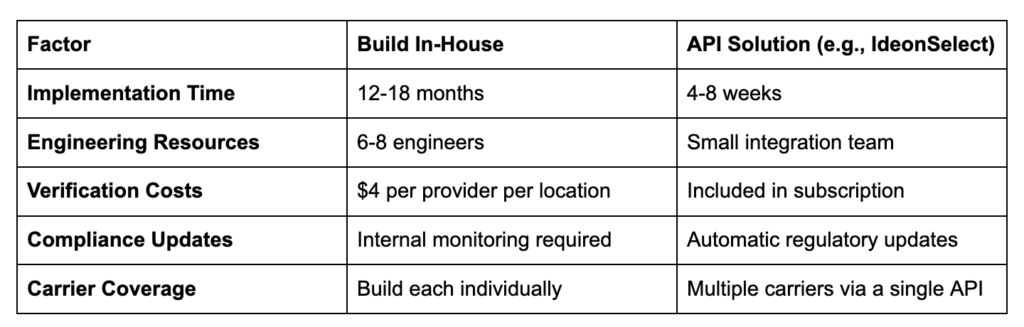
Organizations building custom infrastructure miss market opportunities during 12-18 month development cycles. Engineering teams freed from data plumbing can focus on product differentiation.
Real-World Impact of Data Quality Investment
Organizations investing in provider data quality infrastructure achieve measurable results.
A major health plan replaced over 1 million manual verification calls with automated outreach, achieving an 84% directory accuracy rate—significantly above national average—with substantial improvement in provider engagement and operational efficiency.
Ballad Health, an 800-physician network across 21 hospitals, implemented automated roster submission through CAQH Provider Data Portal. The result: 50% reduction in roster processing time, with data pulled weekly, standardized, quality-checked, and submitted to 30 different health plans.
The Future of Provider Data Quality
The industry is shifting toward API-first infrastructure. Manual processes are being replaced with AI-driven automation and real-time data validation. CAQH is incorporating AI and third-party data at point of entry to validate information in real-time—gathering information from 75-80% of U.S. healthcare providers.
The AI in healthcare market, worth $11+ billion in 2021, is forecast to reach $188 billion by 2030. Quality data is essential for AI algorithms to function properly—poor data quality leads to biased predictions and suboptimal outcomes.
Solving provider data quality requires commitment across the entire industry. The root cause is complex, fragmented, inconsistent data exchange between providers, payers, platforms, and vendors. Organizations with high-quality provider data achieve faster credentialing, superior member experiences, and improved compliance standing.
Platforms leveraging API infrastructure can launch with enterprise-grade data quality in 4-8 weeks. Competitors building internally face 12-18 month timelines. Modern infrastructure frees teams to focus on member experience innovation rather than data plumbing.
Conclusion: Provider Data Quality as Strategic Infrastructure
Provider data quality encompasses six critical dimensions: accuracy, completeness, consistency, validity, timeliness, and uniqueness. Poor quality costs the healthcare industry $17B+ annually in unnecessary expenses. Regulatory requirements—CMS 90-day cycles, the No Surprises Act, HIPAA—make quality non-negotiable.
Organizations face a strategic infrastructure decision. The build approach requires 12-18 months, 6-8 engineers, and contributes to the $4B+ annual industry spend on quality improvements. The API approach delivers 4-8 week implementation, subscription-based pricing, and built-in quality controls.
Organizations prioritizing provider data quality through modern infrastructure achieve faster time-to-market, superior member experiences, and reduced regulatory risk—while competitors struggle with manual verification burdens and compliance complexity.
Explore Ideon's IdeonSelect for Provider Data Quality
Ready to take the next step? See how Ideon works.