Vericred Raises $23M in Oversubscribed Series B Funding Round

**NOTE: Ideon is the company formerly known as Vericred. Vericred began operating as Ideon on May 18, 2022.**

Aquiline Technology Growth-led funding round and board additions to fuel rapid staff expansion and product development.
Benefits infrastructure leader extends its position as industry standard for health and supplemental insurance connectivity, efficiency. 

NEW YORK, April 12, 2021 — Vericred, the innovative data services platform powering digital quote-to-card experiences in health insurance and benefits, today announced the completion of a Series B round of funding totaling $23 million and the addition of two new members to its board of directors. Aquiline Technology Growth led the oversubscribed funding round, which included participation from new investors Echo Health Ventures, MassMutual Ventures, Guardian Strategic Ventures, and existing investors Riverside Acceleration Capital, FCA Venture Partners and First Health Capital Partners. 

Vericred will use the new capital to expand its teams in New York, NY and Omaha, NE, further build its marketing and sales functions, and exponentially grow the community of participants on its market-leading platform, laying the foundation for a united, digitally connected benefits ecosystem. 

“Today’s announcement showcases the market’s clear endorsement of Vericred’s critical innovations in health insurance and employee benefits. We are proud to have attracted the highest caliber of venture and strategic investors, surpassing the goals we initially set out for this fundraise,” said Michael W. Levin, CEO and Co-founder of Vericred. “We are excited to partner with these leading investors who share our vision for building a simplified way for all participants in the benefits ecosystem to connect, communicate, and exchange data rapidly and accurately.”

Vericred offers a full suite of APIs across medical, life, dental, vision and other lines of coverage that power quoting, enrollment, member management, and renewals on multi-carrier InsurTech and BenTech platforms. Vericred’s solutions simplify the complex process of exchanging data with multiple partners. By effectively removing a critical barrier to industry-wide digital transformation, Vericred enables a true digital quote-to-card experience. 

More than 300 carriers, including industry leaders Cigna, Guardian, Humana, MetLife, Principal, Kaiser and 100+ InsurTech companies including Rippling, Gusto, Ease, and Namely have joined Vericred’s platform, creating a powerful network effect and establishing an important channel to bring new products and innovation to market. 

In connection with this funding round, Vericred welcomes two additions to its board of directors: 

Max Chee leads Aquiline Technology Growth (ATG), which is managed by Aquiline Capital Partners, and seeks to invest in early and growth stage FinTech companies. Max brings over 20 years of experience investing in FinTech and enterprise software. 

Jessica Zeaske, PhD is a Partner at Echo Health Ventures, identifying and investing in emerging and growth-stage health care companies. Previously, she invested with GE Ventures and Lemhi Ventures and has a career-long focus on thesis-driven investing.

“Aquiline’s investment in Vericred is rooted in our shared vision of a fully digitally connected employee benefits ecosystem, where plan quoting, enrollment, and renewal is a seamless experience, much like booking travel or applying for a new credit card online,” said Chee. “We’re pleased to add Vericred as a portfolio company, as we view its infrastructure offerings for benefit administration platforms, along with their carrier partners, as a catalyst for the digital transformation of the industry.”

“At Echo Health Ventures, we seek to drive systemic transformations of the health care system through hands-on, purpose-driven investing. Vericred is an ideal investment aligned with that vision and we look forward to partnering with them as they scale their platform” said Zeaske. “As a Board member, I am excited to help Vericred as they continue to modernize the way health insurance and employee benefits are quoted, sold, enrolled, managed, and used.”

About Vericred

Vericred is the way health insurance carriers and employee benefits providers connect with new technology partners to deliver seamless quote-to-card consumer experiences. We are not the websites or apps you use to choose a plan or find a doctor. We are infrastructure. We are the ‘pipes’ that simplify the complex exchange of quoting, enrollment and eligibility data between carriers and the technology partners responsible for delivering health and employee benefits to hundreds of millions of Americans everyday. Our APIs transmit billions of data points between InsurTech and insurance carriers, powering digital distribution across the insurance industry. Come join the community of insurance geeks creating a seamless digital quote-to-card experience. Visit www.vericred.com. 

About Aquiline Technology Growth

Aquiline Technology Growth (ATG) seeks to invest in early- and growth-stage technology companies that are bringing innovation to the insurance and financial services ecosystems. ATG is managed by Aquiline Capital Partners, a private investment firm based in New York and London investing in businesses globally across the financial services and technology sector. The ATG team has experience in technology and financial services and is supported by its colleagues at Aquiline, strategic partners, and an active group of industry Executive Advisors. For more information on ATG, visit: www.aquiline.com.

About Echo Health Ventures

Echo Health Ventures drives systemic health care transformation through hands-on, purpose-driven strategic venture capital and growth equity investing. Echo brings together USAble Corporation, Cambia Health Solutions and Mosaic Health Solutions to accelerate health care innovation on a national scale and support meaningful health care impact. For more information, please visit www.echohealthventures.com.


BenefitsPRO: ICHRA has potential to reshape the way employers pay for benefits

The Top Five Questions Carriers Ask About ICHRA

New to ICHRAs? Download our primer for health insurance executives.

Individual Coverage Health Reimbursement Arrangements (ICHRAs) burst onto the employee benefits scene on Jan. 1, 2020, spawning a new paradigm in group health insurance that shifts the plan shopping and administration responsibility from employer to employee. Now, more than one year into ICHRA’s arrival, insurance carriers are increasingly interested in capitalizing on ICHRA.

To that end, Ideon recently hosted two webinars aimed at helping health insurers in both the group and individual markets understand how they, too, can join the ICHRA revolution. While most carriers are aware of ICHRA’s existence and the legislation behind it, we found that there are still several topics on which carriers have critical questions. In this blog post, we’re sharing, and answering, the most common questions we heard during our webinars.

Is ICHRA adoption among small groups more prevalent in certain geographic areas?
Yes, ICHRA adoption varies by state, and even by county. ICHRAs work best in areas with robust individual markets, affordable plans from name-brand carriers, network options similar to what employees find in the group market, and competitive pricing between individual premiums and their group-plan equivalents. Where’s the next ICHRA hot spot? Check out our interactive map to find rate-favorable states for small groups to shift to ICHRAs.

If the contribution is deemed unaffordable for the employee, can they go to the ACA exchange and receive a subsidy?
A key facet of ICHRAs is affordability. Specifically, large employers (typically those with 50 or more employees) must offer an “affordable” ICHRA or face penalties. Small employers, on the other hand, can offer either an affordable ICHRA or an “unaffordable” version. According to ICHRA legislation, an employer contribution is “affordable” if the remaining amount an employee has to pay for a self-only silver plan on the Exchange is less than 9.83% of the employee’s household income.

The ability to offer an unaffordable ICHRA is an opportunity for small employers. When a small-group ICHRA is “affordable,” employees are not eligible for government subsidies. If small employers offer “unaffordable” ICHRAs, employees can “opt out” and go to the exchange to get their premium tax credit, more commonly known as a subsidy.

How do you address the fact that individual plans do not generally have the same broad networks as group plans do?
One of the benefits of an ICHRA is that employees now have the expanded choice associated with the individual market, where they have more opportunity to find a carrier, plan, and network in which their preferred doctors and providers participate. Provider-centric plan shopping is an essential part of the employee decision process: about 70 percent of consumers, according to Ideon’s internal data, add their doctors as search criteria. When transitioning an employee to an ICHRA, it’s not necessarily about finding the broadest network, it’s about selecting the plan and network that best meets each individual’s needs.

How will ICHRA impact the role of the broker?
Group brokers have a critical role in the ICHRA process, from helping employers evaluate whether ICHRA is the best option for their company, to guiding employees through the individual plan shopping experience. Their role as essential advisors, trusted and valued for their industry expertise, will not change with ICHRA.  

Smaller groups already struggle to understand benefits. Are there tools to help them do the calculations around tax credits and ICHRA affordability?
Yes. Several digital platforms and exchanges have built innovative tools to help employers, brokers, and employees determine whether ICHRA is right for them. From digital affordability calculators to instant subsidy estimates, tech-driven decision-support tools are simplifying the decision process in year two of ICHRA. As an example, our partners Flyte HCM, Gravie, Savvy, and Take Command Health are platforms with ICHRA functionality.

Contact us to learn how Ideon helps carriers navigate the shift toward ICHRAs and provides access to new distribution channels via one central connection.

Explore Key ICHRA Trends – The ICHRA Revolution Webinar Recording

The ICHRA Revolution Webinar Recording

The Effect of Increased Competition on Premium Changes in the Individual ACA Market

Veristat: A Data-Driven Look at Today’s Insurance Markets

During the early years of the ACA individual plan, premiums rose steadily and often steeply, not least because of carriers’ decisions to exit various markets. But now that uncertainty has receded and the risk pool is better understood, carriers are changing course. Bright, Oscar, Centene (Ambetter) and Cigna have all aggressively expanded their footprints, and in 2021 UHC re-entered the individual market in five states.  

To evaluate the impact of this increased competition we looked at premium changes in individual ACA plans over a three-year period, from plan year 2019 to plan year 2021.  

Over that time, state-average, lowest-cost Bronze plan premiums fell in real dollar terms in 94% of states with increased competition (from new entrants), compared with 54% of states without such an increase. State-average, lowest-cost Silver plan premiums fell in 88% of states with increased competition, compared with 54% of states without. And state-average, lowest-cost Gold plan premiums fell in 81% of states with increased competition, compared with 60% of states without. In all, 16 states welcomed new entrants or increased competition; of these, only Louisiana failed to realize real-dollar reductions in Bronze plans over the past three years.

Premiums dropped in the nation as a whole during the same period—with or without increased competition. The nationwide average of each state’s average lowest-cost Bronze plan dropped by 9.4% in states where competition increased, and by 2.7% in those where it didn’t. Similarly, the nationwide average of each state’s average lowest-cost Silver plan dropped by 12% in states where competition increased, and by 5.2% in those where it didn’t. And the nationwide average of each state’s average lowest-cost Gold plan dropped by 25% in states where competition increased, and by 6% in those where it didn’t. 

In short, the news is good. Not only is increased competition expanding consumer choice. It’s accelerating a decrease in individual premiums, too.

Vericred Analytics: Rate Favorable States for Small Groups to Shift to ICHRAs

**Ideon is the company formerly known as Vericred. Vericred began operating as Ideon on May 18, 2022.**

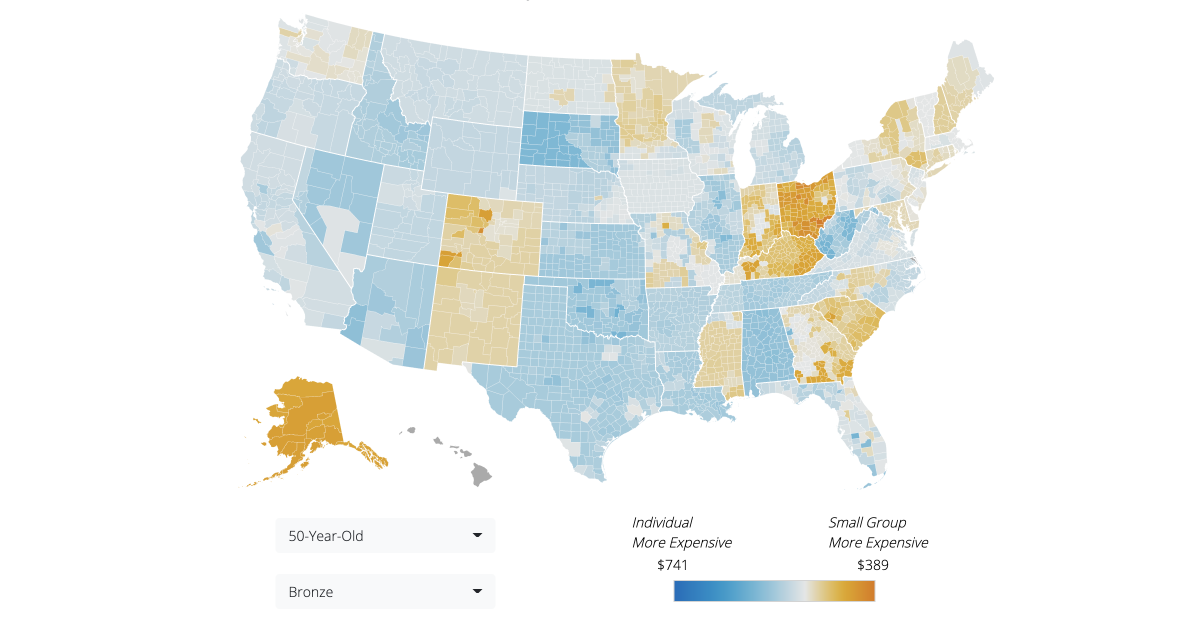
ICHRAs are the hottest topic in employer-sponsored healthcare. We at Vericred are tracking a number of plan attributes that could accelerate or retard this shift from small group coverage to the individual market. Here, we look at one of them: premium changes between 2020 and 2021.

In 2021, there are five new states (Maryland, Maine, Mississippi, New Hampshire and Washington) where individual plan premiums are equal to or less expensive than small group premiums. Interestingly, increased competition was not the driver of these lower individual premiums: only one of the states, Maryland, welcomed a new carrier to its individual market. (Note: Two states—New Jersey and North Dakota—saw small group premiums become less expensive than individual plan premiums.)

In aggregate, the average (across all of a state’s counties) lowest-cost Bronze individual plan premium was equal to or lower than the small group equivalent in 19 states; that’s up from 16 in 2020 and 11 in 2019. The average lowest-cost Silver individual plan premium was equal to or lower than the small group equivalent in 13 states, up from 11 in 2020 and six in 2019. And, the average lowest-cost Gold individual plan premium was equal to or lower than the small group equivalent in 12 states, up from seven in 2020 and five in 2019. Overall, the number of ICHRA premium-friendly states has roughly doubled over the past two years.

Click here to view an interactive version of this map.

More broadly, the disparity between small group and individual rates has attenuated over the same period. In 2021, the average Bronze plan premium differential between individual and small group markets across all states is down to just 10%, from 15% in 2020 and 25% in 2019. Similarly, the average Silver plan premium differential is down to 23%, from 28% in 2020 and 42% in 2019. And, the average Gold plan premium differential is down to 25%, from 32% in 2020 and 45% in 2019.

Since the launch of the ACA, much has been made about the annual rate increases, particularly in the individual market. More recently, though, the opposite appears to be the case. From 2019 to 2021, state-average individual plan premiums actually went down in real dollar terms in two thirds (67%) of the country. Small group rates, on the other hand, fell in only 12-20% of the states, depending on metal level. The data has spoken: Individual rates are falling.

The ICHRA Revolution: A New Model for Employer-Sponsored Health Insurance

In this report Vericred offers insights for carrier executives into the role ICHRAs will play in reinventing employer-sponsored health insurance as a defined-contribution benefit. Read more here.

Breadth and Exclusivity of Hospital and Physician Networks in US Insurance Markets

Eight Reasons ICHRAs May Transform Employer-Sponsored Health Insurance

Predictable employer costs and coverage transportability are just the tip of the iceberg.

Change is afoot in the insurance world. Rules enacted in 2019 spawned a new iteration of employer-sponsored health insurance: Individual Coverage Health Reimbursement Arrangements (ICHRAs).

You can think of ICHRAs as the health insurance equivalent of 401(k) plans (which transformed employer-sponsored retirement savings). That is to say, with this new offering employers can reimburse employees for their insurance costs rather than purchasing policies for them.

The process typically looks like this: 1. An employer designs an ICHRA, with a range of options tailored to meet its needs and those of its employees; 2. employees choose a plan; and 3. employees submit paid expenses to employers for reimbursement. (Expenses might include premiums, claims or both, depending on the design of the ICHRA.)

Whether the shift toward ICHRAs will be as tectonic as the shift to 401(k)s remains to be seen. But there are many reasons to think it might. From an employer’s perspective, the main benefits of ICHRAs include:

  • Reduced and predictable costs: ICHRAs allow employers to set a reimbursement rate that means they never have to pay more.
  • No minimum participation rates: Fully insured plans often require 50% or 75% participation; ICHRAs do not.
  • Less onerous benefit administration: ICHRAs shift the burden of managing benefits to the employee.
  • Something rather than nothing: Some small employers would like to contribute to employees’ health insurance costs but can’t afford traditional fully insured plans. ICHRAs provide a way to provide some help.
  • Different solutions for different classes: ICHRAs allow an employer to move certain classes of employees into the individual market. This may allow the employer to provide coverage, or better coverage, to certain classes.

Likewise, employees will find a lot to like about ICHRAs, such as:

  • Choice: A healthy, single 25 year old has different needs than a 45 year old with children or someone with a chronic condition. ICHRAs give employees the choice of tens, or even hundreds, of health plans, allowing them to find one that best matches their needs.
  • Transportability: ICHRAs make it possible for individuals to leave an employer and still keep their plan. The more ubiquitous ICHRAs become, the more likely it will be that an employee could keep their plan over time.
  • Broader range of covered costs: ICHRAs can be used to pay for certain approved medical expenses in addition to premiums.

Of course, the extent to which ICHRAs become the common currency of employer-sponsored health insurance will dictate their effect on carriers, brokers, insurtech operators and other interested stakeholders.

For a deeper dive into the subject—including potential obstacles to widespread ICHRA adoption—download our latest Ideon Report: The ICHRA Revolution—A New Model for Employer-Sponsored Health Insurance

Vericred CEO Joins CMS Webinar to Talk ICHRAs

Vericred Co-Founder and CEO, Michael Levin, participated as an industry expert during a recent roundtable discussion on ICHRAs hosted by the Centers for Medicare & Medicaid Services (CMS). Featuring industry leaders from throughout the ICHRA landscape, the discussion focused on lessons learned in the inaugural year of ICHRA availability, the ICHRA-evaluation process for businesses, and the impact of COVID-19 on employee benefits.


Interested in learning how Vericred’s APIs support all phases of the ICHRA decision process? Click here for more information or contact sales@vericred.com.

Vericred Launches Health Insurance and Employee Benefits Enrollment APIs, Announces Key Relationships

**NOTE: Ideon is the company formerly known as Vericred. Vericred began operating as Ideon on May 18, 2022.**

Beam, CaliforniaChoice, Kaiser Permanente and Oscar partner with Vericred to create a de facto standard for California group enrollment and member management

September 15, 2020 09:00 AM Eastern Daylight Time

NEW YORK–(BUSINESS WIRE)–Vericred today unveiled a new suite of enrollment and member management APIs, ushering in a new era of digital connectivity between health insurance and employee benefit carriers and InsurTech companies. Vericred’s API Platform enables the simple and seamless exchange of quoting, enrollment and eligibility data between carriers and technology companies such as tech-enabled brokers, BenAdmins, HCMs and HRIS solutions. This news is paired with the announcement of groundbreaking enrollment relationships with Beam, CaliforniaChoice, Kaiser Permanente and Oscar.

“The digital transformation of health insurance and employee benefits is being held back by lack of connectivity and industry standards, resulting in incredible inefficiencies and poor consumer experiences,” said Michael W. Levin, Vericred’s co-founder and CEO. “Our enrollment and member management capability democratizes this connectivity and enables industry-wide digital quote-to-card experiences for carriers, general agents, brokers, employers and employees.”

Vericred’s new suite of APIs enables end-to-end functionality including new group installation, renewals, broker of record changes, member additions, terminations and changes, reconciliation and normalized enrollment status and error handling across all lines of coverage.

“Great products need great foundations. Vericred is critical, foundational infrastructure for our insurance and benefits products at Rippling. We could not have built Rippling without this partnership,” said Parker Conrad, Rippling’s co-founder and CEO.

COVID-19 is a catalyst for the industry’s digital transformation, adding a new layer of complexity to the busy Fall enrollment season. Social distancing regulations permits few, if any, in-person meetings between brokers and their group clients. Open enrollments are being conducted virtually. Employers and brokers need tools and connectivity in order to deliver modern digital experiences to their clients and employees. Vericred’s Platform is essential for those looking to quickly and efficiently scale their digital solutions.

Vericred partners with leading California carriers to create a new standard

CaliforniaChoice, Kaiser Permanente and Oscar, representing a majority of California small group medical members, will use Vericred for health insurance and benefits enrollment and management in California and other regions in which these companies offer coverage.

“Small group health insurance has been stuck in the early 2000s as far as online enrolling, managing and renewing,” noted Kirk Whelan, National Vice President of Small Group Commercial business for Kaiser Permanente. “We support the efforts to move toward digitizing small group enrollments.”

“As the Nation’s largest private exchange we are continuously innovating to meet the needs of our brokers and General Agent partners, and our small business customers,” said Michael Close, CEO of CHOICE Administrators, the parent of CaliforniaChoice and ChoiceBuilder. “Vericred allows us to leverage our own investment in APIs across GAs, tech enabled brokers and a broad spectrum of enrollment and benefit administration solutions.”

In addition to the above health insurance carriers, Vericred is working with Aetna, Anthem, Blue Shield of California, Cigna, Guardian, Humana, MetLife, Principal, Regence Blue Cross Blue Shield, and UnitedHealthcare. Vericred has aggressive plans to complete more than 200 carrier integrations over the next two years.

Interested parties should contact sales@vericred.com for more information.

About Beam

Beam Dental was built around the idea that blending technology with traditional insurance policies could bring incredible value to a commoditized employee benefits market. Beam Dental is a company’s best choice for a differentiated, innovative take on dental and ancillary employee benefits with a nationwide network of dentists. For more information, visit beam.dental.

About CHOICE Administrators

CHOICE Administrators is the parent organization of the nation’s largest multi-carrier, small group private health exchange, CaliforniaChoice, and America’s first ancillary benefits exchange, ChoiceBuilder. Together, the two exchanges currently offer access to 11 health plans and carriers to more than 27,000 small business clients and nearly 450,000 members across the state of California.

About Kaiser Permanente

Kaiser Permanente is one of America’s leading health care providers and not-for-profit health plans. The organization currently serves 12.4 million members in 8 states and the District of Columbia. www.kp.org

About Oscar

Oscar is the first health insurance company built to make health care easy. Headquartered in New York City, Oscar has been challenging the health care system’s status quo since our founding in 2012, developing seamless technology and providing personalized support to help our members navigate their health care. Oscar was the first insurer to offer $0, 24/7 telemedicine to members and to integrate direct scheduling with providers through our app.

Oscar plans also include access to a network of first-rate physicians and hospitals, as well as a personalized Care Team that supports members every step of the way, from finding a doctor to navigating costs. Oscar is known for its easy-to-use digital tools, including a website and mobile app that let members view their health history, speak directly with their Care Teams and virtual providers, and access their account information.

All products and services are provided exclusively by or through operating subsidiaries of Mulberry Health Inc., including Oscar Insurance Company and its affiliates. Say hi or learn more at https://www.hioscar.com or follow us at https://twitter.com/OscarHealth.

About Vericred

Vericred has built the first end-to-end quoting, enrollment and member management middleware (API) platform for health insurance and employee benefits. By simplifying the exchange of data between carriers and technology companies, Vericred is enabling the digital transformation of the health insurance and employee benefits industry. Vericred offers robust solutions for the employer market, as well as the under 65 individual, Medicaid and Medicare markets.