Four Benefits-Focused Insurtech Predictions for 2022

By John Carson, Ideon’s Chief Revenue Officer

2021 has been a banner year for employee-benefits insurtechs—and not just because investors have committed more than $6 billion to U.S. insurtech startups this year. The rate at which benefits-focused insurtechs have introduced innovative solutions to solve long-standing challenges has been inspiring.

But for all the progress, the industry’s digital transformation is far from complete. Some employees still enroll in benefits via paper forms. Others lack the tools to fully understand their options. Still others continue to struggle to maximize their benefits year-round. Not to mention that, behind the scenes, a significant portion of brokers, HR teams, and other stakeholders deal with inefficiencies and limited automation as they undertake day-to-day, benefits-related tasks.

Collectively, though, the industry is heading in the right direction. We can say that because Ideon—a data platform that powers carrier connectivity and digital experiences for benefits-focused insurtechs, HRtechs, and benefits-administration software—has a front-row seat to all that runs this industry. And we see several digital trends gaining momentum. Here are our top benefits-focused insurtech predictions for 2022.  

1. Decision-support tools will transition from “nice-to-have” to “essential feature.” Decision-support tools are gaining traction in two primary ways: first, by helping employees select and enroll in the health insurance and benefits plans that best match their and their family’s specific needs; and second, by enabling employees to make better decisions year-round, e.g., using virtual assistants to steer employees toward in-network doctors to keep out-of-pocket costs low. 

In 2022, we expect most benefits-focused insurtechs to integrate advanced technologies into their decision-support tools. From AI and on-demand virtual assistants to machine learning and data-powered personalized recommendations, new tech is starting to ripple through the benefits industry. Expect a splash in 2022; according to a Guardian survey, 41% of employees want more decision-support tools for the enrollment process.

2. More small employers will offer advanced digital enrollment experiences. For years, insurance carriers and benefits platforms have leaned on EDI for the automated exchange of enrollment and eligibility data. But EDI has been out of reach for most small businesses, leaving them to rely on paper forms and other manual processes. (Nearly 40% of small employers—those with fewer than 50 employees—use paper as the main method for submitting enrollment data to carriers.) 

But the tide is turning. Thanks to APIs like Ideon, more HR and benefits administration platforms are bringing the advantages of automation and streamlined data exchange to small businesses. The result: a faster, more efficient, more accurate enrollment experience. That’s why we expect that in 2022 the benefits experiences offered to small-business employees will begin to catch up to those offered at larger companies.

3. The shift to all-API transactions will accelerate (slowly). There’s been much discussion about the shift from EDI feeds to API connections for data exchange. And that shift is very real. Still, most carriers remain tied to EDI systems, even as some are beginning to develop APIs. We see much the same in 2022—an industry majority continuing to use EDI for most data exchanges as the uphill climb toward API transactions progresses relentlessly. As (relatively) unbiased observers, we can say that carrier-connectivity solutions (such as those offered by Ideon) enable benefits-focused insurtechs and HR platforms to connect to multiple carriers through one easy integration regardless of whether carriers prefer EDI, API, or other means.

4. Back-end processes take a front-row seat. From an employee’s perspective, digital enrollment has become commonplace. Most employees (at large firms, at least) have the ability—through the benefits software or app provided by their employer—to review, select, and enroll in benefits digitally. But from the perspective of folks behind the scenes? Not so much. 

That’s why we think there will be a focus in 2022 on streamlining enrollment and administration for brokers, HR teams, and enrollment-processing departments at carriers and benefits-administration platforms. For these stakeholders, much of open enrollment is spent setting up EDI feeds, manually keying data into carrier portals, correcting errors, and editing spreadsheets. Streamlining those processes, most industry experts have learned, has a trickle-down effect that makes enrollment faster, more accurate, and more enjoyable for employees, too.

Are we fairly certain about these predictions? Yes. Are we even more certain that however the year unfolds Ideon will be there to smooth out the inevitable bumps in the road? You bet.

Senior Software Engineer Perry Hertler shares advice to coders in BuiltInNYC

‘Easy to use, Easy to buy’: A Q&A with Friday Health Plans

In the past decade, several health insurance carriers have entered the individual and employer-sponsored markets, bringing innovative products and consumer-first digital experiences in a bid to compete with legacy carriers. One such entry is Friday Health Plans, a Colorado-based company launched in 2015 to serve the individual and small group markets. As Friday has expanded from a single-state carrier to a rapidly growing multi-state firm with $186 million in venture capital funding, digital technology has been a driving force behind its growth. 

To learn more about the company’s growth strategy, Ideon spoke with Lisa Kwiecien, Friday’s director of channel development. The interview has been condensed and edited for clarity.

IDEON: What is Friday’s key differentiator?

KWIECIEN: We create health plans that are good value, easy to buy, and easy to use. We always put the consumer first, which is apparent in our plan designs. 

How does technology help Friday compete against more established, national health plans?

Because we concentrate on individuals, families, and small groups, we have fewer plan designs, which means that our technology can be more focused and efficient. Tech helps make our plans easy to administer, straightforward to buy, and effortless to understand. That’s true for brokers, employers, and most especially consumers.

How so?

We’ve invested in technology across the company—in our app, in our telehealth function, in customer support. We’ve enhanced our ability to communicate with members, to help them access their ID cards digitally, to understand their deductibles and other plan details. They can also use our app to search for providers. We knew we had to be aligned with today’s consumer expectations generally.

Friday Health Plans recently started working with Ideon. Can you talk about that? 

We work with Ideon in two ways. We share our plan and rate information with Ideon, which then distributes that data to third-party quoting platforms used by brokers, employers, and consumers. And we use Ideon to connect with benefits platforms [e.g., Rippling, GoCo, Decisely, Sequoia, Gusto], which helps us streamline digital enrollment and member management. We know we have great products and competitive rates, but we wanted to make the enrollment process more efficient for small businesses and for brokers. We needed to improve connectivity with today’s benefits ecosystem.

Why is connectivity with respect to brokers so important? 

We pride ourselves on being a broker-friendly carrier. Many decisions by brokers are made because of convenience, so we want to make our products and technology as convenient as possible. We started to search for different ways that we can automate enrollment, because historically it’s been a super manual process to submit member and group enrollment information in the small group market. There’s a lot of back-and-forth. It’s inefficient. And often it still involves a lot of paper. Ideally, we want it so that brokers can digitally manage all transactions, submitting enrollments on their preferred platform so that we’re not working on different CSV files or PDFs, etc. 

Why does uniformity like that matter?

For us, receiving a consistent file format from all these platforms improves our efficiency and accuracy, enabling us to seamlessly process incoming enrollments and member changes. And when we minimize errors, everything happens faster, creating a streamlined process. Members get their ID cards sooner, brokers have fewer fires to put out. We’re always working to build a streamlined process that flows smoother than it does today.

Does having better digital connectivity with benefits platforms factor into Friday’s growth plans?

Absolutely. It’s about scalability. When we anticipate our expansion into new markets and new states, we want to make sure that we have the technology in place to scale effectively. Enhancing our connectivity with benefits administration platforms is a prerequisite for scaling our business. That’s one reason why we’re working with Ideon.

Final question: Friday, which is a member of the HRA Council, supports Individual Coverage Health Reimbursement Arrangements (ICHRAs). How do ICHRAs fit into your company’s strategy?

We’re always thinking about how to improve affordability and optionality to employers and employees. There are a lot of reasons why ICHRAs might appeal to a small employer—e.g., cost predictability, class options—and ICHRA gives an employee more plan choices through the individual market than does a traditional small-group offering. They’re also tax-free and transportable. Our CEO, Sal Gentile, sees ICHRAs as a growth opportunity as they become more prevalent in the next few years. 

Thanks so much for your time and candor, Lisa.

My pleasure.

To learn how benefits platforms can connect with Friday Health Plans, or for information about Ideon’s solutions for carriers, please reach out to support@ideonapi.com.

GoCo Selects Vericred to Bring Groundbreaking Automation to Small Group Benefits Enrollment

**NOTE: Ideon is the company formerly known as Vericred. Vericred began operating as Ideon on May 18, 2022.**
 
Vericred’s enrollment and member management API enables GoCo to reduce new employer group setup time from weeks to days while automating key functions for benefits administrators and HR teams

November 16, 2021 – Vericred, the API platform powering digital quote-to-card experiences in health insurance and benefits, today announced that GoCo, a leading provider of flexible software solutions for HR, benefits, and payroll, has selected Vericred’s enrollment and member management API to dramatically simplify and speed up small group benefits setup, enrollment, and administration. With the API integration, GoCo can now activate new groups for their employer customers substantially faster—within days instead of weeks—without manually forging individual connections between its platform and carriers to facilitate data exchange. 

Simplifying Benefits Administration  

GoCo is an all-in-one HR platform that streamlines time-consuming HR tasks, including benefits administration. With the integration of Vericred’s API, GoCo is, for the first time, automating previously manual employee benefits enrollment tasks for its small business customers. The move will save employers and brokers time and resources as they add or update benefits for employees. 

“Vericred’s enrollment and member management API has helped us unlock an unprecedented level of small group benefits automation previously available only to medium and large employers,” said Nir Leibovich, CEO of GoCo. “As a result, we’ve freed up internal resources, and made the enrollment process faster, easier, and better for employers, employees, and brokers. That is a huge competitive advantage for us during open enrollment periods and beyond.”

Connectivity for Seamless Data Exchange 

Vericred’s API enables GoCo’s platform to seamlessly connect to Vericred’s network of health insurance and employee benefits carriers, making the exchange of quoting, enrollment, and eligibility data between health insurance carriers, brokers, and GoCo instant. As a result, employee data is now automatically transferred to the carrier, removing manual data entry steps for the benefits administrator, and speeding up the path to enrollment for both the employee and employer. Additionally, any errors in the data are corrected before they even reach the carrier. 

“We are thrilled to be GoCo’s partner in blazing a new trail for the small group benefits industry and demonstrating the power that instant carrier connectivity can unleash,” said Michael W. Levin, CEO and co-founder of Vericred. “The GoCo platform is truly maximizing its integration with Vericred’s enrollment and member management API to deliver tangible value to its users.”

Vericred Powers Benefit Sync Dashboard  

GoCo’s Benefit Sync Dashboard puts the power into the hands of the HR and benefits administrators, giving them the tools to craft and automate their preferred workflows. By integrating with Vericred’s API, GoCo’s dashboard now provides users with end-to-end visibility into the entire enrollment transaction, including each stage of the transaction when it’s with the carrier.

About Vericred

Vericred is the way health insurance carriers and employee benefits providers connect with new technology partners to deliver seamless quote-to-card consumer experiences. We are not the websites or apps you use to choose a plan or find a doctor. We are the infrastructure. We are the ‘pipes’ that simplify the complex exchange of quoting, enrollment and eligibility data between carriers and the technology partners responsible for delivering health and employee benefits to hundreds of millions of Americans everyday. Our APIs transmit billions of data points between InsurTech and insurance carriers, powering digital distribution across the insurance industry. Come join the community of insurance geeks creating a seamless digital quote-to-card experience. Visit www.vericred.com.

About GoCo

GoCo.io is modern HR, benefits, and payroll, built with flexibility and ease of use in mind. Founded in 2015 and headquartered in Houston, Texas, GoCo’s mission is to automate manual HR tasks and empower HR to make work a better place.

Unlike other HRIS platforms, GoCo is built to be flexible enough to support existing processes, policies, and providers, so that SMBs don’t have to change the way they work just to adopt a modern HR system. For more information, visit www.goco.io.

Engineering & Leadership Podcast featuring Vericred CTO Dan Langevin

Vericred CTO Dan Langevin joins the Engineering & Leadership Podcast to discuss the importance of accountability, curiosity, and culture within an engineering team. Listen to the episode here.

Vericred Powers One-Stop Shop for Employee Benefits Quoting with Expanded Group Rating API

**NOTE: Ideon is the company formerly known as Vericred. Vericred began operating as Ideon on May 18, 2022.**

Adding two new lines of coverage, Vericred offers the only API enabling group medical, vision, dental, life, and disability insurance quoting

November 9, 2021 – Vericred, the API platform powering digital quote-to-card experiences in health insurance and benefits, today announced it has added group life and disability insurance lines of coverage to its industry-leading, multi-carrier Group Rating API (application programming interface). Employee benefits quoting platforms now have one API from which to power a multi-line, data-driven quoting experience for brokers and employers. 

Guardian Life is among the first life and disability insurance carriers to partner with Vericred at launch of the expanded API. The Group Rating API enables carriers to augment the distribution of their products through more digital sales channels, including benefits-focused insurtechs.

Using the enhanced Group Rating API, Vericred’s quoting platform customers can now easily quote and compare all of the most commonly offered benefits without building and maintaining their own carrier connectivity and rating engines. More than 300 insurance carriers and 100 insurtech companies rely on Vericred for digital connectivity and seamless data exchange, including industry leaders Cigna, Guardian, Humana, Principal, Rippling, Gusto, and Ease.

“By adding the life and disability lines to our rating API, we are helping our quoting platform customers be more efficient, so they can spend more time serving their clients and less time on connectivity and data sourcing,” said Michael W. Levin, Vericred’s co-founder and CEO. “Vericred is a one-stop shop for employee benefits connectivity, from quote to card, supporting insurtechs, carriers, and brokers in meeting the needs of the group market today.”

About Vericred
Vericred is the way health insurance carriers and employee benefits providers connect with new technology partners to deliver seamless quote-to-card consumer experiences. We are not the websites or apps you use to choose a plan or find a doctor. We are the infrastructure. We are the ‘pipes’ that simplify the complex exchange of quoting, enrollment and eligibility data between carriers and the technology partners responsible for delivering health and employee benefits to hundreds of millions of Americans everyday. Our APIs transmit billions of data points between InsurTech and insurance carriers, powering digital distribution across the insurance industry. Come join the community of insurance geeks creating a seamless digital quote-to-card experience. Visit www.vericred.com.

How third-party quoting platforms can drive better analytics and more sales for health insurance carriers

By Matt Leonard, Ideon’s Vice President of Carrier Relations

In recent years, brokers have flocked to third-party services to quote health insurance plans from multiple carriers. As a result, most carriers wanted to immediately tap into this new, growing distribution channel. They were quick to share rates and product information with external partners, making the downstream quoting process easy and accurate for brokers assembling employer proposals.

But not all carriers bought in. Holdouts chose to keep rates in-house, forcing brokers to obtain quotes directly from them. Their chief concern: a perceived black hole of visibility and analytics. Specifically, carriers worried they’d lose access to valuable information typically gleaned when brokers quoted plans via carrier websites and portals—e.g., which brokers sold what products (and where), what employer groups were shopping for new policies, etc.

Today, with a majority of health insurance carriers having made their plans and rates available to third-party quoting platforms, we can now see whether those early fears were justified.

Short answer: Carriers that embraced the “platform revolution” are being rewarded with a stream of high-quality data that can drive advanced analytics and turbocharge sales operations. In fact, their visibility into quoting activity on platforms is not all that different compared to if quotes are prepared on carrier websites. It’s truly a win-win—i.e., modern distribution combined with valuable insights.

Meanwhile, carriers that are not distributing their rates continue to miss out in two ways: limited distribution to digital sales channels and zero visibility into how—and if—their products are being quoted externally.

To understand why, let’s examine two scenarios.

  1. Carrier relies entirely on in-house website or portal for quoting

    In the past, brokers logged on to each carrier’s website to get the quotes they needed to assemble a client proposal. That’s a lot of busy work for the broker, but it gave the carrier critical information. Location data, insights on which brokers are quoting which plans, and information about group sizes and quote-to-close ratios are all part of the typical carrier analytics package. And when they see quotes generated for potentially lucrative accounts, the carriers can assign sales representatives to help brokers to win the business.

    This may seem like an appealing option to carriers that want full control over where their products are quoted. And, understandably, they crave these in-depth analytics. But this mindset—control over distribution—is built upon a false premise. Third-party quoting platforms still add the plan and rate information of non-participating carriers, mainly by tracking down public filings and other sources.

    The difference? The data could well be incomplete or out-of-date, risking the possibility of inaccurate quotes appearing on client proposals. And carriers receive no information at all about how well their products are doing on downstream platforms and no leads on deals in progress.

  2. Carrier engages with today’s platform ecosystem

    Today, nearly all brokers use quoting platforms to save time compiling rates from multiple carriers and building proposals. Most carriers understand this reality and have reacted accordingly. These carriers distribute their product information to quoting platforms to ensure rates and plans are represented accurately.

    At the same time, the participating carriers have access to a precise record of every quote issued, often specifying the individual broker, the employer group, and more.

    Carriers can use this data to build sophisticated analytics that can help optimize the effectiveness of their marketing campaigns and commission programs. For example, they can calculate the quote-to-close ratio across different brokers, client types, geographic areas, and commission rates. Carriers are also feeding the data they get from quoting platforms directly into their CRM systems. That way their sales team can monitor how well they are being represented by each broker in the market and react quickly to opportunities.


Today, most carriers clearly see the two main advantages in working with platforms: distribution and visibility. The good news for those only now seeing the light is that they can catch up quickly, i.e., they need not build relationships with platforms from scratch. Middleware vendors, like Ideon, act as one-to-many distribution partners for carriers, accepting their plan data in any format and sharing it throughout today’s modern quoting ecosystem. And because a middleware partner pulls in quote activity and analytics from many downstream platforms, carriers get all the visibility they need to make informed decisions.

What are the opportunities that non-participating carriers are missing? Consider the recent experience of one new Ideon customer, a major health plan in the South, that recently started using our solutions to publish their plan information to quoting platforms. Until then, this carrier had assumed that most brokers were looking up their rates on their website. They were shocked when they looked at the analytics we delivered to find that brokers, using third-party platforms, were quoting their plans 600+ times per month. Before Ideon, the carrier had zero insight into these potential new business opportunities.

Now that’s a black hole to be concerned about. Contact us to learn more!

Ahead of Open Enrollment, Decisely Selects Vericred to Power Fast, Scalable Digital Enrollment and Member Management

**NOTE: Ideon is the company formerly known as Vericred. Vericred began operating as Ideon on May 18, 2022.**

A long-time Vericred customer, Decisely completes integration with Vericred’s enrollment and member management API; gains critical connections to health insurance and employee benefits carriers for faster group activation

NEW YORK—November 02, 2021—Vericred, the API platform powering digital quote-to-card experiences in health insurance and benefits, today announced that HR and employee benefits platform Decisely has selected Vericred’s enrollment and member management API for a better, faster and more accurate digital enrollment experience. Decisely made the selection ahead of the busy 2021 fall open enrollment season to help it manage a dramatically increased volume of customer transactions in a short timeframe.

Decisely offers a suite of services for small and medium-sized businesses to manage critical HR functions, including employee benefits administration. By integrating Vericred’s API into its platform, Decisely gains instant connections to Vericred’s network of health insurance and employee benefits carriers for easy data exchange. This enables Decisely to quickly add new employer groups to its platform and complete the necessary transactions, from plan quoting to card delivery, in a matter of weeks. As a result, employers can provide a faster and more seamless benefits enrollment experience to their employees.

“Decisely has been a Vericred group rating API user for the past five years. Vericred has demonstrated the ability to manage large data sets consistently and reliably over time. This track record gives us confidence in their ability to manage enrollment transactions via their API as well,” said Richard Mann, COO of Decisely. “Decisely has experienced high double-digit growth for the past two years. Vericred will allow us to continue to scale and keep costs down.”

Reliable, two-way data exchange with multiple carriers is a technical necessity for HR and benefits platforms. However, building individual point-to-point integrations with a multitude of insurers is resource-intensive and cost-prohibitive. HR and benefits platforms like Decisely that integrate with Vericred’s APIs gain one-to-many carrier connectivity, making it faster to activate benefits for new employer groups than if they had forged individual connections with in-house resources.

“We’re thrilled to expand our relationship with Decisely, and play a key role in their business as they grow and scale,” said Michael W. Levin, CEO and co-founder of Vericred. “By leveraging Vericred’s APIs, Decisely is making it easier and more cost effective to deliver the best possible experience to their own customers during open enrollment and throughout the year.”

About Vericred

Vericred is the way health insurance carriers and employee benefits providers connect with new technology partners to deliver seamless quote-to-card consumer experiences. We are not the websites or apps you use to choose a plan or find a doctor. We are the infrastructure. We are the ‘pipes’ that simplify the complex exchange of quoting, enrollment, and eligibility data between carriers and the technology partners responsible for delivering health and employee benefits to hundreds of millions of Americans everyday. Our APIs transmit billions of data points between InsurTech and insurance carriers, powering digital distribution across the insurance industry. Come join the community of insurance geeks creating a seamless digital quote-to-card experience. Visit www.vericred.com.

About Decisely

Decisely is an integrated technology solution to manage all your HR needs from recruitment to retirement, and everything in between. With over 150 years of combined experience, the leadership team has grown Decisely from a simple brokerage firm to a diverse team of licensed industry experts and technical support. The Decisely family is focused on providing the best benefits, HR, and compliance management service on the market. Learn more at www.decisely.com.

BenAdmin Platforms Beware: Three potential data quality pitfalls—and how to avoid them

By Zach Wallens, Ideon’s Communications Manager

The busy season is upon us yet again. And, yet again, health and benefits industry stakeholders are preparing for a mostly digital open-enrollment season in year two of the Covid-19 pandemic. Brokers are quoting the latest benefits products and formulating client proposals; employers are debating whether to stay the course or offer different health insurance and benefits in the coming year; and employees are familiarizing themselves with the digital tools that will guide their selections.

The focus for benefits administration (BenAdmin) platforms and other BenAdmin providers, as usual, is delivering high-level customer experiences through technology that eases the enrollment process rather than inhibits it. But given this emphasis on customer experience, there is another essential consideration for benefits technology vendors: data quality. Even the most user-friendly, feature-rich benefits software can earn a reputation as a front-end failure if data accuracy and quality are problematic during open enrollment.

The good news: BenAdmins have tools at their disposal to rectify—or, at least, minimize—data quality issues. 

The better news: BenAdmins need not rebuild their data infrastructure from the ground up to significantly improve quality. 

Rather, BenAdmins can lower their risk of data snafus by working with specialized vendors, whose solutions improve the speed and accuracy with which enrollment-related data is sent and received. With that in mind, here are three potential hazard areas that BenAdmins should keep an eye on—and how to avoid them.

1. Product-specific data. 

Employees need… 

  • An easy, streamlined way to review specific criteria they deem most important among the health plans offered by their employer. 
  • Confidence that they understand which plans meet their criteria, and will fit their budget. 
  • Help navigating the complexities of choosing not only health insurance, but also ancillary products (vision, dental, life and disability) that best suit their needs. 

API Middleware solutions can… 

  • Ensure data accuracy remains king, by aggregating plan and provider data directly from health plans and ancillary carriers. In doing so, they help BenAdmins maintain fidelity to their plan library and provider directory—plus the thousands of data points associated with each plan—without risking damage to employees’ health, financial well-being and goodwill. 
  • Shift the burden of data accuracy to the API vendor, enabling BenAdmins to confidently display product-specific information without fear of inadvertently misleading employees.

The Takeaway: The pathway to choosing the most appropriate health plan and ancillary benefits begins with employees having access to accurate, in-depth, comparable information about their options. Low-quality or outdated data, for example, can lead an employee into thinking that a plan covers their primary care physician, only to learn, post-enrollment, that the doctor recently dropped out-of-network. In third-party APIs, UX-focused BenAdmins have found a secret sauce for maintaining quality data. 

2. Group and member-level enrollment data. 

Employees need… 

  • Confidence that group and member information won’t fall prey to human error as it is manually keyed into enrollment apps. 
  • A seamless, delay-free receipt of their insurance card and, ultimately, use of their health insurance and benefits.

API Middleware solutions can… 

  • Connect carriers and BenAdmins and exchange accurate data between them (in fact, that’s their specialty). 
  • Enhance the quality of enrollment data by validating whether the submitted information meets carrier-defined business rules and other criteria, before the data even reaches the carrier. 
  • Allow BenAdmins to quickly and accurately identify and revise data issues, minimizing the chance of a lengthy enrollment delay for an employee.

The Takeaway: There will always be some risk of typos and other mistakes in enrollment data transferred from BenAdmins to carriers and benefits providers. After all, enrollment still involves some degree of human data entry. But for BenAdmins, the objective should be minimizing the amount of errors that reach carrier systems. API middleware partners can do that. 

3. Plan, class, and division mapping. 

Employees need… 

  • Confidence they will get enrolled in the correct plans with the correct carriers
  • BenAdmins with streamlined operations based on correct plan maps.

API Middleware solutions can… 

  • Enhance BenAdmins’ mapping capability to ensure groups and employees are enrolled in the right plans for the right coverage periods. 
  • Offer unique visibility into what’s under the hood at carriers and BenAdmins, making it easier to configure complex group setups when an employer has multiple plans, classes, and divisions.

The Takeaway: As with many things related to health insurance and benefits, what should be simple often is not. Where a group or employee may believe that they are enrolled in “Carrier PPO 123,” the carrier might identify that plan, internally, as “Carrier PPO NY ABC.” Or the same plan could have different IDs depending on the state or employee classification. This can generate massive confusion and even instances where employees or groups get enrolled in the wrong plan. Some larger businesses with numerous classes and divisions of employees might offer upwards of, say, 10 medical plans and several ancillary plans. Carrier-connectivity partners can help BenAdmin vendors relieve this pressure. 

And that’s no small thing. At a time when fully-digital, employee-facing enrollment capabilities are nearly universal, maintaining highly accurate data can be a true differentiator. Thankfully, there are partners, such as Ideon, that have considerable experience helping BenAdmins enhance their data quality without much development effort and investment.


Interested in learning more about middleware solutions? Download our guide on outsourcing carrier connectivity.

Employee Spotlight: Tom Aguilar

At Ideon, we’re proud to have such a talented, diverse team leading the charge for a better and more connected health insurance and employee benefits industry. Our ongoing Employee Spotlight series showcases the people behind our product and unveils what life is like at Ideon. Next up… our long-time software engineer, Tom Aguilar.


Name: Tom Aguilar

Department: Engineering

Title: Software Engineer

Location: New York

Work

How long have you worked at Ideon?

Five and a half years. I was one of the earlier employees, No. 14 to be exact!

So you’ve had a front-row seat to Ideon’s transition from a small startup to the well-funded, nearly 100-person company it is today. What’s that experience been like for you?

It’s been a great learning experience over the years. When I started, everyone wore many hats, as is common early on. We were discovering what worked and didn’t. We’ve learned quite a bit from those early days, and we now have a more established process and team structures to fully support our mission.

You started your Ideon career on the data operations team. How was the transition to the engineering team?

When I first joined, I was part of the data operations team, figuring out how our health insurance benefit and rate data should be standardized and sourced into our system. At some point, it became clear that what we were doing was closely tied to our engineering team’s effort to build out our APIs and expose the data to customers. With support from the engineering team, I transitioned from a more data-science role to software engineering, which was a fun and engaging way to learn. And I have a unique perspective that I get to share. I can help new Ideon engineers get up to speed and more deeply understand how the rest of the company functions.

What attracted you to Ideon’s mission?

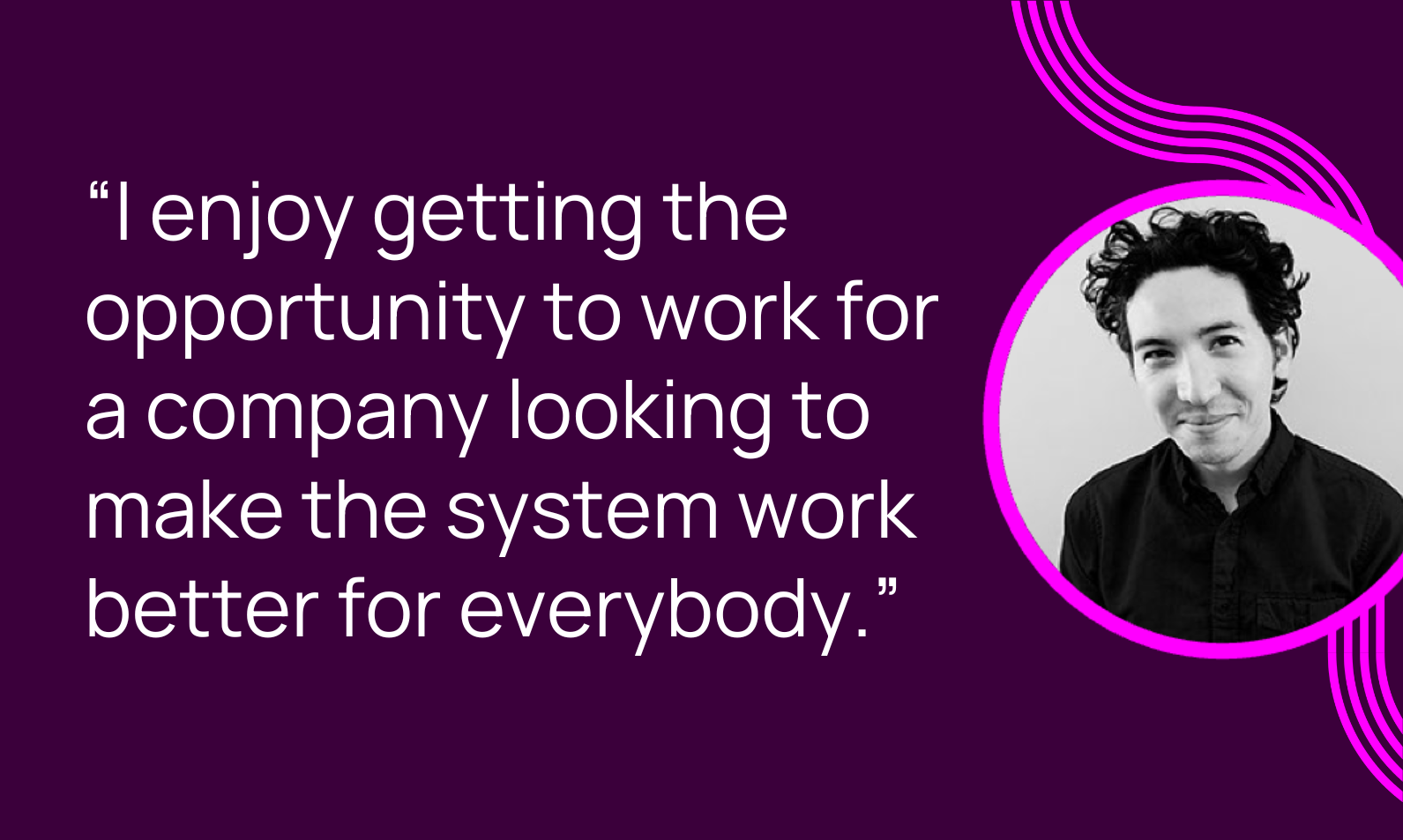
I went to a public health school so I was drawn to the mission of improving access and efficiency in the healthcare system. I enjoy getting the opportunity to work for a company looking to make the system work better for everybody. 

What do you enjoy about Ideon’s company culture?

We have a really strong and diverse team that I get to work with every day. I enjoy the good balance of independent work and collaboration on the engineering side. 

What do you like most about your job and working at Ideon?

I love that I get to take a deep dive into the insurance industry’s challenges, as my workday is full of solving technical problems that impact how millions of Americans access and enroll in benefits.

Tell us about your day-to-day as a member of the engineering team?

My day starts at “stand-up”—our daily morning meeting—going through the tasks I’m currently working on and any blockers that I have run into. Then from there, I’m focused on getting features out to our customers or on improving the internal tooling for our operations team.

Life

Favorite activity when you’re not working?

Drinking natural wines and playing records.

Favorite place you’ve traveled?

Japan.


Interested in joining our team? Check out Ideon’s careers page.

Seven ways benefit administration platforms can provide year-round value

Most benefits administration (BenAdmin) platforms only have genuine access to employees during open enrollment. This small window of engagement is frustrating to BenAdmin leaders, but it need not be. That’s because they already have the building blocks necessary for creating year-round member interactions: existing relationships with employers and information about their employees. 

By smartly leveraging those relationships and that data, BenAdmin platforms can become a 24/7/365 gateway to the myriad of providers of health, retirement, and other programs an employer offers. Not only will that enhance the value BenAdmins deliver to employers, it will further differentiate them from their competition as well. 

Here is just a sampling of the enhanced services that can turn BenAdmin platforms into year-round destinations:

Centralized Portals for single point of access to HSA, FSA, HRA, 401k and other accounts. With these, employees can log onto a BenAdmin site or app and access to all of their health plans, retirement, and flexible spending information. 

Accumulators. A single up-to-date view of the important running totals from all member’s benefit plans, such as deductibles, out-of-pocket maximums, and flexible spending account (FSA) balances.

Provider Search. One interface to find any sort of provider. Since the BenAdmin knows the plans in which each employee is enrolled, it can limit the display of providers to those that are in-network.

Cost Estimator. A tool that enables a member to enter a procedure or drug and see their out-of-pocket cost under their plan. This tool could also let members compare their effective costs at different hospitals, using the price transparency disclosures that the federal government has mandated. 

Benefits Marketplace. A year-round array of voluntary benefits, programs and offers available through the employer such as gym memberships, pet insurance, identity protection, and student loan assistance. The most relevant offers can be surfaced when members get married, have children or experience other qualifying life events.

Healthcare Concierge. Many BenAdmin providers offer sophisticated decision support to help members select plans. This assistance can be extended year-round in regards to selecting providers, lowering costs, and even booking appointments. Concierge services can be offered via human support, automated bots, or in combination.

Wellness Programs.  There are myriad ways to offer members the information, support, and encouragement to make healthier choices about eating, exercising, stopping smoking, managing chronic conditions, and dealing with mental health. These can deploy tools including self-assessments, coaching, gamification, rewards, and integration with mobile devices. 

Concierge and wellness programs can involve significant investments in content and support staff. BenAdmin providers, accordingly, may look to partners for these services rather than building them in-house. But all the other services on this list are essentially extensions of the capabilities that BenAdmins already have—connecting data from benefit providers, employers, and employees. Still, by using this information to offer convenience, utility, and insights, BenAdmin providers can engage members and prove value to employers 12 months of the year.

Michael Levin quoted in Insurance Business America