
How to Achieve Health Care Provider Directory Normalization with APIs: Practical Guide for 2025
Published on December 03, 2025
By: Ideon

Introduction: Building Real-Time Processing That Never Lags
Summary:
This article explains that health care provider directory normalization standardizes fragmented data from EHRs, claims, and other systems into consistent, accurate, and comparable records—an essential step for interoperability, compliance, and efficient care coordination.
It argues that API-driven normalization now provides the fastest, most reliable path forward—cutting implementation from 12–18 months to 4–8 weeks while improving data accuracy, lowering maintenance costs, and turning provider data into a true strategic asset for 2025 health systems.
Health care provider directory normalization means creating consistency across every medical directory by standardizing provider data from different sources – EHRs, claims systems, and patient surveys – into a unified, reliable, and comparable format.
Directory normalization delivers:
- Consistency creation across clinical, claims, and survey data sources
- Reliability through standardized, validated provider records
- True system comparability with clean, uniform datasets
- Smooth integration of provider information from EHRs, insurance, and patient engagement platforms
- Stronger clinical decision-making thanks to accurate, up-to-date listings
Without systematic record uniformity, health systems face fragmentation and duplicate entries that disrupt operations – leading to under-booked or over-booked providers, costly manual corrections, and delays in patient care. That’s why provider data standardization is now critical for information integrity in healthcare and true interoperability across systems.
Defining Health Care Provider Directory Normalization: What It Is and Why It Matters
Health care provider directory normalization means standardizing provider data across disparate systems, so every record – regardless of source – follows consistent formats and definitions. This process ensures directories are usable, comparable, and trustworthy across platforms, driving accuracy in every downstream workflow.
What Normalization Accomplishes:
- Creates consistency across records pulled from sources like EHRs, insurance claims, and patient surveys
- Establishes reliability by enforcing standardized formatting and validation
- Allows for meaningful comparability between different platforms and systems
- Serves as the technical foundation for integrating data from multiple sources
- Enables smarter clinical decision-making by aligning data for accuracy and completeness
The Challenge of Fragmented Data:
Provider data changes by as much as 25% each year, increasing the risk of fragmented or duplicate records. This fragmentation leads to operational inefficiencies – such as misaligned scheduling and care delays – making systematic record uniformity non-negotiable for modern healthcare delivery. Normalization sets the baseline for strategic value, which drives business impact at scale.
The Strategic Value of Normalized Provider Directories in Health Systems
Normalized provider directories are not just a technical requirement – they are a strategic asset. For health systems intent on scaling efficiently and meeting regulatory demands, normalization bridges the gap between fragmented data and operational outcomes that actually move the needle.
Operational Benefits:
- Improved Interoperability: Seamless data exchange across EHRs, claims systems, and partner platforms
- Enhanced Data Quality: Fewer errors and duplicates, leading to trustworthy records
- Advanced Analytics Capability: Clear trend identification and pattern analysis for smarter decisions
- Better Resource Allocation: Data-driven management of networks and provider resources
Clinical & Patient Care Impact:
- Stronger Care Coordination: Up-to-date provider data supports faster, more accurate referrals
- Network Adequacy Assessment: Reliable directories make it easier to evaluate and optimize network coverage
- Patient Access Improvements: Accurate listings reduce patient frustration and missed appointments
- Compliance Support: Maintains directory accuracy for regulatory requirements at both federal and state levels
Strategic Outcomes:
Master patient-provider lists cut out booking inefficiencies and sharpen care delivery timelines, ensuring every provider record is ready for real-world operational use. While the strategic value is clear, achieving normalization still comes with significant implementation challenges that health systems must address head-on.
Common Challenges in Health Care Provider Directory Normalization
Health care provider directory normalization comes with real-world obstacles – technical, operational, and regulatory – that slow down even the most ambitious teams. Recognizing these challenges is the first step toward building a solution that actually works at scale.
Technical Challenges:
- Data Variability: No unified coding standards across sources leads to inconsistent provider records
- Infrastructure Limitations: Legacy systems often can’t support modern integration or standardization
- ETL Process Failures: Complex data pipelines are prone to errors during extraction, transformation, and loading
- High Change Rates: Provider data changes by up to 25% each year, and month to month, requiring constant updates
- Integration Complexity: Managing and syncing data across many disparate sources magnifies normalization difficulty
Regulatory & Security Concerns:
- HIPAA Compliance: Strict privacy controls add complexity to every step of provider data management
- Data Governance: Maintaining protocols for data quality, access, and change management is resource-intensive
- Audit Documentation: Ongoing audit trail requirements mean every data change must be tracked and verifiable
Resource Challenges:
- Skilled Personnel Shortage: Few teams have enough engineers with deep data integration experience
- Ongoing Maintenance Burden: Manual oversight and updates create significant operational drag
- Cost Considerations: Building and maintaining custom normalization solutions drives up both time and spend
- Extended Timelines: Custom builds typically stretch to 12–18 months before they’re production-ready
Despite these barriers, proven techniques and modern API-driven approaches give technical leaders a path forward – making scalable provider directory normalization achievable for 2025 and beyond.
Best Practices and Techniques for Effective Directory Normalization
Battle-tested approaches from leading health systems prove that directory normalization succeeds when automation, validation, and continuous oversight work together. Here’s the comprehensive methodology for achieving accuracy, speed, and ongoing integrity – without locking your team into fragile, manual processes.
Core Best Practices:
- Build Robust Ingestion Pipelines: Automate cleansing at the point of entry to slash manual errors.
- Establish Master Records: Create a single source of truth to eliminate conflicting provider data.
- Automate Business Rules: Programmatically resolve conflicts and duplicates using intelligent logic.
- Implement Continuous Validation: Multi-layered error screening detects data drift in real time.
- Conduct Periodic Audits: Regular integrity reviews catch long-term issues before they impact operations.
- Leverage Specialist Partnerships: Integrate with API platforms to accelerate timelines and scale effortlessly.
Methodology Deep Dive:
- Ingestion and cleansing processes standardize incoming data for immediate use
- Automated matching algorithms catch duplicates and resolve conflicts at scale
- Manual review protocols provide a safety net for edge cases
- Metadata consolidation techniques unify fragmented attributes across sources
- Error screening stages continuously monitor for drift, inconsistency, and format issues
Techniques Comparison:
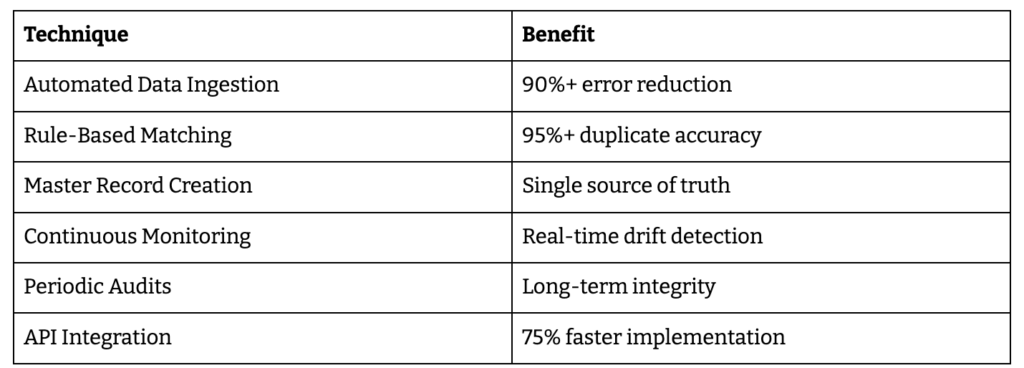
Implementation Considerations:
Balance automation with targeted manual oversight, run pilot programs to pressure-test your workflows, and document every process step for repeatability and compliance at scale.
API-Powered Normalization: How Modern Integration Streamlines Provider Data
Manual directory normalization drags teams into long timelines and mounting errors. API-powered approaches flip the equation – offering a proven, automated path to health care provider directory normalization that compresses months into weeks and delivers enterprise-grade data accuracy.
API Advantages:
- Real-Time Updates: Immediate synchronization of provider data across all connected platforms
- Automated Error Correction: Built-in validation catches and resolves errors before they spread
- Multi-Source Harmonization: Ingests and standardizes data from multiple carriers and systems at once
- Reduced Manual Effort: 90%+ of routine validation, reconciliation, and updates handled automatically
- Faster Implementation: Go live in 4-8 weeks, not 12-18 months
- Scalable Architecture: Effortlessly manage growing provider catalogs and high-change rates
- Lower Maintenance Costs: Rely on vendor-managed API infrastructure, not internal engineering headcount
Performance Metrics:
API-driven normalization delivers 99.5% accuracy, eliminates the maintenance burdens of custom builds, and frees engineering teams to focus on platform differentiation instead of data plumbing. Deploy in weeks, not months, and keep every provider record current – without manual fire drills.
Technical Benefits:
Production-ready API endpoints, robust documentation, and sandbox environments let your team test, iterate, and ship with confidence. Standardized formats across all payloads cut down on integration headaches and speed up onboarding.
Smart health systems are already using APIs to unify provider records at scale. Next, see what this looks like in practice.
Real-World Examples: Directory Normalization in Action
Concrete results beat theory every time. Here’s how real organizations use health care provider directory normalization to solve large-scale data problems and deliver measurable operational, clinical, and compliance wins.
Detailed Implementation Examples:
- Trilliant Health Analytics Platform
- Challenge: Verifying the active status of millions of providers scattered across massive, fragmented datasets.
- Solution: Claims analytics-based verification and specialty classification, powered by real-time directory cleaning in medicine.
- Approach: Tracks provider-organization relationships through billing data to accurately classify specialties and benchmark registry accuracy.
- Outcome: Millions of practitioner records validated, supporting strategic healthcare decisions and optimized provider network outcomes.
- Health System Consolidation
- Challenge: Merging fragmented organizations with inconsistent provider records during network consolidation.
- Solution: Unified health system hierarchies through systematic normalization and benchmarking registry accuracy.
- Outcome: Improved operational efficiency, enhanced patient care coordination, and robust compliance through audit strategies for provider networks.
Impact Summary:
- Compliance improvements driven by accurate directory maintenance
- Operational efficiency gains from error reduction and less manual work
- Patient care enhancements through improved coordination
- Strategic advantages unlocked by data-driven network management
Organizations ready to implement can follow a clear pathway to success.
Getting Started: Steps and Requirements for Directory Normalization Success
Implementation isn’t guesswork – achieving health care provider directory normalization is a structured process. Focus on tangible requirements and a proven workflow so your team can act decisively and confidently.
Technical Requirements:
- Infrastructure: Ingestion pipelines must handle multiple data formats from EHRs, claims systems, and patient surveys
- Standards Compliance: Every workflow needs ISA alignment and must fit broader healthcare interoperability requirements
- Validation Protocols: Quality assurance workflows are essential for ongoing accuracy and trust
- Integration Architecture: API-ready systems are ideal, but legacy modernization is possible if you commit resources
Implementation Approach:
Run a pilot to validate your approach before scaling. Compare 12–18 months to build a custom solution versus launching in 4–8 weeks with APIs. Assess your team’s bandwidth and budget, then leverage enterprise-grade API endpoints and documentation for faster deployment.
Decision Framework:
Decide: build or buy? Anchor your choice in core competencies, strategic goals, and total cost of ownership. The path from planning to execution is clearer than ever.
Conclusion
Provider directory normalization has evolved from a technical nice-to-have into essential healthcare infrastructure. Organizations face a clear choice: invest 12–18 months in custom development, or leverage proven API platforms to achieve the same goals in 4–8 weeks.
The strategic advantages are undeniable – accurate provider data drives better patient care, operational efficiency, regulatory compliance, and data-driven network management. Early adopters gain competitive advantages that compound over time as their data quality improves and their teams focus on innovation instead of maintenance.
The question isn’t whether to normalize your provider directories, but how to do it most effectively. Modern API infrastructure offers the fastest, most reliable path forward for health systems ready to compete in 2025 and beyond.
Frequently Asked Questions
Q: What is data normalization in healthcare?
A: Data normalization in healthcare is the process of standardizing provider data formats from multiple sources, such as EHRs and insurance systems, to create consistent, reliable, and comparable records across connected platforms.
Q: What are the inaccuracies of the provider directory?
A: Provider directories often suffer from fragmented, outdated, or duplicate records due to constant data changes and inconsistent formatting, leading to booking errors, referral gaps, and workflow inefficiencies.
Q: What makes health care data more complex?
A: Health care data is more complex because it’s captured from many sources in varied formats, frequently updated, and tightly regulated, making standardization and consistency challenging across systems.