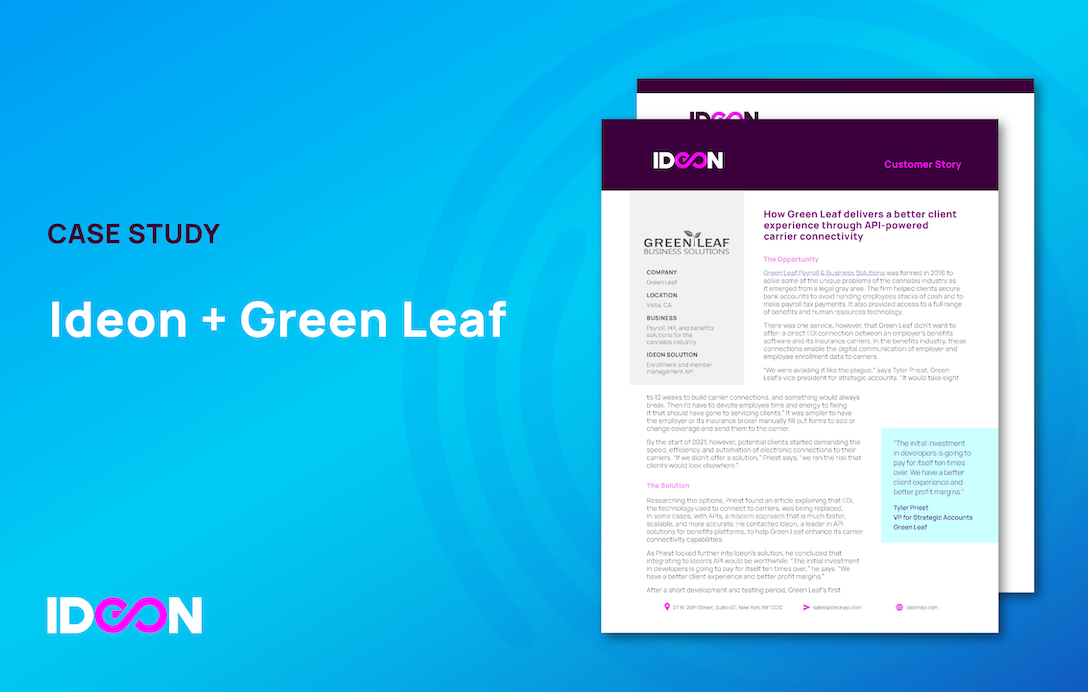
Green Leaf’s Story: How API-powered carrier connectivity delivered a better client experience

“Our benefits enrollment and administration experience is light years faster”

Green Leaf Payroll & Business Solutions helps its clients in the cannabis industry streamline a wide range of payroll and HR tasks, from securing bank accounts to providing access to a suite of benefits and HR technologies.

As Green Leaf expanded its benefits solution, there was one often-requested service that it was hard-pressed to address: connectivity between an employer’s benefits software and its insurance carriers.

Hear it from them:

“We were avoiding it like the plague,” says Tyler Priest, Green Leaf’s vice president for strategic accounts. “It would take eight to 12 weeks to build carrier connections, and something would always break. Then I’d have to devote employee time and energy to fixing it that should have gone to servicing clients.” It was simpler to have the employer or its insurance broker manually fill out forms to add or change coverage and send them to the carrier.

By the start of 2021, however, potential clients started demanding the speed, efficiency, and automation of electronic connections to their carriers. “If we didn’t offer a solution,” Priest says, “we ran the risk that clients would look elsewhere.”

Researching the options, Priest found an article explaining that EDI, the technology used to connect to carriers, was being replaced, in some cases, with APIs, a modern approach that is much faster, scalable, and more accurate. He contacted Ideon, a leader in API solutions for benefits platforms, to help Green Leaf enhance its carrier connectivity capabilities.

Wondering how it went?  (Hint: This story has a happy ending.)  Download the full case study here for all the details.

DOWNLOAD

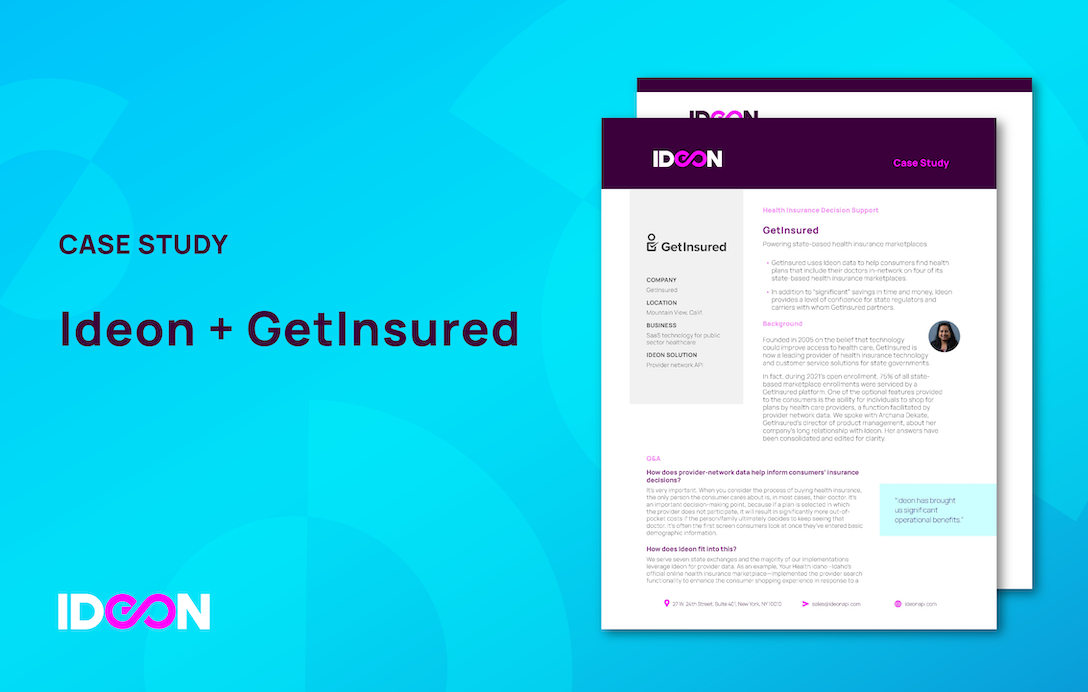
GetInsured’s Story: How Ideon saved the company time and resources—and boosted stakeholder confidence

“It’s a streamlined process when we’re working with a trusted, experienced data partner”

GetInsured powers state-based health insurance marketplaces by providing health insurance technology and customer service solutions for state governments. An important feature of the company’s offering is that consumers have the ability to shop for plans by healthcare provider, which helps individuals keep their doctors when enrolling in a new plan.

Back in the day, sourcing provider-network data was quite the headache. Says GetInsured’s director of product management, Archana Dekate:

Before Ideon we were getting our data directly from carriers or through other vendors. And each vendor had their own APIs and their own set of implementation procedures, which meant that we would have to modify our code every time to accept their data, then QA it, test it, and so on. It was time consuming; every product release would take anywhere from one to three months of setup time.

Thanks to Ideon, that’s all safely in the rearview mirror. To learn how partnering with Ideon helped GetInsured on multiple fronts, download our case study here.

DOWNLOAD

A People-Centric Approach to Digital Transformation in Health Insurance

By Meg Collins, Ideon’s Chief Growth Officer

By now the argument is all too familiar: Digital transformation offers a host of attractive rewards, ranging from cost savings to improved customer experience. 

That’s especially true in health insurance, an industry long dominated by established carriers skeptical of change but also being disrupted by new technology platforms reimagining benefits administration. In this rapidly evolving ecosystem, organizations that embrace digital change will inevitably emerge in a stronger competitive position.

But there’s a caveat. For digital transformation to be, well, transformative, it must be done right. 

And that’s far easier said than done. According to research by consulting giant McKinsey, the success rate of organizational transformations in general is lower than 30%. Digital refittings—which require collaboration between multiple business groups—are even tougher to make work. Just 16% of respondents to the McKinsey survey said that digital transformation efforts at their organizations “have successfully improved performance and also equipped them to sustain changes in the long term.”

There are many reasons for this, but according to Boston Consulting Group one commonality reigns supreme: The human dimension is usually most vital to the outcome of attempted digital transformations. 

In other words: Operating models, processes, and culture are at least as important to digital-transformation success as the technologies themselves. That’s certainly our experience at Ideon. With our APIs, we have successfully helped organizations in every corner of the health insurance and benefits ecosystem. But in doing so we have also observed the importance of a people-centric approach. And though every company is unique, the following four imperatives will go a long way to getting digital transformation right at any organization:

  1. Establish clear goals and governance. In planning stages, digital transformation should be attacked quasi-journalistically: What are we doing? Why are we doing this? Who is accepting ownership of this project? Where will we procure resources from? What is the sequence of events? Whether your organization seeks to replace legacy IT infrastructure or create an end-to-end customer experience, leaders should create a roadmap with quantifiable outcomes for digital transformation projects. But they must also be sure to make clear who “owns” each undertaking, instilling in each owner a clear understanding of how their work fits into the greater whole.

  2. Craft a compelling story. Many of the strongest reasons for dramatic change make for an uninspiring or anxiety-causing narrative. This is notably so with digital transformation, which many employees interpret as job-threatening. That’s why it’s crucial for leadership to craft a compelling story about where a company is headed and why wholesale change in technology and process is necessary. More often than not, that story involves improving the customer experience, but whatever the tale, it needs to be told and reinforced—via regular updates—so that all decisions can be easily understood as part of a meaningful journey.

  3. Assemble a complete team. Yes, having tech-savvy and tech-embracing people on transition teams is crucial. And yes, it’s important to include leaders from across an organization. But it’s also crucial to involve employees of all ranks and personality types wherever possible in planning and execution. First, because wholesale change inevitably impacts employees and workflows at all levels. But also because inclusion builds buy-in, increasing the likelihood that changing priorities, shifting tactics, and other crucial information is widely disseminated. Nothing increases mistrust more than actual or perceived secrecy, and an inclusive transition team helps avoid that reality or perception. Finally, building a transformation team that accounts for personality types and roles lessens the likelihood that this extremely important endeavor will be derailed by unhealthy (and all-too-common) group dynamics. 

  4. Encourage input. Digital transformation is usually messy and rarely without challenges. As a result, it’s important to provide all employees with a mechanism to comment on or contribute to transformation planning or execution in (relatively) real time. This fosters a valuable sense of ownership and investment, which helps to avoid internal resistance (a common-enough phenomenon that it has a name: “blocking”) and also overcome the inevitable glitches or missteps.

Digital transformation is almost always a momentous undertaking, but it need not be intimidating. Organizations that succeed in keeping people and culture top of mind are already halfway to meaningful change. We know this at Ideon, because we see it happen every day with our customers and partners. We can’t enable your entire transformation, but when it comes to revamping your digital connectivity strategy, Ideon is happy to help. Contact us to learn more!


Powerful from the start: How data integrations helped DocMe launch an innovative digital health app

By Zach Wallens
Director of Content and Communications, Ideon

In this blog post, Ideon profiles one of our newest customers, DocMe, a digital health app based in New York.

It’s no secret that new technologies and companies are driving innovation in the healthcare industry. From mental health and virtual care to digital pharmacies, care navigation, and billing, digital health startups are popping up in all corners of the healthcare ecosystem.

That ecosystem, however, is getting crowded. The race for customers, funding, and publicity is more competitive than ever before.

One way to stand out? Build intuitive, data-driven user experiences powered by third-party data integrations. New York-based DocMe, a brand new digital health app, is one example of an innovation-through-integration approach, leveraging several APIs to create a powerful interface for patients and providers.

Connecting the Dots

Founded in 2021 by private equity investor Tim Gollin, the original concept for DocMe was an app to help consumers shop for doctors, comparing availability, insurance coverage, and prices for specific procedures. Of course, there are existing services, such as ZocDoc, for booking medical appointments.

Gollin quickly realized that a connected patient experience—bringing together disparate data sets within a single platform—could truly differentiate DocMe from competitors. Leveraging third-party integrations, Gollin and his developers understood, would be far more efficient than chasing down data sets and building functionality from scratch.

DocMe streamlined its development by relying on specialized companies to provide data and services it incorporated into its app. “A lot of the data and connections we would have had to build ourselves in the past we can now get from vendors,” Gollin says. “We see ourselves as stringing together little bits of Tinker Toys to build a complete product.”

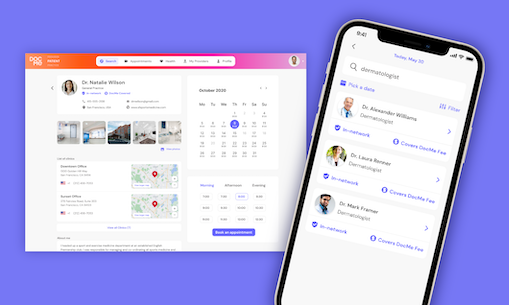
Indeed, DocMe integrates third-party technology for functions like electronic health records, payments processing, video conferencing, and provider identity verification. And it incorporates multiple sources of data about providers, procedure costs, and—with data from Ideon—insurance networks.

“Ideon provides me with the ability to show consumers which doctors are in their network without them having to go to their insurance company website,” Gollin says. “Doctors don’t even know what networks they are in. We’ve heard lots of stories where people get told on the phone the doctor is in their plan only to discover it’s not. Ideon has the definitive answer.”

This tight integration between services provides patients with an easier, more intuitive experience. Some examples:

  • DocMe promises patients that they’ll never have to enter medical information history more than once. 
  • When someone makes a doctor’s appointment, they not only see available times but also the specific services offered and the price they’ll pay according to the terms of their insurance plan.
  • When a patient books an appointment, DocMe will collect the amount not covered by insurance in advance. In other words, patients get a much more transparent market.

DocMe is continuing to add features to its product, integrating data more tightly to save users time. It will use Ideon’s card scanning technology, for example, to extract patients’ network information by simply snapping a photo of their insurance cards. 

DocMe is also preparing to roll out in Brazil, Italy, France, and the United Arab Emirates. Some might ask why a small company would spread its resources across different countries, each with its own health care system. Gollin answers that the work done to build integrated capabilities and smooth user experience into DocMe already gives it an advantage in other markets. “The goofy thing is the U.S. system is super complicated,” he says. “Everyplace else is significantly simpler.”

For more information about Ideon’s APIs for digital health and InsurTech platforms, click here.

Employee Spotlight: Colin Crihfield

At Ideon, we’re proud to have such a talented, diverse team leading the charge for a better and more connected health insurance and employee benefits industry. Our ongoing Employee Spotlight series showcases the people behind our product and unveils what life is like at Ideon. Next up… Colin Crihfield, Product Manager.

Name: Colin Crihfield

Department: Product

Title: Product Manager

Location: New York


Work

How long have you worked at Ideon?

Seven months. I started in July of 2021.

What do you enjoy most about Ideon’s company culture?

There’s a genuinely positive atmosphere at the company. We work hard but we also have fun, which goes a long way in brightening up meetings, especially in a primarily remote working environment.

What is the best part about your job?

The collaboration across teams and willingness to help each other out is fantastic. The learning process at Ideon is endless because of the complexities inherent to our industry and our products. But I feel incredibly lucky to learn from great people every single day.

Tell us about your day-to-day on the product team?

My favorite part of product management is that no two days are the same. My days are a mix of creating innovative products and features for our customers and new internal tooling for our operations team. I also have the privilege of working with Ideon’s marketing, sales, and engineering teams to research, plan, develop, test, launch, and enhance our products.

What attracted you to Ideon’s mission?

I was drawn to Ideon for two reasons. First, the problem we’re solving is incredibly important: people need more choice, transparency, and information to make better decisions about their health insurance and benefits. Second, I wanted an opportunity to work on innovative products. We’re building API infrastructure that has never existed in our industry.

What do you find interesting about managing Ideon’s quoting and decision support (QDS) products?

Over the last five years, the team has done an amazing job establishing our QDS products as the industry leader. Still, there are avenues for us to improve and expand these products. It’s really exciting to face this challenge head-on, through creative problem-solving and analytical thinking.

Life

Favorite activity when you’re not working? 

I love to cook, but recently that has been trumped by the addition of a new furry friend to our family. Now going to the Madison Square dog park is at the top of my list. 

Favorite place you’ve traveled?

Vermont. Not the most exotic, but dirt roads, trees, and fresh air are such a welcome change from my home in NYC.

Interesting fact about yourself…. Go!

Since high school, my claim to fame has been being able to dunk a basketball. I try it out every few months to make sure I can still do it so I’m still clinging to that!


Interested in joining our team? Check out Ideon’s careers page.


Asked & Answered: What group benefits carriers should know about LDEx

If you’re in the group benefits industry, you’ve probably heard the term LDEx, i.e., LIMRA Data Exchange Standards. Whether you’re actively adapting your systems to accept LDEx-formatted enrollment data or have only seen the term in passing, there’s a lot happening around this opportunity and, of course, a lot for carriers to consider.

LDEx won’t immediately solve all of our industry’s data exchange challenges, but it’s a step in the right direction. MetLife, Guardian, Sun Life, Aflac, and other industry leaders are members of the LIMRA committee tasked with developing the LDEx, reflecting its transformative potential. Some carriers, however, have a myriad of questions. 

Ideon, also a committee member, created this primer to answer basic questions about the standards and offer suggestions for leveraging them with minimal effort and expense.

What is LDEx?

The LIMRA Data Exchange (LDEx) Standards® are a set of rules—for terminology, formatting, content, and delivery—that facilitate digital communication between benefits administration (BenAdmin) platforms and insurance carriers. They are meant to replace various ad-hoc formats, such as EDI 834, for transmitting data about employee enrollment and eligibility in group benefit plans.

What are the benefits of LDEx for carriers?

If implemented broadly, LDEx will substantially reduce the complexity and expense of receiving enrollment information from BenAdmin platforms. Without LDEx, carriers typically spend weeks to months setting up and testing variations of EDI connections for each new group they enroll. If the industry uses LDEx, there will be greater consistency and accuracy throughout the integration and testing process, reducing the resources carriers must allocate to adding and managing groups.

As industry adoption increases, carriers will be able to connect more easily to benefits platforms and other insurance technology providers, dramatically improving the user experience for members who want to manage their eligibility through those platforms. 

Ultimately, brokers, HR teams, and members will find that enrolling and modifying group benefits will be faster and more accurate. In today’s competitive environment, this is a business imperative for insurance carriers. Increasingly, brokers and BenAdmin platforms are steering their group clients to insurance carriers that make the enrollment experience as easy and automated as possible, across the software they use today.

Who created LDEx?

LDEx is sponsored by LIMRA, a non-profit consulting group and trade association that works primarily with the life insurance industry. The standards were developed by a steering committee composed of 40 executives from group benefits carriers and insurance technology companies. 

What capabilities does LDEx provide?

The initial standards, released in January 2020, covered a wide range of benefits, including dental, vision, disability, critical illness, and life products. More recently, it has been expanded to include medical plans, flexible spending and health reimbursement accounts, paid family leave, and employee assistance programs.

The LDEx standard covers information about benefit enrollment, eligibility, and member changes. It also allows carriers to communicate data issues and coverage confirmations back to the BenAdmin provider.

The standards are designed to communicate transactions using structured XML files, a flat file format that’s common in the insurance industry. There are also near-term plans for LDEx to support REST APIs, which would allow for faster processing and better, automated error checking.

LIMRA is working on additional standards to support electronic communication of benefit plan designs and quotes.

What must carriers do to use LDEx?

The standards can be downloaded for free from LIMRA. Carriers must modify their existing enrollment systems to accept data in the new formats—or they can use separate data transformation software to convert each LDEx file they receive into the format their system uses. 

How can carriers ease the burden of adopting LDEx?

Although LDEx will ultimately save time and money for carriers, adopting the standards can add development expenses for carriers already spreading limited technology resources across many priorities. Some carriers, however, are finding ways to adopt LDEx without devoting resources to development.

Ideon’s middleware solution enables carriers to accept LDEx files from numerous BenAdmins, with minimal development effort and capital costs, and no need to modify their current system and format. It’s not just a quick fix—it’s a long-term strategic move to enhance your connectivity with BenAdmins and set yourself up for scalability and adaptability in the future. Ideon radically reduces the time and effort needed to set up and administer group benefits, while delivering faster and more accurate information for employers and members. Reach out to us for more information.

Asked & Answered: What benefits administration platforms should know about LDEx

If you work for an HR or benefits administration (BenAdmin) platform, you might have heard the term LDEx, i.e., LIMRA Data Exchange Standards. Whether you’re actively adapting your systems to transmit LDEx-formatted enrollment data or have only seen the term in passing, there’s a lot happening around this opportunity and, of course, a lot for you to consider.

LDEx won’t immediately solve all of our industry’s data exchange challenges, but it’s a step in the right direction. ADP, Benefitfocus, benefitexpress, Businessolver, PlanSource, Selerix, Paycom, and other industry leaders are members of the LIMRA committee tasked with developing the LDEx, reflecting its transformative potential. Some BenAdmins, however, have a myriad of questions. 

Ideon, also a committee member, created this primer to answer basic questions about the standards and offer suggestions for leveraging them with minimal effort and expense.

What is LDEx?

The LIMRA Data Exchange (LDEx) Standards® are a set of rules—for terminology, formatting, content, and delivery—that facilitate digital communication between BenAdmin platforms and group benefits carriers. They are meant to replace various ad-hoc formats, such as EDI 834, for transmitting data about employee enrollment and eligibility in group benefit plans.

What are the advantages of LDEx for HR and benefits platforms?

If implemented broadly, LDEx will substantially reduce the complexity and expense of integrating with carrier systems and sending enrollment data in carrier-specific formats.

As BenAdmins know all too well, the lack of consistency has, traditionally, caused significant operational challenges and group-onboarding delays. BenAdmins typically spend weeks to months setting up and testing carrier connections. But if both carrier and BenAdmin platform use LDEx, there will be greater uniformity and accuracy throughout the integration and testing process, reducing the resources BenAdmins must allocate to adding and managing groups.

As industry adoption increases, BenAdmins will be able to connect and transmit data to carriers more efficiently. Ultimately, brokers, HR teams, and members will find that enrolling and modifying group benefits will be faster and more accurate if their BenAdmin uses LDEx. In today’s hyper-competitive environment, this is a business imperative: BenAdmins need to make the enrollment experience as easy and automated as possible, across as many insurance carriers and product lines as possible.

Who created LDEx?

LDEx is sponsored by LIMRA, a non-profit consulting group and trade association that works primarily with the life insurance industry. The standards were developed by a steering committee composed of 40 executives from group benefits carriers and BenAdmin platforms.

What capabilities does LDEx provide?

The initial standards, released in January 2020, covered a wide range of benefits, including dental, vision, disability, critical illness, and life products. More recently, it has been expanded to include medical plans, flexible spending and health reimbursement accounts, paid family leave, and employee assistance programs.

The LDEx standard is carrier-agnostic and covers information about benefits elections, coverage changes, terminations, non-coverage demographic changes, and eligibility management. It also allows carriers to communicate data issues and coverage confirmations back to the BenAdmin provider.

The standards are designed to communicate transactions using structured XML files, a flat file format that’s common in the insurance industry. There are also near-term plans for LDEx to support for REST APIs, which allow for faster processing and better, automated error checking.

LIMRA is working on extensions to support electronic communication of benefit plan designs and quotes.

What must benefits platforms do to use LDEx?

The standards can be downloaded for free from LIMRA. In general, BenAdmins can implement them the same way they would configure their systems for any other data exchange format.

It remains to be seen how much consistency there will be among carriers adopting the LDEx standard. One cautionary tale: EDI 834. This standard remains the status quo format for most medical plans, but over time carriers have developed their own variations, so BenAdmins have had to modify and test their data formats for each dialect of the standard. 

Will carriers do the same with LDEx? Time will tell. In the meantime, there are tactics BenAdmins can implement to leverage LDEx to the fullest extent possible while leaving room to adapt if necessary.

How can benefits platforms ease the burden of adopting LDEx?

Although LDEx will ultimately save time and money for BenAdmin platforms while enabling a smoother user experience, some remain hesitant. After all, wouldn’t adopting the standard require devoting significant resources to development and testing the format—while still building and maintaining the carrier connections?

Not quite.

Ideon’s middleware solution enables benefits administration platforms to send LDEx-formatted data to any carrier, regardless of whether the carrier is set up for LDEx. Ideon handles the translation into LDEx or whatever format is best for the carrier. It’s not just a quick fix—it’s a long-term strategic move to enhance your carrier connectivity and set yourself up for scalability and adaptability in the future. Ideon radically reduces the time and effort needed to set up and administer group benefits, while delivering faster and more accurate information for employers and members.

For more information, please reach out to us here or send us an email at sales@ideonapi.com

Employee Spotlight: Keriann Iovino

At Ideon, we’re proud to have such a talented, diverse team leading the charge for a better and more connected health insurance and employee benefits industry. Our ongoing Employee Spotlight series showcases the people behind our product and unveils what life is like at Ideon. Next up… Keriann Iovino, our People Operations Coordinator.

Name: Keriann Iovino

Title: People Operations Coordinator

Department: People Team

Location: New York


Work

How long have you worked at Ideon? 

Just shy of 5 years!

What do you enjoy about Ideon’s company culture?

I love the transparency and the people I work with every day.

How has Ideon helped you grow professionally?

Management at Ideon wants to see everyone succeed. Although I was hired as an Office Coordinator in our NYC headquarters, I was always interested in the People/HR field. Ideon’s Head of People, Emily Joseph, and our Chief of Staff, Tory Bensen, were supportive in helping me more closely align my responsibilities with my interests, eventually transitioning me into the People Operations Coordinator role that I’m in today. 

What do you like most about your job and working at Ideon?

I get to meet every new Ideon employee, ushering them through the interview and onboarding process. Our team is amazing and it’s been especially rewarding over the past 12 months, getting an opportunity to meet so many new faces, all from different backgrounds and locations!

What attracted you to Ideon’s mission?

In the past, I’ve worked in the medical field and saw how confusing and messy health insurance can be. When I came across Ideon, I was immediately drawn to its mission to solve these challenges at the industry-wide level. I wanted to be a part of a company making a big impact. 


Life

Favorite activity when you’re not working? 

Besides relaxing with my family, I love crafting! I like to make shirts and tote bags.

Favorite place you’ve traveled?

Curacao was by far my favorite place that I’ve traveled to.

Interesting fact about yourself… Go!

I was once in a Mac Miller music video!

Interested in joining our team? Check out Ideon’s careers page.

Looking back, powering ahead

**Ideon is the company formerly known as Vericred. Vericred began operating as Ideon on May 18, 2022.**

By Michael W. Levin, Vericred co-founder and CEO

Vericred experienced record growth in new customers and revenue in 2021. 

That’s good news by any measure, for any company.

But what is especially gratifying to this company is the extent to which leaders on both the carrier and InsurTech sides of our world increasingly share our vision, one in which data liquidity and connectivity is the minimum operating standard of the industry. Our business won’t succeed—and our industry will not evolve—if buy-in to these ideas does not become universal. Our results strongly suggest this is happening.

That Vericred can handle such rapid growth in a business with resource-intensive, data-integration processes reflects the efforts of an incredible team. It will also serve as a catalyst for expansion. 

The fourth quarter is always an intense time in our industry, but this year gave new meaning to the word, as we built plan and rate data for over 45,000 ACA plans and oversaw a 100x increase in employer group renewals. And we accomplished all of that in the midst of a pandemic, when remote work generally remains our norm. I say “generally” because our data operations team has been coming into the office since July. For that, the rest of us are thankful, not only for their excellent work but also because they avoided significant COVID-related health issues.

Account growth often leads to strategic additions to the staff, and that was the case for us. We increased our employee ranks by 70% in 2021, and more hires are expected in 2022. Recruiting is always difficult, and it is especially so in today’s unique environment. But one reason we’re as good as we are at attracting strong leaders and superior engineering, product, marketing, sales and operations contributors is because every new hire knows they will be joining a team already filled with top talent. We could not be prouder of our people, the work they put in, and the product they put out.

Earlier this year we completed a Series B round of funding totaling $22.7 million. We are gratified to have received sizable monetary votes of confidence from four new investors (Aquiline Technology Growth, Echo Health Ventures, MassMutual Ventures, and Guardian Strategic Ventures) and three existing ones (Riverside Acceleration Capital, First Health Capital Partners, and FCA Venture Partners). That said, we’re also grateful to the potential investors who passed. We learn a lot from “no” votes that test our theories and challenge our views. We cannot fall prey to confirmation bias or any other decision trap if we are to succeed in this societally crucial business.

Our progress in 2021—in customer growth, staff expansion, and investor approbation—suggests that our industry is genuinely ready to embrace transparency and connectivity. That’s no small thing. The time will soon arrive, if it hasn’t already, when employers and members will demand the kinds of seamless digital experiences in choosing and using health insurance and benefits that they have come to expect from most other commercial interactions. 

Indeed, we expect 2022 to be a year that the industry focuses with laser intensity on the member experience, in all its manifestations and with all its opportunities. This can only help Vericred, given how efficiently our platform powers carrier connectivity and digital experiences for benefits-focused insurtechs. But it’s also good for our industry and our country. If there’s anything we’ve learned in the past two years, it’s just how important an efficient insurance-and-benefits ecosystem is to our collective wellbeing. We’re thrilled to be in a position to meaningfully help facilitate that, in this or any year.

Four Benefits-Focused Insurtech Predictions for 2022

By John Carson, Ideon’s Chief Revenue Officer

2021 has been a banner year for employee-benefits insurtechs—and not just because investors have committed more than $6 billion to U.S. insurtech startups this year. The rate at which benefits-focused insurtechs have introduced innovative solutions to solve long-standing challenges has been inspiring.

But for all the progress, the industry’s digital transformation is far from complete. Some employees still enroll in benefits via paper forms. Others lack the tools to fully understand their options. Still others continue to struggle to maximize their benefits year-round. Not to mention that, behind the scenes, a significant portion of brokers, HR teams, and other stakeholders deal with inefficiencies and limited automation as they undertake day-to-day, benefits-related tasks.

Collectively, though, the industry is heading in the right direction. We can say that because Ideon—a data platform that powers carrier connectivity and digital experiences for benefits-focused insurtechs, HRtechs, and benefits-administration software—has a front-row seat to all that runs this industry. And we see several digital trends gaining momentum. Here are our top benefits-focused insurtech predictions for 2022.  

1. Decision-support tools will transition from “nice-to-have” to “essential feature.” Decision-support tools are gaining traction in two primary ways: first, by helping employees select and enroll in the health insurance and benefits plans that best match their and their family’s specific needs; and second, by enabling employees to make better decisions year-round, e.g., using virtual assistants to steer employees toward in-network doctors to keep out-of-pocket costs low. 

In 2022, we expect most benefits-focused insurtechs to integrate advanced technologies into their decision-support tools. From AI and on-demand virtual assistants to machine learning and data-powered personalized recommendations, new tech is starting to ripple through the benefits industry. Expect a splash in 2022; according to a Guardian survey, 41% of employees want more decision-support tools for the enrollment process.

2. More small employers will offer advanced digital enrollment experiences. For years, insurance carriers and benefits platforms have leaned on EDI for the automated exchange of enrollment and eligibility data. But EDI has been out of reach for most small businesses, leaving them to rely on paper forms and other manual processes. (Nearly 40% of small employers—those with fewer than 50 employees—use paper as the main method for submitting enrollment data to carriers.) 

But the tide is turning. Thanks to APIs like Ideon, more HR and benefits administration platforms are bringing the advantages of automation and streamlined data exchange to small businesses. The result: a faster, more efficient, more accurate enrollment experience. That’s why we expect that in 2022 the benefits experiences offered to small-business employees will begin to catch up to those offered at larger companies.

3. The shift to all-API transactions will accelerate (slowly). There’s been much discussion about the shift from EDI feeds to API connections for data exchange. And that shift is very real. Still, most carriers remain tied to EDI systems, even as some are beginning to develop APIs. We see much the same in 2022—an industry majority continuing to use EDI for most data exchanges as the uphill climb toward API transactions progresses relentlessly. As (relatively) unbiased observers, we can say that carrier-connectivity solutions (such as those offered by Ideon) enable benefits-focused insurtechs and HR platforms to connect to multiple carriers through one easy integration regardless of whether carriers prefer EDI, API, or other means.

4. Back-end processes take a front-row seat. From an employee’s perspective, digital enrollment has become commonplace. Most employees (at large firms, at least) have the ability—through the benefits software or app provided by their employer—to review, select, and enroll in benefits digitally. But from the perspective of folks behind the scenes? Not so much. 

That’s why we think there will be a focus in 2022 on streamlining enrollment and administration for brokers, HR teams, and enrollment-processing departments at carriers and benefits-administration platforms. For these stakeholders, much of open enrollment is spent setting up EDI feeds, manually keying data into carrier portals, correcting errors, and editing spreadsheets. Streamlining those processes, most industry experts have learned, has a trickle-down effect that makes enrollment faster, more accurate, and more enjoyable for employees, too.

Are we fairly certain about these predictions? Yes. Are we even more certain that however the year unfolds Ideon will be there to smooth out the inevitable bumps in the road? You bet.

‘Easy to use, Easy to buy’: A Q&A with Friday Health Plans

In the past decade, several health insurance carriers have entered the individual and employer-sponsored markets, bringing innovative products and consumer-first digital experiences in a bid to compete with legacy carriers. One such entry is Friday Health Plans, a Colorado-based company launched in 2015 to serve the individual and small group markets. As Friday has expanded from a single-state carrier to a rapidly growing multi-state firm with $186 million in venture capital funding, digital technology has been a driving force behind its growth. 

To learn more about the company’s growth strategy, Ideon spoke with Lisa Kwiecien, Friday’s director of channel development. The interview has been condensed and edited for clarity.

IDEON: What is Friday’s key differentiator?

KWIECIEN: We create health plans that are good value, easy to buy, and easy to use. We always put the consumer first, which is apparent in our plan designs. 

How does technology help Friday compete against more established, national health plans?

Because we concentrate on individuals, families, and small groups, we have fewer plan designs, which means that our technology can be more focused and efficient. Tech helps make our plans easy to administer, straightforward to buy, and effortless to understand. That’s true for brokers, employers, and most especially consumers.

How so?

We’ve invested in technology across the company—in our app, in our telehealth function, in customer support. We’ve enhanced our ability to communicate with members, to help them access their ID cards digitally, to understand their deductibles and other plan details. They can also use our app to search for providers. We knew we had to be aligned with today’s consumer expectations generally.

Friday Health Plans recently started working with Ideon. Can you talk about that? 

We work with Ideon in two ways. We share our plan and rate information with Ideon, which then distributes that data to third-party quoting platforms used by brokers, employers, and consumers. And we use Ideon to connect with benefits platforms [e.g., Rippling, GoCo, Decisely, Sequoia, Gusto], which helps us streamline digital enrollment and member management. We know we have great products and competitive rates, but we wanted to make the enrollment process more efficient for small businesses and for brokers. We needed to improve connectivity with today’s benefits ecosystem.

Why is connectivity with respect to brokers so important? 

We pride ourselves on being a broker-friendly carrier. Many decisions by brokers are made because of convenience, so we want to make our products and technology as convenient as possible. We started to search for different ways that we can automate enrollment, because historically it’s been a super manual process to submit member and group enrollment information in the small group market. There’s a lot of back-and-forth. It’s inefficient. And often it still involves a lot of paper. Ideally, we want it so that brokers can digitally manage all transactions, submitting enrollments on their preferred platform so that we’re not working on different CSV files or PDFs, etc. 

Why does uniformity like that matter?

For us, receiving a consistent file format from all these platforms improves our efficiency and accuracy, enabling us to seamlessly process incoming enrollments and member changes. And when we minimize errors, everything happens faster, creating a streamlined process. Members get their ID cards sooner, brokers have fewer fires to put out. We’re always working to build a streamlined process that flows smoother than it does today.

Does having better digital connectivity with benefits platforms factor into Friday’s growth plans?

Absolutely. It’s about scalability. When we anticipate our expansion into new markets and new states, we want to make sure that we have the technology in place to scale effectively. Enhancing our connectivity with benefits administration platforms is a prerequisite for scaling our business. That’s one reason why we’re working with Ideon.

Final question: Friday, which is a member of the HRA Council, supports Individual Coverage Health Reimbursement Arrangements (ICHRAs). How do ICHRAs fit into your company’s strategy?

We’re always thinking about how to improve affordability and optionality to employers and employees. There are a lot of reasons why ICHRAs might appeal to a small employer—e.g., cost predictability, class options—and ICHRA gives an employee more plan choices through the individual market than does a traditional small-group offering. They’re also tax-free and transportable. Our CEO, Sal Gentile, sees ICHRAs as a growth opportunity as they become more prevalent in the next few years. 

Thanks so much for your time and candor, Lisa.

My pleasure.

To learn how benefits platforms can connect with Friday Health Plans, or for information about Ideon’s solutions for carriers, please reach out to support@ideonapi.com.

How third-party quoting platforms can drive better analytics and more sales for health insurance carriers

By Matt Leonard, Ideon’s Vice President of Carrier Relations

In recent years, brokers have flocked to third-party services to quote health insurance plans from multiple carriers. As a result, most carriers wanted to immediately tap into this new, growing distribution channel. They were quick to share rates and product information with external partners, making the downstream quoting process easy and accurate for brokers assembling employer proposals.

But not all carriers bought in. Holdouts chose to keep rates in-house, forcing brokers to obtain quotes directly from them. Their chief concern: a perceived black hole of visibility and analytics. Specifically, carriers worried they’d lose access to valuable information typically gleaned when brokers quoted plans via carrier websites and portals—e.g., which brokers sold what products (and where), what employer groups were shopping for new policies, etc.

Today, with a majority of health insurance carriers having made their plans and rates available to third-party quoting platforms, we can now see whether those early fears were justified.

Short answer: Carriers that embraced the “platform revolution” are being rewarded with a stream of high-quality data that can drive advanced analytics and turbocharge sales operations. In fact, their visibility into quoting activity on platforms is not all that different compared to if quotes are prepared on carrier websites. It’s truly a win-win—i.e., modern distribution combined with valuable insights.

Meanwhile, carriers that are not distributing their rates continue to miss out in two ways: limited distribution to digital sales channels and zero visibility into how—and if—their products are being quoted externally.

To understand why, let’s examine two scenarios.

  1. Carrier relies entirely on in-house website or portal for quoting

    In the past, brokers logged on to each carrier’s website to get the quotes they needed to assemble a client proposal. That’s a lot of busy work for the broker, but it gave the carrier critical information. Location data, insights on which brokers are quoting which plans, and information about group sizes and quote-to-close ratios are all part of the typical carrier analytics package. And when they see quotes generated for potentially lucrative accounts, the carriers can assign sales representatives to help brokers to win the business.

    This may seem like an appealing option to carriers that want full control over where their products are quoted. And, understandably, they crave these in-depth analytics. But this mindset—control over distribution—is built upon a false premise. Third-party quoting platforms still add the plan and rate information of non-participating carriers, mainly by tracking down public filings and other sources.

    The difference? The data could well be incomplete or out-of-date, risking the possibility of inaccurate quotes appearing on client proposals. And carriers receive no information at all about how well their products are doing on downstream platforms and no leads on deals in progress.

  2. Carrier engages with today’s platform ecosystem

    Today, nearly all brokers use quoting platforms to save time compiling rates from multiple carriers and building proposals. Most carriers understand this reality and have reacted accordingly. These carriers distribute their product information to quoting platforms to ensure rates and plans are represented accurately.

    At the same time, the participating carriers have access to a precise record of every quote issued, often specifying the individual broker, the employer group, and more.

    Carriers can use this data to build sophisticated analytics that can help optimize the effectiveness of their marketing campaigns and commission programs. For example, they can calculate the quote-to-close ratio across different brokers, client types, geographic areas, and commission rates. Carriers are also feeding the data they get from quoting platforms directly into their CRM systems. That way their sales team can monitor how well they are being represented by each broker in the market and react quickly to opportunities.


Today, most carriers clearly see the two main advantages in working with platforms: distribution and visibility. The good news for those only now seeing the light is that they can catch up quickly, i.e., they need not build relationships with platforms from scratch. Middleware vendors, like Ideon, act as one-to-many distribution partners for carriers, accepting their plan data in any format and sharing it throughout today’s modern quoting ecosystem. And because a middleware partner pulls in quote activity and analytics from many downstream platforms, carriers get all the visibility they need to make informed decisions.

What are the opportunities that non-participating carriers are missing? Consider the recent experience of one new Ideon customer, a major health plan in the South, that recently started using our solutions to publish their plan information to quoting platforms. Until then, this carrier had assumed that most brokers were looking up their rates on their website. They were shocked when they looked at the analytics we delivered to find that brokers, using third-party platforms, were quoting their plans 600+ times per month. Before Ideon, the carrier had zero insight into these potential new business opportunities.

Now that’s a black hole to be concerned about. Contact us to learn more!

Explore Ideon's data solutions for carriers and platforms

Ready to take the next step?